Today was Intel & Qualcomm turns to have their keynotes. One of Intel announcements is the Atom Z2420 1.2 GHz processor (codenamed Lexington) that comes with PowerVR SGX540 GPU, 1080p video decoder & encoder, and features hyper-threading technology. This processor manufactured with 32nm process technology targets low cost smartphones for emerging markets.
Intel Atom Z2420 Block Diagram
Here are the key specifications of Intel Atom Z2420:
Intel Atom Architecture – 512KN Intel Smart Cache, Enhanced Deeper Sleep, C6/Low Power Audio State, Smart Idle Technology and Digital Thermal Sensor (DTS)
3D Graphics Engine – PowerVR Sgx540 with 2000 MPPS peak fil rate, 40 MTSm with support for Open VG 1.1, OpenGL ES 1.1 and 2.0
Hardware Accelerated Video – 1080p30 video encode and decode
Display Controller – Supports up to 4 DSI lanes at 800 Mbps per lane
Memory Interface – Dual channel 32-bit LPDDR2 interface up to 1GB, 800 MT/s data rate.
Image Signal Processor – 320 Mhz support up to 8MP primary camera and 1.3MP secondary camera.
6x I2C Controllers
SPI Controllers – 2 master and 1 master/slave ports
Keypad Controller – Up o 4 direct key inputs
Intel Smart Sound Technology – Low-power programmable codec to decode/encode popular audio formats
Flexible GPIO Configuration – Up to 89 GPIO
As was the case with Atom Z2460 processor last year, Intel also designed a reference smartphone for Z2420 in order to speed up time to market. The key features of this reference design include a 3.5″ display (480×320), full 1080p30 video encode and decode, XMM6265 HSPA+ modem (Up to 21Mbps), dual SIM card support, FM radio, microSD slot and Wireless Display (WiDi) support. They already have 3 partners (Acer, SafariCom and Lava) who will release a phone in Q1 2013.
Later this year, Clover Trail+ should be available for performance smartphones, and 22nm processors will come soon after for both performance and value smartphones.
In the rest of the mobile part of the keynote, they talked a little bit about Z2760 atom processor currently used in Windows RT tablet, and gave some info about “Bay Trail” a 22nm quad core processor for tablet, that should be available in Tablet for Q4 2013.
The other half of the presentation switched to Core processors, and later this year we should be able to get convertible ultrabooks with low power Core processors (Haswell 7W TDP) providing similar performance to current i3 to i7 processors. They showed some prototypes which can last 13 hours on a charge (Batteries in keyboard and screen), or about 10 hours when the screen is detached. The tablets are just about 1cm thick like ARM based tablets we are accustomed to.
You can watch the 48 minutes Intel CES 2012 keynote here.
Asus announced the Qube at CES 2013 with a rather laconic press release:
Qube with Google TV – Bring the world of entertainment to your TV
Instantly add Google TV to your HDTV with the ASUS Qube. Qube with Google TV offers both motion control and voice search that integrates Google Play, Chrome™, YouTube™in one compact device. With access to over 100,000 movies and TV shows* from Netflix and Amazon Instant Video, plus numerous apps, videos and games from Google Play, ASUS Qubewith Google TV is the perfect media content device.
ASUS has developed the unique Qube interface, which displays functions via a rotating on-screen cube shape. The advanced remote control supports motion sensing for gaming and other applications. Customers can also control Qube with Google TV from their Android smartphones and tablets using the Mobile Remote app, available through Google Play. ASUS includes 50GB of WebStorage cloud space with every Qube with Google TV.
Anandtech reports that the device is based on Marvell Armada 1500 Google TV platform. They also spent some time on the device on Asus booth, and noticed the transition animations weren’t really smooth on this demo system.
The remote is dual sided with a a full QWERTY keyboard on one side, and a simpler remote on the other including a navigation button and a Netflix button.. The remote also comes with a built-in mic for voice control, and an integrated gyro.
The board features two HDMI ports, an ethernet port, WiFi, and a USB port as well. The Qube will ship with an IR blaster for $129 at the end of Q3, according to CNET.
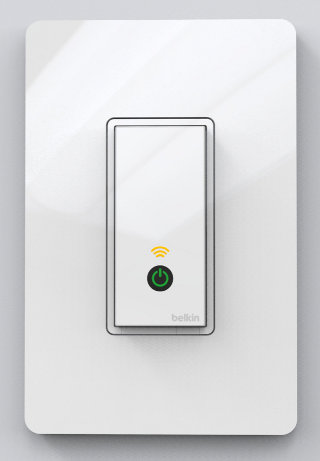
Wemo Wi-Fi-based home automation solution was announced at CES 2012 last year, and included products such as a control switch and a motion control switch, that can detect your presence and only turn on/off the lights or other electrical equipment when needed. At the time however, the only supported platform was iOS. At CES 2013, Belkin has announced a new product with the WeMo Light Switch, an Wi-Fi connected light switch to remotely control wired household lighting from anywhere, and support for Android.
The WeMo Light Switch can replace an existing light switch and connects into your home’s existing electrical wiring. Once in place, you can turn a full bank of lights on and off from anywhere, put them on a schedule, or use other WeMo or online triggers to control them through a smartphone or tablet. The WeMo Light Switch is controlled via the same WeMo app as the WeMo Switch and Motion.
WeMo Light Switch has the following key features:
Controls your homes wired lights from your iOS device
Works with any Wi-Fi router and any Apple iPod touch, iPhone, or iPad with iOS v5 or higher
Will be compatible with Android 4.0 or higher shortly after launch
Operates over Wi-Fi and mobile internet, at home and away
Works with WeMo app
In February, Belkin will launch an open Beta test for users of the Samsung Galaxy SIII and other leading devices, and the official launch should occur in Q2/Q3 2013.
CES 2013 has finally started, and Nvidia has had a pretty amazing keynote with some PC gaming announcements such as “GeForce Experience” which is a piece a software that can configure your games settings automatically based on your PC hardware (e.g. processor and GPU), and 3 cloud and mobile devices announcements:
Nvidia GRID Platform – Cloud Gaming Server with 240 Nvidia GPUs.
Nvidia Tegra 4 – Nvidia 4 cores Cortex A15 , 72 GPU and SDR modem SoC for tablets and smartphones.
Nvidia Project Shield – Game console with a 5″ display powered by Tegra 4 that can also act as a game controller, and play PC games on your TV.
Nvidia GRID Platform
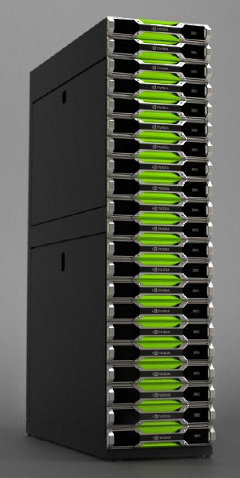
NVIDIA GRID Cloud Gaming Platform is comprised of 20 GRID server per rack with a total of 240 Nvidia GPU capable of 200 TFLOPS or the equivalent of 700 Xbox 360. Nvidia GRID render 3D graphics in the cloud in order to allow virtually any device (e.g. smart TVs, PCs, tablets and smartphones) to play PC quality games on their devices. So one day, you may be able to play high-end games such as Battle Field 3 on your Raspberry Pi.
According to the press release, the NVIDIA GRID Platform delivers three key attributes:
Densest GPU system architecture: NVIDIA GRID provides the highest number of concurrent, interactive data streams by using multi-GPU servers and sophisticated NVIDIA VGX GPU-sharing technology. Each server can deliver up to 36 game streams.
Broadest compatibility and scalability: NVIDIA GRID software and drivers enable interactive streaming of the widest range of games — from casual games using low-graphics capabilities with a high density of streams, to high-performance titles requiring high-graphics capabilities.
Best interactivity: NVIDIA GRID delivers streamed content for seamless interaction without noticeable lag or latency. NVIDIA GRID technology reduces game server latency by up to 30 milliseconds compared to prior solutions, which effectively hides the network delivery time. Game play from an NVIDIA GRID server feels like that from a console next to a TV.
There are currently 6 partners with games on the platform: Agawi (United States), Cloud Union (China), Cyber Cloud Technologies (China), G-cluster Global (Japan), Playcast Media Systems (Israel), and Ubitus (Taiwan).
During the keynote, they demoed “Trine” on a LG TV where the GRID client had been ported, and the game rendered in the GRID platform.
Nvidia Tegra 4
After several leaks (1, 2), Nvidia Tegra 4 processor specifications (4x Cortex A15, 72 GPU, 4G LTE modem) are not really news, and Nvidia CEO did not spent much times on technical details, and focused on demo showing why more processing power is needed in mobile devices.
Nvidia Tegra 4 and SDR modem
The first demo compared the Nexus 10 (Samsung Exynos 5250 dual core Cortex A15) against a Tegra 4 tablet, where both tablets rendered 25 pages locally. The Nexus 10 took 50 seconds (2 seconds/page), but the Tegra 4 tablet just took 27 seconds (~1 second per page).
More processing power will allow much better computational photography. The second demo is about HDR. I’m not very knowledgeable, and that’s an euphemism, when it comes to photography, and today I’ve learned about HDR (high dynamic range), a technique that takes 2 shots (low exposure/high exposure) and combines those to have optimal background and foreground in your picture. This can improve greatly pictures if background and foreground luminosity are much different, as shown in the picture below, where the final picture on the right is the combination the first 2 pictures.
HDR is already used in the latest phones such as iPhone 5, but the whole process takes about 2 seconds because a lot of the work is handled by the CPU, and this will work fine with static scene, but not so much with moving objects.
Nvidia has a computational photography engine that makes use of the GPU and other components of Tegra 4 SoC to bring this time to 0.2s per frame, even allowing HDR movies. The diagram below shows roughly the data flow, and components involved.
They demo photography and real-time HDR at the keynote, the latter is not possible on current devices. Existing Android applications will be able to take advantage of HDR technology without modifications, as this is done by the SoC.
Eventually all that processing power will allow features made possible thanks to faster computational photography such as HDR panorama, strobe motion, 3D reconstruction and object tracking, and our powerful camera phones may even possibly surpass capabilities of DSLR cameras in the future.
They concluded Tegra 4 part with a demo of Dead Trigger 2, and a short introduction of Icera i500 soft modem used in Tegra 4 to provide 3G/4G(LTE) connectivity. This SDR modem is 40% smaller than conventional LTE modem.
Nvidia Project SHIELD Game Console
If Nvidia Tegra 4 was greatly anticipated, Project SHIELD game console powered by Tegra 4 was well kept secret until CES 2013.
This stock Android Jelly Bean gaming device comes with the following specifications:
SoC – Nvidia Tegra 4
Memory - No Idea. 1 or 2 GB RAM I suppose…
Storage – ?? GB Flash + microSD slot,
Display – 5″ 720p multi-touch display
Video Output – micro HDMI (4K2K)
Audio – Tuned Port, Bass Reflex Portable Speaker System and 3.5 mm headphone jack
Connectivity – Wi-Fi 802.11n
USB – 1x microUSB port
Battery – 38 Wh (5 to 10 hours gaming, up to 24 hours video playback)
Controller with 15 buttons
Watch the short video below to see a 3D view of the Nvidia console.
The device can be used as a standalone game console or as a controller if you connect it to your TV via HDMI. Several demos were shown:
Standard Android displayed on 4K TV connected via HDMI
4K2K video playback
Game UI with a selection of games from Android, STEAM, TegraZone… and your PC. Pressing the “SHIELD” button will switch between Android and Game UI.
He played some tablet games (sorry can’t remember) both directly on the device, connected to the TV, and showcased multiplayer mode with 2 Project SHIELD consoles.
But the most impressive part was when they played PC video games on the TV using the SHIELD. The demo did not go very smoothly, but they were soon able to play high-end games such as Assassin Creed III and NFS most wanted on their 4K LG television. You “just” need a PC with a GeForce GTX 650 GPU or higher connected to your LAN, which will render the game, and stream it to project SHIELD via Wi-Fi or Ethernet, and display it with HDMI on the TV. The demo was done via Ethernet since Wi-Fi is usually slow a conferences, so he must have simply connected a microUSB to Ethernet adapter for the demo.
I’ve watched the keynote (nearly 2 hours), and found it pretty informative and entertaining, so if you have time to spare, you can also watch it below.
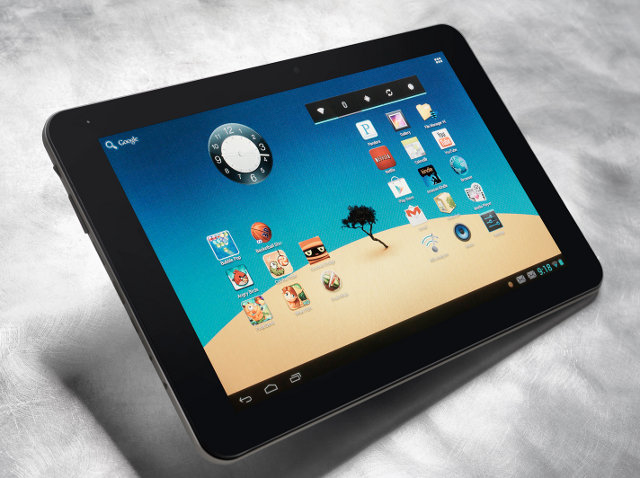
MIPS and Ingenic Semiconductor have just introduced the JZ4780, a low cost dual core MIPS XBurst processor with a PowerVR SGX540 GPU. The companies will demonstrate their solution in a 10″ Android 4.1 Jelly Bean reference tablet during CES 2013, on January 8 – 12, 2013.
JZ4780 SoC Highlights:
SoC – Dual XBurst core up to 1.5GHz CPU + PowerVR SGX540 GPU supporting 2D Graphics, 3D Graphic, OpenGL ES2.0 and ES1.0, OpenVG1.1
Power Consumption – Ingenic’s MIPS-Based XBurst processor is said to consumes approximately 140mW per GHz under full load.
Package – BGA390 17 x 17 x 1.1 mm, 0.8mm pitch
Process – 40nm CMOS
Ingenic will also demonstrate a version of the tablet that includes Altair’s MIPS-Based FourGee chipset bringing LTE networking to the device.
JZ4780 SoC is available now. For more information, including JZ4780 Datasheet, and RD4780_PISCES development board hardware manual and schematics, visit Ingenic JZ4780 page.