Archive

Posts Tagged ‘foss’

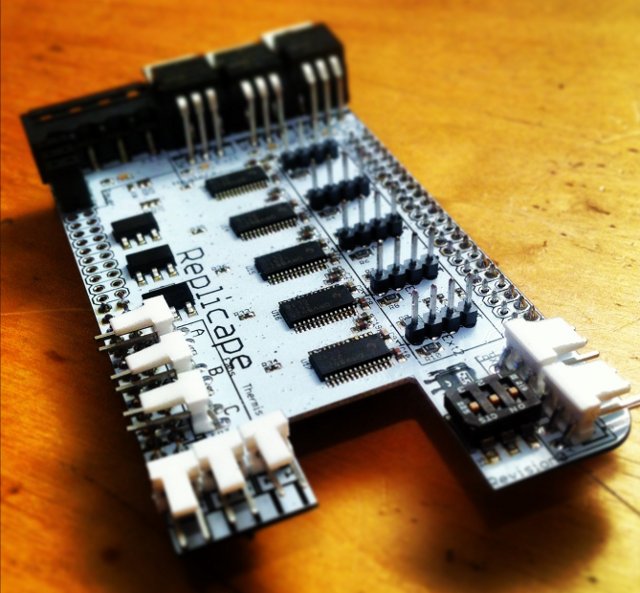
Replicate CAPE Adds 3D Printring Capability to the Beaglebone

February 2nd, 2013 No comments

Beagleboard.org launched the Beaglebone Cape Design Contest back in November, several designs were submitted, and yesterday, they announced the 3 winning CAPEs who will be manufactured and sold by Circuitco Electronics:

  • Replicape by Elias Bakken - 3D printer cape
  • Interacto by Chris Clark – Cape with a triple axis accelerometer,a gyroscope, a magnetometer and a 640×480 30fps camera.
  • Geiger cape by Matt Ranostay – Geiger counter cape

Since today I’ve started to write about 3D printing, let’s carry on and have a closer look at the Replicape.

Replicape

The Replicape 3D printer cape includes:

  • 5 stepper motors (X, Y, Z, Ext1, Ext2)
  • 3 high power MOSFETs (PWM controlled) for 2 extruders and 1 HPB
  • 3 medium power MOSFETs (PWM controlled) for up to 3 fans
  • 3 analog input ports for thermistors
  • 3 inputs for end stops (X, Y, Z)
  • Programmable current limits on steppers motor drivers (SMD). No need to manually adjust a pot meter.
  • Microstepping individually programmable for each SMD from 1 to 32.
  • X, Y and Ext 1 SMDs wired to PRUICSS for hard real time operation.
  • Option for stackable LCD cape

It seems to be working, albeit slowly, as a control board for the Makerbot Cupcake.

The replicate hardware files (schematics, bill of materials, gerber files), and the source code (Python and C) for the PRU and controlling stepper motors, are available on Bitbucket. So you could make it yourself, or buy the Replicate from Circuitco when it’s available, and improve the source.

You can also follow Elias progress on his blog: hipstercircuits.com.

Digg This
Reddit This
Stumble Now!
Buzz This
Vote on DZone
Share on Facebook
Bookmark this on Delicious
Kick It on DotNetKicks.com
Shout it
Share on LinkedIn
Bookmark this on Technorati
Post on Twitter

Telechips Releases Linux Kernel 3.0.8 and Android ICS Source Code

July 17th, 2012 6 comments

Telechips has just uploaded the GPL source code for kernel 3.0.8 and Android 4.0 to the open source section of their website.

If downloading from telechips website is too slow, you can also try alternate downloads (Thanks Gabe!):

I’ve also created 2 repositories in github:

It haven’t looked into the source code in details yet, but hopefully, this will allow developers to customize the firmware running on Telechips TCC8925 based mini PCs such as CX-01 mini Android TV Box or Zero Devices Z900.

Digg This
Reddit This
Stumble Now!
Buzz This
Vote on DZone
Share on Facebook
Bookmark this on Delicious
Kick It on DotNetKicks.com
Shout it
Share on LinkedIn
Bookmark this on Technorati
Post on Twitter

30 Euros Olimex iMX233-OLinuXino Linux Development Board

April 18th, 2012 4 comments

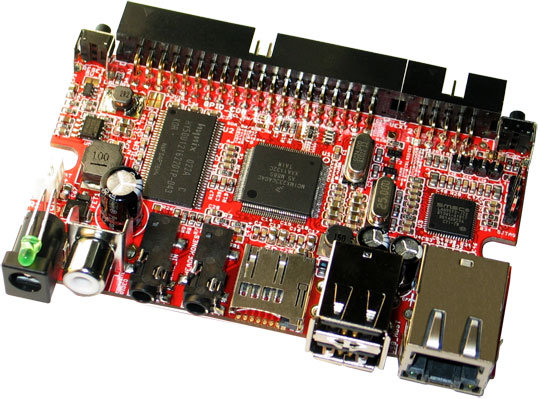
Olimex announced the first 10 prototypes of OLinuXino development board. Started in March of this year, OLinuXino is a development board based on Freescale i.MX233 aiming to provide a low cost (30 Euros)  open source hardware and software single board computer to run Linux.

Freescale i.MX233 Development Board

Olimex iMX233-OLinuXino SBC (MAXI Version)

Here are the specifications of OLinuXino single board computer:

  • Freescale iMX233 454Mhz ARM9 processor
  • 64MB of RAM
  • Linux bootable image from SD-CARD
  • TV-Video Output
  • USB host for Keyboard, camera, WiFi, etc interfacing
  • UEXT connector and GPIO connectors with the same style as DuinoMite so that developers can add external modules supporting Zigbee, Bluetooth, RFID readers, relays, switches, sensors, etc…

The company also plans to provide 2 plug-in modules for this board:

  • iMX-LCD – a 4.3″ TFT 24 bit color LCD with touchscreen (EUR 30)
  • MX-HUB – A board adding 2 USB hosts and Ethernet (EUR 15)

[Update: The company will actually make 2 versions of this board: The MINI and the MAXI (pictured above). The MAXI version will have 2 USB 2.0 host ports and 10/100Mbit Ethernet, whereas the MINI version will just have one USB 2.0 host port. Price is 29.95 Euros for MINI and 44.95 Euros for MAXI with cheaper prices for larger quantities. Check http://www.olimex.com/dev/pricelist.html for details]

The first ten boards will be used for testing and further software development, and the company expects to have the firsst mass production batch ready in May..

Digg This
Reddit This
Stumble Now!
Buzz This
Vote on DZone
Share on Facebook
Bookmark this on Delicious
Kick It on DotNetKicks.com
Shout it
Share on LinkedIn
Bookmark this on Technorati
Post on Twitter

ARM Releases Ne10: An Open Source Library with NEON Optimized Functions

March 29th, 2012 No comments

The Advanced SIMD extension (aka NEON or “MPE” Media Processing Engine) is a combined 64- and 128-bit single instruction multiple data (SIMD) instruction set that provides standardized acceleration for media and signal processing applications for ARM Cortex A (ARMv7) processors and the goal of these instructions is similar to MMX, SSE and 3DNow! extensions for x86 processors.

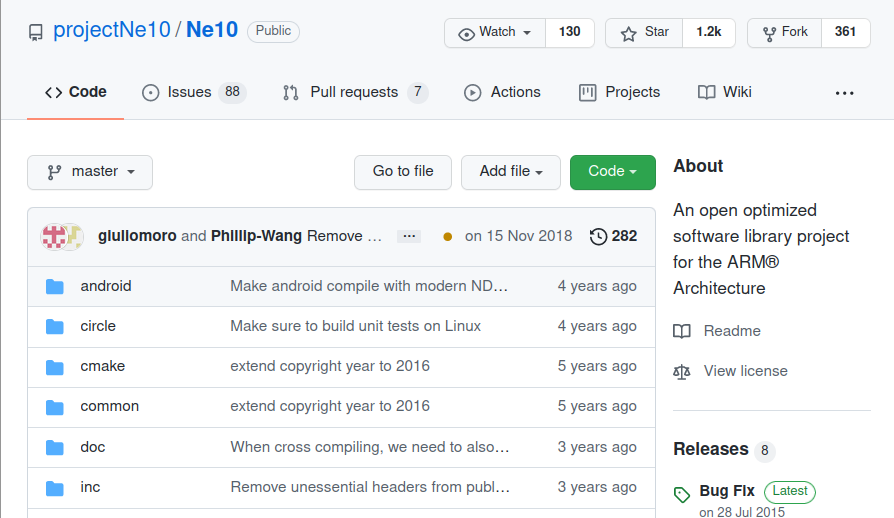
Starting early 2011, ARM has been working internally on a project codenamed Snappy to develop common functions accelerated by NEON. They have now released the first version of Snappy, now called the Ne10 library, which is available on GitHub at https://github.com/projectNe10/Ne10 .

The code has been developed in C and Assembler and tested on Ubuntu on ARM (Linaro). A Makefile is also included to build it for Android (AOSP). The current functions include vector and matrix operations accelerated by NEON instructions.

Since the library is open source, ARM hopes developers to make use of the Ne10 library in their open source packages, add new functions and port the Ne10 libraries to other operating systems.

In the video below Rod Crawford, Principal Engineer at ARM, explains why they started the NE10 Project, what can be done with it, and what’s next for the project.

If you would like to contribute to the project, you can join the community at www.ProjectNe10.org.

If you are not familiar with NEON or just want to improve your skills, you can check the ARM NEON Tutorial in C and Assembler and/or read the 5 parts Coding for NEON on ARM blog.

Finally, you may also want to see the performance improvement brought by NEON instructions on a real project (JPEG Decoding) by reading “Faster JPEG decoding on ARM with libjpeg-turbo and NEON Instructions” blog post.

Digg This
Reddit This
Stumble Now!
Buzz This
Vote on DZone
Share on Facebook
Bookmark this on Delicious
Kick It on DotNetKicks.com
Shout it
Share on LinkedIn
Bookmark this on Technorati
Post on Twitter

The Power of SPDX (Software Package Data Exchange) – ELC 2012

February 27th, 2012 No comments

Mark Gisi, Sr. Manager of Intellectual Property at Wind River , discusses SPDX (Software Package Data Exchange) at Embedded Linux Conference 2012.

Abstract:

Sharing Critical Licensing Information within a Linux Device Supply Chain Embedded Linux device runtimes are derived from 100s of open source packages. A common misunderstanding is that just one or two licenses govern a given open source package, when in fact; often a dozen or more apply. Therefore a device runtime could be under 100s of unique licenses. Determining which licenses are relevant is challenging. SPDX, the Linux Foundation’s license exchange format, provides an effective mechanism for recording and sharing licensing information within a device vendor supply chain. We present an overview of SPDX along with a detailed source code example on how to create and extract relevant licensing information. The target audience includes developers, engineering managers, release operation engineers and license compliance professionals. They will learn what SPDX is, how it’s created, and how it is used. A basic understanding of open source licensing is helpful.

Here are some key points I noted from this presentation:

  • SPDX will generate one file per package in XML/RDF format.
  • SPDX only uses info within a given package (e.g. no access to licensing info on a give website)
  • SPDX only provides raw data about licenses and does not provide about patents or legal interpretation.
  • It looks at each source files to gather license data (there can be several license per file), then tries to determine the library license(s) and finally the application license(s)
  • The SPDX file layout is composed of 6 sections:
    • Spec Info (SPDX specs)
    • Creation Info (who created it and when, etc…)
    • Package Info (Name, Licenses…)
    • Other licenses (For licenses not part of the SPDX license list)
    • File Info (For each file in a given package)
    • Reviewer
  • There are around 40 licenses supported by SPDX such as several versions of GPL, LGPL, Apache, MIT, BSD etc…
  • The key benefits of SPDX:
    • Helps sharing licensing information
    • Brings greater accountability
    • Detects potential licensing incompatibilities (e.g. Apache 2.0 and GPL 2.0)
    • Promotes Licensing Discipline.
  • Ideally, SPDX file should be generated by the copyright holder.
  • Nodoby has adopted SPDX yet, as SPDX 1.0 has just been released at the end of 2011 but the Linux foundation is committed to make this work and some work is being done with Hewlett Packard.

The presentation slides are not (yet) available at elinux.org. You can get more information on SPDX website including the specifications, a white paper and a short (3 minutes) webinar.

Digg This
Reddit This
Stumble Now!
Buzz This
Vote on DZone
Share on Facebook
Bookmark this on Delicious
Kick It on DotNetKicks.com
Shout it
Share on LinkedIn
Bookmark this on Technorati
Post on Twitter

Embedded World Conference 2012 Schedule

February 13th, 2012 No comments

Embedded World Conference and Exhibition 2012The Embedded World Conference 2012 will taken place on the February 28 – March 1 in Nuremberg, Germany. There will be over 1,000 exhibitors for the tenth conference (it started in 2003) showcasing their new products and solutions for the embedded markets. Beyond the exhibition, there will also be 13 classes and 22 sessions during those 3 days.

February 28th 2012

Classes:

  • 09:30 – 15:30 – Modeling Behavior with UML: Interactions and Statecharts by Dr. Bruce Douglass, IBM
  • 16:00 – 17:00 – Agile Systems Engineering by Dr. Bruce Douglass, IBM
  • 09:30 – 18:00 – Introduction to Real-Time Operating Systems by Dr. David Kalinsky, D. Kalinsky Associates
  • 09:30 – 18:00 – Hands-on-Workshop Safety Critical Linux – Automated debugging and code screening with formal methods by Prof. Nicholas Mc Guire, OSADL Safety Critical Linux Working Group and Andreas Platschek, OpenTech.
  • 09:30 – 16:30 – Cryptography and embedded Security – The Workshop chaired by Dr. Thomas Wollinger, escrypt – Embedded Security and Dr. Jan Pelzl, escrypt – Embedded Security.
    There will also be a few other speakers addressing automotive (e.g. SHE: Secure Hardware Extension), industrial and medical security in embedded system in 30 minutes to 1 hour presentations during the day.
  • 09:30–17:30 – Embedded Software Development on Virtual Platforms – Ready for Prime Time ? by Dr. Adam Morawiec, ECSI (Electronic Chips and Systems design Initiative).
  • 14:30 – 18:00 – ARM Cortex-A Workshop by Jens Stapelfeldt and Frank Walzer, Texas Instruments
    • Part I: ARM Cortex-A for industrial real time communication
    • Part II: ARM Cortex-A for Industrial real-time communication! – Running an EtherCat Slave on an ARM Cortex-A8 based MPU!

4-hour sessions (14:00 – 18:00):

  • Session 1: Smart Grid / Smart Metering chaired by Prof. Dr. Axel Sikora
  • Session 2: Managing Embedded System Development and life Cycle chaired by Dr. Torsten Klie
  • Session 3: Achieve High Embedded Software Quality chair by Dr. Jens Gerlach

February 29th 2012

Classes:

  • 09:00 – 17:00 – Software Design for Multicore Systems – 2012 Edition by Dr. David Kalinsky, D. Kalinsky Associates
  • 09:00–17:00 – Hands-on-Introduction to RT-Linux by Prof. Nicholas Mc Guire, OSADL Safety Critical Linux Working Group; N.N., Linutronix
    Microprocessor Architectures and Cores, Part II – Cortex-M
  • 13:30–18:00 – Application programming with the new leading edge Cortex-M4 by Stefan Grohmann, Hitex Development Tools

All day sessions:

  • Session 4: ARTEMiS – Visions, Projects and Results chaired by Alun Foster, Laila Gide (morning) and Ad ten Berg (Afternoon)
    Artemis is a European initiative whose goal is to design a “common Strategic Research Agenda (SRA) which acts as a reference for the Embedded Computing domain to attract investment from the stakeholders”.
  • Session 5: Cryptography and embedded Security chaired by Prof. Dr. Andreas Grzemba, Prof. and Dr. Axel Sikora
  • Session 6: The Multicore Session chaired by Dr. Ronald Veldema and Friedrich Schön
  • Session 7: Model Based Development of Embedded Systems  chaired by Prof. Dr. Ralf Gessler
  • Session 8: Functional Safety of Embedded Systems chaired by Dr. Jens Gerlach
  • Session 9: Software Development in High Level Languages chaired by Jaroslav Svacina, Friedrich Schön
  • Session 10: Software Development and Debug Methods chaired by Hartmut Lackner
  • Session 11: RToS chaired by Robert Hilbrich

March 1st 2012

Classes:

  • 09:00–17:00 – Fault Tolerant Design of Embedded Systems by Dr. David Kalinsky, D. Kalinsky Associates
  • 09:00–12:30 – How to use the iPad as an embedded interface – program your iPad interface for Embedded Systems by Matthias Müller, HTWK Leipzig; N. N., IEQualize Leipzig/TQ Group
  • 13:30–17:00 – MCU System Design with RTOS and Middleware Components by Matthias Hertel, ARM

Half-day and All-day sessions:

  • Session 12: Communication by Embedded Systems Institute Erlangen
  • Session 13: Open Source Projects chaired by Dr. Torsten Klie
  • Session 14: Embedded Linux and Android – Development & Trends chaired by Prof. Dr. Andreas Grzemba
  • Session 15: Embedded System Architectures and SoC chaired by Dr. Alexander Borusan
  • Session 16: Internet Technology and M2M chaired by Prof. Dr. G. Kupris, K.-D. Walter
  • Session 17: Wired and Wireless network Technologies chaired by Prof. Dr. Axel Sikora
  • Session 18: Development tools chaired by Prof. Dr. Holger Schlingloff
  • Session 19: Test and Verification chaired by Dr. Norbert Oster
  • Session 20: Embedded System Applications chaired by Prof. Dr. Peter Fromm
  • Session 21: Low Energy Embedded Systems chaired by Dr. Thomas Ußmüller
  • Session 22 : oSADl – FloSS Safety chaired by Dr. Carsten Emde, Prof. Nicholas Mc Guire, OSADL

The sessions are chaired by academics, but most speakers come from the industry with companies such as NXP, ARM, Dassault Systèmes, IBM, Wind River, etc.. being represented.

Exhibition, Classes and Sessions Fees

If you are interested in going to the exhibition or attending classes or exhibitions, here are the ticket prices and fees (excluding 19% VAT).

The ticket for the exhibition costs 25 Euros and can be purchased online.

None of the classes and sessions are not sponsored in this events, and the price is relatively steep:

  • Half Day Class 340 Euros.
  • Full Day Class 520 Euros.
  • 1 Conference Block 280 Euros.
  • 2 Conference Blocks 405 Euros.
  • 3 Conference Blocks 530 Euros.
  • 4 Conference Blocks 630 Euros.
  • Full Conference (Classes excluded) 720 Euros.

You can also register for the classes and session online.

Further information is available on Embedded World website.

Digg This
Reddit This
Stumble Now!
Buzz This
Vote on DZone
Share on Facebook
Bookmark this on Delicious
Kick It on DotNetKicks.com
Shout it
Share on LinkedIn
Bookmark this on Technorati
Post on Twitter

ARM Mali-200 and Mali-400 GPU Open Source Driver Released

February 10th, 2012 No comments

There has been a lot of controversy around GPU drivers and open source, as GPU drivers usually come with a blob (a binary file). If you have been lurking in Raspberry Pi forums you’ll know what I mean.

But this will change thanks to Lima. No, not the capital of Peru but the open source graphics driver for ARM Mali GPUs (Mali-200 and Mali-400) also called Lima whose goal is stated as follows:

The aim of this driver is to finally bring all the advantages of open source software to ARM SoC graphics drivers. Currently, the sole availability of binary drivers is increasing development and maintenance overhead, while also reducing portability, compatibility and limiting choice. Anyone who has dealt with GPU support on ARM, be it for a Linux with a GNU stack, or for an Android, knows the pain of dealing with these binaries. Lima is going to solve this for you, but some time is needed still to get there.

Yesterday, the Lima developers created a repository and pushed the current code to Lima’s gitorious project.

This is not a release in the sense of having a stable binary, but an alpha (beta?) source code release. As explained on Lima’s website:

The Lima driver currently only has some preliminary and highly experimental support. This experimental phase is necessary to gain a full and complete understanding of how the Mali GPUs work. Once more is known, an actual graphics driver (most likely based off of Mesa/Gallium) can be written.

The Lima driver is supported on the following ARM SoC:

  • AMLogic 8726-M – Single core Cortex A9 with Mali-400 found in many cheap Android Tablets.
  • Allwinner A10 – Cortex A8 with Mali-400 found in some cheap tablets and the upcoming RhombusTech low cost board.There is also a development board.
  • ST-Ericsson Novathor – Dual Core Cortex A9 with Mali 400. This processor is found in Snowball development board as well as one HTC Z710t smartphone  (Only available in China).
  • Samsung Exynos – Dual core Cortex A9 with Mali 400. It is used in high-end smartphones (E.g. Samgun Galaxy S II) and the Samsung Origen development board.
  • Telechips 8902 and 8803 – ARM11 and Cortex A8 SoC with Mali-200 found in many (older) cheap tablets.

If you are interested in conrtibution to the projects, you can reach the developers on irc on freenode in the #lima channel or by subscribing to the mailing list

Digg This
Reddit This
Stumble Now!
Buzz This
Vote on DZone
Share on Facebook
Bookmark this on Delicious
Kick It on DotNetKicks.com
Shout it
Share on LinkedIn
Bookmark this on Technorati
Post on Twitter