Small enough to fit on a keychain, Openterface KVM-GO is a tiny, open-source hardware KVM-over-USB gadget available with an HDMI, DisplayPort (DP), or VGA connector and is designed for headless device troubleshooting and remote server monitoring. It follows the company’s earlier Mini-KVM KVM-over-USB device introduced in 2024 with HDMI and audio inputs. The new KVM-GO is more versatile with an HDMI, DP, or VGA connector, and does not require any video cable since it’s designed to be connected directly to the target device. It also adds a microSD card slot for easy OS installation. Openterface KVM-GO specifications: Microcontroller – WCH CH32V208 RISC-V MCU @ up to 144 MHz with Bluetooth LE, USB 2.0 Storage – MicroSD card for remote OS installation and file transfers Control method – KVM-over-USB Video capture Up to 4K @ 60 Hz Input port – HDMI, DisplayPort, or VGA, depending on model (direct connection to target, […]
WCH CH32H417 dual-core RISC-V MCU offers USB 3.0, 500MB/s UHSIF, and Fast Ethernet interfaces
WCH CH32H417 is a high-performance dual-core RISC-V microcontroller clocked at up to 400 MHz with up to 960 KB flash, 896KB SRAM, and a range of interfaces, including a 5 Gbps USB 3.0 Host/Device SuperSpeed interface. Other notable features include a 500MB/s UHSIF (Universal High Speed Interface), 10/100Mbps Ethernet MAC and PHY, a SerDes high-speed isolated transceiver, a USB 2.0 High-Speed Host/Device, a USB 2.0 OTG Full Speed, USB PD support, and Display and Camera interfaces. The CH32H417 also offers the usual low-speed I/Os (95x GPIO, SPI…) and analog inputs and outputs (ADC/DAC). WCH CH32H417 CH32H417 specifications: Cores (Coremark: 5.73/MHz) QingKe RISC-V5F up to 400 MHz QinKe RISC-V3F up to 144 MHz GPU – Graphics Processing Hardware Accelerator GPHA Memory – 896KB SRAM Storage 960KB Flash 200MHz dual-edge SD/EMMC controller (SDMMC) SDIO master/slave interface with support for SD/SDIO/MMC Flexible Storage Controller FMC Display – DCT-TFT Display Controller LTDC Camera I/F […]
WCH BLE Analyzer Pro – A Bluetooth LE sniffer, analyzer, and debugging tool
WCH BLE Analyzer Pro is a USB-based Bluetooth Low Energy (BLE) sniffer and debugging tool designed to capture, decode, and analyze BLE communication packets in real-time. The analyzer supports adjustable polling intervals, broadcast and connection packet tracking, address filtering, and detailed packet inspection with statistics and graphical representation. It can monitor BLE broadcast and connection data in real-time and includes functions such as PHY mode selection and whitening control. These features enable low-level monitoring of BLE communication, help identify transmission issues, and verify protocol behavior. Applications include use in R&D, testing, and debugging of Bluetooth-enabled products such as IoT devices, wearables, and sensors. WCH BLE Analyzer Pro specifications: Main chips – 3x CH582F Bluetooth LE RISC-V microcontrollers, and a CH334 USB hub (see board photo at the end of the post) Supported protocol – Bluetooth Low Energy (BLE) 4.0/4.2/5.0 Capture range – BLE advertisement and connection packets Frequency band – […]
Sub $7 CH32V317 board offers 10/100Mbps Ethernet, dual USB 2.0 Type-C, DVP interface
The nanoCH32V317 from MuseLab is a low-cost RISC-V development board designed for prototyping embedded systems and education. Built around the 144MHz WCH CH32V317WCU6 MCU. This development board is suitable for various embedded, IoT, prototyping, and automation projects. Other features of the development board include a USB 2.0 high-speed and full-speed controller, a 10/100Mbps Ethernet MAC with PHY, SDIO, and a DVP interface for digital video input, as well as advanced motor PWM timers for control applications. The board also includes an 8MHz main crystal and a 32.768KHz RTC crystal. For programming, it includes a dual USB Type-C interface, a USB ISP, as well as an SWD port. nanoCH32V317 board specifications: MCU – WCH CH32V317WCU6 32-bit RISC-V core up to 144 MHz clock frequency USB 2.0 High-Speed (HS) and Full-Speed (FS) controllers Integrated Ethernet MAC + 10/100M PHY DVP interface, SDIO, and advanced motor PWM timer support Memory – Up to […]
Raspberry Pi 5 gets a microSD Express HAT
Will Whang’s RPI5-SDexpress-Hat is a small HAT+ for the Raspberry Pi 5, adding a microSD Express card slot for ultrafast storage, an eject button, and two Qwiic connectors, probably because there was still some spare space on the board… As a reminder, microSD Express cards can deliver SSD performance thanks to the use of of PCIe interface and NVMe commands. The standard was first introduced in 2019, and even earlier (2018) for full-size SD cards, but manufacturers have not exactly rushed to release compatible hardware. A major change this year is the launch of the Nintendo Switch 2 portable game console, one of the first mass market devices with a microSD Express slot, and this was partially why Will created the microSD Express HAT+ for the Raspberry Pi 5. RPI5-SDexpress-Hat board specifications: MCU – WCH CH32V003 RISC-V microcontroller for hotplugging and unmount Host interface – PCIe Gen3 x1 FFC connector […]
$3.50 nanoCH57x CH570/CH572 RISC-V development board offers USB-C port, 2.4GHz radio/BLE, and GPIO pins
Designed by MuseLab, the nanoCH57x is a WCH CH570/CH572 development board with a 2.4 GHz proprietary radio (CH570) or Bluetooth LE (CH572) that only costs $3.50 and is more compact than the official CH570 Basic Evaluation Board. We first came across this low-cost MCU back in March this year, and saw that the official development board became available for purchase as early as April. The nanoCH57x development board currently features the 100 MHz CH572D RISC-V microcontroller (the CH570D version is coming later), which includes 256KB of flash memory, 12KB of SRAM, and an onboard 32 MHz crystal. The board also includes a USB 2.0 Type-C Host/Device port and PCB antenna for BLE/RF communication. MuseLab nanoCH57x development board specifications: MCU (one or the other) – WCH CH570D or CH572D CPU – QingKe 32-bit RISC-V3C core @ up to 100 MHz Memory – 12KB SRAM Storage – 256KB non-volatile memory 240KB code […]
10-cent WCH CH570/CH572 RISC-V MCU features 2.4GHz wireless, Bluetooth LE 5.0, USB 2.0
Patrick Yang, CTO at WCH, has recently unveiled the CH570 RISC-V SoC with 2.4GHz wireless and USB 2.0 (host & device) as an upgrade to the popular CH32V003 general-purpose RISC-V MCU with more features at the same low price (10 cents). CH570 also comes with 12KB SRAM and 256KB flash (vs 2KB SRAM and 16KB flash for the CH32V003), offers up to twelve GPIO, six PWM, I2C, UART, SPI, and a 20-channel key detection module. There’s also the CH572 with the same features, except it also supports Bluetooth LE 5.0. As a side note, I wrote about the CH572 RISC-V MCU with BLE in 2019, but I guess it was scrapped likely because it had OTP instead of flash…, and the new CH572 (2025) is different. WCH CH570/CH572 specifications: CPU core QingKe 32-bit RISC-V3C core @ up to 100 MHz (RV32IMBC instruction set and custom instructions) Low-power 3-stage pipeline High-speed […]
$5 CH32-Ant CH32V003 RISC-V development board comes with Stemma QT connector
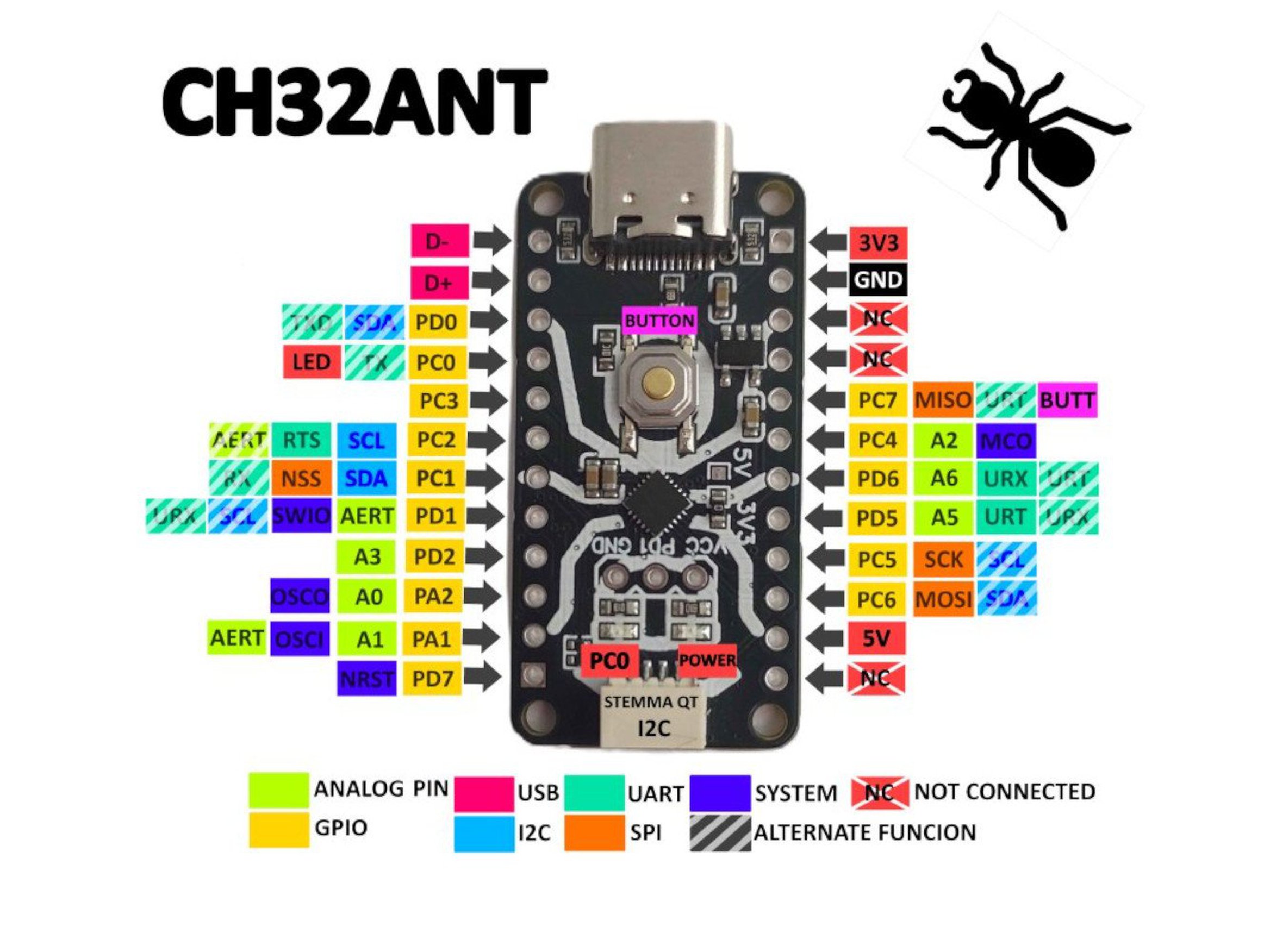
The CH32-Ant is a low-cost, breadboard-compatible development board powered by the WCH Electronics CH32V003-F4U6 RISC-V microcontroller, ideal for prototyping. It is pin-compatible with Prokyber’s ESP32-C6-Bug, offering an easy transition for users who don’t need wireless capabilities or the higher performance of the ESP32-C6FH4. The board features a Stemma QT connector for straightforward I2C sensor integration and a USB Type-C port that supports data transfer and power through software-based USB on the CH32V003. The CH32-Ant offers configurable logic voltage at 3.3V or 5V, adjusted via an onboard 0-ohm resistor, providing flexibility for sensor projects. Powered by the CH32V003F4U6 microcontroller, it operates up to 48MHz with 2kB of RAM and 16kB of flash, making it cost-effective for applications requiring basic processing without wireless. The CH32-Ant features a compact layout designed for breadboard compatibility, a Stemma QT connector for an I2C module on one end of the board, and a USB Type-C connector […]