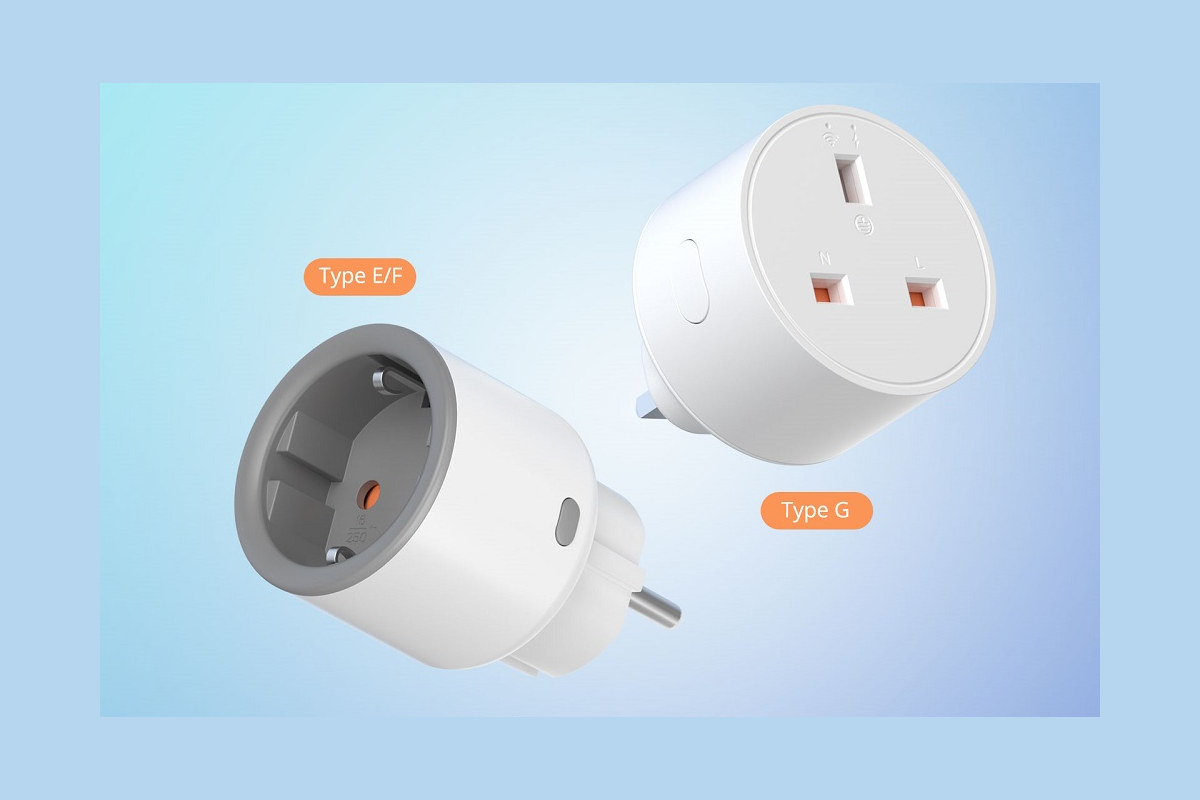
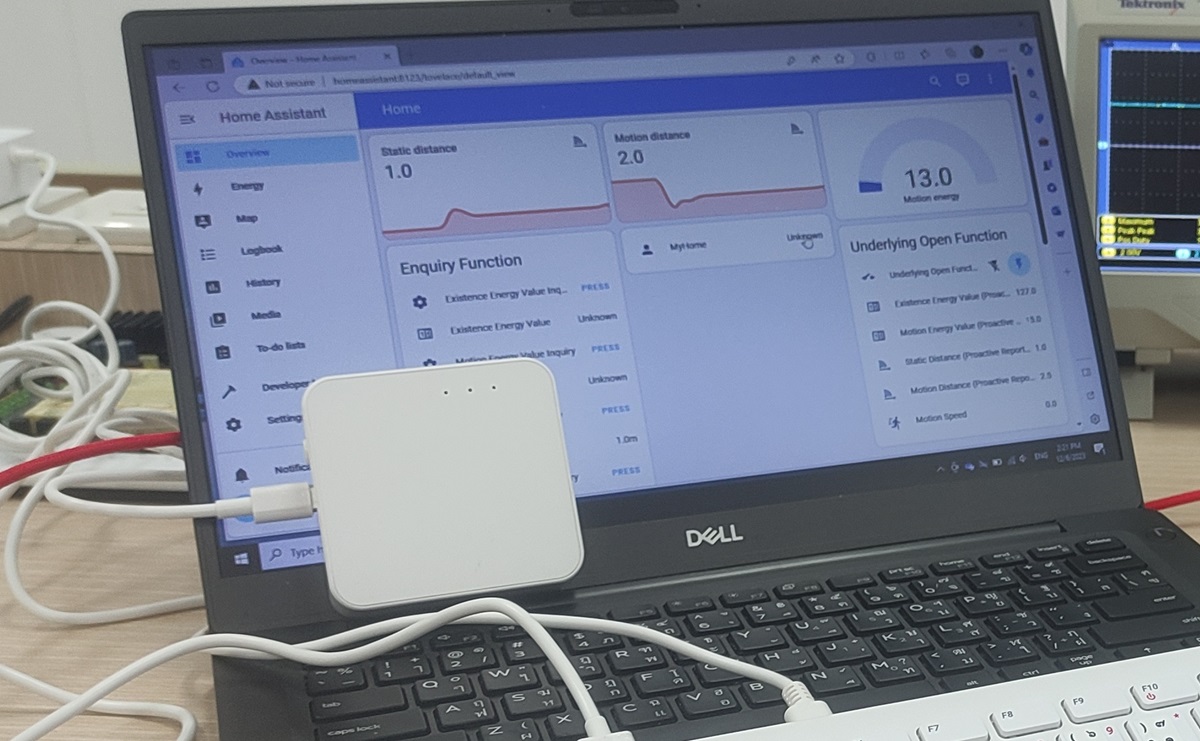
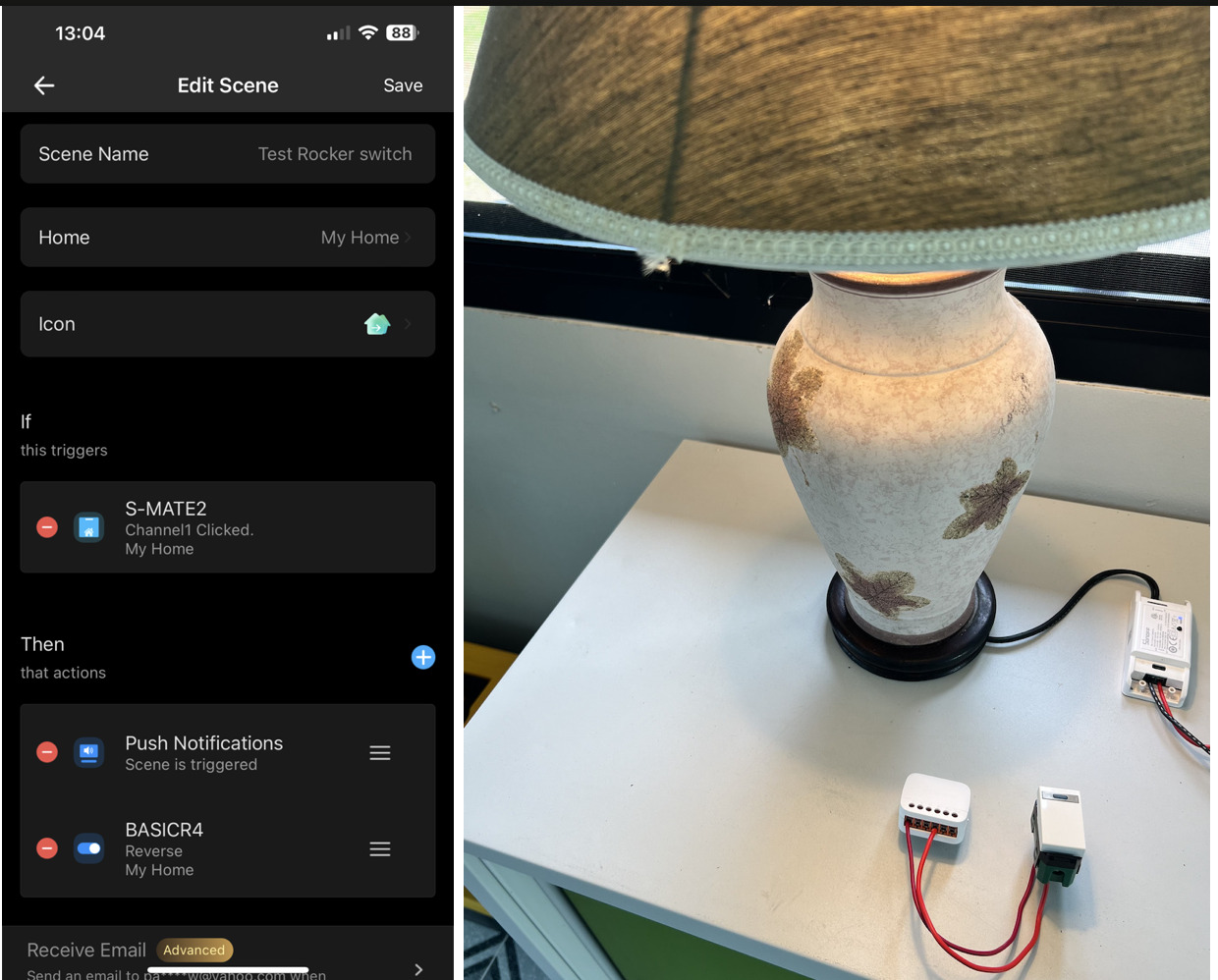
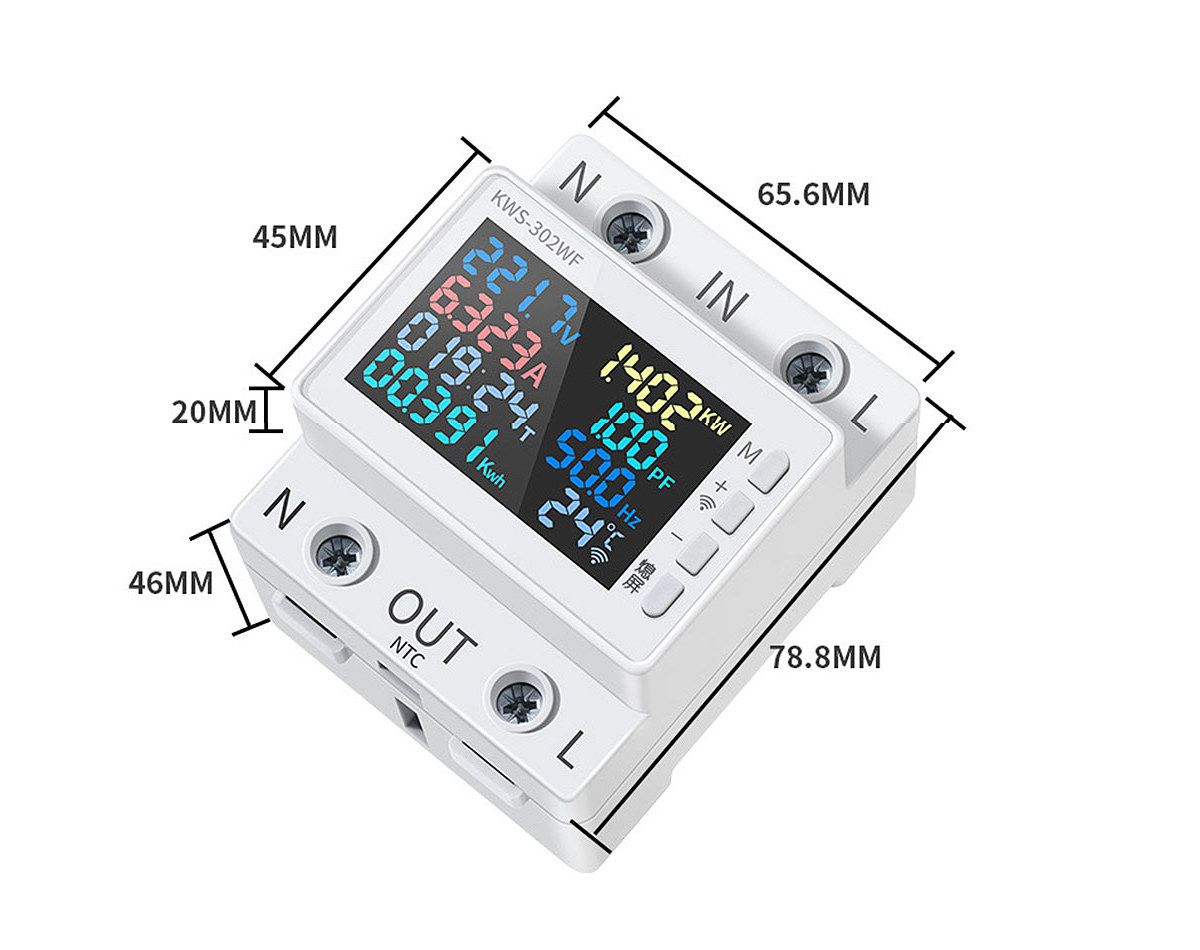
The Energy Meter for Home Assistant is an ESP32-S3-based single-phase energy monitoring and control module designed to work with Home Assistant via ESPHome. It measures real-time power and energy consumption and also has a remote on/off control. The device is built around the BL0942 calibration-free energy metering IC, which supports voltage, current, power, and energy measurements with less than 1% error. It operates directly from AC 100–240V, includes an onboard 15A relay for switching loads, and provides electrical isolation for safety. Connectivity is done through USB and Wi-Fi using ESPHome for easy firmware flashing, API encryption, and automatic discovery in Home Assistant. These features make it suitable for smart homes, DIY energy monitoring, smart sockets, home energy dashboards, and automation projects. Energy Meter for Home Assistant specifications: Core module – Espressif Systems ESP32-S3-WROOM-1 SoC – ESP32-S3 CPU – Dual-core Tensilica LX7 up to 240 MHz with vector extension for AI/ML workloads […]
Quectel SRG091X and SRG093X NXP i.MX 9 industrial AIoT modules integrates Wi-Fi 6, Bluetooth 5.4, and 802.15.4 radios
After releasing the very powerful P895BD-AP AIoT module at CES 2026, Quectel now released two new low-power industrial AIoT modules based on NXP’s i.MX 9 series SoCs. The module integrates Wi-Fi 6, Bluetooth 5.4, and 802.15.4 radios through the IW610G chipset, so it can simply be dropped into a PCB to create a fully compliant Matter Border Router without any RF design or coexistence concerns. While both modules share the same 46 x 41.5 mm form factor and wireless capabilities, they are different in terms of CPU power as the SRG091X is an entry-level solution built around a single-core NXP i.MX 91 processor, while the SRG093X features dual-core NXP i.MX 93 SoC, which includes a Cortex-M33 real-time core and a neural processing unit (NPU) for edge AI workloads. The module supports LPDDR4/LPDDR4X memory, eMMC storage, and various I/O options, including dual Gigabit Ethernet, USB 2.0, CAN-FD, SPI, UART, I²C/I³C, ADC, […]
STM32MP21 Arm Cortex-A35/M33 MPU targets cost-effective applications in smart factories, homes, and cities
STMicroelectronics’ STM32MP21 microprocessor family combines a 1.5 GHz 64-bit Arm Cortex-A35 application core with a 300 MHz 32-bit Arm Cortex-M33 core for real-time processing. It is designed for “cost-aware” edge applications in smart factories, smart homes, and smart cities. The new STM32MP21 is a cost-optimized version of the earlier STM32MP23 and STM32MP25 that does without an AI accelerator (yes, those still exist!), GPU, H.264 decoder and encoder, or PCIe Gen2 / USB 3.0 interfaces. It still offers a MIPI CSI-2 camera interface, two Gigabit Ethernet interfaces with Time-Sensitive Networking (TSN), and strong security targeting SESIP Level 3 and PCI pre-certification. STM32MP21 specifications: CPU – Arm Cortex-A35 core running at up to 1.2 or 1.5 GHz with 128KB L2 cache Real-time MCU – Arm Cortex-M33 core with FPU/MPU running at up to 300 MHz GPU – None VPU – None AI accelerator – None Memory 456 KB SRAM 256KB AXI SYSRAM […]
ESP32-C6 development board features 1.8-inch AMOLED touch display, built-in mic and speaker, IMU, RTC, and more
Waveshare ESP32-C6-Touch-AMOLED-1.8 is an ESP32-C6-based touch display development board featuring a 1.8-inch capacitive AMOLED display, a 6-axis IMU, RTC, audio codec, microSD card slot, USB-C for power and programming, power/boot buttons, and various I/Os including I²C, UART, USB, and GPIO pads. Compared to boards like Waveshare ESP32-S3-LCD-1.28, ESP32-S3-Touch-LCD-1.69 (based on ESP32-S3), and ESP32-P4-WIFI6-Touch-LCD-3.4C/4C (based on ESP32-P4), this board is based on the ESP32-C6 wireless SoC with 2.4 GHz Wi-Fi 6, Bluetooth 5 LE, Zigbee, and Thread connectivity. It also includes a 16 MB external flash and a 368 × 448 AMOLED display with 16.7 million colors and capacitive touch support. Power is managed by an AXP2101 PMIC for Li-ion battery support and charging. Typical applications include smart home control panels, wearable and handheld IoT devices, voice-enabled assistants, data loggers, portable dashboards, and HMI-focused embedded prototypes. Waveshare ESP32-C6-Touch-AMOLED-1.8 specifications: SoC – Espressif Systems ESP32-C6 CPU Single-core 32-bit RISC-V clocked up to 160 MHz […]
M5Stack NanoH2 – An ultra-compact ESP32-H2 IoT development kit with Zigbee, Thread, and Matter connectivity
M5Stack NanoH2 is an ultra-compact, standalone IoT development kit powered by an Espressif Systems’ ESP32-H2 wireless SoC with support for Zigbee, Thread, and Matter, and designed for smart home and low-power wireless applications. It also features a built-in LED, an RGB LED, an infrared transmitter, a Grove port for expansion, a user button, and a USB-C port for power and programming. On the surface, it looks very similar to the Unit Gateway H2 introduced last March, with an ESP32-H2 SoC and a Grove connector. But while the earlier model is designed as an add-on board to other M5Stack products, the NanoH2 is a standalone development kit that you can use directly without another board from M5Stack. M5Stack NanoH2 specifications: SoC – Espressif Systems ESP32-H2FH4S CPU – 32-bit RISC-V SoC clocked at up to 96 MHz Memory – 320 KB SRAM, 4 KB LP memory Storage – 128 KB ROM, 4MB […]
4-inch round HDMI display offers USB touchscreen for Raspberry Pi, AIDA64, Smart Home, Art projects
VIEWE has launched a 4-inch round HDMI display with 720×720 resolution, and a USB touchscreen function suitable for SBCs like the Raspberry Pi, PCs running AIDA64, Smart Home applications, and Art projects. It looks to build upon the company’s 4-inch square HDMI display using the same control board with a MIPI DSI display interface, HDMI 1.4 input, and a USB Type-C port for power and touch input. VIEWE 4-inch HDMI round display specifications: Display 4-inch round HDMI IPS display with 720×720 resolution ST7703 display driver Brightness – 300 cd/㎡ Active area – 101.52mm ∅ Touchscreen – 5-point capacitive touch screen via USB-C port; FT6336U touch IC Video Input – HDMI 1.4 Display Interfaces via Lontium LT6911C HDMI to MIPI DSI/LVDS chip Single/Dual-Port MIPI DSI/CSI transmitter Single/Dual-Port LVDS transmitter (connector present but not used with the provided 4-inch MIPI display) USB – USB-C port for power and touchscreen Dimensions – 109.62 […]
NASP NeuroVoice VAD chip enables always-on voice activity detection at microwatt-level power consumption
POLYN Technology’s Neuromorphic Analog Signal Processor (NASP) NeuroVoice VAD is an always-on, ultra-low-power chip that detects voice in any noisy background, at microwatt-level power consumption and microsecond-scale latency. Everything happens on the chip, so no Internet is needed. Potential applications include smart remote controls, earbuds, wearables, voice access, IoT, Industry 4.0, robotics, Smart Home/Factory, mobility, and more. NASP NeuroVoice VAD chip (NV-VAD 100) specifications: Features Voice detection at ultra-low power consumption Voice passthrough – Passes voice and mutes background sounds Background signal bypass – Wake Word Detection (WWD) command to activate transparent voice bypass Speech/command intelligibility in noisy spaces – Increases voice command intelligibility for WWD/KWS (Keyword Spotting) functionality in noisy environments for Smart Home, Smart Factory, Wearables, etc. Audio Interfaces – PDM/I2S Voice delay detection – 25 ms Host interfaces – SPI/I2C used for initial configuration and status readout, VAD pin Debugging – Boundary Scan and Debug unit access […]
Fusion HAT+ Raspberry Pi expansion board targets motor and servo control with AI and LLMs
SunFounder Fusion HAT+ for Raspberry Pi 5/4/3B+ and Zero single board computers is a motor control and GPIO expansion board designed to work with LLMs such as ChatGPT or Gemini using the board’s built-in speaker and microphone for voice interaction. It features four DC motor drivers, twelve PWM servo channels, four ADC inputs, I2C, SPI, and UART interface for sensors, and ships with two 18650 rechargeable batteries with smart power management & safe shutdown. It can be used in smart cars, humanoid robots, robotic arms, multi-legged spiders, and smart home systems. Fusion HAT+ specifications: MCU – Gigadevices GD32E203C8T6 Arm Cortex-M23 microcontroller @ 72MHz with 64KB flash, 8KB SRAM. Motor control – 4x motor ports Audio 2030 audio chamber speaker connected to an I2S audio port MEMS microphone Expansion 4-channel digital pins 4-pin I2C interface compatible with Qwiic/STEMMA Qt 7-pin SPI interface 4-pin UART interface 12-channel PWM pins for servos 4-channel […]