beagleboard News - CNX Software - Embedded Systems News

BeagleBadge – A Linux-powered 4.2-inch ePaper badge based on TI Sitara AM62L32 SoC

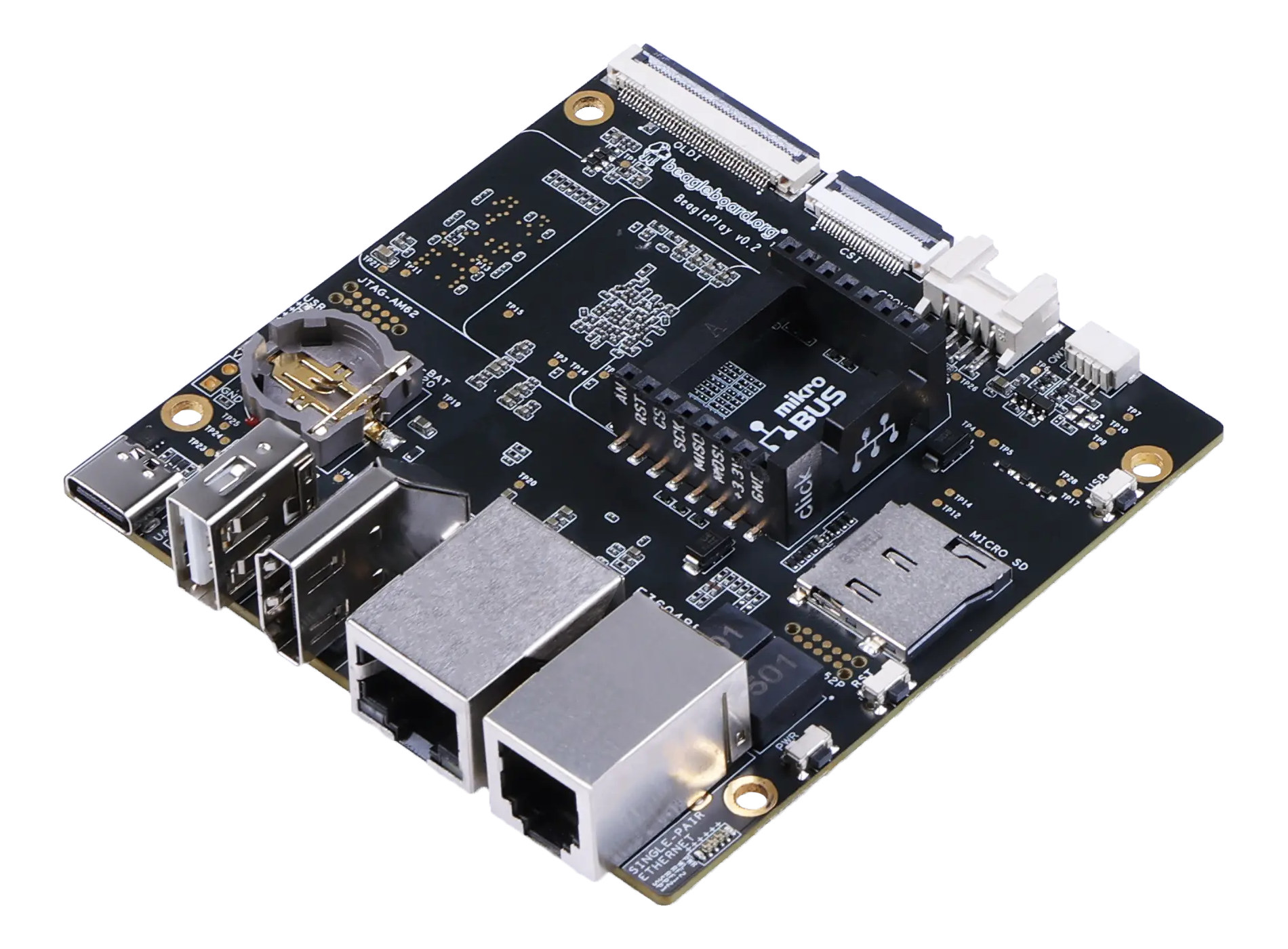
BeagleBadge

The BeagleBoard.org Foundation has just introduced the BeagleBadge featuring a 4.2-inch ePaper display and a Linux-capable Texas Instruments Sitara AML62L32 dual-core Cortex-A53 SoC. It’s quite feature-rich for a badge, as it offers WiFi 6, Bluetooth 5.4 LE, and LoRa/LoRaWAN connectivity, various motion and environmental sensors, a USB 2.0 host port, Mikrobus, Grove, and QWIIC expansion connectors, a 4-way joystick, a buzzer, and a range of buttons and LEDs. BeagleBadge specifications: SoC – Texas Instruments Sitara AM62L32 dual-core Arm Cortex-A53 processor @ 1.25GHz System Memory – 256 MB (128M x 16bit) LPDDR4 @ 1600 MHz Storage 4GB eMMC flash 256Mbit OSPI flash 32Kbit EEPROM MicroSD card slot Display 4.2-inch ePaper display via 24-pin FPC Connector MIPI DSI connector for LCD Wireless 2.4 GHz WiFi 6 + Bluetooth 5.3 via BeagleMod CC3301-1216 module with MHF4 Connector LoRaWAN via Wio SX1262 module with u.FL Connector USB USB 2.0 Type-A host port USB Type-C […]

PocketBeagle 2 SBC gets industrial version with 1GB RAM, 64GB eMMC flash

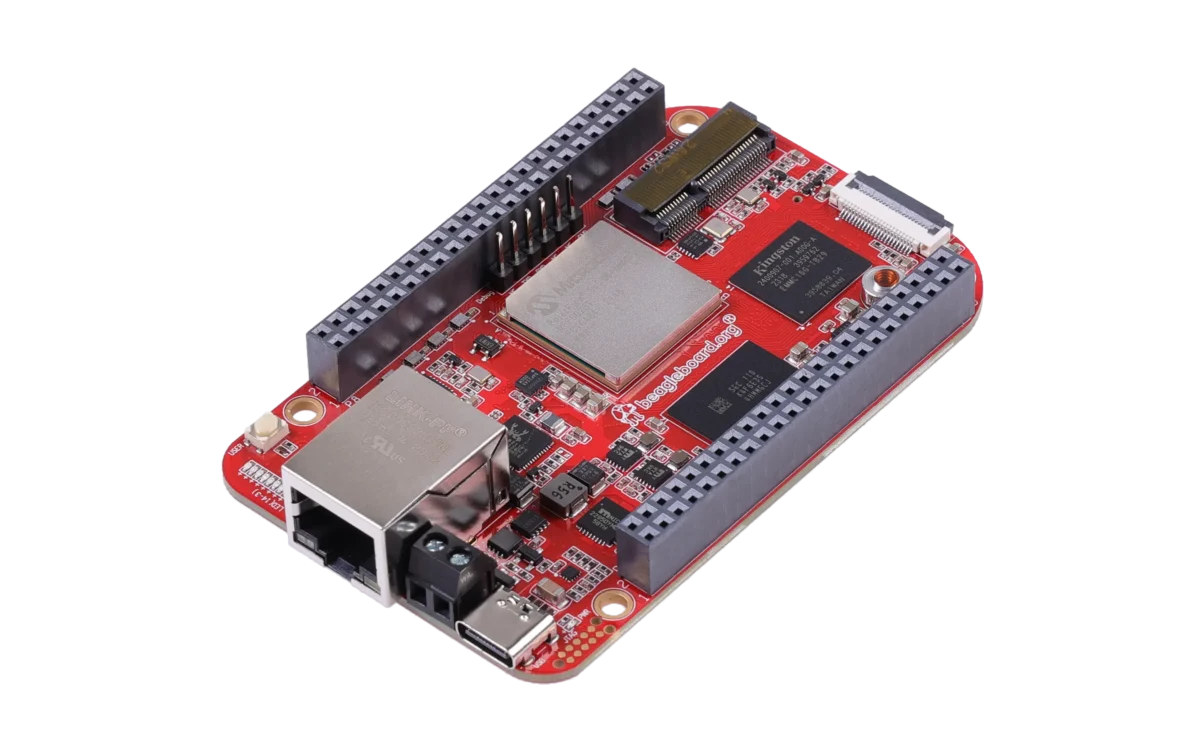
PocketBeagle 2 Industrial 1GB RAM 64GB eMMC flash

The PocketBeagle 2 Industrial is an update to the PocketBeagle 2 Rev A1 SBC featuring 1GB DDR4 RAM, a 64GB eMMC flash, and industrial temperature range support. The original board only comes with 512MB DDR4 memory, an eMMC flash footprint (unpopulated), and commercial temperature range support. Apart from those changes, the other specifications remain the same, with a Texas Instruments AM6254 quad-core Cortex-A53 SoC, an MSPM0L1105 Cortex-M0+ microcontroller, a microSD card slot, a USB-C port, UART and JTAG debugging support, and two 36-pin GPIO headers. Another difference is that the PCB is red for the PocketBeagle 2 Industrial (like the BeagleBone Black Industrial 4G), while the PocketBeagle 2 features a black PCB. PocketBeagle 2 Industrial specifications: Main SoC – Texas Instruments AM6254 CPU Quad-core 64-bit Arm Cortex-A53 @ 1.4 GHz Arm Cortex-M4F real-time core @ 400 MHz with 256KB SRAM GPU – Imagination PowerVR Rogue AXE-1-16M with support for OpenGL […]

PocketBeagle 2 Rev A1 board gets 1.4 GHz Sitara AM6254 quad-core Cortex-A53/Cortex-M4F SoC with 3D GPU

PocketBeagle 2 Rev A1

The PocketBeagle 2 was first introduced with a 1.0 GHz Texas Instruments Sitara AM6232 dual-core Cortex-A53 GPUless SoC in February with Rev A0 of the PCB. The BeagleBoard.org Foundation has now released a new PocketBeagle 2 Rev A1 board with a 1.4 GHz Sitara AM6254 quad-core Cortex-A53/Cortex-M4F SoC with a 3D GPU. All other features remain the same, with a secondary Texas Instruments MSPM0L1105 Arm Cortex-M0+ microcontroller, 512 MB LPDDR4 memory, a microSD card slot, a USB Type-C port for power and connectivity, a Raspberry Pi Debug Probe port, and two 36-pin expansion headers. PocketBeagle 2 Rev A1 specifications: Main SoC – Texas Instruments AM6254 as found in the BeaglePlay SBC CPU Quad-core 64-bit Arm Cortex-A53 @ 1.4 GHz Arm Cortex-M4F real-time core @ 400 MHz with 256KB SRAM GPU – Imagination PowerVR Rogue AXE-1-16M with support for OpenGL 3.x/2.0/1.1, Vulkan 1.2 Dual-core Programmable Real-Time Unit Subsystem (PRUSS) running up […]

Root Commit releases free training materials on OpenEmbedded and Yocto using the BeaglePlay SBC

BeaglePlay Yocto Project Tutorial

Michael Opdenacker, Founder of Root Commit, has published free and open-source training materials on OpenEmbedded and Yocto using the BeaglePlay SBC powered by a Texas Instruments AM625 processor. If the name rings a bell, it’s because Michael was the founder of Bootlin (previously Free Electrons) before selling the company to employees in 2021. He’s now started a new company called Root Commit, where he continues providing Embedded Linux training and development services. He’s kept the tradition of releasing free training materials, with the latest course being related to Yocto development on the BeaglePlay board. You’ll find resources on the Root Commit website with three files, including 220 pages of lectures, 18 practical labs for the BeaglePlay board and QEMU, and source code/patchsets released under a Creative Commons BY-SA 4.0 license. The course includes an introduction to the Yocto Project 5.0 and Embedded Linux, a Getting Started guide explaining how to […]

PocketBeagle 2 SBC combines TI AM6232 dual-core Cortex-A53 SoC with MSPM0 MCU

PocketBeagle 2 single board computer

Beagleboard has recently announced the PocketBeagle 2, a single board computer (SBC) built around TI’s AM6232 dual-core Cortex-A53 and Cortex-M4F SoC and an additional MSPM0L1105 Arm Cortex-M0+ microcontroller for ADC pins and board ID storage. Designed for developers, students, and hobbyists, it’s a direct upgrade from the previous generation PocketBeagle which the company released in 2017. The new board comes with a faster dual-core 64-bit CPU (compared to a single-core CPU), faster memory (DDR4), improved power management (USB-C + LiPo charger), and easier debugging (UART + JTAG) for faster development. Additionally, it comes with four user-controllable LEDs, a power LED, and a battery-charging LED for better status indication. Unlike the first generation, this new version comes with pre-soldered GPIO headers with the same compact (55 x 35mm) form factor, making it suitable for embedded applications and IoT projects. PocketBeagle 2 single-board computer specifications Main SoC – Texas Instruments AM6232 CPU […]

BeagleY-AI SBC review with Debian 12, TensorFlow Lite, other AI demos
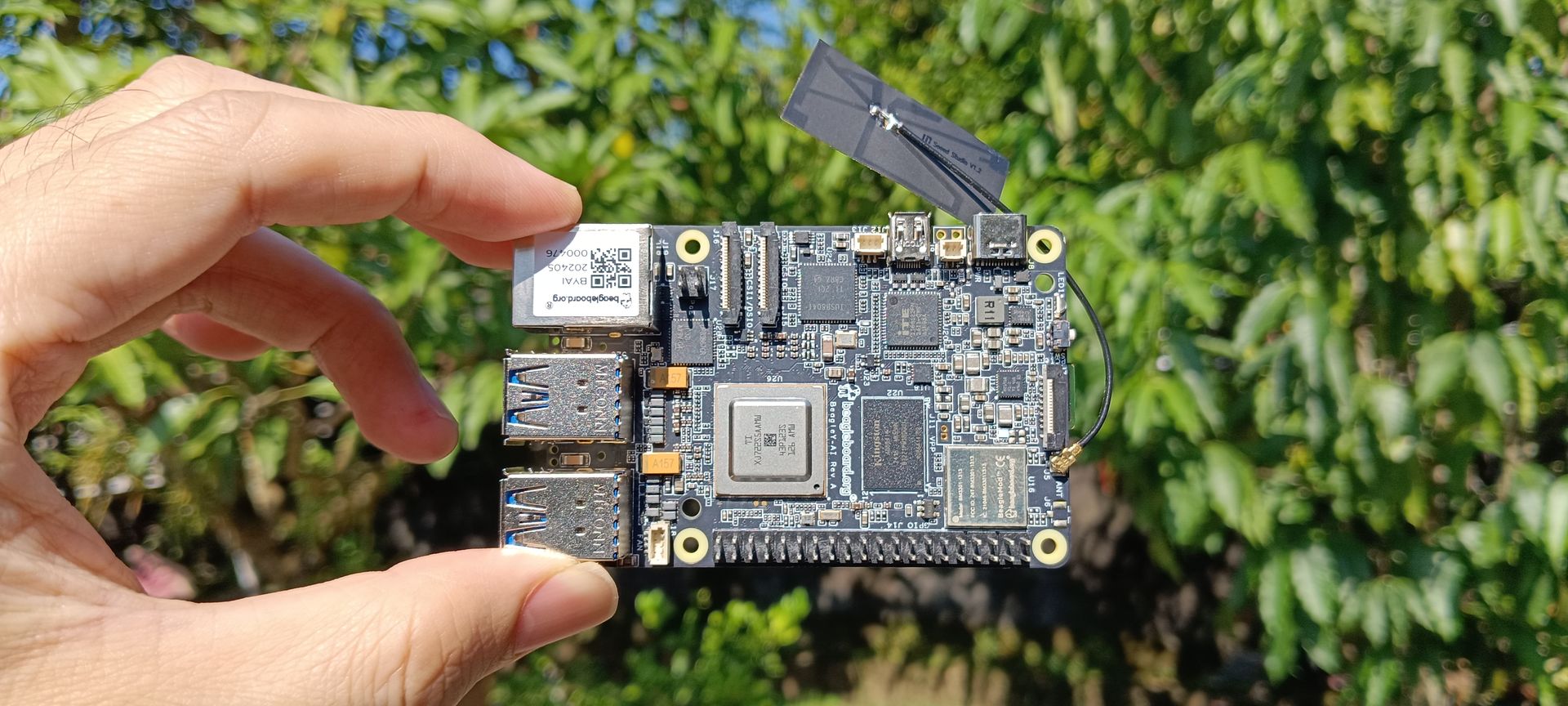
BeagleY-AI review

Today I’ll be reviewing the BeagleY-AI open-source single-board computer (SBC) developed by BeagleBoard.org for artificial intelligence applications. It is powered by a Texas Instruments AM67A quad-core Cortex-A53 processor running at 1.4 GHz along with an ARM Cortex-R5F processor running at 800 MHz for handling general tasks and low-latency I/O operations. The SoC is also equipped with two C7x DSP units and a Matrix Multiply Accelerator (MMA) to enhance AI performance and accelerate deep learning tasks. Each C7x DSP delivers 2 TOPS, offering a total of up to 4 TOPS. Additionally, it includes an Imagination BXS-4-64 graphics accelerator that provides 50 GFlops of performance for multimedia tasks such as video encoding and decoding. For more information, refer to our previous article on CNX Software or visit the manufacturer’s website. BeagleY-AI unboxing The BeagleY-AI board was shipped from India in a glossy-coated, printed corrugated cardboard box. Inside, the board is protected by […]

BeagleY-AI SBC features TI AM67A vision processor with 4 TOPS AI accelerators

Texas Instruments AM67A single board computer

The BeagleBoard.org Foundation’s BeagleY-AI is an open-source hardware, credit card-sized SBC powered by a Texas Instruments AM67A quad-core Cortex-A53 vision processor with various programmable blocks capable of delivering up to 4 TOPS for AI algorithms. The board ships with 4GB RAM, relies on a microSD card slot for storage and OS booting, implements gigabit Ethernet, WiFi 6, and Bluetooth 5.4 connectivity, and can drive up to three displays via micro HDMI, OLDI (LVDS), and MIPI DSI interfaces. The BeagleY-AI also comes with two MIPI CSI camera interfaces, four USB 3.0 ports, a USB Type-C port, and a 40-pin GPIO header for expansion. We can also see a 16-pin PCIe FPC connector that looks somewhat similar to the 20-pin PCIe connector on the Raspberry Pi 5 but officially supports PCIe Gen3 x1. BeagleY-AI specifications: SoC – Texas Instruments AM67A (J722S) “vision processor” CPU Quad-core 64-bit Arm Cortex-A53 processor at 1.4GHz Arm […]

Linux 6.8 release – Notable changes, Arm, RISC-V, and MIPS architectures

Linux 6.8 release

Linus Torvalds has just announced the release of Linux 6.8 on the Linux kernel mailing list: So it took a bit longer for the commit counts to come down this release than I tend to prefer, but a lot of that seemed to be about various selftest updates (networking in particular) rather than any actual real sign of problems. And the last two weeks have been pretty quiet, so I feel there’s no real reason to delay 6.8. We always have some straggling work, and we’ll end up having some of it pushed to stable rather than hold up the new code. Nothing worrisome enough to keep the regular release schedule from happening. As usual, the shortlog below is just for the last week since rc7, the overall changes in 6.8 are obviously much much bigger. This is not the historically big release that 6.7 was – we seem to […]