benchmark News - Page 51 of 51 - CNX Software - Embedded Systems News

Java SE Server Compiler now Available on ARM

Hardware and software development is going full-steam ahead for ARM servers.  After Calxeda and AppliedMicro server SoCs – based respectively on Cortex A9 and ARMv8 architecture – have been announced and Ubuntu focusing further ARM development on Servers (Calxeda, Marvell and ARMv8), Oracle has released the Java SE server compiler – a throughput optimizing JIT compiler –  for ARMv7. The ARMv7 server compiler is part of Java SE for Embedded 7 Update 2. First, some quick explanations on the 2 JIT compilers available for Java SE: Client: The client compiler is a fast start-up, lightly optimizing compiler. It’s better suited for smaller footprint systems and those running applications that require fast start-up such as Android applications. Server:  The server compiler is optimizing code for throughput and produces highly-optimized code but incurs a start-up cost in achieving that. The server compiler only works on ARMv7 processors with hardfloat (VFPv3 FPU), and  initial […]

Embedded Linux Optimization Techniques – ELCE 2011

Benjamin Zores, Alcatel-Lucent, describes different optimization techniques (focusing on hardware choice and software architecture) that can be used to improve the performance of embedded linux at Embedded Linux Conference Europe 2011. Abstract: This presentation provides a series of techniques that can be used for Linux embedded systems fine-grain tuning and performances optimization. Embedded systems are, by definition, always limited in terms of resources while people keep on trying to use desktop-oriented software on top of it. This talk presents a series of tips that can be used to actually measure, find and isolate bottlenecks in your system, whether it is by complete system profiling or software architecture optimization. Focus is also made on the traditional caveats that need to be avoided for your system not to be slow by design. You can also download the presentation slides. Jean-Luc Aufranc (CNXSoft)Jean-Luc started CNX Software in 2010 as a part-time endeavor, before […]

Energy Efficiency of ARM Architecture for Cloud Computing Applications
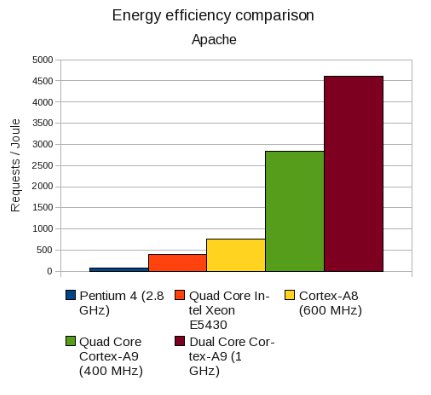
Following “Pandaboard Cloud Cluster Running Google App Engine” post, there were some questions regarding the actual power efficiency of ARM servers vs Intel (Xeon) servers and some commenters questioned the performance of ARM chips. I’ve found a thesis evaluating how the energy efficiency of the ARMv7 architecture based processors Cortex-A9 and Cortex-A8 compares – in applications such as a SIP Proxy and a web server (Apache2) – to Intel Xeon processors. The focus of this thesis is to compare the energy efficiency between the two architectures rather than pure performance where the Xeon largely outperforms ARM processors, although a cluster of ARM servers could be used instead to reach the same processing power. Depending on the application, benchmarks indicate energy efficiency of 3-11 times greater for the ARM Cortex-A9 in comparison to the Intel Xeon. The full thesis (74 pages) is available below. Jean-Luc Aufranc (CNXSoft)Jean-Luc started CNX Software in […]

Freescale i.MX6 Quad-Core Benchmark Demo

Freescale is showcasing the performance of their Quad Core ARM Cortex-A9 i.MX6 Quad processor at ARM Techcon 2011. The Freescale i.MX6 reference design runs a demo in Android 3.x (Honeycomb) with four windows: JPEG Decoding Window Web browser rendering and scrolling HTML5 Fish tank CPU Usage real-time chart The 3 windows used for the benchmark are all using software processing (no GPU involved) to show to performance improvement by moving from 1 to 2 and finally 4 cores. The benchmark results are quite impressive as with one core JPEG decoding is about 0.6 frame per second and with 4 cores it can decode 4.2 frames per seconds while other windows also show performance improvement.  Freescale says there was little modifications done to make the software work on four core and you don’t even need to have multi-threaded applications to take advantage of 4 cores as the OS will usually take […]