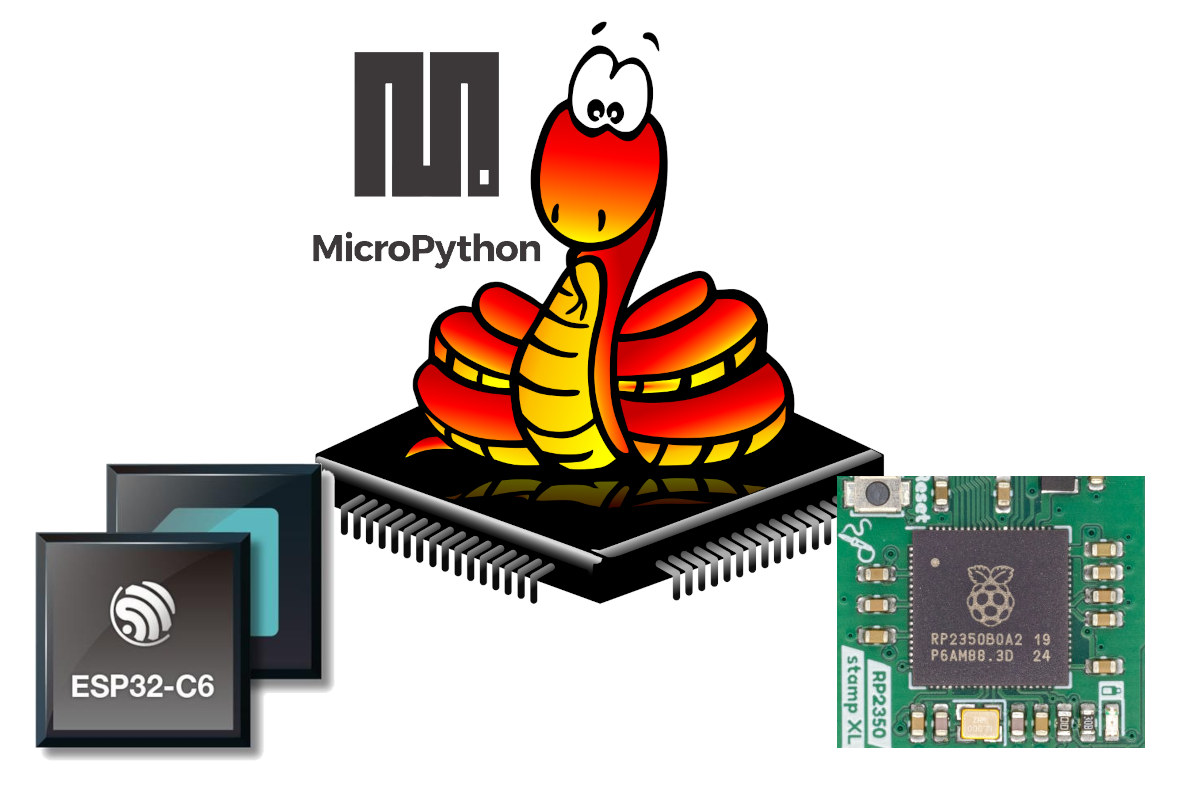
MicroPython is one of the most popular firmware for microcontrollers due to its ease of use. The MicroPython v1.27 release adds support for some interesting microcontrollers, namely Espressif Systems ESP32-C5 and ESP32-P4, thanks to an update to the ESP-IDF v5.5.1 framework, as well as STMicroelectronics STM32U5, and features a range of other changes. These include improvements to the test suite to cater to the increasing number of supported hardware platforms, the introduction of tier levels for different hardware platforms, various optimizations and bug fixes, updated libraries, new ESP32 and STM32 boards, and more. The last time we reported on a MicroPython release was for v1.24, which added support for Raspberry Pi RP2350 and ESP32-C6 microcontrollers. Other MicroPython v1.27 highlights: Test suite improvements Auto-detecting if the target has Unicode support Automatically including float tests when possible Always including stress tests Improving the skipping of tests that use slice and the […]
HealthyPi 6 – A portable Wi-Fi 6 biosignal acquisition device with ECG, PPG, respiration, and temperature sensors (Crowdfunding)
Designed by ProtoCentral Electronics in India, the HealthyPi 6 is an open-source, portable, research-grade biosignal acquisition device designed for academic research, education, and prototyping. It targets labs, classrooms, and field studies that need professional-quality physiological measurements without bulky desktop systems or proprietary lock-in. Building on the HealthyPi 5 (2023) and HealthyPi 4 (2019), the HealthyPi 6 is a standalone device with 3-channel/5-lead ECG, dual-wavelength PPG for heart rate and SpO₂, respiration via impedance pneumography, skin temperature sensing, and a 9-axis IMU for motion and artifact detection. Built around the STM32H757 real-time microcontroller and an ESP32-C6 handling Wi-Fi 6 and BLE connectivity, the device features a USB-C port, onboard flash and microSD storage, and 48+ hours of operation on a charge. Modular HealthyLink ports allow for EEG, EMG, GSR, additional analog inputs, triggers, and co-processors expansion. These features make it suitable for cardiovascular and sleep research, rehabilitation studies, wearable prototyping, biosignal […]
Nuvoton NuMicro M55M1 low-power Arm Cortex-M55 MCU enables on-device AI with Ethos-U55 NPU
Nuvoton’s NuMicro M55M1 is a low-power AI MCU that combines a 220 MHz Arm Cortex-M55 CPU with a 111 GOPS Ethos-U55 NPU to run basic AI tasks on-device. It specifically targets small IoT and embedded devices that need low-power voice, audio, or simple image processing. The chip embeds 1.5 MB RAM, 2 MB flash, and supports external OctoSPI/HyperRAM memory. Connectivity options include Ethernet, USB-OTG, CAN-FD, I3C/I2C/SPI, SDIO, and an 8-bit camera interface, along with ADCs, DACs, comparators, PWM, and multiple low-power modes. It’s built for secure IoT applications with Arm TrustZone, secure boot, AES, and PSA Level 2 certification. Typical uses include voice triggers, smart sensors, simple vision nodes, small appliances, and industrial monitoring devices. Nuvoton NuMicro M55M1 specifications: CPU Core – 220 MHz Arm Cortex-M55 core Architecture – Armv8.1-M with Helium M-Profile Vector Extension (MVE) Arm TrustZone Technology DSP extensions Hardware Floating-point Unit (FPU), double-precision Cache – 16KB I-Cache […]
Microchip PIC32-BZ6 BLE 6.0, Thread, and Matter wireless MCU integrates touch and motor control
Microchip has recently introduced the PIC32-BZ6 family of single-chip, multiprotocol wireless MCUs, also available as RF-certified modules, and designed for smart home, industrial automation, and automotive applications. The module supports Bluetooth LE 6.0, IEEE 802.15.4-based Thread and Matter, and proprietary mesh protocols. For wired connectivity, there are two CAN-FD ports, a 10/100 Mbps Ethernet MAC, and a USB 2.0 full-speed transceiver. Other features include CVD-based touch sensing and motor control interfaces for interactive and real-time applications. As a secure MCU, the PIC32-BZ6 integrates a hardware-based security engine, a secure boot ROM, and encryption accelerators, along with OTA update capability for long-term device management. The microcontroller offers up to 54 GPIO pins, multiple pin and package options (up to 132-pin VQFN), and automotive-grade variants rated for -40°C to +125°C operation. Microchip PIC32-BZ6 specifications: MCU Core – 128 MHz Arm Cortex-M4F with FPU and DSP extensions Memory 512 KB multi-port SRAM (with […]
Qualcomm acquires Arduino, introduces Arduino UNO Q “dual-brain” SBC
Qualcomm has just signed an agreement to acquire Arduino, and the goal of the purchase is to “combine Qualcomm’s leading-edge products and technologies with Arduino’s vast ecosystem and community to empower businesses, students, entrepreneurs, tech professionals, educators, and enthusiasts to quickly and easily bring ideas to life.” They also took the opportunity to launch the Arduino UNO Q “dual-brain” SBC powered by a Qualcomm DragonWing QRB2210 SoC running Linux and an STMicro STM32U585 MCU for real-time control, as well as the Arduino App Lab integrated development environment to “unify the Arduino journey across Real‑time OS, Linux, Python, and AI flows”. Will the acquisition change anything? I suppose we’ll see more and more Arduino boards based on Qualcomm processors, but the company also promises to preserve Arduino’s open approach and community: Arduino will retain its independent brand, tools, and mission, while continuing to support a wide range of microcontrollers and microprocessors […]
nRF54L15 Connect Kit – A compact Bluetooth 6.0 LE, 802.15.4, and NFC development board
MakerDiary nRF54L15 Connect Kit is a compact Nordic Semi nRF54L15 development board offering Bluetooth 6.0 LE, 802.15.4 (Zigbee/Thread), and NFC connectivity as well as two 20-pin headers for expansion. It has the same form factor as the earlier nRF9151 Connect Kit board with LTE-M, NB-IoT, and GNSS connectivity, and still features an nRF52820 MCU connected over UART to the nRF54L15 to handle programming and debugging through the board’s USB-C port, as well as power management, and a button and a few LEDs. nRF54L15 Connect Kit specifications: Wireless MCU – Nordic Semi nRF54L15 wireless SoC CPU Arm Cortex-M33 @ up to 128 MHz RISC-V coprocessor for “software-defined peripheral” Memory – 256 KB SRAM Storage – 1.5MB Non-volatile Memory (NVM) Wireless Bluetooth LE 6.0 (includes Channel Sounding) Thread, Zigbee (IEEE 802.15.4-2020) Matter Amazon Sidewalk Proprietary 2.4 GHz protocols with a new 4 Mbps mode NFC support Interface MCU – Nordic Semi nRF52820 […]
NXP MCX A34 mixed-signal Cortex-M33 MCU delivers 17x faster math acceleration for motor control and HVAC systems
NXP has launched the MCX A34 mixed-signal Arm Cortex-M33 industrial MCU, an upgrade of the MCX A14x and MCX A15x MCUs, which were introduced in 2024. While the A14x/A15x offered Cortex-M33 cores up to 96 MHz, 128 KB Flash, 32 KB SRAM, a 12-bit ADC, the A34 scales up with a 180 MHz core, up to 1 MB Flash, 256 KB SRAM, four 16-bit ADCs (3.2 Msps), four OpAmps, a 12-bit DAC, and FlexPWM with enhanced quadrature decoding. It also features a dedicated Math Acceleration Unit (MAU) that executes trigonometric, reciprocal, and square root operations up to 17x faster than CMSIS-DSP, a SmartDMA coprocessor for offloading data transfers, and advanced security features with tamper detection and secure boot. Connectivity is also richer, with up to six UARTs, four I²C, two SPI, and a CAN FD interface. MCX A34 specifications: MCU core – Arm Cortex-M33 core clocked at up to 180 […]
Alif Ensemble E4, E6, and E8 Cortex-M55/A32 MCUs and MPUs feature Ethos-U85 NPU for small language models (SLM)
Alif Semiconductor unveiled the Ensemble E4, E6, and E8 dual-core Cortex-M55 Edge AI microcontrollers and fusion processors, all equipped with Arm Ethos-U85 with the ability to run small language models (SLM) on-device while consuming just 36mW of power on the E4 SKU. Besides the ability to handle generative AI workloads, the new microcontrollers also integrate two power-efficient Ethos-U55 NPUs for AI vision. They can perform power-efficient object detection in less than 2ms and image classification in less than 8ms. Other highlights include support for up to two MIPI CSI image sensors, a fully hardware-accelerated image signal processor (ISP) pipeline operating at up to 60 FPS at 2MP resolution, and a new wide memory subsystem to enable an inferencing speed of well under a millisecond. Alif Ensemble E4 Ensemble E4 specifications: CPU High-Performance Arm Cortex-M55 core @ up to 400 MHz High-Efficiency Arm Cortex-M55 core @ up to 160 MHz GPU […]