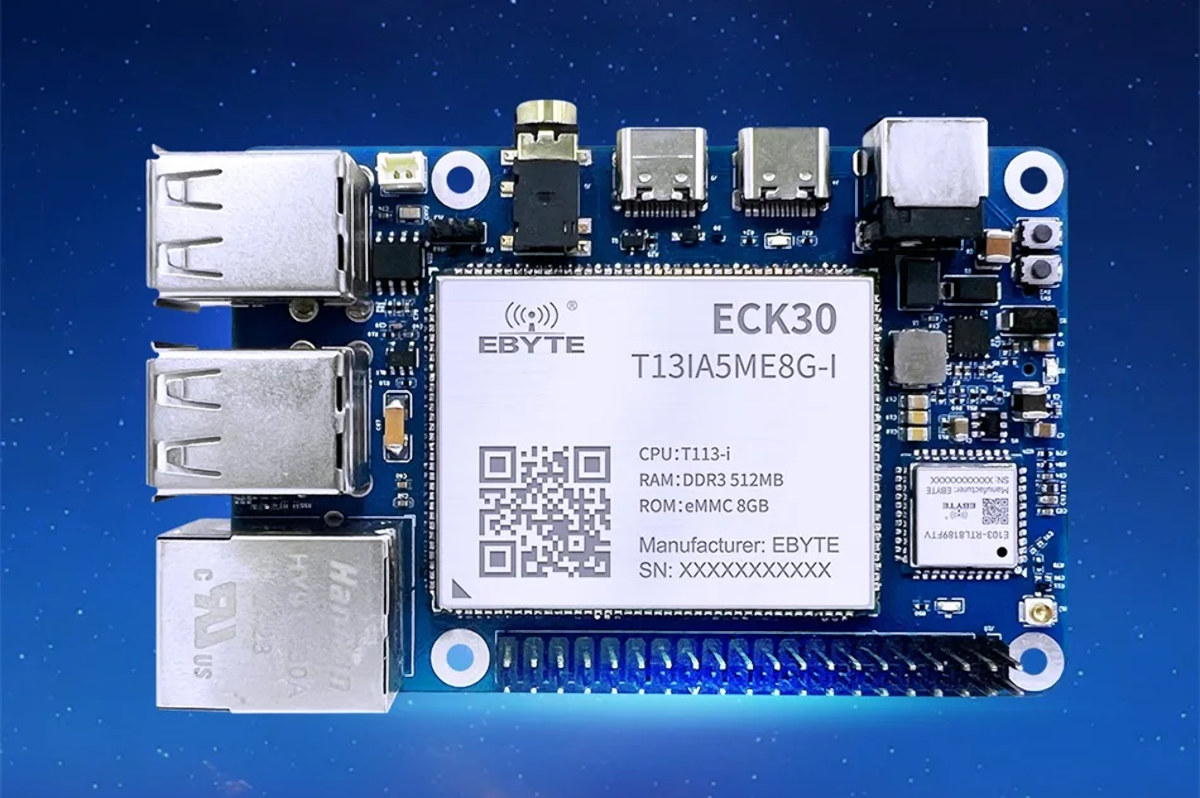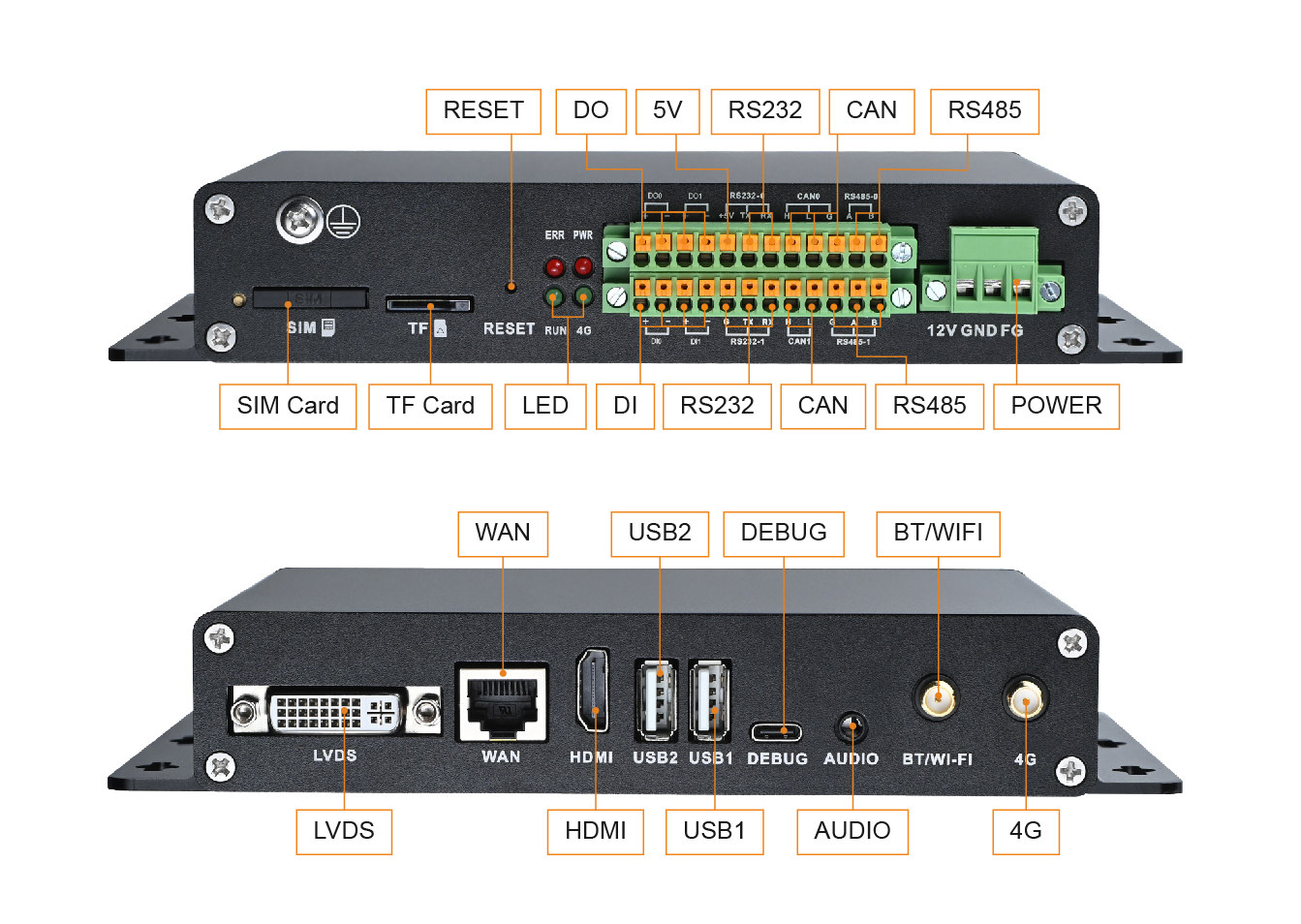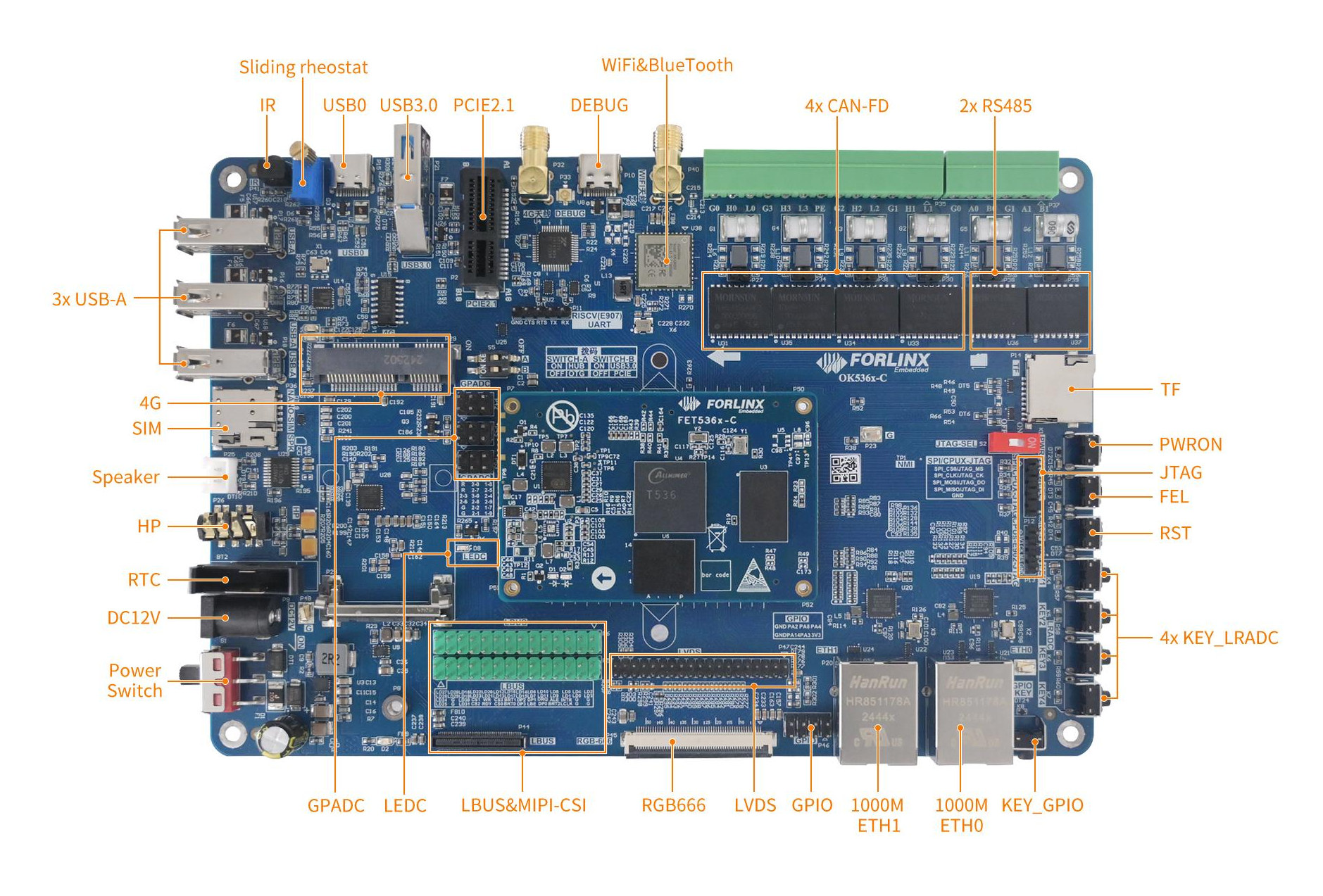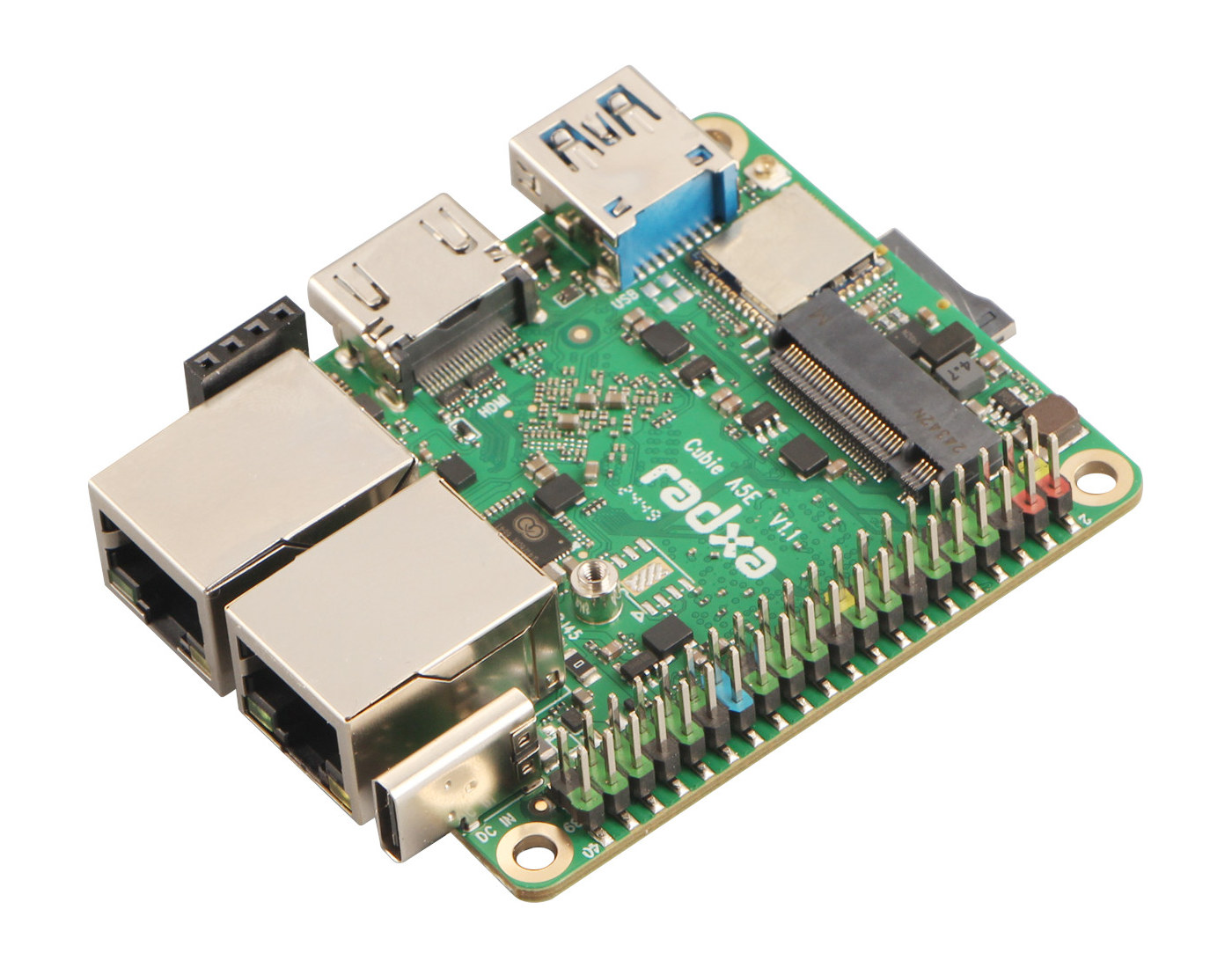

Boardcon PICOT536 SoM and EMT536 SBC feature Allwinner T536 Edge AI processor

EMT536 Development Board

Back in April last year, Allwinner released the T536 SoC, and since then, we’ve seen MYiR Tech and Forlinx introduce SoM and SBC based on it. The latest to join the lineup is Boardcon, which has recently launched the PICOT536 SoM and EMT536 SBC for industrial HMI, machine vision, robotics, and other edge computing applications. As a reminder, the Allwinner T536 SoC features a quad-core Arm Cortex-A55 CPU, XuanTie E907 and E902 RISC-V coprocessors, and a 2 TOPS NPU for edge AI. The module comes with up to 8GB LPDDR4/LPDDR4X memory, up to 64GB eMMC flash, an optional WiFi 6 and Bluetooth 5.4 module, and a 314-pin MXM edge connector exposing I/Os such as MIPI DSI and LVDS, camera inputs, audio inputs and outputs, Gigabit Ethernet, PCIe, USB 3.0, and more. PICOT536 System-on-Module PICOT536 specifications: SoC – Allwinner T536 CPU – Quad-core Arm Cortex-A55 at up to 1.6GHz, RISC-V XuanTie […]

Forlinx UP4 – A 40×40 mm LCC + LGA system-on-module family with Rockchip, NXP, and Allwinner CPU options

Forlinx UP4 system-on-module

Forlinx Embedded UP4 is a new family of pin-to-pin compatible system-on-modules currently offered with Rockchip RK3568J/RK3562J, NXP i.MX 9352, or Allwinner T527N/T536 processors. The UP4 modules measure just 40×40 mm and expose 487 pins through a hybrid LCC (Leadless Chip Carrier) and LGA (Land Grid Array) design with 1.0mm contact pitch and 1.27mm ball pitch, respectively. This should allow companies to design a single carrier board for multiple CPU variants. Forlinx UP4 specifications: SoC FET-MX9352-UP4 – NXP i.MX 9352 with 2x Arm Cortex-A55 cores @ up to 1.7 GHz, Cortex-M33 real-time core @ 250 MHz, 2D GPU only, 0.5 TOPS Arm Ethos U65 microNPU FET3568-UP4 – Rockchip RK3568B2/J with 4x Arm Cortex-A55 cores @ up to 2.0/1.8 GHz, Arm Mali-G52 MP2 3D GPU, 1 TOPS AI NPU FET3562J-UP4 – Rockchip RK3562J with 4x Arm Cortex-A53 cores @ 1.8 GHz,  Arm Mali-G52-2EE 3D GPU, 1 TOPS NPU FET527N-UP4 – Allwinner T527N […]

Linux 7.0 Release – Main changes, Arm, RISC-V, and MIPS architectures

Linux 7.0

Linus Torvalds has just released Linux 7.0 on LKML: The last week of the release continued the same “lots of small fixes” trend, but it all really does seem pretty benign, so I’ve tagged the final 7.0 and pushed it out. I suspect it’s a lot of AI tool use that will keep finding corner cases for us for a while, so this may be the “new normal” at least for a while. Only time will tell. Anyway, this last week was a little bit of everything: networking (core and drivers), arch fixes, tooling and selftests, and various random fixes all over the place. Let’s keep testing, and obviously tomorrow the merge window for 7.1 opens. I already have four dozen pull requests pending – thank you to all the early people. Linus This follows the Linux 6.19 release about two months ago, which brought us PCIe link encryption and […]

Luckfox Lume – A compact Allwinner T153 SBC with dual GbE, PoE, GPIO header, and MIPI interfaces for industrial HMI applications

Luckfox Lume

Luckfox Lume is a compact industrial SBC powered by an Allwinner T153 quad-core Cortex-A7 SoC with a low-power RISC-V core, and equipped with 128MB DDR3, 256MB SPI NAND flash, and dual Gigabit Ethernet The board also features a microSD card slot, a USB 2.0 Type-A port, a USB Type-C port, MIPI DSI and CSI connectors, and a 40-pin GPIO header suitable for a range of HMI applications. By default, the board is powered through USB-C, but a PoE model is also available. Luckfox Lume specifications: SoC – Allwinner T153 M3-QCX CPU 4x Arm Cortex-A7 cores @ up to 1.6GHz XuanTie E907 RISC-V core @ up to 600MHz GPU – 2D GPU only No VPU, no NPU System Memory – 128 MB built-in DDR3 (TBC) Storage 256 MB SPI NAND flash (Winbond 25N02KVZEIR) MicroSD card slot Display Interface – 4-lane MIPI DSI Camera Interface – 2-lane MIPI CSI Networking – 2x […]

Linux 6.19 Release – Main changes, Arm, RISC-V, and MIPS architectures

Linux 6.19

Linus Torvalds has just released Linux 6.19 on the Linux Kernel Mailing List (LKML): No big surprises anywhere last week, so 6.19 is out as expected – just as the US prepares to come to a complete standstill later today watching the latest batch of televised commercials. The betting man would expect them all to be AI-generated, but maybe some enterprising company decides to buck the trend? Doubtful, but there’s always a slight chance. But for anybody outside the US, maybe taking the newest kernel out for a spin instead is an option? I have more than three dozen pull requests for when the merge window opens tomorrow – thank you to all the early maintainers. And as people have mostly figured out, I’m getting to the point where I’m being confused by large numbers (almost running out of fingers and toes again), so the next kernel is going to […]

Olimex HoT aims to be lightweight, easier-to-use alternative to Home Assistant

Olimex HoT

Olimex HoT (Home of Things) is a lightweight Smart Home solution designed to run on low-end hardware (128MB RAM, 128MB flash) and interface with nodes running ESPHome. It can serve as an easier-to-use alternative for people who don’t need all the bells and whistles provided by powerful home automation frameworks such as Home Assistant or OpenHAB. Home Assistant open-source home automation software is great, but it requires a system with at least 2GB of RAM, and 4GB of RAM is often recommended for most users. There’s also a steep learning curve. This is what Tsvetan Usunov, Olimex CEO, realized last year when he tried Home Assistant, and he decided to start working on a low-cost, easy-to-use solution for IoT and Smart Home applications. That’s why the Olimex HoT project was created. Tsvetan gave a talk about the project entitled “Designing EUR 20 Open Source Hardware running Free/Libre Open Source Software […]

Forlinx OK153-S12 Mini – A low-cost Allwinner T153 SBC with Raspberry Pi GPIO header and long-term availability

OK153 S12 Mini SBC

Forlinx has introduced the OK153-S12 Mini, an Allwinner T153 SBC/development board, which looks to be a low-cost version of the OK153-S SBC that we previously covered. It keeps the same FET153-S SoM, but swaps the industrial terminal blocks, mini PCIe, and some other interfaces for a more compact footprint and a Raspberry Pi-compatible 40-pin header. The SBC supports up to 1 GB of DDR3 memory, up to 512 MB of NAND flash or 8 GB eMMC flash, and also features a microSD card slot for storage. Other interfaces include two Gigabit Ethernet ports, two USB Type-C ports for power, data, and debugging, and a USB 2.0 host port. Display is supported via an RGB LCD interface with backlight control via PWM. Other features include mono audio line-out via a 3.5mm headphone jack, multiple GPIOs, and buttons for reset, download, and user input, along with various status LEDs, and a 40-pin […]

NetCube Systems Nagami Allwinner T113-S3 mini PCIe SoM features ESP32 wireless SoC, supports mainline Linux

Netcube Systems Allwinner T113-S3 SoM mainline Linux

NetCube Systems Nagami is a small Allwinner T113-S3 system-on-module that I just saw added to Linux 6.18. Besides mainline Linux support, the Allwinner SoM offers somewhat unique or unusual features that include a mini PCIe form factor and an ESP32 co-processor for WiFi 4 and Bluetooth connectivity. The Nagami also comes with 128MB DDR3 embedded in the T113-S3, 4GB eMMC flash, a Fast Ethernet PHY, and a Qwiic connector for I2C expansion modules. All I/Os are exposed through a standard mini PCIe edge connector: audio I/Os, Ethernet, USB 2.0 OTG/host, and a range of low-speed I/Os. Nagami SoM specifications: SoC – Allwinner T113-S3 CPU – Dual-core Arm Cortex-A7 @ 1.2 GHz with 32 KB L1 I-cache + 32 KB L1 D-cache per core, and 256 KB L2 cache DSP – Single-core HiFi4 VPU – H.265/H.264 video decoding up to 1080p60 and JPEG/MJPEG video encoding up to 1080p60 Memory – 128 […]

Exit mobile version