Embedded Linux Conference Europe (ELC-E 2011) will take place on October 26 – 28, 2011 at Clarion Congress Hotel in Prague, Czech Republic. The event will be co-located with LinuxCon Europe 2011 and GStreamer Conference. The day before the official opening of the conference, two tutorials will be offered on Tuesday 25th of October:b Outside the Box: An Introduction to Embedded Linux and Hardware Interfacing Using the Snowball Board – 9:00 – 17:00 – Trainer: Chris Simmonds – Cost: 350 USD. Embedded Android Workshop – 9:00 – 17:00 – Trainer: Karim Yaghmour- Cost: 300 USD. ELCE consists of 3 days of presentations, tutorials and sessions. There will be over 50 sessions during those 3 days. I’ll highlight a few sessions that I find particularly interesting. October 26 10:45 – 11:45 – Linaro’s Android Platform by Zach Pfeffer, Linaro Android Platform team leader. Linaro uses components from the Android Open Source […]
Android Developer Conference: DroidCon 2011 Schedule
DroidCon UK will be held for two days (October 6th & 7th 2011) at the Islington Design Center in London and boasts to be United Kingdom’s largest Android-only developer conference. Here’s the program for day 1 (6th of October): 9:00 Barcamp Talks will be selected by attended among the following proposals: From Publisher to Platform – the role of OpenSource in engaging with developers by Oscar Clark, Papaya Mobile. Reality of Mobile Advertising by Terence Eden, Inmobi. OpenGLES2 & Android QEMU Emulator by Jonathan White and Jose Commins, Accenture. Enhancing User Experience with HTC: 3D, Pen, and Audio Lance Nanek, HTC. Cisco Workshop by Marcus O’Sullivan, Cisco. OpenGL & NDK by Ashraf Hegab, Orange. Fed up with trying to make pay per download pay back? Try API revenue share by James Parton, o2. (Re)Branding Headache? Here’s your Pain Killer by Joana Cruz e Costa, Masabi. Smooth and User Friendly UI […]
Embedded MasterClass Conference Schedule in Cambridge, UK
Embeded MasterClass will take place in Cambridge on the 5th of October 2011. This conference will give you the chance to meet with embedded systems engineers from many of the world’s leading vendors and you’ll be able to attend presentations and workshops free of charge. Here’s the presentations’ schedule for the event: Time Stream 1 Stream 2 8.30 – 9.30 Tea/Coffee – Meet the Exhibitors 9.30 – 10.15 1: Leveraging the Performance of Intel® Architectures in low power, fan-less solutions with the latest Intel® Atom™ processor-based platform. Regis Cheval CEng MIET, Intel® Atom™ Platform Application Engineer – Intel 10.30 – 11.15 2: Proving your code quality. Barry Lock – Lauterbach 3: Developing reliable embedded systems using COTS and custom processors. Michael Pont, CEO – TTE Systems 11.15 – 11.45 Coffee and Exhibition 11.45 – 12.30 4: Strategic Research Agenda. Helen Finch – Artemis and Infineon 5: Safely from Conception to […]
Select an ARM MCU during Development with Atollic TrueSTUDIO for ARM
Atollic has released the latest version of TrueSTUDIO development tool for ARM, a C/C++ development tool for embedded developer that looks similar to Eclipse. It supports micro-controllers from a number of semiconductor manufacturers, making it possible to switch MCU supplier during the design process. This release of TrueSTUDIO supports several ARM MCU cores such as ARM7, ARM9, Cortex-M0, Cortex-M1, Cortex-M3 and Cortex-M4 processors. It also includes device-specific support for an extensive list of ARM processor-based micro-controller families, including: Atmel AT91SAM, EnergyMicro EFM32, Freescale Kinetis, Fujitsu FM3, STMicroelectronics STM32, Texas Instruments Stellaris and Toshiba TX. As well as an optimizing C/C++ compiler and a multiprocessor-aware debugger, the tool also has serial wire viewer tracing, graphical UML diagram editors for model-based design and architecture, performs code-quality analysis via TrueINSPECTOR and TrueANALYSER and features a test-automation toolbox (TureVERIFIER). There is also an ECLIPSE-based IDE with editor, x86 C/C++ build and debug tools for development of […]
Most Engineers have Multicore/Multiprocessor Experience
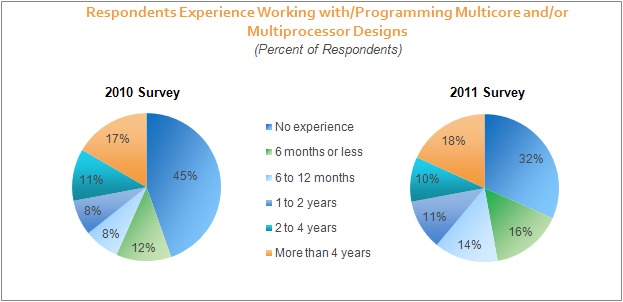
In a recent blog post entitled “Engineers’ Multicore/Multiprocessor Experience Improving” , VDC research revealed a survey showing that more and more engineers are gaining experience working on multicore or multiprocessor projects. In their 2011 survey, there are now only 32% of engineers who have never worked on projects based on multicore and/or multiprocessor versus 45% in 2010. VDC Research questions the the factors that are driving engineers’ expanding experience with multiprocessing, such as the increasing availability and affordability of multicore processors, advancements in processor technology, the effectiveness of ISVs efforts around educating the engineering community about the use of multicore or the continued maturation of software solutions that enable parallel programming. But I believe it’s all of the above. There are now many cost effective multicore processors for embedded systems (mainly thanks to ARM). Some of them have low cost development platforms that attract more developers. For device where battery […]
Setting Up a Git Server on Ubuntu
Git is a version control system used by many projects such as Linaro, the Linux kernel, Android, Eclipse, Qt and more. For projects that can not afford their own servers and still need to collaborate, hosted git is available from github and as today there are a total of 2,769,642 repositories (private and public) hosted on github. For software developed internally, you can start to setup you own Git server by following some simple steps (in Ubuntu). Installing the Git Server Update Ubuntu and install git-core: sudo apt-get update sudo apt-get install git-core That’s it. Installing Gitolite Gitolite allows you to setup git hosting on a central server, with fine-grained access control and many more powerful features. First get gitolite with git: git clone git://github.com/sitaramc/gitolite.git Obtain a public key based access to your server, so that you can log in from your workstation to the server without getting a password […]
Best Practices for Writing Safer C Code
Thomas Honold wrote an article published on EETimes giving 17 steps to safer C code. Not only this article provides tips to write safer C code, but I believe those steps are simply best practices when writing C code for embedded systems as they shorten the software life cycle by making it easier for a software team to write, debug and maintain code and by improving the software QA procedure. Here’s a summary of the 17 steps to achieve safer C code: Follow the rules you’ve read a hundred times: Initialize variables before use. Do not ignore compiler warnings. Check return values. Use enums as error types. Define an ENUM_MAX value at the end, so that the code to check the range does not have to be modified each time you add a new error code. Expect to fail Always assume there will be an error and set to default […]
LinuxCon 2011 Presentation: Hosting Open Source Projects at the OSUOSL
The second presentation entitled “Hosting Open Source Projects at the OSUOSL” was presented by Lance “Ramereth” Albertson, Systems Administrator / Architect at OSUOSL (Oregon State University Open Source Lab) at LinuxCon 2011. Abstract: This presentation describes the hosting infrastructure (data centers, networking etc..) and human resources at OSUOSL, lists some famous customers (linux.org, xiph.org), explains how to request hosting for your open source project, lists the software tools used in the hosting servers and finally deals with funding and the future of open source hosting services at OSUOSL. If you want to download the presentation slides, please go to Hosting Open Source Projects at the OSUOSL and use the download button on top of the Slideshare presentation. If it does not work, you may also download a copy here. Jean-Luc Aufranc (CNXSoft)Jean-Luc started CNX Software in 2010 as a part-time endeavor, before quitting his job as a software engineering manager, and starting […]