
Echo Pyramid enables smart voice interaction applications on M5Stack Atom ESP32 IoT controllers

M5Stack Echo Pyramid

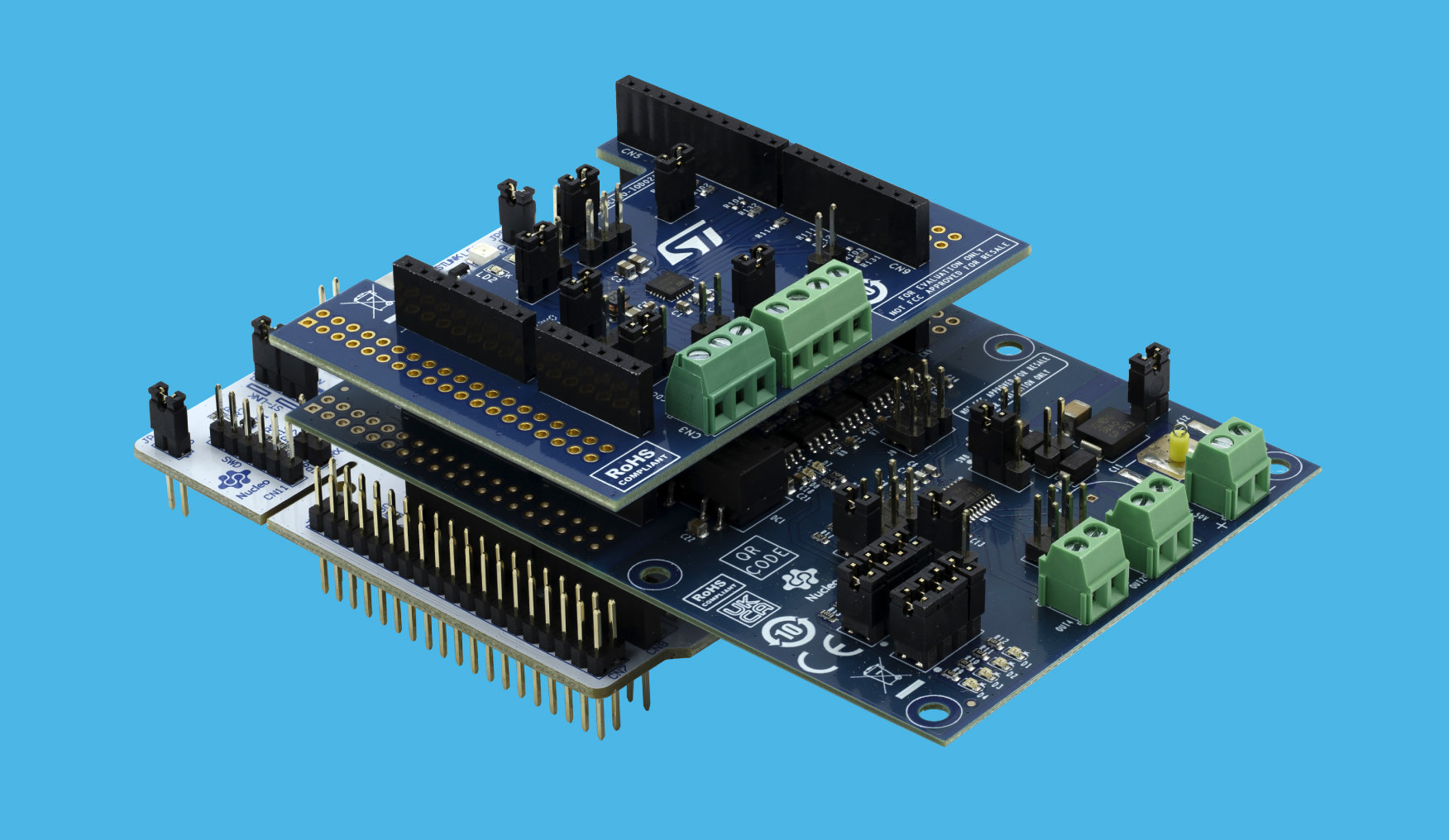
Designed for M5Stack Atom, AtomS3, and AtomS3R series IoT controllers based on ESP32 or ESP32-S3 wireless SoC, the Echo Pyramid base enables smart voice interaction applications such as far-field voice recognition, voice assistants, voice control, and more. The device features a built-in speaker, a MEMS microphone, an ES8311 HD audio codec for playback and capture, and an STM32 MCU for touch areas and RGB LED management. It’s powered via a USB Type-C port and can be expanded through a 4-pin connector for I2C modules. Echo Pyramic specifications: Supported IoT controllers – M5Stack Atom, AtomS3, and AtomS3R Microcontroller –  STMicro STM32G030F6P6 32-bit Arm  Cortex-M0+ CPU @ 64 MHz with 8KB SRAM, 64 KB flash Audio HD Codec – ES8311, handles playback and recording Microphone – LMA3729T381-0Y3S MEMS microphone ADC – ES7210 for microphone input Built-in speaker on the bottom of the pyramid Amplifier – AW87559 Class-D speaker driver for the speaker […]

STM32U3B5/C5 ultra-low-power MCU features 640 KB RAM, 2 MB Flash, and HSP accelerator to run AI without batteries

STM32U3B5 STM32U3C5 block diagram

STMicroelectronics has added two members to the STM32U3 ultra-low-power Arm Cortex-M33 microcontroller family: the STM32U3B5 and STM32U3C5 MCUs get more resources with up to 640 KB SRAM and 2 MB flash, as well as an HSP (hardware signal processor) accelerator to run AI/ML workloads without batteries, just using energy harvesting. The new chips are still clocked at up to 96 MHz, benefit from a near-threshold design (down to 0.65 V), allowing a power consumption of just 117 Coremark/mW in active mode, and can operate up to 105°C ambient temperature. They come with one additional group of interfaces, bringing the total to four SPI and I2C, two I3C and CAN-FD, and five UARTs, as well as five more 16-bit timers, for a total of 10. The STM32U3C5 also includes a cryptocore to accelerate encryption and decryption operations, and supports the CCB (Coupling and Chaining Bridge) hardware security feature, both of which […]

STMicroelectronics Stellar P3E quad-core Arm Cortex-R52+ automotive MCU features Neural-ART AI accelerator

Stellar P3E AI automotive MCU Block Diagram

STMicroelectronics has introduced the Stellar P3E, the first automotive MCU with an embedded Neural-ART AI accelerator, designed to simplify X-in-1 Electronic Control Units (ECUs) by consolidating powertrain functions like the inverter, on-board charger (OBC), and DC-DC converter into a single module. The MCU enables smart sensing, predictive maintenance, and virtual sensor applications without the cost and complexity of a separate SoC. The microcontroller features four 500 MHz Arm Cortex-R52+ cores with 19.5 MB of xMemory, which is based on phase-change memory (PCM), offering roughly twice the density of embedded flash. The chip integrates multiple ADC channels for precise sensing, high-resolution PWM down to 102 ps for fine motor control, and 10 timer modules for deterministic real-time operation. Connectivity options include Gigabit Ethernet and CAN-XL, for high-speed, low-latency in-vehicle communication. Stellar P3E (SR6P3EC4/SR6P3EC6) specifications: MCU – SR6P3EC4 / SR6P3EC6 CPU Cores – 4x Arm Cortex‑R52+ cores at up to 500 MHz; […]

Ariel OS – A Rust RTOS for IoT microcontrollers

Ariel OS architecture diagram

Ariel OS is a new RTOS for microcontrollers written in Rust with support for popular hardware architectures (Arm Cortex-M, ESP32, RISC-V) and boards from Espressif, Nordic Semi, Raspberry Pi, and STMicroelectronics. Ariel OS is built on top of Embassy Rust framework and embedded-hal Hardware Abstraction Layer (HAL) for embedded systems, and adds several OS functionalities and a multi-core capable scheduler. It is mainly designed for secure, memory-safe, networked applications on microcontrollers. The developers further describe Ariel OS as follows on the project’s website: Ariel OS follows an approach whereby it simultaneously integrates a curated ecosystem of libraries (available via crates.io), and adds missing operating system functionalities as depicted below. Such functionalities include a preemptive multicore scheduler, portable peripheral APIs, additional network security facilities, as well as a meta-build system to bind it all together. As a result, a low-power IoT developer can focus on business logic sitting on top of […]

FOSDEM 2026 schedule – Embedded, RISC-V, Robotics, Rust, Open Hardware, and more

FOSDEM 2026 schedule

FOSDEM 2026 will take place on January 31-February 1, with thousands of developers meeting in Brussels to discuss open-source software & hardware projects. The free-to-attend “Free and Open Source Software Developers’ European Meeting” gets more traction every year, and in 2026, there will be at least 1,113 speakers, 1,016 events, 70 tracks, and potentially close to 10,000 attendees. As usual, I’ll create a virtual schedule with sessions most relevant to the topics covered on CNX Software from the “Embedded, Mobile and Automotive” and “Open Hardware and CAD/CAM” devrooms, but also other devrooms, including “RISC-V”, “Robotics and simulation”, and “FOSS on Mobile”, among others. I’m aware some of the talks overlap by a couple of minutes or so… FOSDEM 2026 Day 1 – Saturday, January 31 10:40 – 11:15 – RISC-V Vector optimisations in FFmpeg by Rémi Denis-Courmont FFmpeg is the most versatile multimedia codec and format support library, and was […]

Arduino UNO Q 4GB board with 4GB RAM, 32GB storage is now available for $59

Arduino UNO-Q 4GB

When the Arduino UNO Q was first unveiled in October 2025, the specifications of the Qualcomm DragonWing SBC listed the ABX00162 SKU with 2GB RAM and 16GB eMMC flash, and the ABX00173 SKU with 4GB RAM and 32GB eMMC flash. So far, only the 2GB variant was available, and Arduino has now announced the availability of the Arduino UNO Q 4GB with 4GB of RAM and 32GB eMMC storage for more complex projects. Arduino UNO Q 4GB (ABX00173) specifications: Application SoC/MPU – Qualcomm QRB2210 CPU – Quad-core Cortex-A53 processor at up to 2.0 GHz GPU – Adreno 702 GPU at 845 MHz with support for OpenGL ES 3.1, Vulkan 1.1, OpenCL 2.0 DSP – Hexagon QDSP6 v66 VPU – 1080p 30 fps encode / 1080p 30fps decode ISP – 2x Image Signal Processor (13 MP + 13 MP or 25 MP) @ 30 fps Real-time MCU – STMicro STM32U585 Arm Cortex-M33 microcontroller […]

STM32MP21 Arm Cortex-A35/M33 MPU targets cost-effective applications in smart factories, homes, and cities

STM32MP215F-DK Discovery Kit

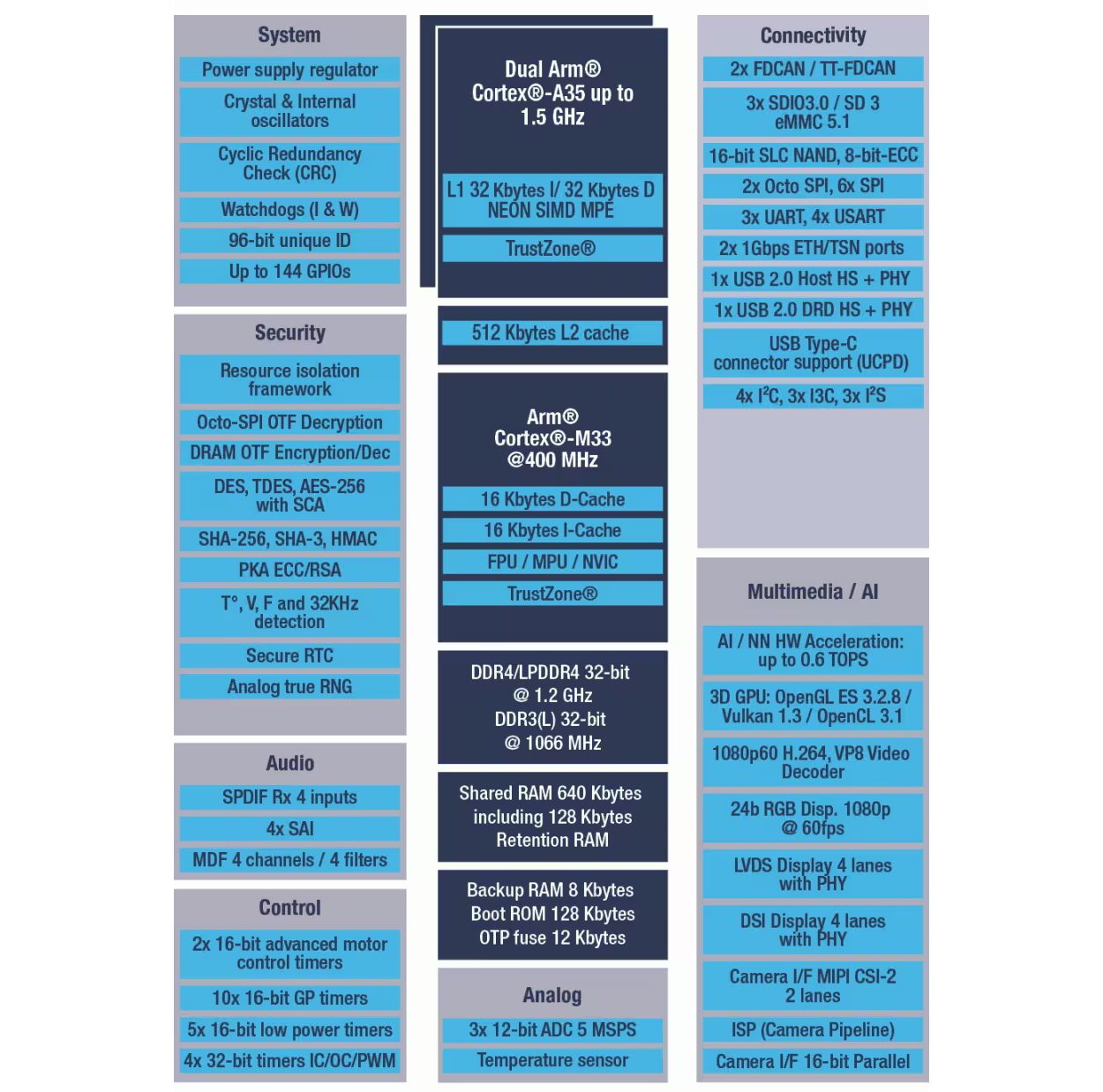
STMicroelectronics’ STM32MP21 microprocessor family combines a 1.5 GHz 64-bit Arm Cortex-A35 application core with a 300 MHz 32-bit Arm Cortex-M33 core for real-time processing. It is designed for “cost-aware” edge applications in smart factories, smart homes, and smart cities. The new STM32MP21 is a cost-optimized version of the earlier STM32MP23 and STM32MP25 that does without an AI accelerator (yes, those still exist!), GPU, H.264 decoder and encoder, or PCIe Gen2 / USB 3.0 interfaces. It still offers a MIPI CSI-2 camera interface, two Gigabit Ethernet interfaces with Time-Sensitive Networking (TSN), and strong security targeting SESIP Level 3 and PCI pre-certification. STM32MP21 specifications: CPU – Arm Cortex-A35 core running at up to 1.2 or 1.5 GHz with 128KB L2 cache Real-time MCU – Arm Cortex-M33 core with FPU/MPU running at up to 300 MHz GPU – None VPU – None AI accelerator – None Memory 456 KB SRAM 256KB AXI SYSRAM […]

Year 2025 in Review, CNX Software stats, and looking ahead to 2026

Happy New Year 2026 CNX Software

Time for the last post of 2025, as the year is almost over. I’ll look back at key developments and notable products launched in 2025, share some CNX Software website traffic statistics, and look ahead to 2026. Year 2025 in Review After 22 product releases in 2024, Raspberry Pi calmed down a little bit in 2025, and the highlights of the year included the Raspberry Pi 500+ mechanical keyboard, the 5-inch variant of the Raspberry Pi Touch Display 2, and a Raspberry Pi 5 1GB RAM. What didn’t quite stop were the accessories from third parties for Raspberry Pi SBC and Raspberry Pi Pico boards. The most exciting Arm SoC release of 2025 was probably the 12-core CIX P1 Armv9 SoC found in Radxa Orion O6 SBC, MINISFORUM MS-R1 Arm mini PC, and Orange Pi 6 Plus board, but while performance was fine, it was overhyped in 2024, and software […]

Exit mobile version