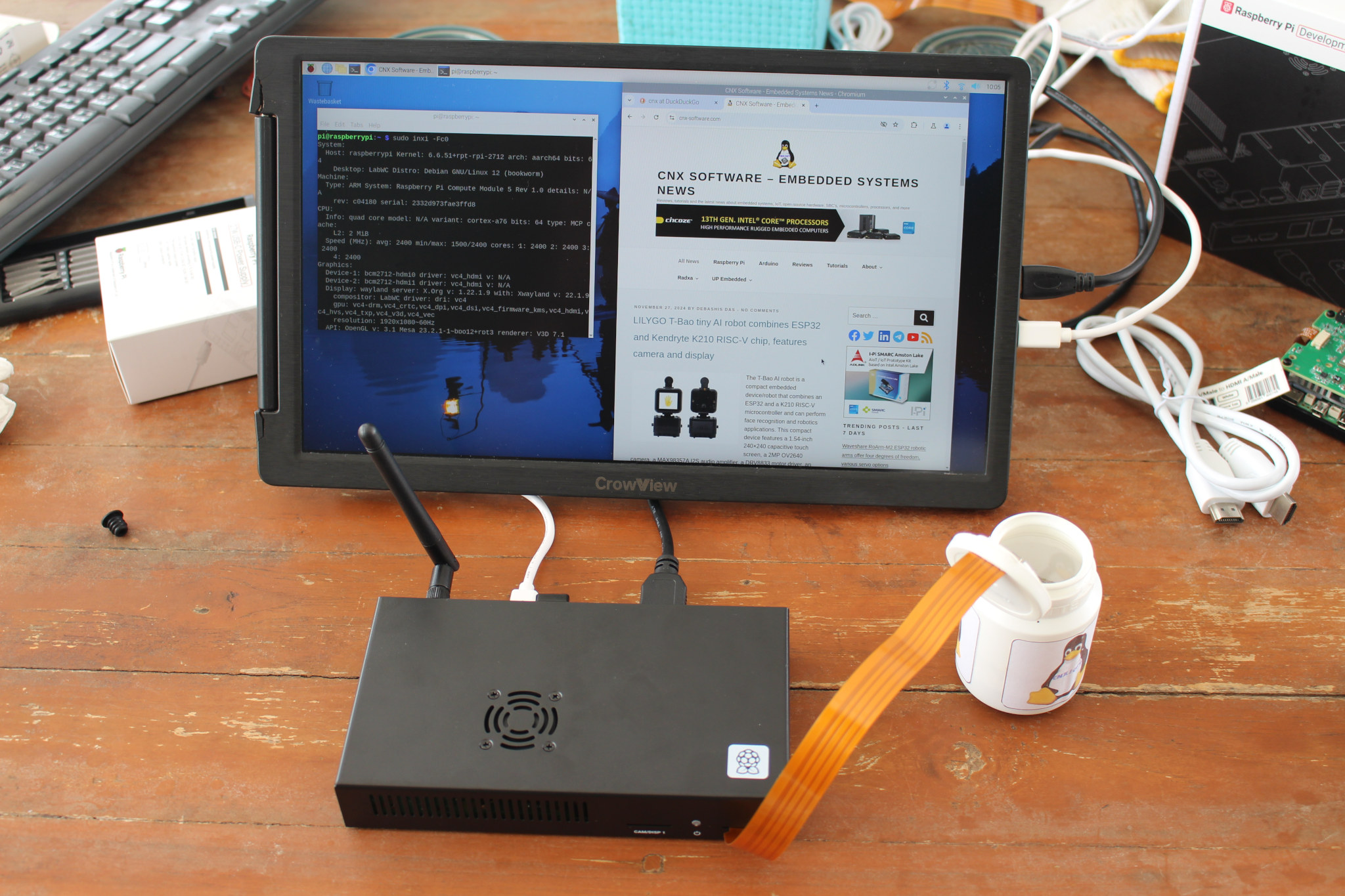
Hello, today I am going to review the reComputer AI Industrial R2135-12 from Seeed Studio. This is an industrial edge computer built around the Raspberry Pi Compute Module 5 platform. The model is configured with 8 GB LPDDR4 memory and 32 GB eMMC storage. It provides a rich set of I/O options, including dual Gigabit Ethernet, USB 3.0/USB 2.0, HDMI output, and industrial interfaces such as RS-485/RS-232, CAN, and GPIO, along with Wi-Fi and Bluetooth support and a wide DC power input range suitable for industrial environments. In addition to standard checking and benchmarking the device, I will also include a hands-on demo application in which the system runs an AI model for real-time people detection from a USB camera, then sends detection results to an external ESP32 microcontroller to drive LED matrices for visually highlighting the locations of detected people. I made the following YouTube video to quickly demonstrate […]
MUSE Book laptop review – Testing an octa-core RISC-V Linux laptop in 2026
SpacemiT sent me a sample of the MUSE Book RISC-V Linux laptop for review. It’s based on the SpacemiT K1/M1 octa-core 64-bit RISC-V SoC, ships with up to 16 GB of RAM, eMMC flash and/or NVMe SSD, and features a 14.1-inch IPS display with 1920×1080 resolution, WiFi 6 connectivity, a few USB ports, and more. I won’t go through all the hardware specifications since Leo already did that when he wrote about the MUSE Book Laptop in April 2024, along with a teardown, and additional details about the SpacemiT K1/M1 SoC. I’ll still do an unboxing and quickly check the hardware, but I’ll focus on the software part to show the progress with Bianbu OS 2.3 (Ubuntu 24.04-based) on RISC-V hardware, as I just did for the low-end StarFive JH7110S-based VisionFive 2 Lite SBC. It’s quite a long review, so if you are short on time, you can jump directly […]
VisionFive 2 Lite SBC Review – Ubuntu 24.04 on a low-cost RISC-V SBC in 2026
StarFive has sent me a sample of the VisionFive 2 Lite RISC-V SBC for review. It’s a low-cost credit card-sized board based on the StarFive JH7110S quad-core RISC-V SBC and designed to get started with Linux RISC-V on the cheap. When I first tested the earlier VisionFive 2 SBC with a StarFive JH7110 RISC-V SoC in February 2023, I didn’t call it a review, but rather a hands-on experience, since, at the time, many features still didn’t work properly. Almost three years have passed since then, so reviewing the VisionFive 2 Lite SBC with Ubuntu 24.04 will allow us to see how much progress has been made on the software side. If you are in a rush, you can jump to the what works, what doesn’t section. VisionFive 2 Lite unboxing I received the board in a plastic box with a cover reading “VisionFive 2 Lite Your Gateway to RISC-V”. […]
DFRobot HUSKYLENS 2 AI camera review – From built-in AI samples to training a custom model to detect elephants
Hello, today I am going to review the HUSKYLENS 2, released in October 2025. It is the next generation of HUSKYLENS, an AI vision sensor equipped with a Kendryte K230 dual-core RISC-V SoC with a 6 TOPS AI accelerator and a 2.4-inch IPS touchscreen. The device runs machine vision algorithms fully on-device, providing fast and low-latency performance, and includes more than 15 built-in AI models. HUSKYLENS 2 also supports deploying custom-trained models, including integration with Large Language Models (LLMs) via a Model Context Protocol (MCP) service. In addition, it is compatible with various microcontrollers, such as Arduino and Raspberry Pi, through UART or I2C communication interfaces. HUSKYLENS 2 unboxing The manufacturer sent the HUSKYLENS 2 module and the Microscope Lens separately. Both parcels were shipped from Chengdu, China, and arrived at my office in Chanthaburi, Thailand, in about one week. The parcels were packed in standard cardboard boxes and arrived […]
CrowPanel Advanced 7inch Review – Part 1: ESP32-P4 HMI AI display hands-on with LVGL factory firmware
Elecrow has sent us a sample of the “CrowPanel Advanced 7inch” ESP32-P4 HMI display for review. It is designed for high-performance AI and IoT (AIoT) applications with a 2MP camera module, an ESP32-C6-MINI-1 module for Wi-Fi 6, Bluetooth 5.3, and 802.15.4 (Zigbee, Thread, Matter) connectivity. Our kit also shipped with three wireless modules, namely an ESP32-H2 wireless module for an additional Thread, Zigbee, and Matter radio, an SX1262 module for LoRa low-power long-range connectivity, and an nRF2401 2.4 GHz wireless module. In the first part of the review, we will take you through an unboxing of the CrowPanel Advanced 7-inch, checking out the ESP32-P4 HMI AI Display’s hardware before testing it with the preinstalled firmware using LVGL and AI features. You can check the detailed specifications in our previous article: CrowPanel Advance 7-inch ESP32-P4 HMI display supports Zigbee, LoRa, and 2.4GHz radio modules. Note that the company calls it “Advance” […]
XIAO Soil Moisture Sensor review with Home Assistant
Seeed Studio sent us a review sample of the XIAO Soil Moisture Sensor powered by the XIAO ESP32C6 wireless module and running on a single AA battery. Designed for ultra-low power consumption, it’s supposed to offer long-lasting operation with dynamic adjustment of monitoring intervals. It’s preloaded with ESPHome firmware and is fully compatible with Home Assistant. It’s ideal for indoor plants monitoring, but it can’t be used outdoors since the 3D printed enclosure is not weatherproof. In this review, we’ll start with an unboxing, do a quick teardown, and test it with Home Assistant to receive a notification on our smartphone when the soil is dry. XIAO Soil Moisture Sensor specifications Wireless module – XIAO ESP32C6 Wireless MCU – Espressif Systems ESP32-C6 CPU 32-bit RISC-V core up to 160 MHz Low-power RISC-V core up to 20 MHz Memory – 512 KB SRAM, 16KB low-power SRAM Storage – 320 KB ROM, 4MB […]
reTerminal E1001/E1002 Review – B&W and color ePaper displays tested with SenseCraft HMI and Home Assistant
Seeed Studio sent us samples of the reTerminal E1001 (monochrome) and E1002 (color) ePaper displays for review. They are powered by an ESP32-S3 microcontroller providing WiFi and Bluetooth LE wireless connectivity, and are designed for low-power information display applications, consuming power only when updating the screen content. This makes them ideal for tasks requiring long battery life (average of 3 months per charge, depending on how often they are updated) and always-on display capabilities. In this review, we will unbox the devices, go through a teardown, and test them with Seeed Studio’s SenseCraft no-code HMI platform, as well as ESPHome firmware for Home Assistant integration. reTerminal E1001/E1002 unboxing We received two cardboard packages that look identical and are labeled “Seeed Studio reTerminal ePaper Display”. But the sticker on the bottom side of the boxes provides clarity… Inside each box, we’ll find the ePaper display, a USB Type-C cable, a display […]
UP Xtreme ARL AI Dev Kit review – Benchmarks and AI workloads on an Intel Core Ultra 5 225H Arrow Lake SBC
That’s the last part of my review of three Intel-based UP AI development kits, and after testing the UP TWL AI Dev Kit with an Intel N150 CPU and the UP Squared Pro TWL AI Dev Kit with an Intel N150 CPU coupled with an Hailo-8L M.2 AI accelerator, I’ll now report my experience with the high-end UP Xtreme ARL AI Dev Kit with a 14-core Intel Core Ultra 5 225H “Arrow Lake” single board computer with Intel Arc 130T graphics delivering up to a combined 83 TOPS of AI performance. I’ve followed the same procedure as with the previous models, using the pre-installed Ubuntu 24.04 Pro operating system to report system information, run some benchmarks, and go through AI workloads using Nx Meta and the AAEON UP AI Toolkit system. It just ran additional benchmarks and tests since it’s my first Intel Arrow Lake platform. UP Xtreme ARL system […]