IoT News - CNX Software - Embedded Systems News

Nexalta Guardian NXG0042AI – Qualcomm IPQ9574-based networking solution with 10GbE, WiFi 7, 5G, local AI (Crowdfunding)

Nexalta Guardian NXG0042AI

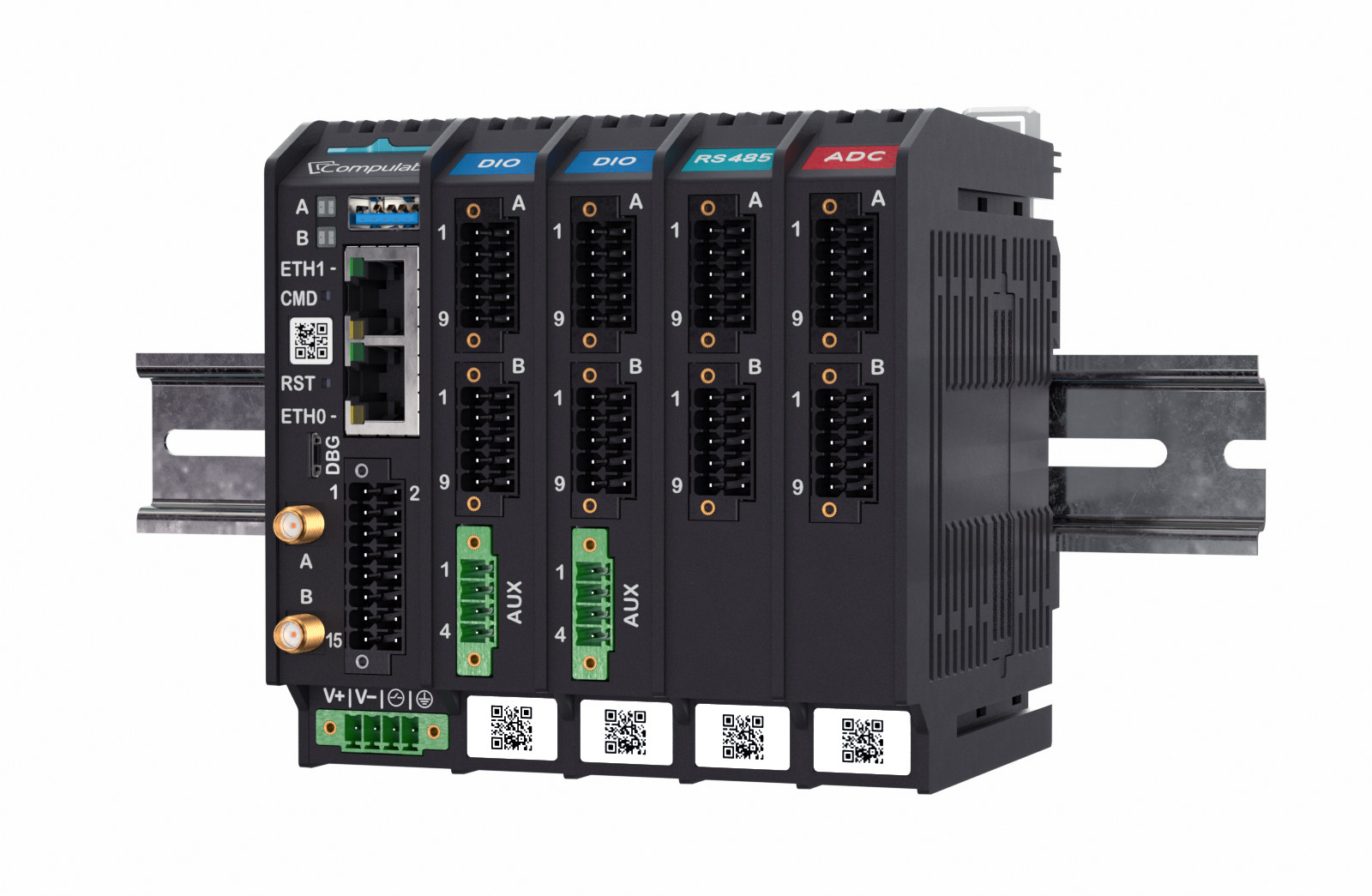
Nexalta Guardian NXG0042AI is a large networking and IoT gateway “monster” powered by a Qualcomm IPQ9574 chipset offering 10GbE and 2.5GbE networking, WiFi 7 support with up to five concurrent WiFi radios, up to four/seven 5G modems, up to 52 (e)SIMs, and two on-board Compute Module slots for Rockchip RK3588 or NVIDIA Jetson SO-DIMM system-on-modules. The main board (XWR A1) also offers 25Gbps WAN fabric, three MCUs for BMC, power management, and cryptography, M.2 slots for NVMe storage or AI accelerators, two mSATA sockets, HDMI video output, USB ports, Starlink satellite support, and a range of IoT protocol options such as LoRaWAN, 5G RedCap, UWB, Bluetooth LE, and so on. Nexalta Guardian specifications: Main SoC subsystem SoC – Qualcomm IPQ9574 quad-core Arm Cortex-A73 processor @ 2.2GHz processor System Memory – 2GB DDR4 RAM Storage –  8GB eMMC flash, 64MB NOR flash SoM sub-system 2x 260-pin SO-DIMM sockets for: Turing RK1 […]

Progress on upstream Linux for MediaTek Genio IoT SoCs and boards

upstream Linux Mediatek Genio 1200 Radxa NIO 12L SBC

Collabora announced a partnership with MediaTek to bring upstream support to the Genio IoT SoCs and boards in  November 2024, but since the announcement was new at the time, no work had been done, and I didn’t write about it. However, almost one year later, Collabora can now report very good progress, especially for MediaTek MT8395 boards like Genio 1200 EVK and Radxa NIO 12L, which are now usable with mainline/upstream Linux since most features are implemented. But improvements also extend to MediaTek Genio 510 and Genio 700 EVKs, and the collaboration will continue with work on newer MediaTek Genio and Kompanio processors for IoT solutions and Chromebooks. The two MediaTek Genio 1200 boards can now boot mainline Linux without any out-of-tree patches while providing support for the Audio DSP, JPEG, video hardware encoders and decoders, the Arm Mali-G57 MC5 GPU (via the open source Panfrost driver), as well as […]

Microchip PIC32-BZ6 BLE 6.0, Thread, and Matter wireless MCU integrates touch and motor control

Microchip IC32 BZ6 single chip wireless MCU

Microchip has recently introduced the PIC32-BZ6 family of single-chip, multiprotocol wireless MCUs, also available as RF-certified modules, and designed for smart home, industrial automation, and automotive applications. The module supports Bluetooth LE 6.0, IEEE 802.15.4-based Thread and Matter, and proprietary mesh protocols. For wired connectivity, there are two CAN-FD ports, a 10/100 Mbps Ethernet MAC, and a USB 2.0 full-speed transceiver. Other features include CVD-based touch sensing and motor control interfaces for interactive and real-time applications. As a secure MCU, the PIC32-BZ6 integrates a hardware-based security engine, a secure boot ROM, and encryption accelerators, along with OTA update capability for long-term device management. The microcontroller offers up to 54 GPIO pins, multiple pin and package options (up to 132-pin VQFN), and automotive-grade variants rated for -40°C to +125°C operation. Microchip PIC32-BZ6 specifications: MCU Core – 128 MHz Arm Cortex-M4F with FPU and DSP extensions Memory 512 KB multi-port SRAM (with […]

1GHz Renesas RA8D2 and RA8M2 Cortex-M85 MCUs feature up to 1MB MRAM, 2MB SRAM

Renesas RA8M2 and RA8D2 dual core Cortex M85, M33 MCU with MRAM storage

After introducing the 1 GHz RA8T2 MCU earlier this month, Renesas has recently expanded its RA8 lineup with the RA8D2 and RA8M2 groups of MCUs, where the RA8D2 is designed for graphics, HMI, and AI applications with support for display, camera, and audio interfaces, while the RA8M2 targets general-purpose, high-performance IoT and industrial control systems with networking and compute capabilities. Both MCU groups deliver a performance of up to 7,300 Coremarks, offer up to 1MB of MRAM and 2MB of SRAM, and support SiP options with up to 8MB flash. The RA8D2 adds HMI capabilities, including a 1280×800 graphics LCD controller, a 2D drawing engine, MIPI DSI and CSI-2 interfaces, and audio input support for voice and vision AI. Common features include dual Gigabit Ethernet with TSN, USB 2.0, CAN FD, I3C, and various analog peripherals. Integrated RSIP-E50D security, Helium acceleration for DSP/ML with various software support. Renesas RA8D2 and […]

$35 Orange Pi 4 Pro – An Allwinner A733 Edge AI SBC with up to 16GB LPDDR5, WiFi 6

Orange Pi 4 Pro – Allwinner A733 Edge AI SBC

Just last week, we wrote about the Orange Pi 6 Plus, a powerful CIX P1 SBC that features up to 64GB LPDDR5 memory. Now, the company has introduced the Orange Pi 4 Pro, an Allwinner A733-based low-cost, low-power SBC,  which is very similar to the Radxa Cubie A7A in terms of architecture, AI capabilities, and use cases. It supports up to 16 GB of LPDDR5 RAM, eMMC modules (16–128 GB), NVMe SSD via an M.2 M-key PCIe 3.0  slot, and microSD storage. Connectivity options include Gigabit Ethernet with PoE, WiFi 6, and Bluetooth 5.4. It also features HDMI 2.0, dual MIPI CSI/DSI interfaces, USB 3.0/2.0 ports, and audio I/O. Target applications include robotics control, industrial automation, smart gateways, NAS, and more. Orange Pi 4 Pro specifications: SoC – Allwinner A733 CPU Dual-core Arm Cortex-A76 @ up to 2.00 GHz Hexa-core Arm Cortex-A55 @ up to 1.79 GHz Single-core RISC-V E902 real-time […]

u-blox MAX-M10N GNSS module supports Low Energy Accurate Positioning (LEAP) mode, firmware upgrades

u blox UBX M10150 KB chip and the MAX M10N module

Following the launch of the UBX-M10150-CC low-power GNSS module, u-blox has expanded its lineup with the MAX-M10N, another ultra-low-power module based on the UBX-M10150-KB GNSS chip. The new module supports firmware upgradeability and offers up to 50% lower power consumption thanks to features such as Low Energy Accurate Positioning (LEAP) and PSMCT cyclic tracking modes. The latest SPG 5.30 firmware also adds support for RTCM correction input for sub-meter positioning accuracy, along with improved spoofing and jamming detection. It also includes data logging and geo-fencing for autonomous tracking and uses AssistNow Predictive and Live Orbits for faster satellite acquisition. The MAX-M10N integrates an LNA and dual SAW filters for better RF sensitivity and interference protection, while maintaining pin compatibility with earlier MAX modules. These features make it suitable for low-power, high-accuracy applications such as wearables, asset tracking, and battery-powered IoT devices. u-blox MAX-M10N GNSS module specifications: Receiver type – u-blox M10 […]

M5Stack Cardputer-Adv ESP32-S3 computer gains improved antenna, larger 1,750 mAh battery, ES8311 audio codec

M5Stack Cardputer-Adv

In 2023, M5Stack introduced the Cardputer, a mini portable computer based on an ESP32-S3 module and equipped with a display and a keyboard. The Cardputer-Adv is an update based on the Stamp-S3A core module, with the same 1.14-inch LCD and 56-key keyboard, but featuring a range of upgrades. These include enhanced audio with an ES8311 audio codec, a high‑SNR MEMS microphone, an NS4150B amplifier, a 1W speaker, and a 3.5 mm headphone jack, an improved antenna design, a larger 1,750 mAh battery, and a built-in BMI270 6-axis IMU. M5Stack Cardputer-Adv specifications: (bold highlights show improvements/changes over the original Cardputer) Wireless MCU module – M5Stack M5Stamp S3A with SoC – Espressif Systems ESP32-S3FN8 CPU Dual-core 32-bit Xtensa LX7 microcontroller with AI vector instructions up to 240MHz RISC-V ULP co-processor Memory – 512KB SRAM Storage – 8MB flash Wireless – 2.4GHz WiFi 4 (802.11b/g/n), Bluetooth 5.0 BLE + Mesh 2.4GHz 3D antenna USB […]

Upbeat introduces UP201 and UP301 ultra-low power RISC-V MCUs with always-on AI processing

Upbeat UP201 and UP301 Series AI MCUs No BG

Upbeat Technology, in collaboration with SiFive, has introduced UP201 and UP301 always-on AI MCUs for ultra-low-power AI and IoT applications such as wearables, drones, and sensor-based systems. The UP201 is designed for compact, battery-driven devices such as smartwatches, hearing aids, and IoT sensor nodes, whereas the UP301 targets AI and vision-based applications for more complex edge systems such as smart glasses, robotics, and industrial AI equipment. Both chips feature a dual-core RISC-V architecture. The SiFive E21 lightweight core is Always-On (AON), managing continuous low-power sensing, whereas the SiFive E34 performance core activates for higher workloads. The MCUs also integrate a 2.5D GPU and various I/O options. UP201 and UP301 MCU specifications: CPU cores (SiFive Essential RISC-V IP cores) E21 core in Always-On (AON) domain for continuous low-power sensing E34 performance core in the Non-AON domain for higher workloads Up to 400 MHz operating frequency Up to 717 DMIPS performance Near-threshold […]

UP 710S Alder Lake-N Credit Card-size SBC