Back in August last year, we wrote about NXP’s IW623 tri-band (2.4GHz, 5GHz, 6GHz) Wi-Fi 6E and Bluetooth LE Audio SoC, but at the time, there was no ready-to-use module based on it. Now, NXP has partnered with Silex Technology to launch the SX-SDMAX6E module, available in a surface-mount LGA package or an M.2 2230 Key-E card. The module supports Bluetooth 5.x connectivity via UART and Wi-Fi via SDIO. It operates from a 3.3V supply with 1.8V support on the LGA version. It has an industrial operating temperature range of -40°C to +85°C and is designed for both high-throughput applications, such as video streaming, and low-power, battery-operated devices in harsh environments. It also supports various antenna options, fast roaming, and long-term lifecycle backing through Silex and NXP. Silex SX-SDMAX6E specifications: Wireless chipset – NXP IW623 tri-band SoC Connectivity Wi-Fi Tri-band Wi-Fi 6E (2.4 GHz, 5 GHz, 6 GHz) IEEE 802.11a/b/g/n/ac/ax […]
The Ambient IoT Alliance aims to promote and develop standards for batteryless IoT devices using energy harvesting
The Ambient IoT Alliance, or AIoTA, is a global, cross-industry coalition working to promote and develop standards for batteryless IoT devices relying on energy harvesting for power. Ambient Internet of Things (IoT) refers to a class of IoT devices powered by radio waves, light, motion, heat, or any other viable ambient energy source. It is an evolution of legacy IoT and RFID technologies that promises lower costs and high scalability through Bluetooth, 5G Advanced, and the IEEE 802.11bp ambient power communication (AMP) standard. The alliance says its mission is to “promote and support the development of an open, harmonized, and aligned multi-standard ecosystem”. Ambient IoT-enabled devices can gather location, temperature, humidity, and/r other data, and communicate with the wireless infrastructure through a nearby mobile device, wireless access points, domestic appliances, or other standard gateways using a compatible standard. This reduces maintenance costs since batteries do not need to be replaced, […]
MediaTek Genio 360/360P hexa/octa-core Cortex-A76/A55 AIoT SoC features 8 TOPS NPU for cost-sensitive embedded applications
MediaTek Genio 360 and Genio 360P are respectively hexa-core and octa-core Arm Cortex-A76/A55 AIoT processors featuring a MediaTek NPU delivering up to 8 TOPS of AI performance, and designed for cost-sensitive embedded applications. The chips support up to 8GB of memory and eMMC 5.1, SPI NOR, and SD 3.0 storage interfaces. They feature two 4-lane MIPI DSI and one 4-lane DP/eDP interfaces for single or dual display setups, two 4-lane MIPI CSI camera interfaces, audio inputs/outputs, Gigabit Ethernet with TSN, optional WiFi 5 and Bluetooth 5.3 via MT6631N, USB 3.1 and USB 2.0 interfaces, PCIe Gen2 x1, and low-speed interfaces. MediaTek Genio 360/360P specifications: CPU MediaTek Genio 360 (MT8366) – Hexa-core processor 1x Arm Cortex-A76 core clocked at up to 1.9 GHz (industrial) / 2.0GHz (commercial) 5x Arm Cortex-A55 cores clocked at up to 1.7 GHz (industrial) / 2.0GHz (commercial) MediaTek Genio 360P (MT8367) – Octa-core processor 2x Arm Cortex-A76 […]
Open Stack standalone 4G LTE IoT board runs RTOS on Quectel EC200U LTE module (Crowdfunding)
Open Stack is a standalone 4G LTE IoT connectivity board designed to run RTOS-based C applications directly on the Quectel EC200U series LTE module, meaning you don’t need an external MCU like Arduino, ESP32, or Raspberry Pi. By removing the MCU, the board reduces power consumption, bill-of-materials (BOM) cost, and physical footprint. The board supports multi-band LTE with GSM fallback, GNSS, and Bluetooth 4.2, as well as IPv4/IPv6 client and server modes. It also includes a USB Type-C port, a Nano SIM card slot, LTE/GNSS/BLE antenna connectors, an OLED information display, status LEDs, control buttons, and a 40-pin Raspberry Pi HAT-compatible GPIO header. Networking support includes TCP/UDP, SSL/TLS, HTTP/HTTPS, MQTT, LwM2M, CoAP, FTP/FTPS, and PPP, making it suitable for asset tracking, industrial monitoring, BLE-to-LTE gateways, remote infrastructure, and always-connected IoT deployments without additional controller hardware. Open Stack specifications: Cellular Module – Quectel EC200U-CN series (EC200UCNAA-N05-SGNSA) module Cellular Connectivity: LTE FDD […]
ESP32 Marauder 5G – Apex 5 module for Flipper Zero combines ESP32-C5, two Sub-GHz radios, nRF24, and GPS
Designed by HoneyHoneyTrading, the ESP32 Marauder 5G – Apex 5 Module is an ESP32-C5-based hacking and penetration testing tool for the Flipper Zero, with dual-band WiFi 6 (2.4GHz and 5GHz), two Sub-GHz radios (868MHz and 433MHz), an NRF24 radio, and a built-in GPS. This new Flipper Zero module can be considered an upgrade from the ESP32 Marauder – Double Barrel 5G, as it does not rely on a dual-chip configuration for 5 GHz operation, leveraging the ESP32-C5 dual-band capabilities instead. A microSD card slot handles storage, and the device can also save data directly to the Flipper Zero’s microSD card. It also features five antennas, including WiFi, Sub-GHz, nRF24, and GPS, along with dedicated LED indicators for the Sub-GHz radios and nRF24 activity. There is also a hardware button to toggle 433 MHz and 868 MHz Sub-GHz operation, a USB-C port, and a side button for power management and firmware […]
Geniatech DB3506 is a full-featured Rockchip RK3506 development board and 3.5-inch industrial SBC
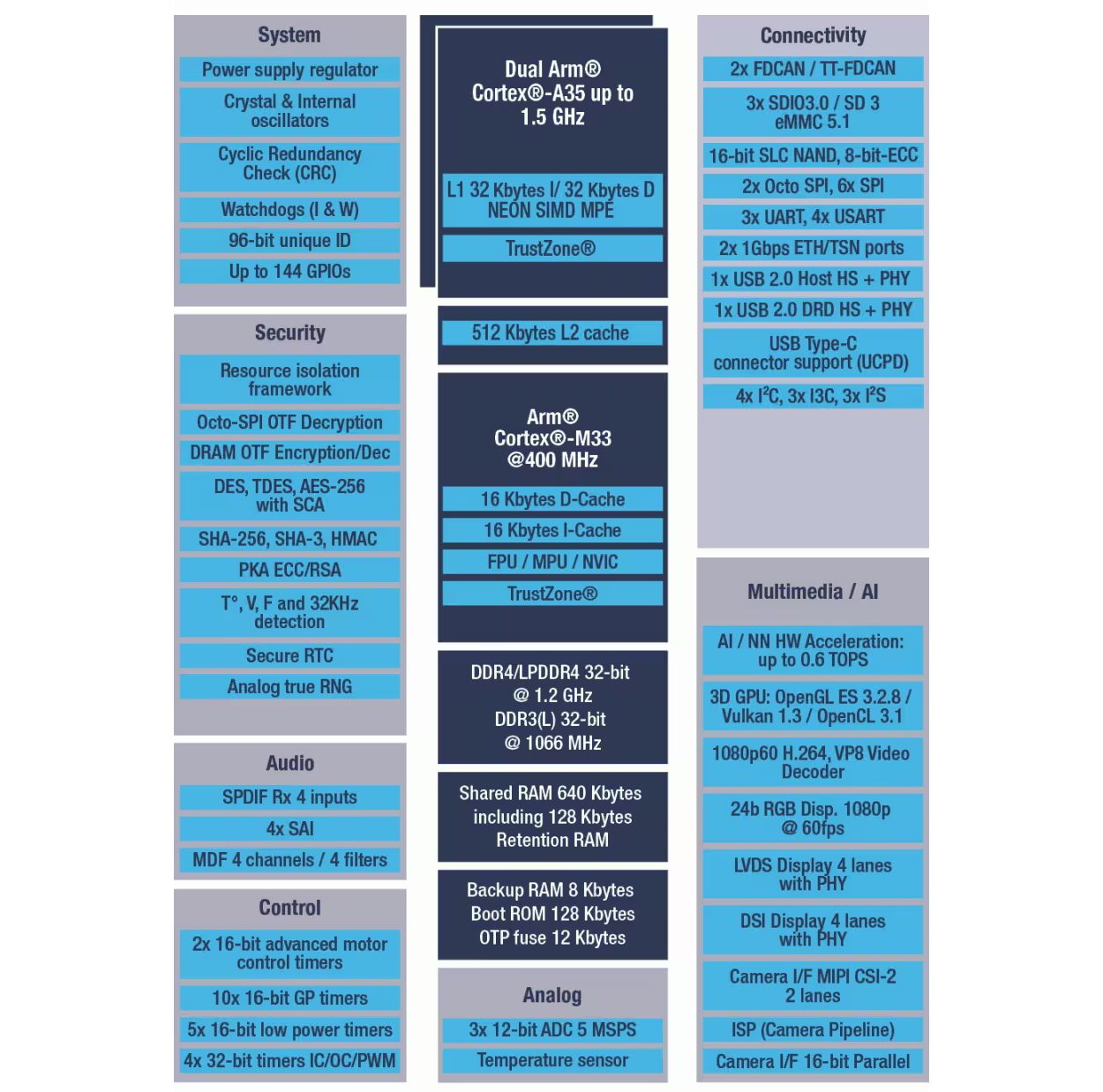
Geniatech DB3506 is a full-featured Rockchip RK3506 development board and 3.5-inch SBC designed for industrial control, human–machine interface (HMI) systems, IoT gateways, and other embedded applications. The board combines the tri-core Arm Cortex-A7 SoC with 256 MB to 1 GB LPDDR3 RAM and 256 MB or 512 MB NAND flash options, offers HDMI and RGB touchscreen display interfaces, dual Fast Ethernet, dual-band WiFi and Bluetooth 5.0, optional 4G LTE via a mini PCIe slot, two USB 2.0 ports, and a range of headers for CAN bus, RS-232/RS-485, Audio, GPIOs, and more. Geniatech DB3506 specifications: SoC – Rockchip RK3506 CPU 3x Arm Cortex-A7 cores Arm Cortex-M0 real-time core GPU – 2D GPU only with hardware-accelerated 2D rendering No VPU, no NPU System Memory – 512MB LPDDR3 (option for 256MB or 1GB) Storage – 256MB NAND flash (option for 512MB) Video Output HDMI output 50-pin RGB display FPC interface up to 1280 × 1280 @ 60 […]
86-type Smart Home control panel features a 3.5-inch display, physical buttons, Bluetooth SIG Mesh gateway
The Tuya WiFi 3.5-inch Smart Center Control Panel (CCP-S05) is designed to replace traditional 86-type switches while adding a Bluetooth SIG Mesh gateway, a touchscreen interface, and three buttons for smart homes, apartments, and small commercial spaces. Compared to other 86-type control panels such as the Luckfox-Pico-86-Panel, Dusun DSGW-130, and Waveshare’s ESP32-P4 Smart 86 Box, the Tuya device follows a hybrid approach, combining a capacitive touchscreen with three physical buttons for instant local control. Tuya WiFi 3.5-inch Smart Center Control Panel (CCP-S05) specifications: SoC – Unknown (potentially based on Allwinner F1C100s ARM9 application processor, slightly more powerful Rockchip or Allwinner SoC) Display – 3.5-inch capacitive touchscreen Audio – Built-in microphone and speaker Networking Wi-Fi (2.4 GHz) Bluetooth Mesh USB – USB Type-C port for debugging only Relays – 3x independent relay channels (200 W per channel max 600W) Misc 3x programmable physical buttons Reset button (on the bottom side) RTC […]
8devices Maca 2 – A ultra-long-range data radio with 80km range for drones and robotics
8devices Maca 2 high-power plug-and-play ultra-long-range wireless data radio targets drones, UAS, robotics, interceptor systems, industrial IoT, and defense-grade communications, where long range, resilience, and scalability are critical. The device features high transmit power of up to 39 dBm (with 36 dBm per RF chain) and a receiver sensitivity of –98 dBm, and is designed for air-to-ground and point-to-point connectivity over distances of up to 80 km. To maintain stable links over extreme distances, the radio supports ultra-narrow channel widths ranging from 1.5 MHz to 19.5 MHz, significantly improving signal-to-noise ratio and resistance to interference and jamming. Additionally, it includes dual Ethernet, USB 2.0, UART, GPIO, and 14–33 V power input. It also supports industrial temperature operation and NDAA/TAA-compliant manufacturing. For unmanned systems, the radio allows users to manage bandwidth asymmetry. It’s a feature where a user can allocate 90% of the channel to downstream video data while reserving 10% […]