
RAKwireless has just launched the WisGate Connect Router RAK7392 (not to be confused with the older WisGate Connect RAK7391), an industrial-grade edge router and gateway built around Raspberry Pi Compute Module 4/5 (CM4/CM5). The system features three Gigabit Ethernet ports, one 2.5GbE port, wireless expansion via a mini PCIe slot, and WisBlock connectors for sensors and I/O modules. The gateway is designed for industrial IoT applications such as edge computing, VPN, Modbus-to-MQTT conversion, and LoRaWAN packet forwarding, eliminating the need for multiple boards and USB adapters for complex deployments. WisGate Connect Router RAK7392 specifications: SoM options (one or the other) Raspberry Pi CM4 – Broadcom BCM2711 quad-core Cortex-A72 processor @ 1.5 GHz Raspberry Pi CM5 – Broadcom BCM2712 quad-core Cortex-A76 processor @ 2.4 GHz Storage and Memory will depend upon the module Storage – MicroSD card socket for CM4/CM5 Lite modules only Networking 3x Gigabit Ethernet ports (eth1, eth2, eth3) […]
Large-scale LoRaWAN deployments become easier through QR codes and relays
LoRaWAN devices typically require users to enter parameters such as the DevEUI, JoinEUI (formerly AppEUI), AppKey, and potentially the DevAddr plus the session keys, depending on the activation mode (ABP vs OTAA). This is manageable for a handful of devices, but becomes time-consuming, error-prone, and costly at scale. To make the onboarding process easier and scale LoRaWAN networks more effectively, the LoRa Alliance has now introduced three new documents: the TS014 and TS018 specifications and the TR016 technical recommendations. They should all help users get a device onto a network quickly, securely, and with minimal manual work, such as scanning a QR code. Here are the links and summaries for all three documents: TS014-1.0.0 – LoRaWAN End-Device Capabilities API Specification – TS014 eliminates manual data entry and proprietary workarounds by enabling LoRaWAN networks to automatically pull device profiles. It specifically describes a standard interface which enables the hNS (Home Network […]
$7.99 Seeed Studio Wio-S3 WiFi, Bluetooth LE, and LoRa IoT module combines ESP32-S3 and SX1262 RF transceiver
Seeed Studio Wio-S3 is a compact (21.6 x 16.5 x 3.3 mm) wireless module that combines an ESP32-S3R8 dual-core WiFi 4 and Bluetooth LE MCU and a Semtech SX1262 LoRa transceiver. The module includes 16MB Flash and 8MB PSRAM, and supports LoRa (EU868/US915) with up to +20.9 dBm transmit power and -137 dBm sensitivity. It also supports Wi-Fi 4 and BLE 5.0, and comes with two IPEX connectors for external antennas. With interfaces such as UART, I2C, SPI, ADC, and USB, and support for -40°C to 85°C operation, it is designed for remote monitoring, industrial automation, smart agriculture, and IoT data logging. Seeed Studio Wio-S3 module specifications: SoC – Espressif ESP32-S3R8 CPU – Dual-core Tensilica LX7 microcontroller up to 240 MHz with vector instructions for AI acceleration Memory – 8MB PSRAM Wireless – 2.4 GHz 802.11b/g/n WiFi 4 and Bluetooth 5.0 LE + Mesh connectivity Storage – 16MB external SPI flash […]
RAKwireless WisMesh Pi HAT RAK6421 turns your Raspberry Pi 4/5 into a modular Meshtastic gateway
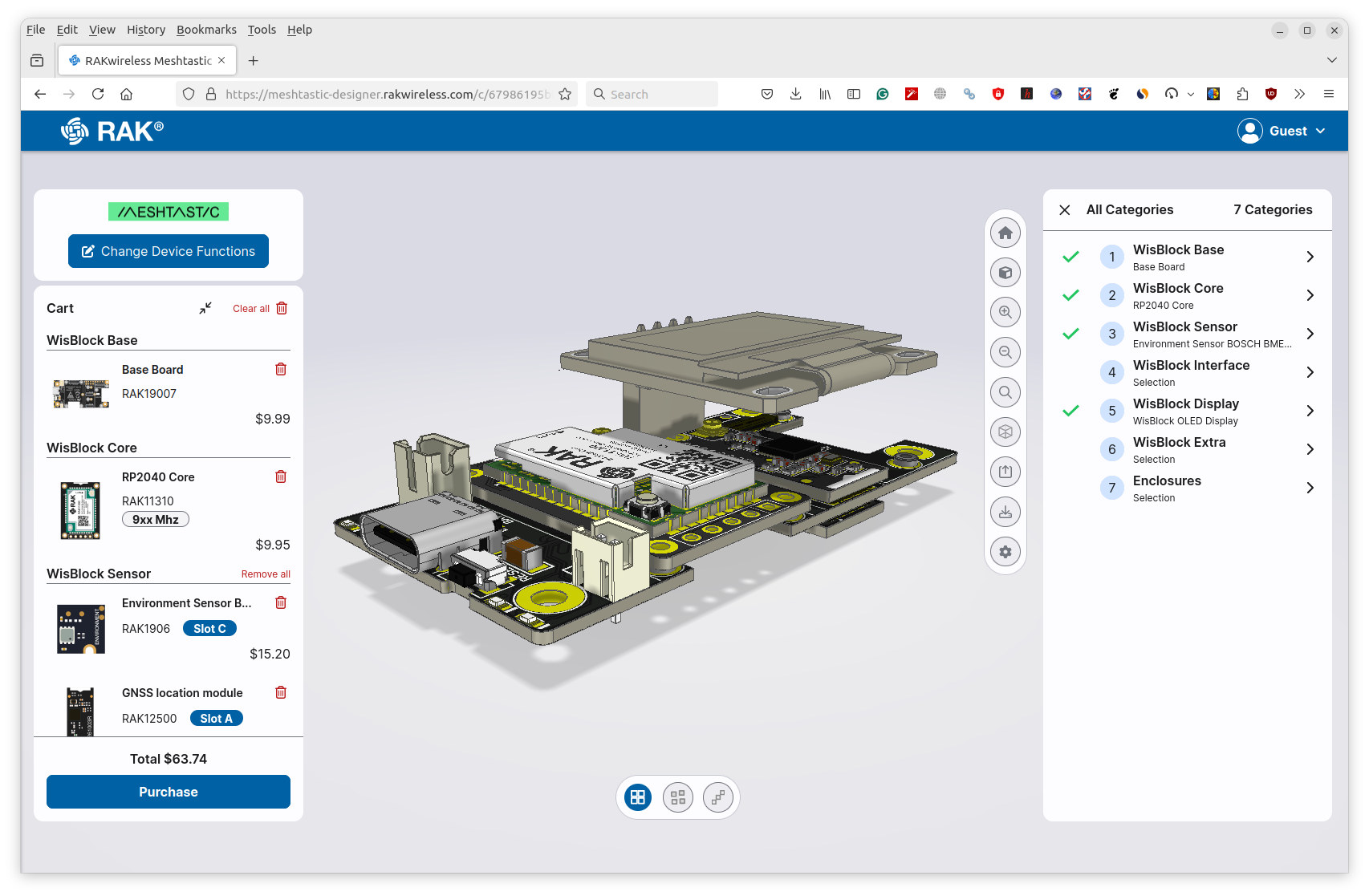
RAKwireless WisMesh Pi HAT RAK6421 is a modular Meshtastic gateway expansion board for Raspberry Pi 4/5 that adds support for the company’s WisBlock ecosystem. Designed for users running meshtasticd (the Linux-native Meshtastic service), it enables scalable, always-on Meshtastic base stations, MQTT gateways, and backbone relay nodes. Unlike other LoRa solutions based on Raspberry Pi, the RAK6421 takes a modular approach. Instead of a built-in radio, it offers two WisBlock IO slots and four sensor slots, allowing users to easily plug in or swap modules. This means you can choose between standard LoRa modules like the RAK13300 or higher-power 1W versions like the RAK13302, without dealing with messy USB adapters or breadboard wiring. RAK6421 WisMesh Pi HAT RAK6421 specifications: Compatibility Raspberry Pi 4, Raspberry Pi 5, and Raspberry Pi Zero 2W SBCs Potentially other SBC with standard 40-pin Raspberry Pi GPIO header (HAT+ compliant) Expansion 2x WisBlock IO slots for LoRa radio […]
reComputer RK3576/RK3588 Edge AI computers are supported by reComputer AI Lab one-click deployment platform
Seeed Studio has just launched the reComputer RK3576/RK3588 Edge AI computers designed for developers, embedded AI innovators, robotics, industrial AI, vision AI, local LLMs, and real-world edge deployment. Rockchip RK3576 and RK3588 computers are pretty common these days, and the Seeed Studio models offer triple video output, dual Ethernet (GbE or 2.5GbE), several USB ports, and M.2 expansion. But the most interesting part is probably the software with Armbian-based Linux OS and support for the reComputer AI Lab platform that enables one-click deployment of AI-accelerated computer vision, audio, and LLM/LVM demos. reComputer RK3576/RK3588 specifications: SoC (one or the other) Rockchip RK3576 Octa-core CPU – 4x Cortex-A72 cores at 2.2GHz, 4x Cortex-A53 cores at 1.8GHz GPU – ARM Mali-G52 MC3 GPU NPU – 6 TOPS (INT8) AI accelerator with support for INT4/INT8/INT16/BF16/TF32 mixed operations. VPU Video Decoder: H.264, H.265, VP9, AV1, and AVS2 up to 8K at 30fps or 4K at […]
T-Display-P4 smartphone-like devkit features ESP32-P4 MCU, ESP32-C6 wireless SoC, and SX1262/LR2021 LoRa transceiver
LILYGO T-Display-P4 is a feature-rich ESP32-P4 + ESP32-C6 devkit, but with a smartphone-like design and support for GPS, Ethernet, and LoRaWAN through SX1262 or LR2021 LoRa transceiver, besides the usual WiFi 6, Bluetooth 5.x, and 802.15.4 wireless connectivity. The T-Display-P4 is offered with either a 4.05-inch IPS display and a 2MP front-facing camera or a 4.1-inch AMOLED with a 2MP rear camera. The devkit is equipped with 32MB PSRAM and 16MB NOR flash for the ESP32-P4, a microSD card slot, a built-in microphone and speaker, a 3.5mm audio jack, a few USB ports, and a 9-axis motion sensor, as well as a GPIO port and two Qwiic connectors for expansion. T-Display-P4 specifications: MCU – ESP32-P4 CPU Dual-core RISC-V microcontroller @ 360 MHz with AI instructions extension and single-precision FPU Single-RISC-V LP (Low-power) MCU core @ up to 40 MHz GPU – 2D Pixel Processing Accelerator (PPA) VPU – H.264 and […]
8-inch ESP32-P4 touch display offers WiFi 6, BLE, 802.15.4 connectivity, optional 4G LTE and LoRaWAN
Seeed Studio’s reTerminal D1001 is an 8-inch capacitive touch display powered by an ESP32-P4 RISC-V microcontroller and equipped with an ESP32-C6 wireless module, a camera, a dual-microphone array, and a speaker. The reTerminal D1001 is a fully enclosed solution designed for HMI applications such as control panels, vision-enabled IoT terminals, video intercoms, and smart dashboards. One highlight compared to other ESP32-P4 displays is optional support for 4G LTE cellular connectivity using an mPCIe module and SIM card slot, as well as LoRaWAN using a Stamp module. reTerminal D1001 specifications: SoC – Espressif Systems ESP32-P4NRW32 CPU Dual-core 32-bit RISC-V HP (High-performance) CPU @ up to 400 MHz with AI instructions extension and single-precision FPU Single-RISC-V LP (Low-power) MCU core @ up to 40 MHz Memory 768 KB HP L2MEM (for dual-core CPU), 32 KB LP SRAM, 8 KB TCM (for LP MCU core) 32MB PSRAM Storage – 128 KB HP ROM, 16 […]
M5Stamp C6LoRa tiny (18×15×2.3 mm) SMD module pairs ESP32-C6 with SX1262 LoRa chip
The M5Stamp C6LoRa is a compact LoRa SMD module that combines the ESP32-C6 Wi-Fi 6, Bluetooth LE, and 802.15.4 microcontroller with the SX1262 LoRa transceiver for both high-speed and long-distance communication. The module targets applications such as smart agriculture, remote meter reading, industrial monitoring, and outdoor long-range wireless control systems. The module measures 18 × 15 × 2.3 mm, making it suitable for space-constrained systems and compact embedded designs. M5Stack has also added an SGM13005L4 low-noise amplifier (LNA) to improve reception performance, along with a PI4IOE5V6408 I/O expander that manages the LoRa control signals without using too many of the ESP32-C6’s GPIO pins. M5Stamp C6LoRa specifications: SoC – Espressif Systems ESP32-C6 CPU Single-core 32-bit RISC-V clocked up to 160 MHz Low-power RISC-V core @ up to 20 MHz Memory/Storage – 512KB SRAM, 320KB ROM Wireless – WiFi 6, BLE 5.3, 802.15.4 (See wireless section) Storage – 16 MB external NOR flash […]