AkiraOS is a Zephyr-based embedded OS that runs sandboxed WebAssembly applications on microcontrollers and lets users deploy and update firmware OTA without reflashing. In other words, it’s similar to Docker containers, but for microcontrollers. The open-source embedded platform separates the OS from the application. That means the firmware stays stable, while apps are independent .wasm binaries deployable over-the-air without touching the OS, and portable so a single binary works on ESP32-S3, nRF5x, or STM32 MCU boards. AkiraOS highlights: User space Up to 8 wasm apps can be installed Up to two apps can run at the same time Footprint: 50KB to 200KB per app Akiraz runtime – Custom WASM runtime App Manager UI Framework with 32 widgets Shell/console 18 API modules WebAssembly Micro Runtime (WAMR) – Two options: Interpreter or Ahead-Of-Time (AOT) compilation with 10 to 50x higher performance RTOS – Zephyr RTOS Scheduler Network stack HTTP for OTA updates […]
Modos Flow – An FPGA-based 13.3-inch USB-C touchscreen e-paper monitor (Crowdfunding)
Modos Flow is a paper-like, 13.3-inch USB Type-C touchscreen monochrome or color monitor that builds upon the Modos Paper devkit introduced last year with an AMD/Xilinx Spartan-6 LX16 FPGA and STMicro STM32H750 Arm Cortex-M7 microcontroller. The main difference is that the Modos Flow is more like a consumer product with a full enclosure, a touchscreen, and optional stylus support, 4096-color e-paper display, and frontlight. Modos Flow specifications: FPGA – AMD Xilinx Spartan-6 LX16 FPGA running Caster gateware like the earlier devkit MCU – STMicro STM32H750 Arm Cortex-M7 microcontroller for USB communication, firmware upgrades, and standalone applications. Display 13.3-inch e-paper display with 3200 x 2400 resolution Refresh rate – 60 Hz with additional power, 40 Hz via a single USB-C cable Monochrome or 4096 colors/16 levels of grayscale Touchscreen support Optimized display modes for reading, browsing, watching, and writing Amber-tinted frontlight (color model only) Video Input – USB Type-C DisplayPort Alt-Mode with […]
FalCAN Probe is an open-source, STM32-based USB to CAN/RS-485/RS-422 adapter
Most USB-to-bus adapters, including tools like CANTact Pro or MeatPi’s Ollie V1 and V2, typically support either CAN or RS-485/RS-422 as fixed-function serial devices. In contrast, the FalCAN Probe by Anders B. Nielsen is a multi-protocol USB adapter based on the STM32F042 microcontroller. The FalCAN Probe is a compact open-source USB Type-C board that connects a computer to CAN, RS-485, and full-duplex RS-422 networks. Instead of using a fixed USB bridge, it exposes the MCU’s native USB interface along with SWD and GPIOs, and can also be used as a small Arm Cortex-M0 development platform. FalCAN Probe specifications: MCU – STMicro STM32F042C6Tx Arm Cortex-M0 microcontroller @ 48 MHz with 32KB flash, 6KB SRAM Host Interface – USB 2.0 Full Speed via USB Type-C port Interfaces (non-isolated) CAN bus via Texas Instruments SN65HVD230 transceiver; enumerates as a GS_USB CAN device when jumper JP4 is open RS485 and full-duplex RS422 via dual […]
Study compares Rust and C languages for embedded firmware development
There’s a lot of hype around the Rust programming language, and I’m seeing it being adopted by various projects, not least the Linux kernel. However, so far it was unclear to me whether it was suitable for embedded firmware development since the hardware resources are limited on microcontrollers. A low memory and storage footprint is required, and optimal performance may also be important, for example, to lower the power consumption of battery-powered devices. A research paper by STMicroelectronics, Inria, and the Freie Universität Berlin, entitled “Lessons from an Industrial Microcontroller Use Case with Ariel OS” published on ArXiv hosted by Cornell University, attempts to answer this question using embedded C and Rust, and the conclusion is that Rust is a viable option: As Rust gains traction for developing safer systems software, a reality check for the microcontroller hardware segment becomes necessary. How ready is the Rust ecosystem for this segment? Can […]
Prunt Board 3 3D printer control board offers smoother and quieter operation (Crowdfunding)
Prunt Board 3 is a 3D printer control board with six TMC2240 stepper drivers, two 15A heater outputs, four fan outputs, four thermistor inputs, and four endstop inputs that is designed to offer smoother and quieter operation. The hardware is said to offer better ESD protection than boards such as the Duet 3 Mini 5+ or BTT SKR 3 EZ and supports hardware-accelerated step generation, but the magic happens with the Prunt firmware and associated server, which enable a 31-phase velocity profile for smoother operation and higher-quality prints compared to boards running Klipper or Marlin firmware. Let’s have a look at the hardware first. Prunt Board 3 specifications: 6x TMC2240 stepper drivers, all capable of running at 3A with minimal airflow 2x 15A heater outputs with short circuit protection (1.3 µs response time) Fan outputs 4x fan outputs supporting 2, 3, and 4-pin fans, all up to 2A with short […]
$15 STM32U575 development board features FPC display connector, microSD card slot, two 48-pin GPIO headers
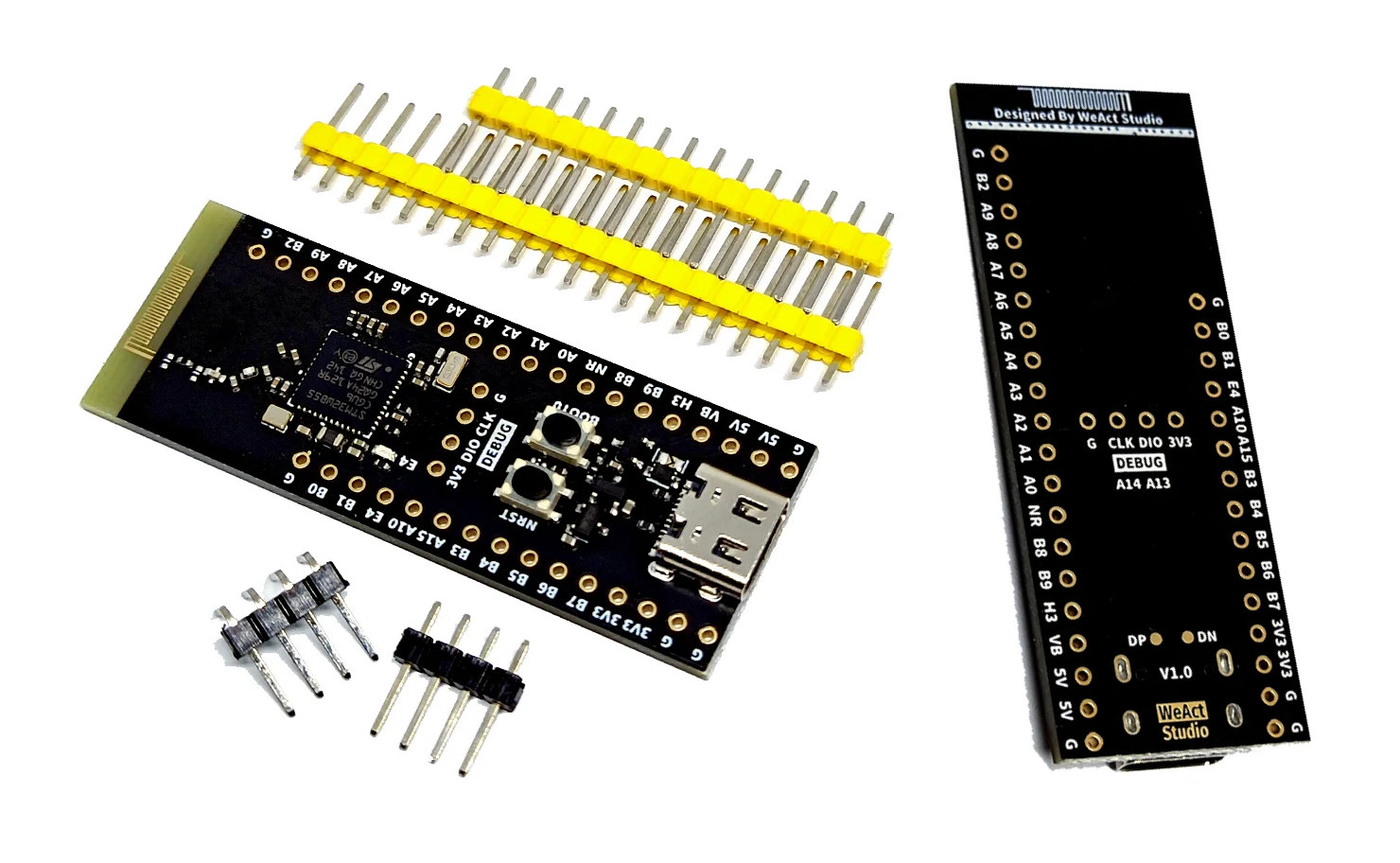
A few days ago, we looked at the WeAct Studio STM32U585CIU6 development board, which features an ultra-low-power STM32U5 Cortex-M33 MCU and was added to MicroPython v1.28. If you’re looking for another STM32U5-based option, especially for compact UI projects, Maker Go now offers an STM32U575 board with a display connector, a microSD card slot, and many more GPIOs While the STM32U585 on the WeAct board features cryptographic accelerators, the STM32U575VGT6 MCU on the Maker Go board is closely related and still offers the same high-performance Cortex-M33 core running at 160 MHz, along with ultra-low-power capabilities. This new board also adds 8MB of external flash and is designed to accept 1.47-inch or 2.0-inch LCDs directly via a ribbon cable. STM32U575VGT6 board specifications: Microcontroller – ST STM32U575VGT6 Core – Arm Cortex-M33 Armv8-M core clocked at up to 160 MHz with FPU, Arm TrustZone Memory – 786 KB SRAM Flash – 1024 KB (1 […]
WeAct STM32U585CIU6 Core Mini – An $8 STM32U5 board supported by MicroPython v1.28
While checking out MicroPython v1.28 changelog, I noticed a board from WeAct Studio based on ST’s STM32U5 Cortex-M33 microcontroller: the WeAct STM32U585CIU6 Mini Core board (WEACTSTUDIO_MINI_STM32U585 in MicroPython code). I found it interesting/newsworthy, as while I had written about the initial STM32U5 MCU release in 2021, and followed up with beefier STM32U5 SKUs with NeoChrom 2.5D GPU and up to 4MB flash in 2023, we had yet to cover a third-party board based on an STM32U5 MCU, excluding the Arduino UNO Q SBC running Linux on a Qualcomm QRB2210 MPU and using an STM32U585 for real-time and I/O control. The WeAct STM32U585CIU6 Core Mini changes that as a low-cost, standalone STM32U5 MCU board. WeAct STM32U585CIU6 Core Mini specifications: Microcontroller – ST STM32U585CIU6 Core – Arm Cortex-M33 Armv8-M core clocked at up to 160 MHz with FPU, Arm TrustZone Memory – 768 KB RAM Flash – 2048 KB flash GPU – […]
wolfIP – An open-source, lightweight TCP/IP stack with no dynamic memory allocations for embedded systems
Better known for its open-source wolfSSL SSL/TLS library, wolfSSL (the company) has now released the wolfIP open-source, lightweight TCP/IP stack with no dynamic memory allocations (e.g., no malloc calls) designed for resource-constrained embedded systems.
The company highlights that wolfIP “supports both endpoint-only mode and full multi-interface support with optional IP forwarding. By default, it operates as a network endpoint, but can be configured to forward traffic between multiple network interfaces”.