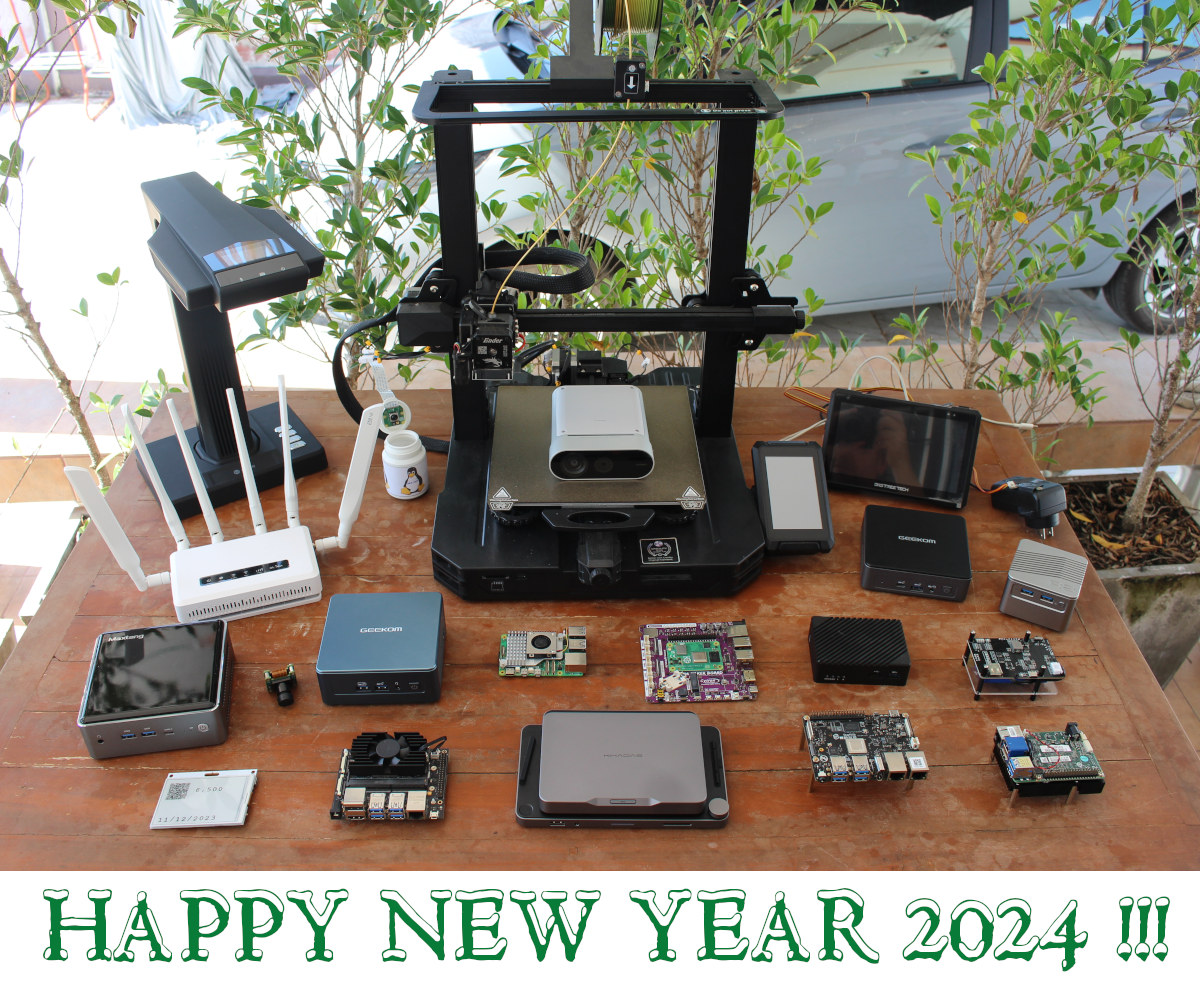
Time for the last post of 2025, as the year is almost over. I’ll look back at key developments and notable products launched in 2025, share some CNX Software website traffic statistics, and look ahead to 2026. Year 2025 in Review After 22 product releases in 2024, Raspberry Pi calmed down a little bit in 2025, and the highlights of the year included the Raspberry Pi 500+ mechanical keyboard, the 5-inch variant of the Raspberry Pi Touch Display 2, and a Raspberry Pi 5 1GB RAM. What didn’t quite stop were the accessories from third parties for Raspberry Pi SBC and Raspberry Pi Pico boards. The most exciting Arm SoC release of 2025 was probably the 12-core CIX P1 Armv9 SoC found in Radxa Orion O6 SBC, MINISFORUM MS-R1 Arm mini PC, and Orange Pi 6 Plus board, but while performance was fine, it was overhyped in 2024, and software […]
CIX releases P1 CPU TRM and developer guides for GPU, AI accelerator, OS and firmware/BIOS
CIX has finally released the technical reference manual (TRM) for the P1 (CD8180/CD8160) Arm Cortex-A720/A520 SoC, along with developer guides for the GPU (Arm Immortalis G720 and NVIDIA/AMD discrete graphics cards), the AI accelerator, as well as OS (Android, Linux, and Windows) and firmware (BIOS) installation and development. A slow (but steady?) progress There was a lot of excitement when the Radxa Orion O6 mini-ITX motherboard was introduced in December 2024, as we were told the CIX P1 12-core Armv9 processor would offer performance similar to Apple M1 SoC and Qualcomm 8cx Gen3 platform, at an affordable price ($199 and up for the mini-ITX board), and software support would include a Debian image, full UEFI via an open-source EDKII implementation, as well as an SDK along with hardware and software documentation, community forum support, and regular firmware & OS updates. CIX was even called “a native open source ecosystem chip […]
Up to 16-core AMD EPYC Embedded 2005 Series Zen 5 processors support up 28 PCIe Gen5 lanes, offer 10-year availability
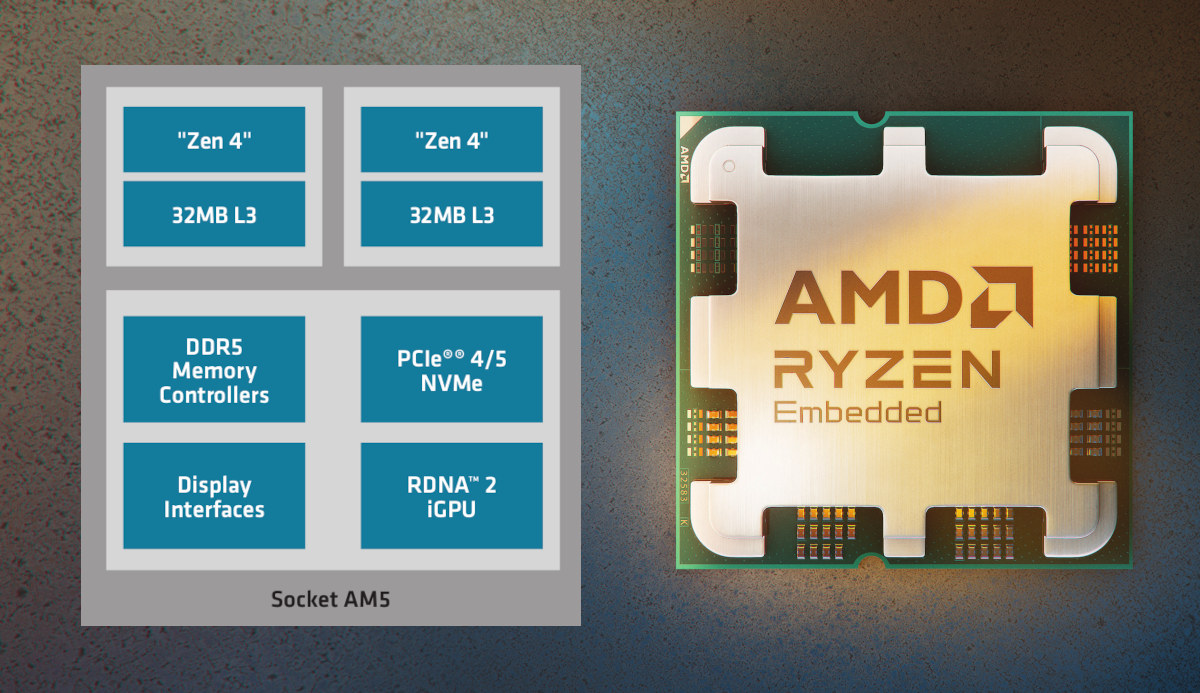
After the release of the high-performance EPYC Embedded 9005, AMD has now introduced the EPYC Embedded 2005 Series, a mid-range processor family also based on the “Zen 5” architecture and designed for space-constrained networking, storage, and industrial edge applications. The new SoCs feature up to 16 cores (32 threads) with 64 MB L3 cache, support dual-channel DDR5-5600 memory with ECC, and offer 28 lanes of PCIe Gen5 connectivity. It also supports advanced RAS capabilities, BMC, PCIe Hot Plug, multi-SPI ROM, and AMD Infinity Guard security. The processors come in a compact 40 x 40mm BGA package, which, according to AMD, is up to 2.4x smaller than competing enterprise solutions (Intel Xeon 6500P-B). Yet, they are designed for 24/7 operation, with up to 10 years of availability with full open-source software support. These features make it suitable for networking switches/routers, cold storage systems, aerospace, robotics, and other high-reliability embedded infrastructure. EPYC […]
AMD Spartan UltraScale+ SU35P FPGA evaluation kit supports Raspberry Pi, Arduino, Mikrobus, and Pmod expansion
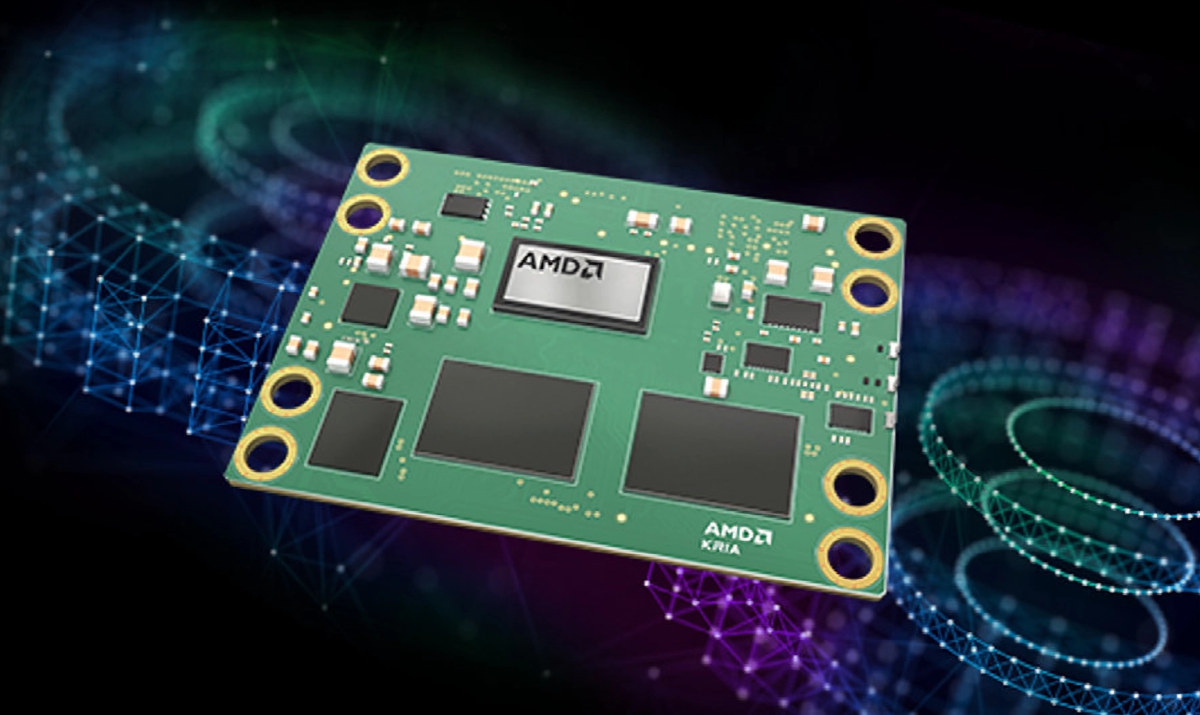
AMD’s SCU35 Evaluation Kit is an affordable ($229) development board powered by the AMD Spartan UltraScale+ SU35P FPGA device, which targets low-power industrial, medical, and data center applications requiring I/O expansion and board management capabilities. Designed for headless applications, the board features a 10/100 Mbps Ethernet port and a USB-C port for power, as well as plenty of headers and connectors compatible with off-the-shelf expansion boards or modules, including Arduino UNO headers, two 40-pin Raspberry Pi GPIO headers, two Mikrobus headers, four Pmod connectors, and an HSIO board-to-board connector. AMD SCU35 evaluation kit specifications: FPGA – AMD Spartan Ultrascale+ SU35P (XCSU35P-2SBVB625E) 36K Logic Cells 304 Max Total I/O• Board Management Controller Memory – 1.93 Mb on-chip memory Memory – 64 Mbit HyperRAM Storage 128 Mbit QSPI flash 64 Kbit EEPROM Networking – 10/100Mbps Ethernet RJ45 port Sensor – 3-axis linear accelerometer Expansion Arduino UNO headers 2x 40-pin Raspberry Pi […]
FPGA-based Game Bub handheld console supports original Nintendo cartridge, wireless controllers (Crowdfunding)
Game Bub is an open-source AMD Artix-7 FPGA and ESP32-S3-based handheld gaming console that supports Nintendo Game Boy, Game Boy Color, and Game Boy Advance cartridges. On top of that, it supports TV output via the Game Bub Dock and features Bluetooth for connecting wireless controllers. The device also features cartridge backup and restore functions through FlashGBX, letting users save files, dump ROMs, reflash writable carts, and even extract photos from the Game Boy Camera. The device supports direct ROM loading and the built-in rumble motor, accelerometer, gyroscope, and real-time clock ensure compatibility with games that rely on these peripherals. The device is housed in a transparent 90s-style enclosure, runs on a 3000 mAh battery for over 14 hours of gameplay, and weighs just 250 g, making it portable yet durable. Additionally, it can be used as an FPGA development board with its PMOD expansion slot and plenty of unused […]
5th Gen AMD EPYC Embedded 9005 Series Zen 5 processors supports up to 6TB DDR5 memory, up to 160 PCIe Gen 5 lanes
AMD has just introduced the 5th Gen AMD EPYC Embedded 9005 Series “Zen 5” processors designed for embedded systems with a focus on longevity (7 years), reliability, and system resiliency, and targeting networking, storage, and industrial edge systems with support for up to 6TB of DDR5 memory, up to 160 PCIe Gen5 lanes with CXL 2.0. The EPYC Embedded 9005 Series processors are offered with 8 to 192 cores in a single socket and deliver up to a 1.3x faster networking process and 1.6x faster storage. The company also claims a 1.3x increase in socket throughput and 1.3x better performance/Watts compared to the competition thanks to the new Zen 5c architecture. AMD EPYC Embedded 9005 highlights: CPU sub-system AMD EPYC Embedded 9745 to 9965 – Zen 5c architecture up to 12x core complex dies (CCDs), 192x cores, 384x threads AMD EPYC Embedded 9015 to 9655 – Zen5 architecture up to […]
ASROCK Industrial launches NUC(S) Ultra 200 (Intel Arrow Lake-H) and 4X4 AI300 (AMD Ryzen 300 AI) motherboards and BOX PCs
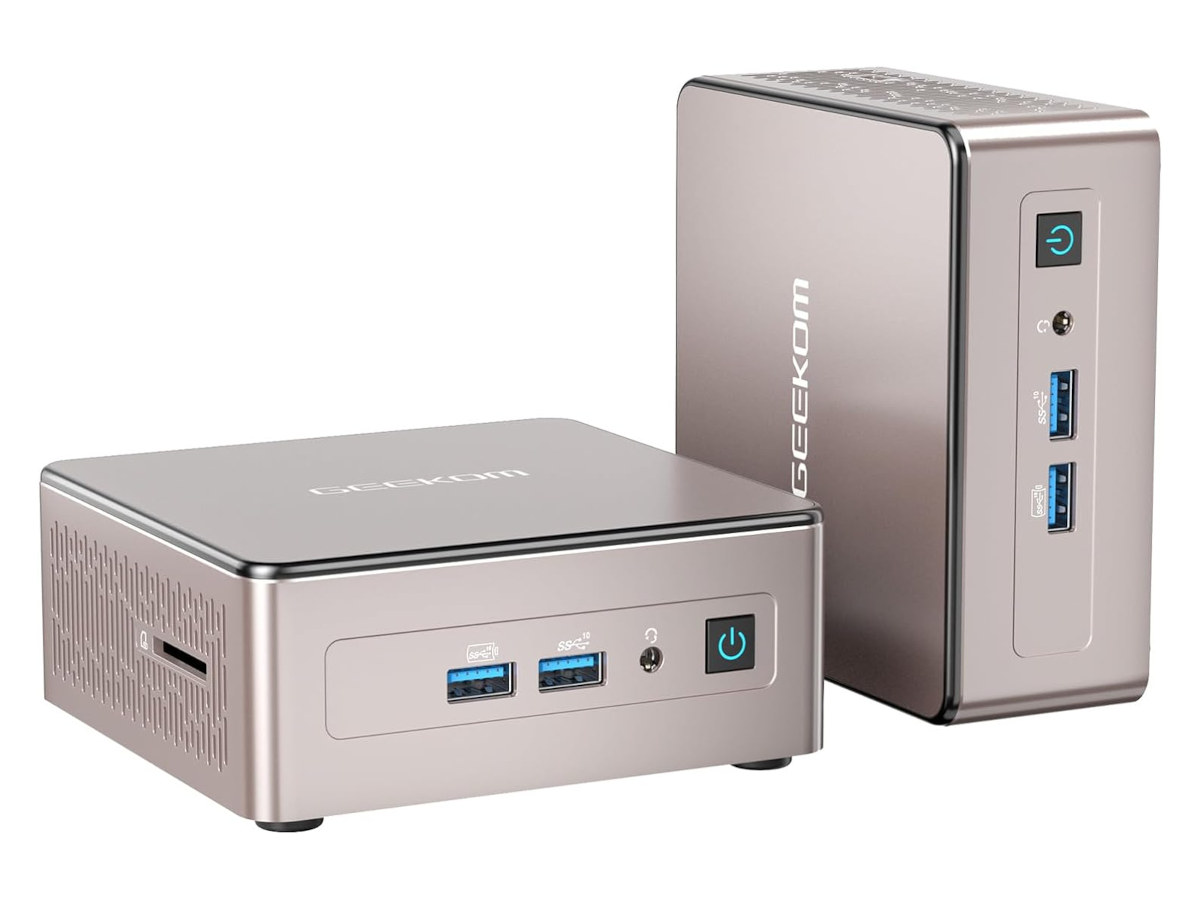
Following new SoC announcements by Intel and AMD at CES 2025, ASRock Industrial has launched the NUC(S) Ultra 200 BOX Series and NUC Ultra 200 Motherboard Series powered by Intel Core Ultra 200H Arrow Lake-H processors with of to 99 TOPS of AI inferencing power, and the 4X4 BOX AI300 Series and 4X4 AI300 Motherboard Series based on AMD Ryzen AI 300 processors with up to 50 TOPS of NPU performance. ASROCK NUC(S) Ultra 200 BOX PCs & NUC ULTRA 200 motherboards NUC(S) Ultra 200 specifications: Arrow Lake-H/U SoC (one or the other) Intel Core Ultra 7 255H (6P+8E) processor up to 5.1 GHz with 24MB cache, Intel Arc 140T GPU (74 TOPS), and Intel AI Boost (13 TOPS); PBP: 28 Watts Intel Core Ultra 5 225H (4P+8E) processor up to 4.9 GHz with 18MB cache, Intel Arc 130T GPU (63 TOPS), and Intel AI Boost (13 TOPS); PBP: 28 […]
Sonata v1.0 RISC-V platform combines AMD Artix-7 FPGA and Raspberry Pi RP2040 MCU, features CHERIoT technology for secure embedded systems
lowRISC has released Sonata v1.0, a stable platform developed under the Sunburst project. Designed for embedded systems engineers, Sonata supports CHERIoT technology, enabling features like compartmentalization and enhanced memory safety. It provides a reliable foundation for building secure embedded systems. CHERIoT is a security-focused technology built on lowRISC’s RISC-V Ibex core, based on CHERI research from the University of Cambridge and SRI International. It addresses memory safety issues like buffer overflows and use-after-free errors using CHERI’s capability-based architecture. The CHERIoT capability format includes permissions for memory access, object types for compartmentalization, and bounds to restrict accessible memory regions. These features enable scalable and efficient compartmentalization, making it suitable for securely running untrusted software in embedded systems. Sonata v1.0 leverages this architecture to isolate components like network stacks and kernels within the CHERIoT RTOS. The lowRISC Sonata v1.0 specifications: FPGA – AMD Xilinx Artix-7 (XC7A35T-1CSG324C) CPU – AMD MicroBlaze soft-core based on […]