DFRobot has introduced a 6.67-inch flexible AMOLED display with a 2400×1080 resolution, designed for easy use with single-board computers such as Raspberry Pi and LattePanda. While flexible displays are common in smartphones, they are difficult to interface with SBCs, so DFRobot added a dedicated MIPI-to-HDMI driver board for plug-and-play compatibility with a wider range of platforms. The panel is just 1.2mm thick and bendable, enabling curved and space-constrained designs, while delivering 450 cd/m² brightness and 16.7 million colors. Like typical OLEDs, it offers deep blacks and high contrast without requiring a backlight, making it suitable for applications ranging from wearables and robotics to industrial HMI systems. DFRobot 6.67” flexible AMOLED Display specifications: Compatibility – Raspberry Pi, Banana Pi, Orange Pi, and most devices with an HDMI output. Display Panel Screen Size – 6.67 inches Screen Material – Flexible AMOLED Resolution – 2400 x 1080 (SPR – Sub-Pixel Rendering) Aspect Ratio […]
LILYGO T-Watch Ultra – An IP65-rated ESP32-S3 smartwatch with 2.01-inch AMOLED, LoRa, and GNSS
LILYGO’s T-Watch Ultra is an ESP32-S3-based smartwatch development platform that appears to be an upgrade over the previous T-Watch-S3 Plus (1.3-inch display and a 940mAh battery), with a larger 2.01-inch AMOLED touch display, a higher-capacity 1,100mAh battery, and an IP65 waterproof and dustproof rating. The device integrates a u-blox MIA-M10Q GNSS module for positioning, a SX1262 LoRa transceiver for long-range communication, and a Bosch BHI260AP smart sensor for motion-based AI applications. Additionally, it features an RTC chip, NFC, a built-in microphone, a haptic driver, a microSD card slot, and a USB Type-C port for programming and charging. The watch targets applications such as Meshtastic nodes, GPS tracking, wearable IoT interfaces, edge AI sensing, and custom smartwatch firmware development. LILYGO T-Watch Ultra specifications: SoC – Espressif ESP32-S3R8 CPU – Dual-core Tensilica LX7 microcontroller up to 240 MHz with vector instructions for AI acceleration Memory – 512KB SRAM, 8MB PSRAM Wireless – WiFi […]
Bee Write Back – A Raspberry Pi Zero 2 W-based DIY writerdeck with 5.5-inch OLED and mechanical keyboard
Based on Raspberry Pi Zero 2 W, the Bee Write Back writerdeck is another DIY project that should be relatively easy to reproduce, since it relies on off-the-shelf parts, including an OLED and mechanical key switches and caps, as well as a 3D printed enclosure. Simon (shmimel) had trouble falling asleep and found out that journaling helped him a lot, but he was not so fond of writing in a physical journal. So instead, he created the Bee Write Back journal/writerdeck as a distraction-free writing machine, and the result looks pretty neat. Bee Write Back key components: Raspberry Pi Zero 2 W SBC with Broadcom BCM2711 quad-core Cortex-A53 SoC, 512 MB RAM, WiFi 4 and Bluetooth 4.2 Display – 5.5-inch AMOLED screen with 1280 x 720 resolution($52 on AliExpress) Keyboard accessories 47x switches 47x keycaps YMDK Air40 keyboard PCB (about $30 on AliExpress) Power – Seengreat Pi Zero UPS USB HUB […]
PineTime Pro smartwatch to feature dual-core Cortex-M33 MCU, 2.13-inch AMOLED, GPS, and more
Pine64 has announced progress on the PineTime Pro smartwatch, powered by a dual-core Cortex-M33 microcontroller with Bluetooth 5.2 Classic and LE and 800KB SRAM. The watch also features a 2.13-inch AMOLED display, GPS support, a heart rate monitor, and a 6-axis motion sensor. It’s an upgrade to the PineTime project unveiled in September 2019, and one of the most popular Pine64 devices thanks to open-source software projects such as InfiniTime firmware. For reference, the PineTime ships with a Nordic nRF52 Arm Cortex-M4 Bluetooth MCU with 64 KB SRAM, a 1.3-inch IPS display, and basic HRM and accelerometer. The PineTime Pro is a massive upgrade that should support a wider range of firmware. PineTime Pro specifications: SoC – Unnamed wireless MCU CPU – Arm Cortex-M33 MCU @ up to 200 MHz Memory – 800 KB SRAM Wireless – Bluetooth 5.2 Classic (BR/EDR) & Low Energy (additional Cortex-M33) Memory – 8 MB […]
Kode Dot – An easy-to-use, pocket-sized, battery-powered ESP32-S3 devkit (Crowdfunding)
Kode Dot is a pocket-sized ESP32-S3 maker device for prototyping with a built-in 2.13-inch AMOLED, a 500mAh battery, a 9-axis IMU, a microphone and a speaker, an RTC, a few buttons, a GPIO header, and a magnetic connector for expansion. Kode Dot is designed to simplify the prototyping process. Users can still write code using the Arduino IDE, PlatformIO, or ESP-IDF framework and upload it via the kit’s USB-C port, but thanks to kodeOS firmware, each program becomes a standalone app with its own name, icon, and interface, accessible from the graphical user interface. Kode Dot specifications: SoC – Espressif Systems ESP32-S3 dual-core microcontroller with 2.4 GHz Wi-Fi, Bluetooth 5 LE, ESP-NOW peer-to-peer protocol System Memory – 8 MB octal PSRAM Storage 32 MB octal SPI flash microSD card slot Display – 2.13-inch Color AMOLED with 502 x 410 resolution Audio ICS-43434 MEMS microphone 1W MAX98357A speaker amp USB – […]
Waveshare ESP32-S3 watch devkit features AMOLED touch screen, supports on-device AI voice interaction
Waveshare has recently released the ESP32-S3 2.06-inch AMOLED Touch, an ESP32-S3-based watch devkit with Wi-Fi 4, Bluetooth 5, and offline voice recognition in a watch-style enclosure. We have written about various ESP32-S3-powered smartwatches in the past. Some examples include the TinyWatch S3 open-source device with various sensors, but no battery or a strap, and the more complete LILYGO’s T-Watch S3 with LoRa, audio, and a built-in battery. Compared to both of those, the Waveshare ESP32-S3 watch stands out with a 2.06-inch AMOLED capacitive touchscreen, a 6-axis IMU, two digital microphones, an ES8311 audio codec, an RTC (PCF85063), and AXP2101 PMIC with lithium battery support. The watch also features a microSD card slot, a USB Type-C port, programmable buttons, and reserved I2C/UART/USB headers for communications. ESP32-S3-Touch-AMOLED-2.06 specifications: SoC – Espressif ESP32-S3R8 CPU – Dual-core Tensilica LX7 microcontroller up to 240 MHz with vector instructions for AI acceleration Memory – 8MB PSRAM Wireless – […]
Fully enclosed ESP32-S3 board features 1.8-inch AMOLED, microphone & speaker for AI audio applications
Waveshare ESP32-S3-Touch-AMOLED-1.8 is an ESP32-S3 development board with an AMOLED display and AI audio support fully housed in a plastic enclosure. The most interesting feature of this devkit is its 1.8-inch AMOLED display with a 100000:1 contrast ratio and a wide 178° viewing angle, plus support for AI speech using its built-in microphone and speaker, and a built-in battery for IoT and AI applications. Other features include a QMI8658 6-axis IMU for motion detection, a PCF85063 RTC for time, and an ES8311 audio codec for high-quality audio. The ESP32-S3 provides Bluetooth and Wi-Fi connectivity and the board also features a USB-C port for power and programming. The AXP2101 power management IC enables battery charging and optimization, while GPIO, I2C, and UART pads allow expansion. Waveshare ESP32-S3-Touch-AMOLED-1.8 specifications Wireless MCU – Espressif Systems ESP32-S3R8 CPU – Dual-core Tensilica LX7 @ up to 240 MHz with vector instructions for AI acceleration. Memory – […]
ESP32-S3 board features 1.91-inch AMOLED display and QMI8658 6-axis motion sensor
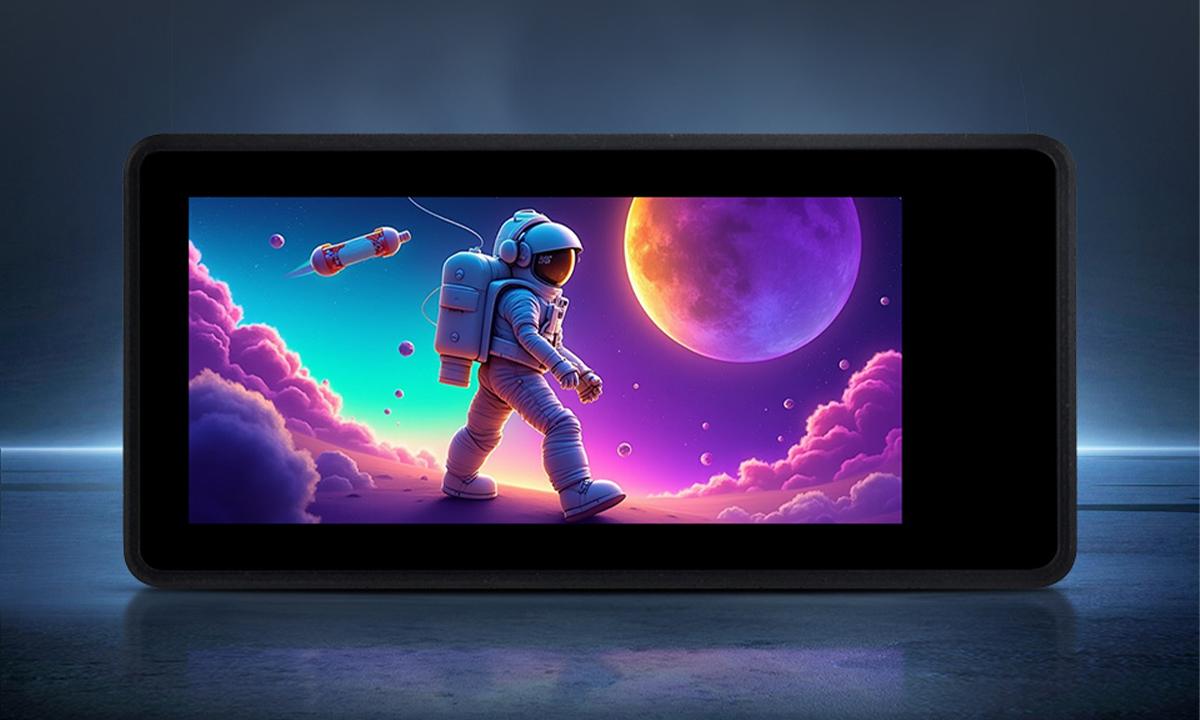
Waveshare has launched an ESP32-S3 1.91-inch AMOLED development board with a 6-axis motion sensor designed for the rapid prototyping of IoT and portable projects with interactive displays. The board is built around the ESP32-S3R8 chip, featuring a 32-bit LX7 dual-core processor running at up to 240MHz, with integrated 2.4GHz Wi-Fi and Bluetooth BLE 5. It also includes 16MB Flash, 8MB PSRAM, 512KB SRAM, and 384KB ROM for efficient processing and memory management. At the core of its display capabilities is a 1.91-inch AMOLED screen with a 240×536 resolution, supporting 16.7 million colors. Powered by the RM67162 controller and connected via the QSPI interface, the display is ideal for running GUI applications like LVGL. The board is available in both touch and non-touch versions, with the touch-enabled models using the FT3168 touch IC. Other features include a QMI8658 6-axis IMU, a microSD card slot, and a Lithium battery header. The ESP32-S3 […]