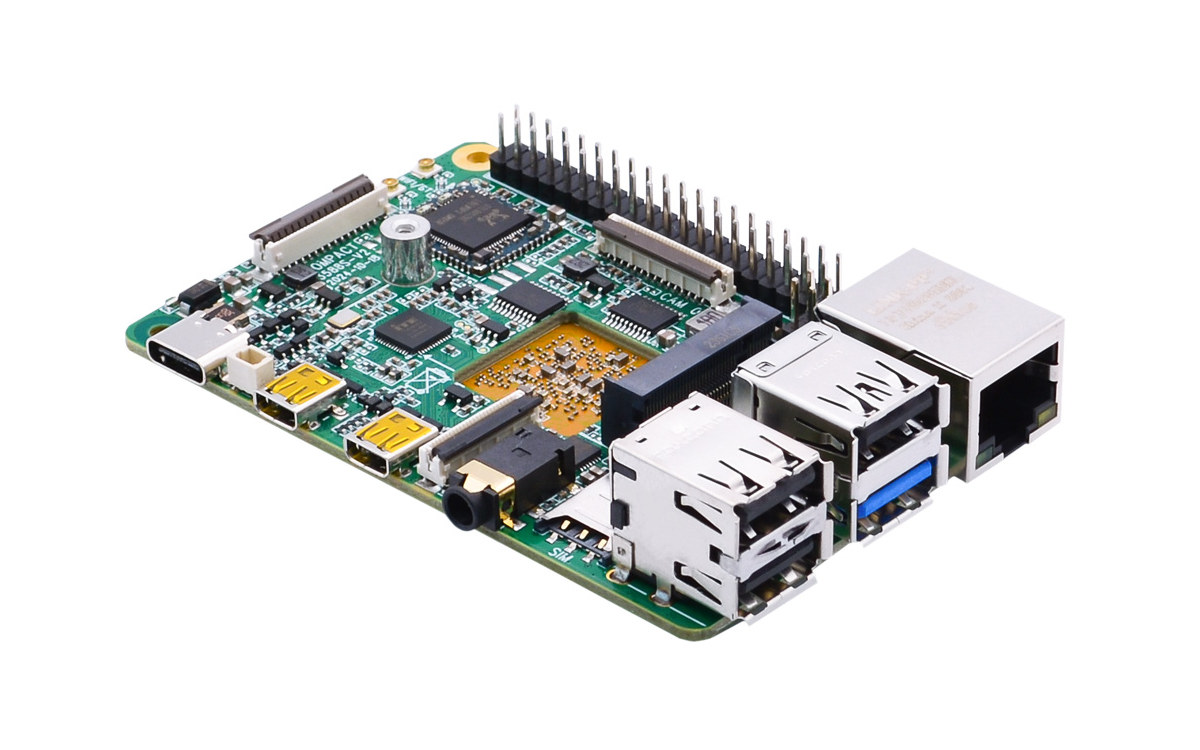
Calixto Systems has recently introduced the SL1680 OPTIMA, an industrial SoM built around the Synaptics SL1680 quad-core Arm Cortex-A73 SoC with a 7.9+ TOPS secure NPU for Edge AI and advanced multimedia applications. They also announced an evaluation kit (EVK) for rapid product development. The SoM offers up to 4GB LPDDR4 RAM, up to 16GB eMMC flash, an onboard Gigabit Ethernet PHY, and a wide range of interfaces through compact Hirose connectors, including dual MIPI CSI camera inputs, MIPI DSI, HDMI 2.1 Tx/Rx, PCIe 2.0, USB 3.0/2.0, SDIO, RS485, CAN-FD, and various GPIOs. The EVK further expands connectivity with MikroBUS, display and camera interfaces, and industrial I/O, making the platform suitable for AI-enabled vision systems, smart HMIs, automation equipment, and other edge computing applications. SL1680 OPTIMA SoM specifications SoC – Synaptics SL1680 (Astra Series) CPU – Quad-core Arm Cortex-A73 processor @ 2.1 GHz GPU – Imagination PowerVR Series9XE GE9920 GPU with […]
CIX releases P1 CPU TRM and developer guides for GPU, AI accelerator, OS and firmware/BIOS
CIX has finally released the technical reference manual (TRM) for the P1 (CD8180/CD8160) Arm Cortex-A720/A520 SoC, along with developer guides for the GPU (Arm Immortalis G720 and NVIDIA/AMD discrete graphics cards), the AI accelerator, as well as OS (Android, Linux, and Windows) and firmware (BIOS) installation and development. A slow (but steady?) progress There was a lot of excitement when the Radxa Orion O6 mini-ITX motherboard was introduced in December 2024, as we were told the CIX P1 12-core Armv9 processor would offer performance similar to Apple M1 SoC and Qualcomm 8cx Gen3 platform, at an affordable price ($199 and up for the mini-ITX board), and software support would include a Debian image, full UEFI via an open-source EDKII implementation, as well as an SDK along with hardware and software documentation, community forum support, and regular firmware & OS updates. CIX was even called “a native open source ecosystem chip […]
iWave Systems iG-RainboW-G69M TI AM62L OSM Size-S system-on-module powers Raspberry Pi-sized SBC
Yesterday, I wrote about the Beacon AM62L SoM, one of the first system-on-module based on Texas Instruments AM62L dual-core Cortex-A53 SoC for low-power IoT and HMI applications. It turns out there’s another AM62L module compliant with the OSM Size-S standard, along with a Raspberry Pi-sized carrier board. iWave Systems iG-RainboW-G69M is a 30x30mm CPU module with 1GB or 2GB LPDDR4, 8GB eMMC flash by default, and 332 LGA contacts exposing interfaces such as RGB LCD and MIPI CSI display interfaces, dual gigabit Ethernet, I2S audio, USB 2.0 interfaces, and a range of low-speed I/Os. iWave Systems iG-RainboW-G69M specifications: SoC – Texas Instruments AM62Lx CPU – Dual-core Arm Cortex-A53 processor up to 1.25GHz Cache – 32KB L1 D-cache, 32KB L1 I-cache per core; shared 256KB L2 cache System Memory – 1GB LPDDR4, expandable up to 2GB Storage 8GB eMMC flash (other capacities available upon request) 32Kbit EPPROM 332 LGA contacts Storage […]
STEVAL-ROBKIT1 – A robot evaluation kit based on STM32H725 and STM32G0 microcontrollers
The STEVAL-ROBKIT1 is an evaluation kit for robotics applications based on ST’s STM32H725 and STM32G0 Arm microcontrollers. It’s the first such robot kit from the company, and it targets both traditional engineering teams, educators, and students. The kit features an STM32H725 main board, an STM32G0 motor-control PCB, and a 1.53MP camera + ToF sensor module, as well as a robotic frame, wheels, and motors with encoders. It does not require a soldering iron for assembly to make it easier for students. STEVAL-ROBKIT1 key components and features: Main board – STEVAL-ROBKIT1-1 SoC – STMicro STM32H725IGT6 Arm Cortex-M7 microcontroller @ 550 MHz with 1MB flash, 564 KB SRAM with ECC Wireless – BlueNRG-M2 Bluetooth LE 5.2 SoC Sensors 6-axis IMU (LSM6DSV16BX) Magnetometer (LIS2MDL) Microphone (MP34DT06J) Expansion – 40-pin Raspberry Pi-like header Motor control board – STEVAL-ROBKIT1-2 SoC – STMicro STM32G071CBT6 Arm Cortex-M0+ microcontroller at 64 MHz with 128 KB flash, 36KB SRAM Motor […]
Beacon AM62L – A compact (38x28mm), low-power dual-core Cortex-A53 System-on-Module (SoM)
Beacon EmbeddedWorks has announced a compact (38x28mm) System-on-Module (SoM) based on the recently introduced low-power Texas Instruments Sitara AM62L dual-core Cortex-A53 SoC designed for IoT, HMI, and general-purpose applications requiring a display. The AML62L SoM features LPDDR4 or DDR4 memory, an 8-bit eMMC flash, and an optional WiFi 5 and Bluetooth 5.0 LE module. All I/Os are exposed through two board-to-board connectors, including RGB LCD or MIPI DSI display interface, two gigabit Ethernet interfaces with TSN support, USB 2.0, CAN FD, analog inputs, and more. Beacon AM62L specifications: SoC – Texas Instruments AM62L dual-core Arm Cortex-A53 processor up to 1.25GHz; 5600 DMIPS System Memory – LPDDR4, DDR4 Storage – 8-bit eMMC flash Wireless – 802.11ax WiFi 6 1×1 and Bluetooth 5.0 LE; cnxsoft: 802.11ax is WiFi 6, but the company only mentions support for WiFi 5 in other parts of the description. 2x board-to-board connector Storage – 2x 4-bit SD/SDIO […]
Rikomagic DS08 – A Rockchip RK3588-powered 8K digital signage player with RTC and watchdog support
Rikomagic DS08 is a Rockchip RK3588-powered Android 13 digital signage player with 8K and 4K HDMI video outputs, RTC and watchdog support, and support for portrait and landscape orientation. It looks to be an update to the Rockchip RK3288-powered Rikikomagic DS02 introduced in 2020. The new model appears to have the same enclosure, but with a slightly different port layout, and much better specifications. Besides an octa-core Cortex-A76/A55 SoC, the system ships with 8GB of RAM and a 128GB eMMC flash, and features a Gigabit Ethernet port, WiFi 6 and Bluetooth 5.2 connectivity, optional 4G LTE, and a few USB ports. Rikomagic DS08 specifications: SoC – Rockchip RK3588 CPU – Octa-core 64-bit Armv8 SoC with 4x Cortex-A76 cores @ 2.4GHz, 4x Cortex-A55 cores @ 1.8 GHz GPU – Arm Mali-G610 MP4 with support for OpenGL ES 3.2, OpenCL 2.2, Vulkan 1.1 NPU – Up to 6 TOPS, supports INT4/INT8/INT16, compatible […]
Lockzo AL501 3-in-1 smart door lock review with the Tuya mobile app
We’ve received a review sample of the Lockzo AL501 3-in-1 smart door lock system (Smart Lock + Video Camera + Doorbell). It supports 2.4GHz Wi-Fi and integrates a 2K resolution camera with a wide 180° field of view, a doorbell, AI motion detection, and infrared night vision. It supports multiple unlocking methods, namely physical key, AI fingerprint scanning, keypad PIN code, and the Tuya mobile app, which enables the user to check the live video, talk to visitors, and unlock the door in real time from anywhere via your smartphone, as well as voice control through Amazon Alexa or Google Assistant. The included 10,000 mAh rechargeable battery is designed to last approximately 6 months per charge, and the device has an IP65 dust and water resistance rating. In this review, we’ll go through an unboxing, show how we installed it on a wooden door, connect it to WiFi through the […]
Quectel QSM560DR industrial Qualcomm QCM6490/QCS6490 SBC supports Ubuntu, Android, and Windows
The Quectel QSM560DR is a Qualcomm QCM6490/QCS6490-based industrial Edge AI SBC with an octa-core processor, a 12 TOPS NPU, up to 8GB LPDDR4X RAM, and UFS storage. It offers 5G, WiFi 6E, Bluetooth 5.2, and GNSS, plus dual Gigabit Ethernet, four USB 3.0 ports, and HDMI and eDP display outputs. The board also includes three MIPI CSI camera connectors, a microSD card slot, GPIOs, RS232/RS485, CAN bus, audio output, and an M.2 connector for expansion. These features make it suitable for robotics, smart retail systems, industrial control panels, and other high-performance edge AI systems. Quectel QSM560DR specifications: SoC – Qualcomm QCS6490(WF variant) / QCM6490 (CN variant) CPU – Octa-core Kryo 670 with 1x Gold Plus core (Cortex-A78) @ 2.7 GHz, 3x Gold cores (Cortex-A78) @ 2.4 GHz, 4x Silver cores (Cortex-A55) @ up to 1.9 GHz GPU – Adreno 643L GPU @ 812 MHz with support for Open GL ES […]