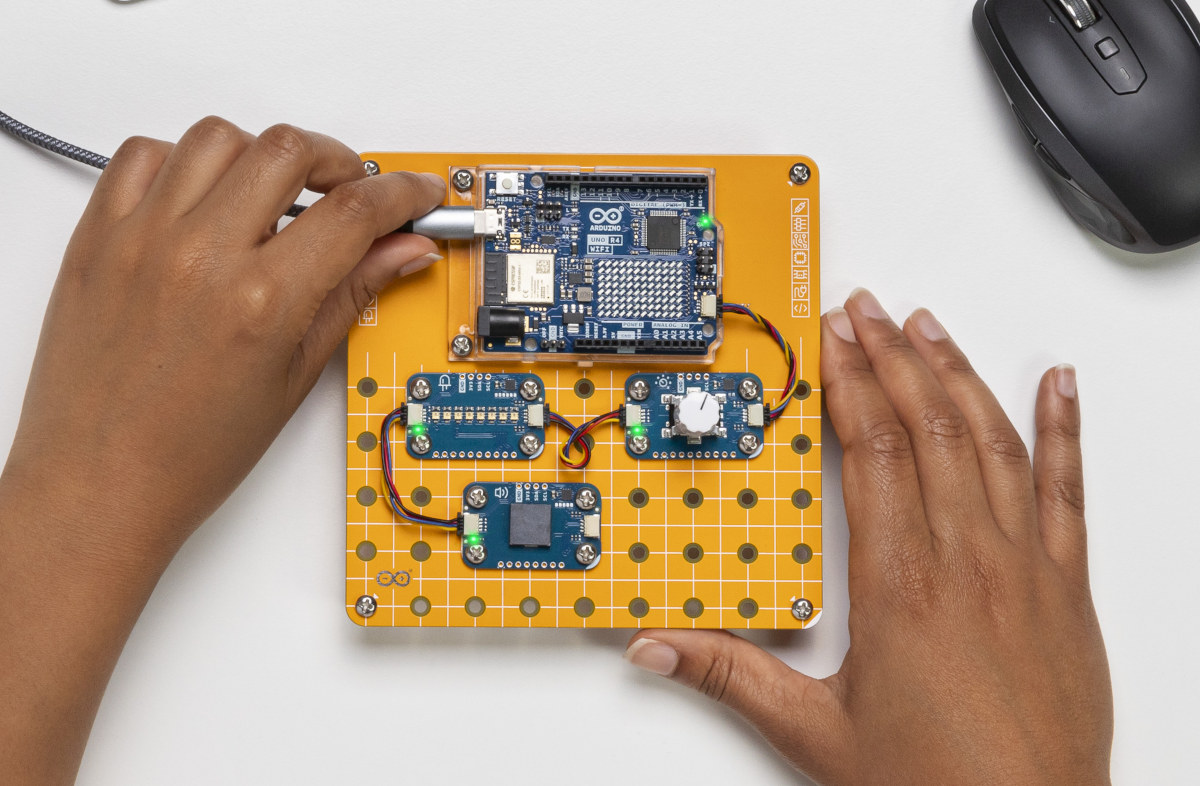
Arduino has just introduced three new Modulino modules: the Modulino Hub to support up to eight I2C devices (64 devices with 8 Hubs), the Modulino Extender to extend the I2C range to up to 30 meters, and the Modulino Motors to control two DC motors or a single stepper motor with precision. I’ll focus on the I2C modules in this post, as I find the Modulino Extender module particularly interesting, since I always considered I2C to be a short-range communication protocol, and never thought of using it for (relatively) long-range wired communication. Modulino Hub While the I2C protocol supports up to 127 devices in theory, address conflicts can become an issue in complex builds where multiple sensors or actuators share the same default address. The Modulino Hub aims to solve that, and multiple Hubs can be daisy-chained, each with its own address, to support up to 64 devices. Modulino Hub specifications: […]
Makerfabs MaTouch ESP32-P4 10.1-inch HMI display features 4G LTE and Ethernet connectivity, a 2MP camera
Makerfabs MaTouch ESP32-P4 TFTTouch 10.1 MIPI with 4G LTE is an ESP32-P4 + ESP32-C6-based display development platform for HMI edge AI, and connected embedded applications. The development board features a 10.1-inch IPS LCD, very similar to those of Seeed Studio’s reTerminal D1001, Waveshare ESP32-P4-WIFI6-Touch-LCD, and CrowPanel Advanced 7-inch displays. However, what makes it unique compared to other devices is that it also features a SIM7670G 4G LTE modem with a SIM card slot, an RJ45 Ethernet jack, and a 2MP camera. The HMI display also comes with microphone and speaker connectors, a microSD card slot, various USB interfaces, lithium battery support, and two 2.54 mm pitch GPIO expansion headers exposing UART, I2C, SPI, and other peripheral interfaces. All these features make it suitable for HMI, edge AI, and connected embedded applications. Makerfabs MaTouch ESP32-P4 10.1-inch 4G LTE specifications: SoC – Espressif Systems ESP32-P4NRW32 CPU Dual-core 32-bit RISC-V HP (High-performance) CPU @ up to 400 […]
ST VL53L9CX direct Time-of-Flight 3D LiDAR supports 5cm to 9m range, 2.3K zones resolution
STMicroelectronics VL53L9CX, or VL53L9 for short, is the company’s first direct Time-of-Flight (dToF) 3D LiDAR all-in-one module. It offers a sensing range of 5 centimeters to 9 meters, a wide 72º field of view, a resolution of 2.3K zones, and up to 100 Hz frame rate. ST’s ToF sensors have gone a long way since we covered the VL53L0X sensor with a single zone and 2-meter range in 2017. Since then, the company has steadily improved its tiny ToF sensors with up to 64 zones and long range in recent sensors like the VL53L8CP. While the VL53L9CX is still tiny at 12.8 x 6.1 x 4.6 mm, it’s in a class of its own, acting like a mini 3D scanner with 2268 zones, and will be used for a range of applications in robotics, industrial automation, smart buildings, AR/VR, and healthcare. ST VL53L9CX 3D ToF camera module specifications: Multizone ranging […]
Linux 7.1 Release – Main changes, Arm, RISC-V, and MIPS architectures
Linus Torvalds has just released Linux 7.1 on LKML: So it’s only Sunday morning back home, but it’s Sunday afternoon where I am right now, so I’m doing the 7.1 release at the regular time – just not in the regular timezone. This obviously means that the merge window opens tomorrow, but I’ll be in yet another timezone by then, so timing will all be a bit irregular. Normally I try to front-load the merge window and do as much as possible the first few days – this time I’m not sure that will work out with my laptop and a couple of long flights without internet, but I’ve made sure that I have fetched the early pull requests (thank you – you know who you are), so I will be able to do some of it off-line. Anyway, possible slight hiccups in the merge window aside, the news today […]
M5Stack Capsule Kit v1.1- A Battery-powered ESP32-S3 IoT controller with IMU sensor, MEMS microphone, and IR transmitter
M5Stack Capsule v1.1 is a Stamp-S3A-based IoT controller with a microSD card slot, several sensors (6-axis IMU, microphone), an IR transmitter, a built-in 250 mAh battery, a few buttons, a buzzer, an RTC, and expansion capabilities through GPIO headers and a Grove connector. It’s an upgrade to the earlier Capsule based on the Stamp-S3 module. The new version still features an ESP32-S3 WiFi and Bluetooth microcontroller, 8MB flash, a USB-C port, and a few GPIOs, but benefits from the Stamp-S3A improvements, including an optimized antenna design and lower power consumption. We never had a look at the Capsule before, so let’s do it now. M5Stack Capsule v1.1 specifications: M5Stack Stamp-S3A module WiSoC – Espressif Systems ESP32-S3FN8 CPU Dual-core 32-bit Xtensa LX7 microcontroller with AI vector instructions up to 240MHz RISC-V ULP co-processor Memory – 512KB SRAM Storage – 8MB flash Wireless – 2.4GHz WiFi 4 (802.11b/g/n), Bluetooth 5.0 LE + […]
Erqos EQSP32CE – An industrial IoT ESP32-S3 PLC with Ethernet, RS232, RS485, CAN Bus, DIN Rail support
Erqos EQSP32CE is a DIN rail-mountable industrial IoT PLC based on an ESP32-S3 WiFi and Bluetooth SoC and offering Ethernet, RS-485, RS-232, and CAN bus industrial communication interfaces. The IIoT logic controller also features several protected digital (16x) and analog (8x) inputs, eight current inputs, eight “special mode” analog inputs, and sixteen digital outputs with PWM support. A USB-C port is used for firmware flashing and monitoring, and the PLC takes a wide 7V – 26V DC input voltage and outputs 5V/1A for I/O expansion modules. Erqos EQSP32CE specifications: SoC – Espressif ESP32-S3 dual-core LX7 processor @ 240 MHz with 8MB Flash, 512kB RAM, wireless connectivity (so probably ESP32-S3FN8) Communication interfaces 10/100 Mbps Ethernet RJ45 port Wi-Fi + Bluetooth Low Energy (on ESP32-S3) with internal antenna RS232 (protected) and RS485 half-duplex (protected) with support for Modbus RTU, DMX512, and custom serial protocols CAN Bus (protected) USB – 1x USB-C power for […]
Convert old IR remote controls into presentation clickers using an RP2040 USB board and open-source TTVKTR firmware
Brisk4t’s “Tossed The TV — Kept The Remote” (TTVKTR) is an open-source firmware project for Raspberry Pi RP2040 USB boards that aims to reduce electronics waste by converting old IR remote controls into presentation clickers. Most Raspberry Pi RP2040 boards with USB ports should work, but the project highlights the Waveshare RP2040-Zero combined with a standard 38 kHz infrared receiver due to its small size and low price ($4-5). The project also relies on the built-in RGB LED for layer color feedback. That’s about it for the hardware. It just required some basic soldering of the IR receiver to GPIO 28 (OUT), 5V or 3.3V, and GND pins. Nothing too hard. The WS2812 RGB LED is already connected to GPIO 16. I tried to look for RP2040 USB boards with a built-in IR receiver, but I could not find any. The firmware receives IR codes from a standard 38 […]
PCMFlow722 library enables two-way real-time HD voice over ESP-NOW with G.722 audio codec
Tanaka Masayuki’s PCMFlow722 library enables (half-duplex) two-way real-time HD voice over ESP-NOW on ESP32 boards with a speaker and a microphone, effectively transforming them into walkie-talkies. The library implements a G.722 wideband codec add-on for PCMFlow lightweight audio decode and PCM flow library for Arduino, which already supports uncompressed PCM, MP3, and FLAC audio codecs. PCM and FLAC take too much bandwidth over ESP-NOW, and MP3 is not suitable for real-time audio, so the legacy G.722 audio codec was selected instead. The keyword here is “HD voice,” since two-way audio over ESP-NOW was previously implemented in projects such as Atomic14’s esp32-walkie-talkie (5 years ago) and, more recently, the well-documented Adafruit ESP-NOW Walkie-Talkie project, but these typically rely on lower-quality G.711 audio or compressed audio. The PCMFlowG722 library and G.722 codec enable HD voice with “7 kHz audio at 16 kHz sampling using the same 64 kbps wire budget as G.711 […]