Sonocotta (Andriy Malyshenko), the developer of Esparagus “Media Center”, HiFi-Amped, Louder Raspberry Pi, and Louder Raspberry Hat Plus, has returned to Crowd Supply with the Esparagus Audio Brick, a compact ESP32 or ESP32-S3-powered Hi-Fi Class-D amplifier with Home Assistant support. With support for Music Assistant, Snapcast, and Logitech Media Server (LMS), the module can be used to build whole-home audio setups, retrofit vintage speakers with modern streaming features, or power custom speaker configurations such as subwoofers or bi-amp systems. The board is built around an ESP32 or ESP32-S3 dual-core microcontroller with 16 MB flash and 8 MB PSRAM, and features Wi-Fi with optional W5500 SPI Ethernet for connectivity. Audio is processed via a Texas Instruments TAS5825M stereo I²S DAC with an integrated 65 W Class-D amplifier, and includes a DSP for a 15-band equalizer and hardware fault management. Other features include a USB Type-C port with a CH340 chip for […]
Echo Pyramid enables smart voice interaction applications on M5Stack Atom ESP32 IoT controllers
Designed for M5Stack Atom, AtomS3, and AtomS3R series IoT controllers based on ESP32 or ESP32-S3 wireless SoC, the Echo Pyramid base enables smart voice interaction applications such as far-field voice recognition, voice assistants, voice control, and more. The device features a built-in speaker, a MEMS microphone, an ES8311 HD audio codec for playback and capture, and an STM32 MCU for touch areas and RGB LED management. It’s powered via a USB Type-C port and can be expanded through a 4-pin connector for I2C modules. Echo Pyramid specifications: Supported IoT controllers – M5Stack Atom, AtomS3, and AtomS3R Microcontroller – STMicro STM32G030F6P6 32-bit Arm Cortex-M0+ CPU @ 64 MHz with 8KB SRAM, 64 KB flash Audio HD Codec – ES8311, handles playback and recording Microphone – LMA3729T381-0Y3S MEMS microphone ADC – ES7210 for microphone input Built-in speaker on the bottom of the pyramid Amplifier – AW87559 Class-D speaker driver for the speaker […]
Telink ML9118A – A 32-bit RISC-V IoT module with Wi-Fi 6, Bluetooth 5.4, and 802.15.4 connectivity
Telink ML9118A is a wireless IoT module with Wi-Fi 6, Bluetooth 5.4, and 802.15.4 (Zigbee/Thread/Matter) connectivity designed for smart home, smart lighting, and smart remote control applications. The module also features a 32-bit RISC-V microcontroller clocked at 160 MHz with 576KB SRAM, 4MB flash, and various peripheral interfaces such as SDIO 3.0, 19x GPIOs, I2C, SPI, UART, as well as I2S for audio. Telink ML9118A module (ML9118A-GAIA-M0-PG12) specifications: MCU – 32-bit dual-core RISC-V MCU @ 160MHz Memory – 576KB SRAM Storage – 4MB embedded flash Wireless 2.4 GHz Wi-Fi 6 IEEE 802.11 b/g/n/ax with support for DL/UL OFDMA, RX STBC, TWT, etc… Bluetooth 5.4 LE up to 2 Mbps bit rate 802.15.4 radio for Matter 1.3, Zigbee 3.0 compatible with ZHA and ZLL, Thread 2.4GHz proprietary – Supports Matter over Wi-Fi and Thread Tx Power – 15dBm @ Bluetooth LE mode Rx Sensitivity -88dBm @ 11B CCK 11Mbps -76dBm @ […]
2.1-channel audio HAT for Raspberry Pi features Texas Instruments TAS5825M class-D amplifier
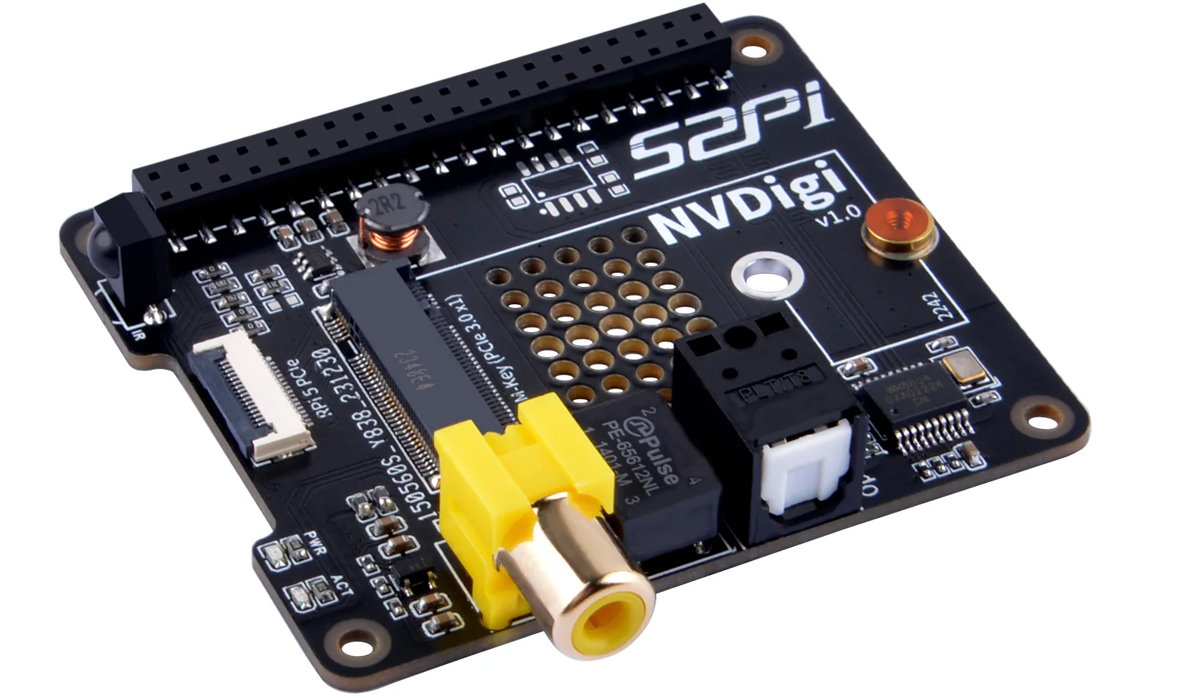
Previously, we wrote about the Louder Raspberry Pi, an open-source media center that integrates the Louder Raspberry Hat based on a 25W TAS5805M Class-D amplifier. Now, the developer has introduced the Louder Raspberry Hat Plus, upgrading from the TAS5805M amplifier to the more powerful TAS5825M, capable of driving up to 53W in mono (PBTL) mode while offering improved efficiency and thermal performance. The Louder Raspberry Hat Plus is compatible with all Raspberry Pi models and comes in 1X and 2X variants. The 1X version delivers up to 2×32W at 8Ω or 2×45W at 4Ω, the 2X version, on the other hand, supports 2×32W plus a dedicated 53W subwoofer channel, with bridge mode available for higher mono output. The board also integrates a DSP with 15-band parametric EQ per channel, 128-tap FIR filtering, 3-band DRC, selectable LF/HF crossovers, digital volume and gain control (32-step analog gain), selectable modulation schemes, adjustable switching […]
Meterbit Pixlpal – An open-source ESP32-S3 smart display with 128×64 RGB LED matrix, Hi-Fi audio output (Crowdfunding)
Designed by Meterbit Cybernetics in Nigeria, the Pixlpal is an open-source, ESP32-S3-based 11.25-inch 128×64 RGB LED matrix display designed as a customizable ticker for news, crypto, and smart home notifications, while also offering Hi-Fi audio playback. The device also includes a multi-function rotary encoder for local control, a digital MEMS microphone, and a 3.5 mm headphone output driven by a TI PCM5102A DAC for Hi-Fi audio playback. Pixlpal also provides a USB Type-C OTG port for power and programming, and a USB Type-A adapter port for firmware updates and peripherals. The device targets Smart Home dashboards, desktop information displays, and educational or maker-focused IoT applications. Pixlpal specifications: Wireless Module – Espressif Systems ESP32-S3-WROOM-1 SoC – ESP32-S3 CPU – Dual-core Tensilica LX7 up to 240 MHz with vector extension for AI/ML workloads Memory – 512KB SRAM Storage – TBD Wireless – WiFi 4 802.11b/g/n and Bluetooth 5.0 LE PCB antenna Display – […]
Cadence Tensilica HiFi iQ DSP to power next-generation Voice AI and Audio applications
Cadence Tensilica HiFi iQ DSP IP is the sixth generation of the company’s HiFi DSP family found in countless SoCs with audio features, and is based on a new architecture designed for next-generation voice AI and immersive audio applications. Compared to the Tensilica HiFi 5s DSP, the HiFi iQ DSP offers twice the compute performance, 8x higher AI performance, and more than 25% energy savings for most workloads, while delivering over 40% performance uplift on several audio codecs. The company claims it can act as an all-in-one AI processor for voice AI applications running popular SLMs and LLMs on the DSP itself. Tensilica HiFi iQ DSP key specifications: Load Units – 2 VLIW Slots – 5 Vector operations (SIMD) – 256-bit Accumulator Width – 80-bit Fixed Point MACs MACs for AI – Up to 128 16×8, up to 256 16×4 Optional instructions for AI (improved from HiFi 5s) Optional Vector […]
Rockchip RK628D based HDMI-to-MIPI-CSI board converts HDMI video into camera feed for embedded systems
The Firefly HDMI-to-MIPI-CSI converter board converts an HDMI video and audio source into a MIPI-CSI camera stream for supported Rockchip SoCs, which is the complete opposite of the Olimex MIPI-HDMI adapter that converts MIPI DSI display signals to HDMI output. Built around the Rockchip RK628D video bridge chip, the board supports HDMI 1.4/2.0 input with 8-bit and 10-bit video, RGB888 and YUV420 color formats, and resolutions up to 4K @ 60fps. On the output side, it provides a MIPI-CSI interface compliant with MIPI D-PHY v1.2, with video output in YUV422 color format, supporting resolutions up to 4K @ 30fps. Audio output is available through a 3.5 mm headphone jack and onboard pin headers, making the board suitable for HDMI capture, smart display, micro-projector, and embedded video conversion applications. Firefly HDMI-to-MIPI-CSI board Specifications: Main Chip – Rockchip RK628D HDMI-to-MIPI CSI-2 converter Input HDMI 1.4 / HDMI 2.0 compliant 8-bit and 10-bit […]
NASP NeuroVoice VAD chip enables always-on voice activity detection at microwatt-level power consumption
POLYN Technology’s Neuromorphic Analog Signal Processor (NASP) NeuroVoice VAD is an always-on, ultra-low-power chip that detects voice in any noisy background, at microwatt-level power consumption and microsecond-scale latency. Everything happens on the chip, so no Internet is needed. Potential applications include smart remote controls, earbuds, wearables, voice access, IoT, Industry 4.0, robotics, Smart Home/Factory, mobility, and more. NASP NeuroVoice VAD chip (NV-VAD 100) specifications: Features Voice detection at ultra-low power consumption Voice passthrough – Passes voice and mutes background sounds Background signal bypass – Wake Word Detection (WWD) command to activate transparent voice bypass Speech/command intelligibility in noisy spaces – Increases voice command intelligibility for WWD/KWS (Keyword Spotting) functionality in noisy environments for Smart Home, Smart Factory, Wearables, etc. Audio Interfaces – PDM/I2S Voice delay detection – 25 ms Host interfaces – SPI/I2C used for initial configuration and status readout, VAD pin Debugging – Boundary Scan and Debug unit access […]