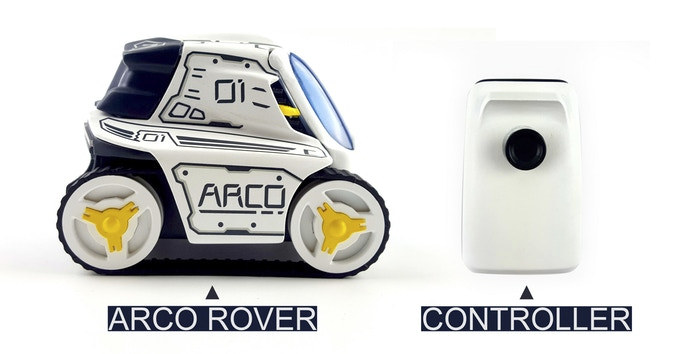
Quarky Intellio is an ESP32-S3-based development kit designed as an educational platform for learning AI, Augmented Reality (AR), and IoT concepts. It is compatible with LEGO bricks and targets users aged 10 and older. The core AI-AR module features an SPI TFT display interface, a 5MP camera, a speaker and microphone, a microSD card slot for data storage, a USB-C port for programming and charging, servo and GPIO expansion ports, and a 1,000 mAh battery. The company offers a discovery kit with the core module only as well as a rover car kit, and since it’s compatible with LEGO, users can easily create their own robot. Quarky Intellio specifications: Core module – Espressif Systems ESP32-S3-WROOM-1-N16R8 SoC – ESP32-S3 CPU – Dual-core LX7 processor with up to 240MHz Memory – 512KB SRAM, 8MB PSRAM (SiP) Storage – 384KB ROM Wireless – WiFi 4 802.11b/g/n and Bluetooth 5.0 LE Storage – 16MB flash […]
Bluetooth 6.2 gets more responsive, improves security, USB communication, and testing capabilities
Bluetooth 6.2 specification has just been released with a range of new features to enhance responsiveness with shorter connection intervals, strengthen security against amplitude-based RF attacks, and improve communication with a new “Bulk Serialization Mode” that’s especially useful for USB Bluetooth LE audio applications. The new Bluetooth Core 6.2 specification also introduces various BLE Test Mode enhancements. If you feel like Bluetooth specifications are released more often than in the past, that’s normal because the Bluetooth SIG switched to a bi-annual release schedule. For instance, the Bluetooth 6.1 specification was just published last May, or about 6 months ago… Bluetooth 6.2 highlights: Bluetooth Shorter Connection Intervals (SCI) reduce the minimum Bluetooth LE connection interval from 7.5 ms to just 375 µs for faster responsiveness. The change will especially impact high-performance HID devices, real-time human-machine interfaces (HMIs), and latency-sensitive sensors. AR/VR and gaming applications will particularly benefit from the lower latency. […]
Orange Pi AIPro (8T) SBC features a 8 TOPS Huawei Ascend AI SoC, runs Ubuntu or openEuler
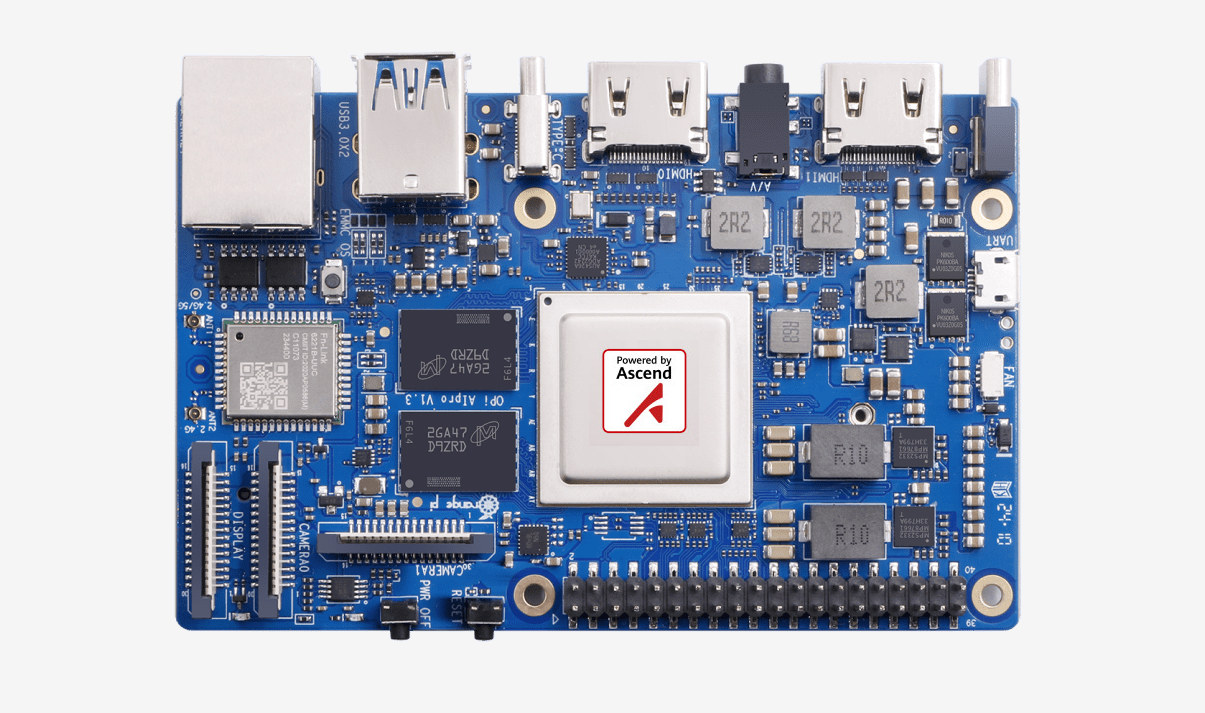
Orange Pi AIPro (8T) is a new single board computer for AI applications that features an unnamed Huawei Ascend AI quad-core 64-bit processor delivering up to 8 TOPS (INT8) of AI inference performance, although there’s also a 20 TOPS (INT8) variant of the SoC. The SBC comes with up to 16GB LPDDR4X and a 32MB SPI flash but also supports other storage options such as a microSD card, an eMMC flash module, and/or an M.2 NVMe or SATA SSD. The board also features two HDMI 2.0 ports, one MIPI DSI connector, a 3.5mm audio jack, two MIPI CSI camera interfaces, Gigabit Ethernet and WiFi 5 connectivity, a few USB ports, and a 40-pin GPIO header for expansion. Orange Pi AIPro specifications: SoC – Huawei Ascend quad-core 64-bit processor delivering up to 8 TOPS (INT8) AI performance and equipped with an unnamed 3D GPU; Likely Ascend 310B with Arm Cortex-A76 equivalent […]
STMicro VD55G1 – A small, low-power global shutter I3C camera sensor for computer vision
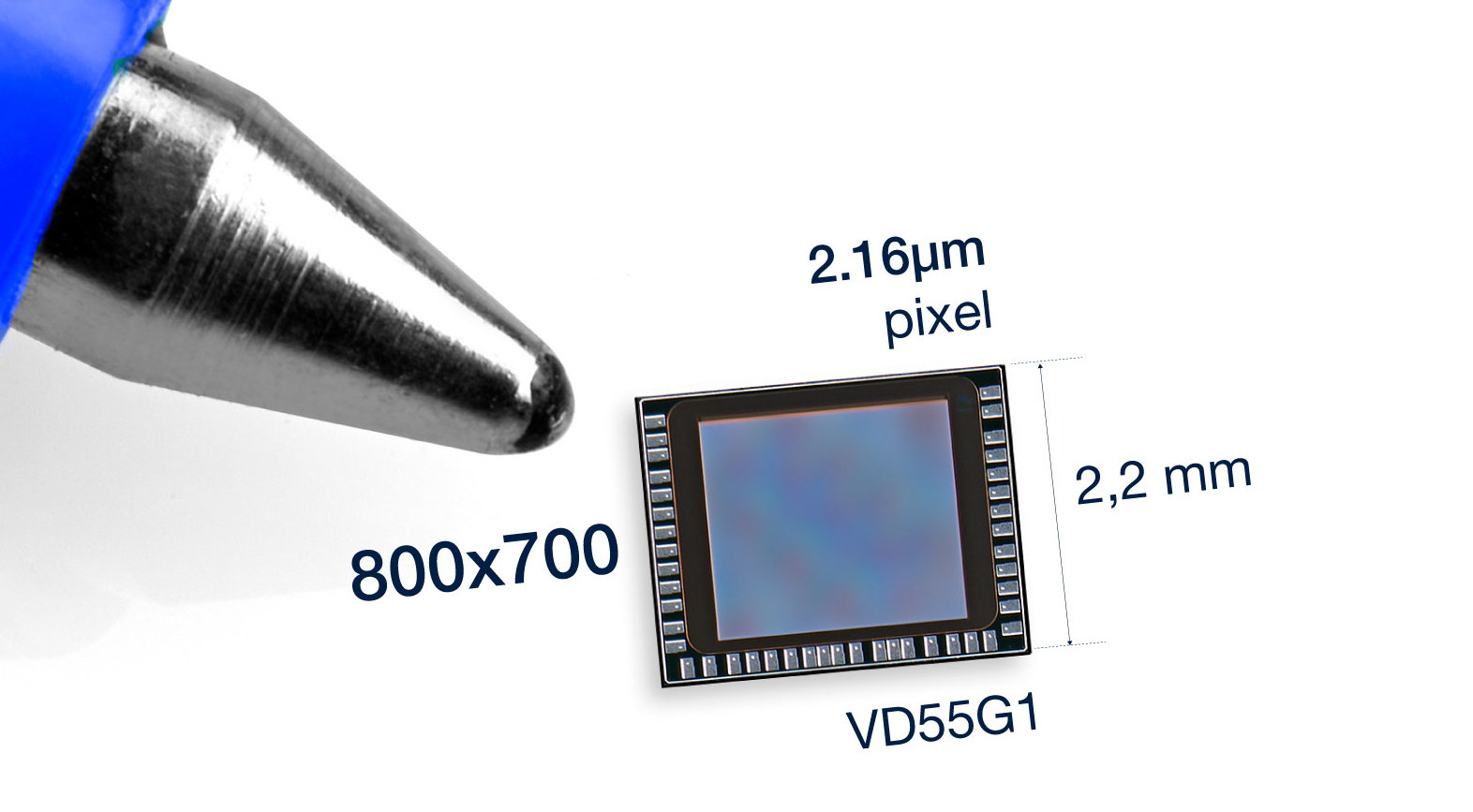
STMicro VD55G1 is a new global shutter I3C camera sensor with a small die size of 2.7 x 2.2 mm, 804 x 704 pixels native resolution, and consuming about 1mW in its ‘always-on’ autonomous mode to wake up the host when motion is detected. Camera sensors are available with rolling or global shutter, with most from the former type, but as we’ve seen in our reviews of the e-Con Systems See3CAM_24CUG (USB 3.1) and the Raspberry Pi Global Shutter (MIPI CSI) global shutter cameras, the latter is much better we capturing moving objects clearly at high frame rates with fewer artifacts than with rolling cameras. The VD55G1 global shutter sensor will also benefit from the same advantage but is offered in a smaller package working over MIPI CSI and/or I3C, making it suitable for devices with small batteries used in applications such as eye tracking or motion estimation. STMicro VD55G1 […]
LiFi 802.11bb standard uses light for in-room data transmission up to 224GB/s
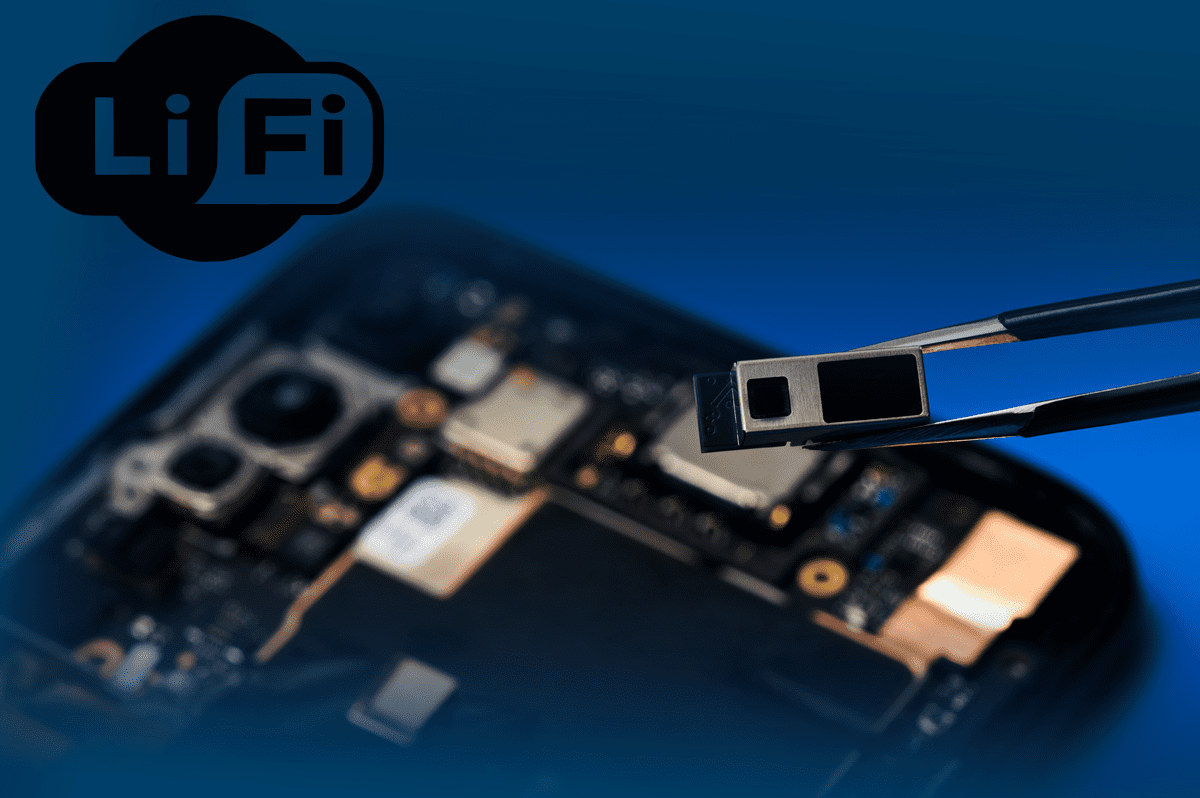
The 802.11bb WiFi-like standard, also called LiFi, was ratified in June 2023. It enables data transmission up to 224GB/s at a few meters range within a room using light instead of RF signals used in most other wireless standards. The technology has been worked on for many years, and we first covered (a version of) LiFi in 2014 that was still part of the IEEE 802.15 standard with speeds up to 1 Gbps. But the Light Communications 802.11bb Task Group was only formed in 2018 chaired by pureLiFi and supported by Fraunhofer HHI, and led to be ratification of the IEEE 802.11bb standard last month. In a typical LiFi setup, you’d have a LiFi-capable router connected to your local network and the Internet, a LiFi-enabled light bulb on a ceiling, and one or more LiFi receivers. From the end-user perspective, it would work like accessing a WiFi access point. We’re […]
Lightweight wireless AR Smart Viewer reference design is powered by Snapdragon XR2 platform
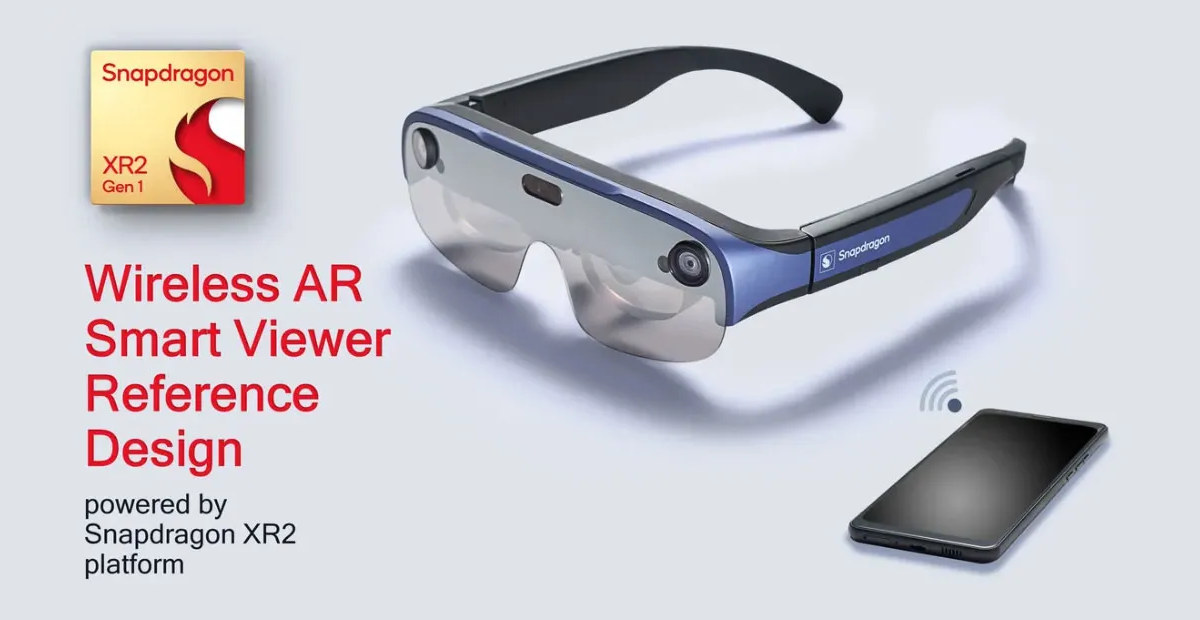
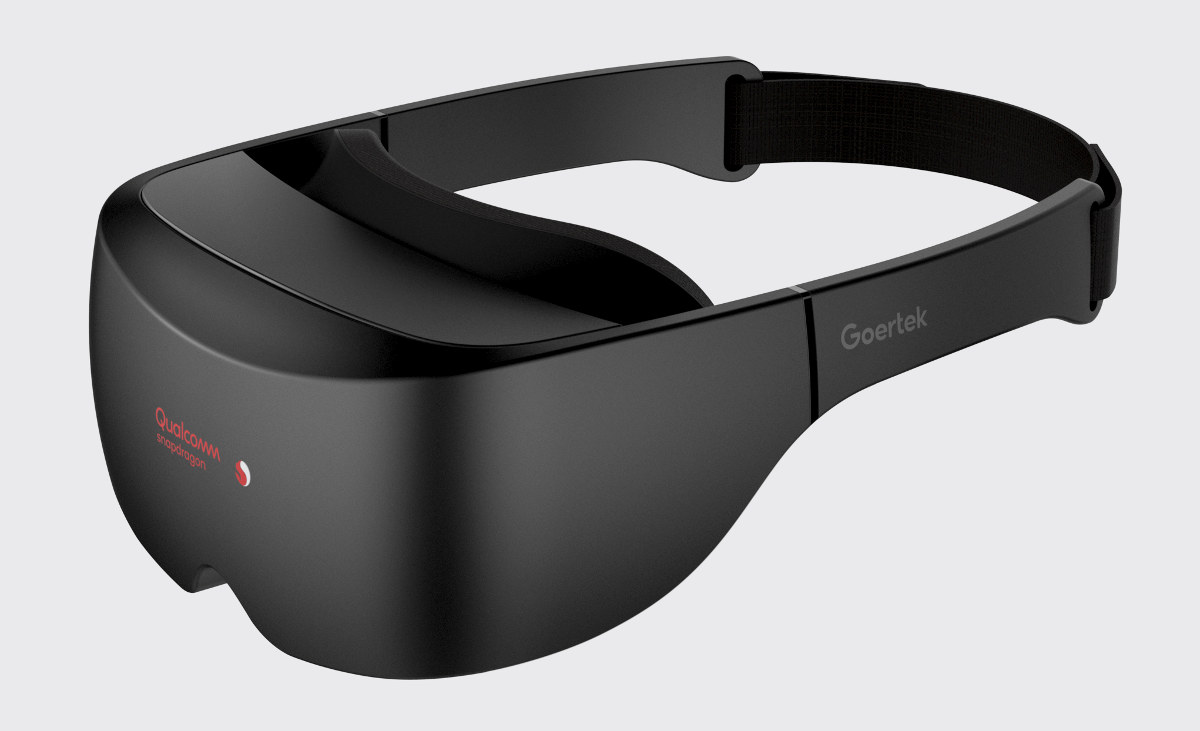
Qualcomm unveiled a new Wireless AR Smart Viewer Reference Design powered by the Snapdragon XR2 platform last week with very few details, but the company has now demonstrated the system to some members of the press, so let’s have a closer look. The reference design aims to provide a similar level of performance as a headset connected to PC or premium smartphone, but with some of the processing offloaded to the Snapdragon XR2 processor, thereby eliminating the need for a cord while still achieving lag-free experiences in combination with the Qualcomm FastConnect 6900 WiFi 6 and Bluetooth 5.3 solution. It is supposed to offer a 40% thinner profile and a more balanced weight distribution than the earlier Snapdragon XR1 smart glasses reference design. Wireless AR Smart Viewer reference design specifications: SoC – Qualcomm Snapdragon XR2 with Octa-core processor with 1x Kryo Gold prime @ 2.84 GHz + 3x Kryo […]
TurboX C865 CPU module and 96Boards devkit feature Qualcomm QCS8250 IoT processor
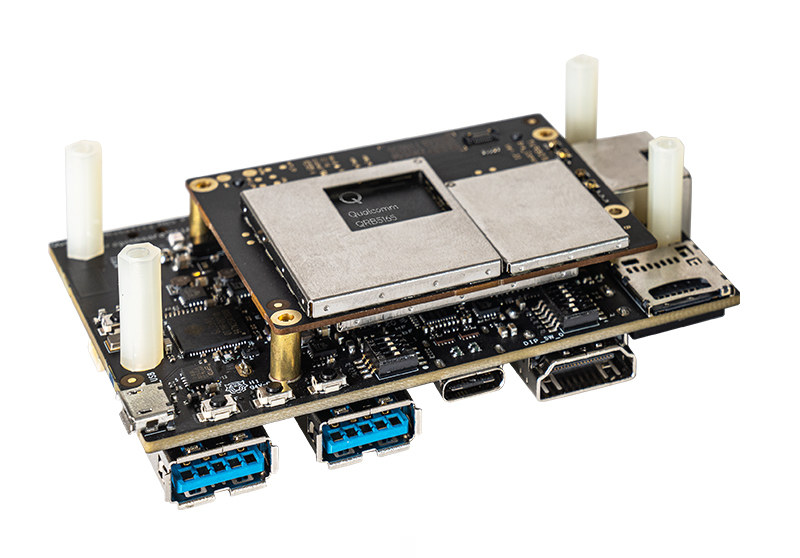
Thundercomm has unveiled another Qualcomm IoT module and development kit with the TurboX C865 SOM and development kit based on Qualcomm QCS8250, based on Snapdragon 865 but for IoT applications, which follows our coverage of the company’s TurboX CM2290 and C2290 SoM & devkit based on Qualcomm QCM2290/QCS2290 quad-core Cortex-A53 processor several days ago. The new TurboX C865 system-on-module is for higher-end IoT applications with a faster processor combines with 8GB LPDDR5 RAM, and 128G UFS storage, WiFI 6 & Bluetooth 5.1 connectivity, and the company also offers a 96Boards compliant development kit to help with the development of more advanced IoT products running Android 10. TurboX C865 SoM Specifications: SoC – Qualcomm QCS8250 octa-core Kryo 585 processor with Adreno 650 GPU, Adreno 665 VPU, Adreno 995 DPU, Hexagon DSP with quad HVX, Spectra 480 ISP; 15 TOPS AI processing power System Memory – 8GB LPDDR5 (PoP) Storage – 128G […]
Qualcomm Snapdragon XR2 5G VR Reference Design Comes with Dual 2Kx2K Display, Up to 7 Cameras
Qualcomm Snapdragon XR1 was the first processor from the company dedicated to extended reality (XR) and virtual reality (VR) applications. It found its way in various hardware development kits, a well as Google Glass Enterprise Edition v2. We missed the company’s announcement of the Snapdragon XR2 platform with 5G support last December, but Qualcomm has now just unveiled the Snapdragon XR2 5G Reference Design to help OEMs shorten time to market. Qualcomm Snapdragon XR2 Platform Qualcomm did not provide detailed specifications, but the company claims Snapdragon XR2 delivers 2x the CPU and GPU performance, 4x more video bandwidth, 6x higher resolution and 11x AI improvement compared to Snapdragon 835 Mobile XR Platform. It’s also the first XR/VR platform to support seven concurrent cameras, optional 5G connectivity, and enables “true” MR (Mixed Reality) thanks to low latency camera pass-through. Some of the highlights of the processor include: Up to 3K by […]