Olimex ESP32-C5-EVB is an evaluation board built around Espressif’s ESP32-C5-WROOM-N8R4 module with dual-band (2.4/5.0GHz) WiFi 6, Bluetooth 5.0 LE, and 802.15.4 (Zigbee/Thread/Matter) wireless connectivity, 8MB flash, and 4MB PSRAM. The board integrates two relays rated 250V/10A, two opto-isolated inputs, and a LiPo UPS charger and step-up converter. Other features include USB-C ports, a UEXT connector for expansion, and two buttons. It’s one of the first ESP32-C5 boards we’ve seen, after Espressif’s own ESP32-C5-DevKitC-1 development kit, and Wireless Tag’s WT99P4C5-S1 board using the ESP32-C5 as a wireless co-processor to the ESP32-P4 MCU. Olimex ESP32-C5-EVB specifications: Wireless module – ESP32-C5-WROOM-N8R4 SoC – Espressif Systems ESP32-C5 CPU Single-core 32-bit RISC-V processor @ up to 240 MHz Low-power RISC-V core @ 40 MHz acting as the main processor for power-sensitive applications Memory – 384 KB SRAM on-chip, support for external PSRAM Storage – 320 KB ROM, support for external flash Connectivity Dual-band 802.11ax WiFi 6 […]
Elecrow ESP32-S3 rotary displays combine round IPS touchscreen, knob, and press input
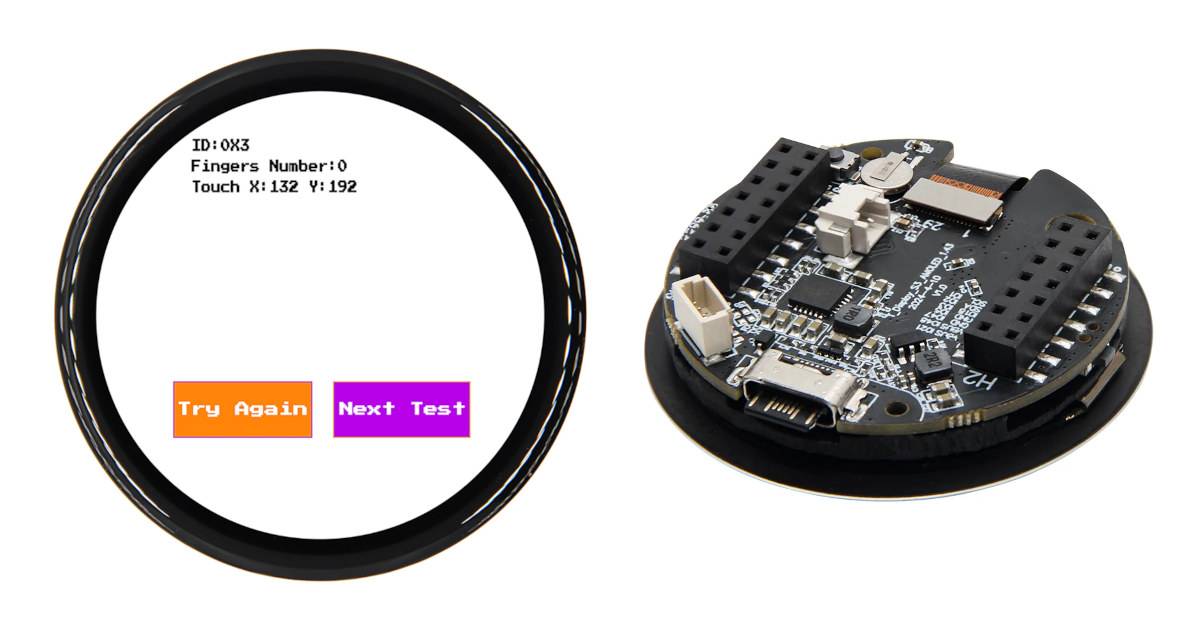
Elecrow has added two new ESP32-S3-powered rotary displays to its CrowPanel Advance lineup, which come in 1.28-inch (240×240) and 2.1-inch (480×480) sizes, and feature a round IPS screen with rotary, touch, and press input. Both rotary displays feature IPS capacitive touchscreens, rotary input with a smooth feel, knob-press operation, ambient lighting, USB-C (5V) power, and expansion capabilities via UART, I²C, and FPC connectors. These features make them suitable for DIY projects, IoT prototypes, and embedded product development across various applications, including smart home appliances, industrial control, and UI training scenarios. Elecrow CrowPanel 1.28-inch and 2.1-inch rotary display specifications: SoC – Espressif Systems ESP32-S3R8 CPU – Dual-core Xtensa LX7 processor @ up to 240 MHz Memory – 512 KB SRAM, 8 MB PSRAM Wireless Wi-Fi 4 (802.11 b/g/n, 2.4 GHz) Bluetooth 5.0 LE Storage – 16 MB flash Display Two options 1.28-inch IPS touchscreen, 240 × 240 resolution 2.1-inch IPS touchscreen, […]
SONOFF Dongle Max (Dongle-M) – A PoE-based Zigbee/Thread gateway with ESP32 and MG24 chips
As expected, SONOFF has now launched the Dongle Max (also known as Dongle-M) Zigbee coordinator and Thread Border Router with Ethernet, WiFi, and USB connectivity. The company also highlights PoE or USB power supply options, web console access, and support for advanced features such as Webhooks, MQTT, WireGuard VPN, and Turbo mode. SONOFF Dongle Max specifications: Wireless SoCs Silicon Labs EFR32MG24 MCU core – Arm Cortex-M33 MCU @ 78 MHz Memory – 256 KB RAM (300% more RAM than ZBDongle-E) Storage – 1536 KB flash (twice the flash of ZBDongle-E) Radios/Protocols – 802.15.4, Matter, OpenThread, Zigbee 3.0, BLE, Bluetooth Mesh, Proprietary 2.4 GHz, Multiprotocol Espressif Systems ESP32-D0WDR2-V3 MCU cores – Dual-core Xtensa LX6 32-bit microprocessor up to 240 MHz Memory – 520 KB SRAM + 2 MB embedded PSRAM Wireless – 2.4 GHz 802.11 b/g/n WiFi 4 and Bluetooth: v4.2 + EDR Storage – 16MB flash for ESP32 Wired networking […]
RAK3112 WisDuo LoRa + WiFi + BLE module targets Edge AI and Meshtastic UI
RAKwireless “RAK3112 WisDuo Module for Edge AI with LoRa” combines an ESP32-S3 WiFi and BLE SoC with a Semtech SX1262 LoRa transceiver for Edge AI applications and Meshtastic user interfaces. The 3-in-1 LoRa + WiFi + BLE module is an update to the ESP32-based RAK11200 WisDuo LoRa module, which has limitations in terms of computing power and memory. Those became apparent in more demanding applications such as Edge AI or complex mesh networks. With 16MB of flash and 8MB of PSRAM and a more powerful ESP32-S3 microcontroller, the RAK3112 WisDuo module overcomes those limitations for camera and audio processing, as well as mesh networks like Meshtastic. It also offers a more powerful alternative to the pin-compatible RAK11160 STM32 + ESP32-C2 module that’s better suited for battery-powered sensors. RAKwireless RAK3112 specifications: Main MCU – Espressif Systems ESP32-S3 CPU – Xtensa 32-bit LX7 dual-core CPU @ 240 MHz with vector instructions, AI […]
Baguette S3 ESP32-S3 board gets the breadboard-friendly crown
We often write about breadboard-friendly boards, which typically means they plug nicely into a breadboard, but usually leave only one or two rows to play with on each side. So far, the best option we have come across is probably the Raspberry Breadstick, which is designed for full-length breadboards, but is limited by the I/Os on the Raspberry Pi RP2040 MCU. When it comes to breadboard friendliness, it’s hard to beat The Pi Hut’s Baguette S3, as it provides a single 30-pin header designed to be inserted in one of the rows of a breadboard, leaving plenty of space for prototyping. The board also features an ESP32-S3 microcontroller, a microSD card slot, a USB-C for power and programming, a Qwiic port for further expansion, an RGB LED, and RESET and BOOT buttons. Baguette S3 specifications: Wireless module – ESP32-S3-MINI-1-N8 module SoC – ESP32-S3 dual-core Xtensa LX7 processor with WiFi 4 […]
ESP32-H2-Zero mini Zigbee, Thread, and BLE USB-C board is based on ESP32-H2 RISC-V SoC
Waveshare ESP32-H2-Zero is a tiny USB-C development board based on Espressif Systems’ ESP32-H2 RISC-V SoC with Zigbee, Thread, and Bluetooth LE (BLE) connectivity. It’s specifically based on the ESP32-H2FH4S chip with 4MB Flash memory, and features two 9-pin headers and castellated for I/Os, plus four additional pads. It also features a ceramic antenna instead of an external antenna, as well as BOOT and Reset buttons. ESP32-H2 Mini specifications: SoC – Espressif Systems ESP32-H2FH4S CPU – 32-bit RISC-V SoC clocked at up to 96 MHz Memory – 320 KB SRAM, 4 KB LP memory Storage – 128 KB ROM, 4MB flash Wireless 802.15.4 radio with Zigbee 3.0, Thread 1.3, and Matter support Bluetooth 5.2 LE/Mesh USB – USB Type-C port for power, programming, and debugging Expansion 2x 9-pin header and castellated holes with up to 15x GPIO, 5x ADC, UART, Fast SPI, JTAG, and power signals (5V, 3.3V, GND) 4x pads […]
Ambiq Apollo510B ultra-low-power Cortex-M55 Edge AI MCU adds Bluetooth LE 5.4
After the release of Apollo510, Ambiq has released Apollo510B, an ultra-low power Edge AI MCU that adds a 48 MHz network coprocessor for Bluetooth 5.4 LE (BLE) support. The new SoC combines Cortex-M55 with Helium MVE for AI/ML acceleration, secureSPOT 3.0 security, and graphiqSPOT 2.0 graphics for connected wearables, healthcare devices, and industrial IoT applications. The Apollo510B features 3.75MB of system RAM, 4MB of non-volatile memory, and a 12-bit ADC. It supports MIPI DSI and Quad SPI interfaces for displays, and offers audio capabilities such as always-on low-power ADC, a PDM stereo microphone interface, and dual multichannel I²S ports with asynchronous sample rate conversion. Peripheral options extend to USB 2.0 HS/FS, dual SDIO/eMMC controllers, multiple SPI and I²C masters, UART interfaces with flow control, and various GPIOs. Ambiq Apollo510B specifications: MCU Core Arm Cortex-M55 core at up to 250 MHz with Helium (MVE) vector instructions, FPU, TrustZone, MPU Caches/TCM – […]
NXP IW623 SoC supports 2×2 tri-band Wi-Fi 6E, Bluetooth LE audio
NXP has recently launched the IW623, a Tri-band Wi-Fi 6E and Bluetooth LE Audio SoC, which can be considered as the 4th member of the IW62x family, as back in 2020, NXP launched the IW620, with Wi-Fi 6 and Bluetooth 5.1 connectivity. After that, in January 2022, they released the IW612 tri-radio SoC, adding 802.15.4 support for Matter-enabled smart home gateways, and later in September 2025, they launched the IW693 Wi-Fi 6E SoC with concurrent dual-Wi-Fi and Bluetooth for industrial IoT and automotive markets. The IW623 Wi-Fi 6E Bluetooth SoC also includes features like 2×2 MU-MIMO, OFDMA, Target Wake Time (TWT), wireless multi-streaming, adaptive scheduling, and agile channel switching for congested environments. A dedicated Wi-Fi/Bluetooth coexistence engine with hardware and software arbitration ensures smooth operation when both radios are active, while the integrated PA/LNA/Switch reduces external RF components and improves range. Host connectivity is available over PCIe and SDIO for […]