The Analog Discovery Studio Max (ADS Max) is an all-in-one electronics trainer kit with four breadboards developed by Digilent for academic and engineering experimentation. Designed for both classroom and remote learning, it combines the functionality of 14 essential instruments into one, making it ideal for circuit design, signal analysis, and embedded systems education. The instruments include an oscilloscope, waveform generator, logic and spectrum analyzers, DMM, programmable and static power supplies, and a protocol analyzer. It supports WaveForms software, LabVIEW, C, and Python for control and data analysis. With a 100 MS/s, 14-bit oscilloscope, ±15 V power supplies, 16 digital I/O channels, and WaveForms SDK, it provides a complete learning and experimentation ecosystem. Analog Discovery Studio Max specifications: Core Instruments Oscilloscope 4x single-ended BNC channels, 14-bit resolution (16-bit with averaging) ±25 V input range (50 V p-p max), 50 MHz @ –3 dB bandwidth 100 MS/s per channel, 1 MΩ ‖ […]
Olimex RP2350-PICO2 open hardware boards expose all 48 GPIOs for breadboard prototyping
Olimex RP2350-PICO2-BB48 and RP2350-PICO2-BB48R open hardware development boards are built around the Raspberry Pi RP2350B MCU, and expose all 48 GPIOs in a 0.6-inch dual-inline PCB layout. Compared to the earlier PICO2-XL and PICO2-XXL boards, this new board features a breadboard-friendly design with options for PSRAM and microSD on the BB48R version. Other features include USB-C power/data, BOOT and RESET buttons, a 2A 3.3V regulator, UEXT and Qwiic/Stemma connectors, status LED, and debug pads. With pre-soldered headers, it can be plugged directly into a breadboard, making it ideal for DIY projects, IoT, retro computing, and hardware prototyping. Olimex RP2350-PICO2-BB48 and RP2350-PICO2-BB48R specifications: MCU – Raspberry Pi RP2350B CPU Dual-core Arm Cortex-M33 @ 150 MHz with Arm Trustzone, Secure boot OR Dual-core RISC-V Hazard3 @ 150 MHz Either two cores can be used. Memory – 520 KB on-chip SRAM Package – QFN-80 Memory – 8 MB external QSPI PSRAM (only on […]
Baguette S3 ESP32-S3 board gets the breadboard-friendly crown
We often write about breadboard-friendly boards, which typically means they plug nicely into a breadboard, but usually leave only one or two rows to play with on each side. So far, the best option we have come across is probably the Raspberry Breadstick, which is designed for full-length breadboards, but is limited by the I/Os on the Raspberry Pi RP2040 MCU. When it comes to breadboard friendliness, it’s hard to beat The Pi Hut’s Baguette S3, as it provides a single 30-pin header designed to be inserted in one of the rows of a breadboard, leaving plenty of space for prototyping. The board also features an ESP32-S3 microcontroller, a microSD card slot, a USB-C for power and programming, a Qwiic port for further expansion, an RGB LED, and RESET and BOOT buttons. Baguette S3 specifications: Wireless module – ESP32-S3-MINI-1-N8 module SoC – ESP32-S3 dual-core Xtensa LX7 processor with WiFi 4 […]
Brodboost-C is a USB Type-C breadboard power supply board with adjustable 3.3V or 5V voltage (Crowdfunding)
Axiometa BrodBoost-C is a USB Type-C breadboard power supply with a simple design that powers both rails of a breadboard with voltage adjustable between 3.3V or 5V. It also includes an on/off switch, an LED indicator, and built-in fuse protection. BrodBoost-C specifications: Output voltage – Adjustable: 3.3V or 5V DC Maximum current – 1A Ports USB Type-C connector for power input 2x 2×5 2.54 mm breadboard-compatible power and ground rails 2x 3-pin 2.54 mm selection headers with 2x jumper caps Safety – Short circuit protection Input filtering – Ferrite bead for noise suppression and decoupling capacitors Misc – Red Power LED, ON/OFF power switch Voltage regulation: 5.0 V selected by USB CC Pins (5.1 k resistors) 3.3 V step-down regulation via AMS1117-3.3 Dimensions – 54 x 19.5 x 11.4 mm Weight – About 20 grams We’ve written about several breadboard power supplies over the years including the Toaster board with […]
XIAO Powerbread is a breadboard power supply and meter based on XIAO RP2040 or ESP32 USB-C board
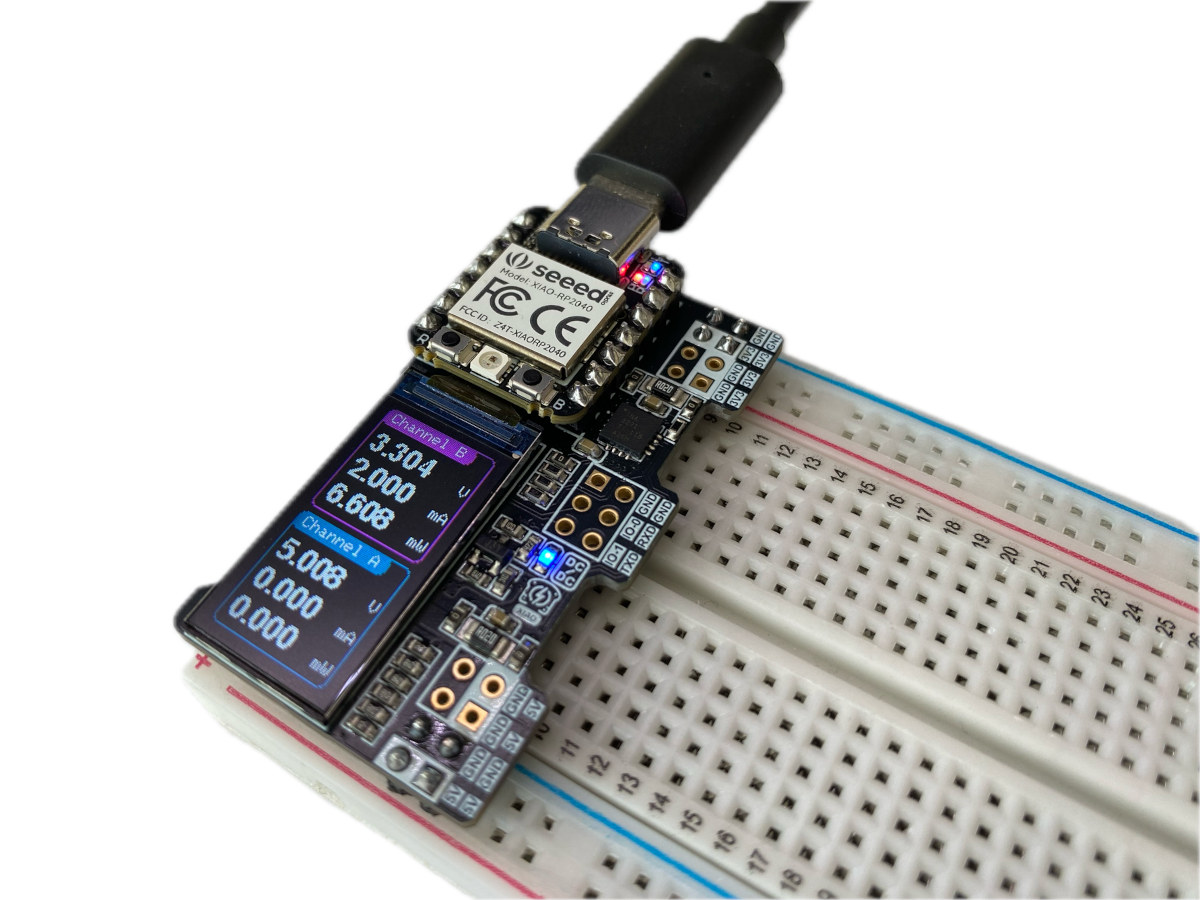
The XIAO Powerbread is a breadboard power supply and meter compatible with XIAO RP2040 or ESP32 USB-C boards and equipped with a color LCD display showing real-time voltage, current, and power consumption for 5V and/or 3.3V power rails. Breadboard power supplies are nothing new. We’ve written about several over the years including the Toaster board with adjustable voltage from 5 to 16V, the SwitchTrick switching power supply board, and the MEGO portable breadboard power supply with a built-in battery. The XIAO Powerbread only supports 5V and 3.3V power rails, but its main selling point is its integrated breadboard power meter function. XIAO Powerbread specifications: Supported USB-C modules General purpose MCU – XIAO RP2040, XIAO RP2350 WiFi / Bluetooth MCU – XIAO ESP32S3, XIAO ESP32C3, XIAO ESP32C6 Display – 0.96-inch color TFT LCD with 160×80 resolution and ST7735S SPI controller Power monitoring – 2x TI INA3221 sensors connected over I2C […]
Jumperless V5 programmable breadboard is based on Raspberry Pi RP2350B, features a built-in power supply (Crowdfunding)
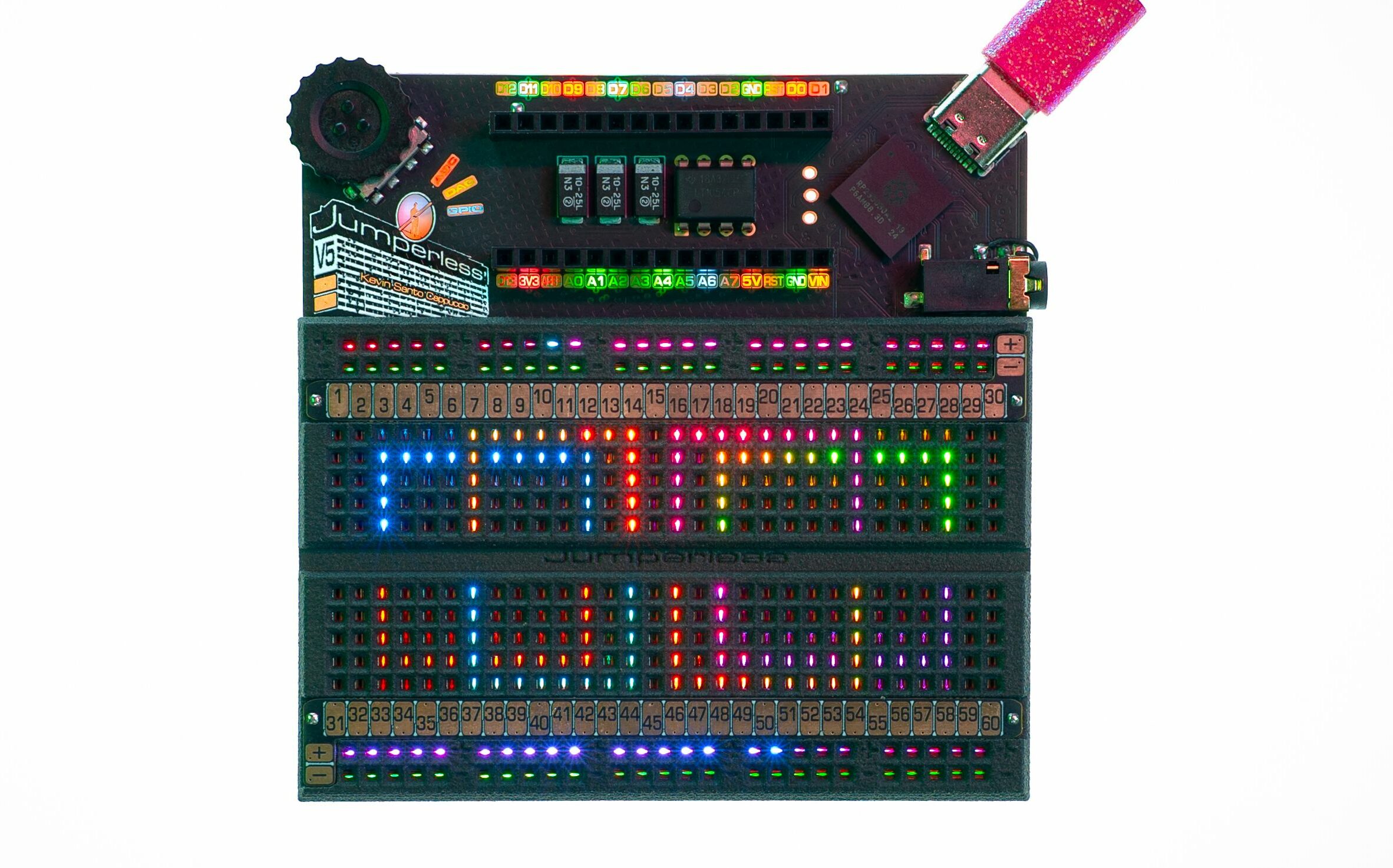
Jumperless V5 is a one-of-a-kind, programmable breadboard based on a Raspberry Pi RP2350B microcontroller that lets you skip the jumper wires and jump right into prototyping. It is described as “an Integrated Development Environment (IDE) for hardware.” The Jumperless V5 also removes the need for test equipment as it comes with built-in power supplies and can function as a multimeter, oscilloscope, function generator, and logic analyzer. As the name implies, the Jumperless V5 breadboard is a revamped version of the original Jumperless, with significant upgrades to make the board easier to use. The Jumperless V5 features a 14 x 30 LED matrix display under the breadboard, a probe for making connections and measurements, four ±8 V, 300 mA power supplies, daisy-chain headers, and overcurrent/overvoltage protection. The software-defined jumpers allow all points to be connected. The four individually programmable ±8 V power supplies, GPIOs, and management channels for voltage, current, and […]