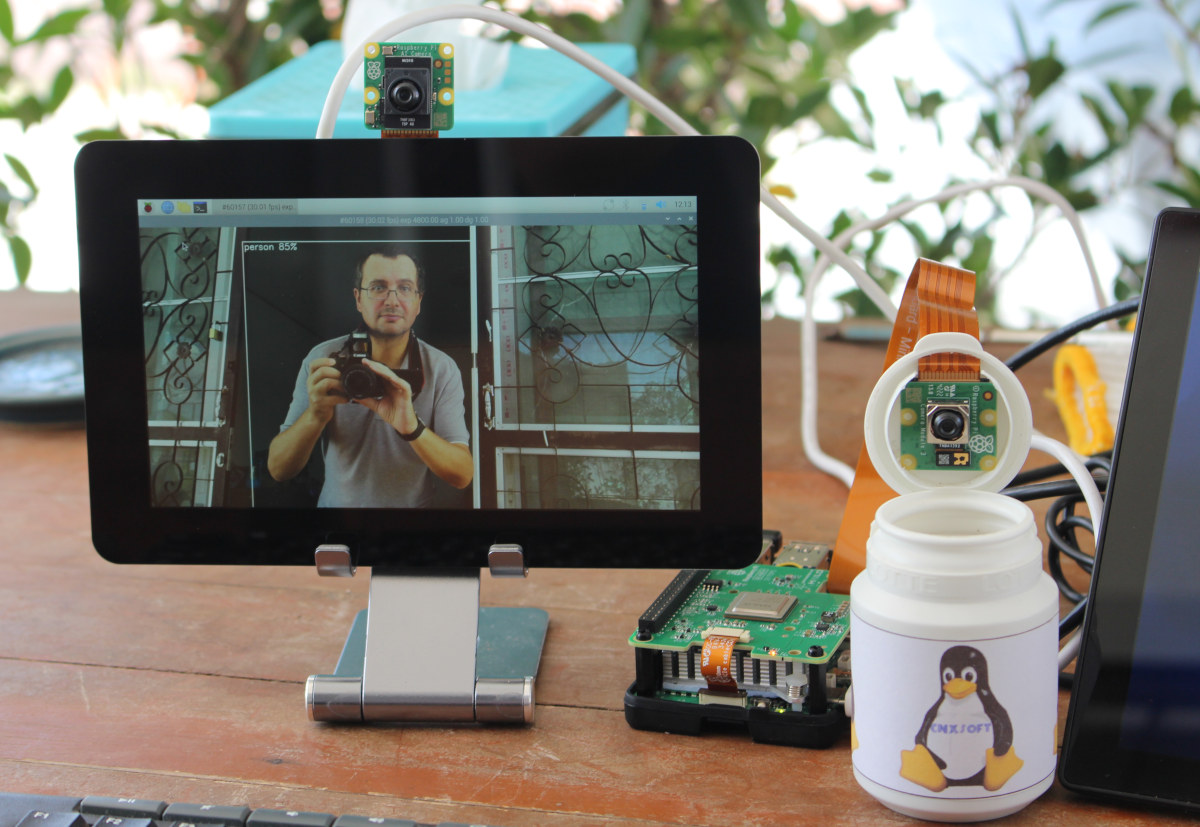
OpenCV 5 open-source computer vision library has recently been released with a brand-new DNN (Deep Neural Network) engine that provides better ONNX coverage and enables LLM/VLM support. The fifth version of the popular CV library also adds support for Intel, Arm, Qualcomm, and RISC-V hardware acceleration, improved 3D vision, and various new core features such as new data types, real N-dimensional and scalar support, and performance improvements. OpenCV 5’s DNN Engine OpenCV 4.x supports about 22% of ONNX operators, and the new DNN engine in OpenCV 5 brings coverage to over 80%. That means models with dynamic shapes that used to fail on OpenCV 4.x, should now work, as the 5.x engine was rebuilt around a typed operation graph with proper shape inference, constant folding, and operator fusion. The table below shows the main difference between OpenCV 4.x and OpenCV 5 Since it’s quite a big change, to make sure […]
Reolink OMVI triple-lens AI security cameras combine 4K PTZ camera with dual-lens system with fixed 180° panoramic view
Reolink has launched the new OMVI Series of triple-lens AI security cameras, featuring a 4K PTZ motorized camera and a fixed dual-lens system that offers a 24/7 180° panoramic view. The camera also supports AI detection and video search, designed to eliminate the typical blind spots of a standard Pan-Tilt-Zoom (PTZ) camera. The series includes three models: the OMVI 3i PoE, OMVI 3i WiFi, and OMVI X16 PoE. All of them use the same basic design, combining a fixed dual-lens camera for a 180° panoramic view with a separate PTZ camera in a single housing. This setup allows the camera to monitor a wide area continuously while the PTZ lens focuses on and tracks specific objects. Reolink OMVI triple-lens security cameras specifications: The OMNI cameras are supported by the Reolink mobile app for iOS 15.1+ and Android 8.0+, the Reolink Client for Windows 8.1+ and macOS 10.15+, Reolink NVR, and […]
Sixfab AI HAT+ for Raspberry Pi 5 integrates DEEPX DX-M1 AI accelerator
Sixfab has launched the AI HAT+ for Raspberry Pi 5, a PCIe HAT+ based on the DEEPX DX-M1 AI accelerator, which we also found in the DEEPX DX-AIPlayer, Mini DX-M1 SoM, and ALPON X5. Unlike the M.2 module used in the ALPON X5, the AI HAT+ has the accelerator soldered directly to the board. It connects to the Pi 5 via the PCIe FFC cable and draws power from the 40-pin header. The board is also available in 13 TOPS and 25 TOPS versions and is designed to run vision AI tasks such as object detection and segmentation locally on the Pi 5. Sixfab AI HAT+ specifications: Supported SBC – Raspberry Pi 5 AI Accelerator (one or the other): DEEPX DX-M1M with up to 25 TOPS (INT8), 1 GB LPDDR4X NPU memory DEEPX DX-M1ML with up to 13 TOPS (INT8), 512 MB LPDDR4X NPU memory Host Interface – PCIe Gen […]
Nuvoton NuMaker-GestureAI-M55M1 module combines Cortex-M55 MCU with GC0308 camera for AI gesture control
Back in November last year, we covered the launch of the NuMicro M55M1 MCU from Nuvoton, which combines an Arm Cortex-M55 core with an Ethos-U55 microNPU for on-device AI and gesture control. Now, they have released the NuMaker-GestureAI-M55M1, a development module based on that MCU for AI vision-related applications. This new board integrates the M55M1 MCU with a GC0308 CMOS image sensor, a digital microphone, and a microSD card slot for storing AI models. It is designed for applications such as gesture control, basic vision systems, and touchless interfaces. NuMaker-GestureAI-M55M1 specifications: MCU – Nuvoton NuMicro M55M1R2LJAE CPU – Cortex-M55 MCU @ 220 MHz Memory – 1.5 MB SRAM Storage – 2 MB Flash AI Accelerator – Arm Ethos-U55 micro-NPU @ 220 MHz Storage – MicroSD card slot (located on the back) for storing AI model files Camera – Integrated VGA GC0308 CMOS image sensor Audio – On-board digital microphone (DMIC) USB – […]
Radxa’s 2026 Qualcomm hardware: Dragon Q8B and Q5E SBCs, DragonStation and DragonBay NAS systems
Radxa started its partnership with Qualcomm last with the Dragon Q6A SBC, but it turns out it was just the start, and the company showcased more Qualcomm SBCs and NAS systems at a Radxa + Qualcomm developer day on May 30, 2026. The Radxa Q8B SBC will be based on a Qualcomm Snapdragon 8cx Gen3 octa-core SoC and the Q5E SBC on a Dragonwing QCS6690 octa-core Kryo SoC. The company also teased DragonStation and DragonBay NAS systems, and a 2026 roadmap features a total of 22 Qualcomm systems made by Radxa. Radxa Dragon Q8B Dragon Q8B specifications: SoC – Qualcomm Snapdragon 8cx Gen 3 compute platform Octa-core CPU – 4x 3.0 GHz Kryo Prime cores, 4x 2.4 GHz Kryo Efficiency Cores GPU – Adreno 690 GPU with DirectX 12 (DX12) API support DSP – Qualcomm Hexagon Processor, Qualcomm Sensing Hub AI – Qualcomm Neural Processing Engine SDK support for AI […]
Privacy-focused, open-source Raspberry Pi Zero 2W DIY security camera offers end-to-end encryption, on-device AI
Secluso is a private, open-source, DIY home security camera system built around the Raspberry Pi Zero 2 W, featuring true end-to-end encryption (E2EE) and on-device AI for human, pet, and vehicle detection. It was designed as an alternative to commercial smart home cameras that require sending raw video feeds to a proprietary cloud, a practice that often raises significant privacy concerns. Developed by Secluso, Inc., co-founded by UC Irvine professor Ardalan Amiri Sani and John Kaczman, the project utilizes Messaging Layer Security (MLS, RFC 9420) to ensure end-to-end encryption between the camera and the user’s smartphone. Because the system uses an untrusted relay (either self-hosted on a VPS or via Secluso’s free beta relay), the server routing the footage only sees encrypted files and cannot decrypt the video or thumbnails. Secluso hardware requirements: SBC – Raspberry Pi Zero 2W Camera – Raspberry Pi Camera Module V1 (OV5647) or V2 (IMX219) […]
reComputer RK3576/RK3588 Edge AI computers are supported by reComputer AI Lab one-click deployment platform
Seeed Studio has just launched the reComputer RK3576/RK3588 Edge AI computers designed for developers, embedded AI innovators, robotics, industrial AI, vision AI, local LLMs, and real-world edge deployment. Rockchip RK3576 and RK3588 computers are pretty common these days, and the Seeed Studio models offer triple video output, dual Ethernet (GbE or 2.5GbE), several USB ports, and M.2 expansion. But the most interesting part is probably the software with Armbian-based Linux OS and support for the reComputer AI Lab platform that enables one-click deployment of AI-accelerated computer vision, audio, and LLM/LVM demos. reComputer RK3576/RK3588 specifications: SoC (one or the other) Rockchip RK3576 Octa-core CPU – 4x Cortex-A72 cores at 2.2GHz, 4x Cortex-A53 cores at 1.8GHz GPU – ARM Mali-G52 MC3 GPU NPU – 6 TOPS (INT8) AI accelerator with support for INT4/INT8/INT16/BF16/TF32 mixed operations. VPU Video Decoder: H.264, H.265, VP9, AV1, and AVS2 up to 8K at 30fps or 4K at […]
Coralboard features Synaptics Astra SL2619 Edge AI SoC, supports Google Gemma 3 inference
Synaptics Coralboard is a development board powered by a Synaptics Astra SL2619 Edge AI SoC with a 1 TOPS Synaptics Torq inference engine implementing a Google Coral NPU, and supporting hardware-accelerated Google Gemma 3 lightweight models. The board features 2GB of RAM and offers MIPI camera and display interfaces, a microSD card slot, a USB Type-A port, microphone inputs (I2S), mikroBUS and Qwiic- expansion connectors, and optional Wi-Fi and Bluetooth connectivity through an M.2 expansion slot. Synaptics Coralboard specifications: System-on-module – Grinn AstraSOM-261x SoC – Synaptics Astra SL2619 SoC with 2x Cortex-A55 cores @ 2GHz, 1x Cortex-M52 core @ 200MHz, and 1 TOPS Synaptics Torq (Google Coral NPU) System Memory – 2GB DDR4 @ 3200Mbps (optionally 1GB) Storage – 16GB flash, up to 64GB Input Voltage – 3.2V to 5.5V Dimensions – 25 x 25mm, LGA178 package Storage – MicroSD card slot for mass storage Display – 4-lane MIPI DSI connector […]