ESP-FLY DIY kit is a miniature DIY drone kit based on Seeed Studio’s XIAO ESP32-S3 board that was initially introduced as a DIY project on Instructables by Max Imagination, but is now available as a complete kit for $59.99 on Seeed Studio. It’s certainly not the first ESP32 drone, but the ESP-FLY drone must be the smallest, as the miniature (67 x 67 x 31mm) quadcopter design allows users to store into any pocket or small boxes. It’s mainly designed for STEM education, hobbyist DIY Projects, and indoor flight practice. ESP-FLY drone kit key features and specifications: Main Controller – Seeed Studio XIAO ESP32-S3 board Wireless MCU – Espressif Systems ESP32-S3R8 CPU – Dual-core Tensilica LX7 microcontroller @ 240 MHz System Memory – 512KB SRAM, 8MB PSRAM Wireless – Wi-Fi 4 & Bluetooth 5.0 dual-mode (Classic + BLE) connectivity Storage – 8MB SPI flash Antenna – External u.FL antenna USB […]
MiciMike’s open-source drop-in PCB converts Google Home Mini into a local voice assistant (Crowdfunding)
The MiciMike Home Mini Drop-In PCB is an open-source replacement mainboard designed to convert a 1st Gen Google Home Mini into a fully local, privacy-focused voice assistant running Home Assistant Voice. Built around an ESP32-S3 MCU and an XMOS XU316 audio processor, it removes cloud dependencies without any case modifications or soldering. The board offers on-device wake word detection, echo cancellation, and noise suppression via two MEMS microphones, and comes pre-flashed with ESPHome for easy Home Assistant integration. The PCBA fully supports local voice processing, optional cloud LLM integration, media playback, and Snapcast. It’s released as open hardware under the CERN-OHL-S v2 license, with complete design files available, making it suitable for privacy-focused smart-home automation, DIY voice assistants, and hardware-reuse projects. MiciMike Home Mini Drop-In PCB specifications: Compatibility – Google Home Mini 1st generation Wireless MCU – Espressif Systems ESP32-S3 CPU – Dual-core Xtensa LX7 microcontroller @ up to 240 […]
DIY Sendspin audio receiver supports multi-room audio synchronization, integrates with Home Assistant
SendspinZero is an open-source, DIY Sendspin audio receiver for your amplifier that relies on off-the-shelf parts costing around $10 and a 3D printed enclosure. It integrates with Home Assistant for multi-room audio synchronization. It sounds good, but what is Sendspin exactly? It’s a royalty-free, open protocol developed by the Open Home Foundation for synchronized audio playback across multiple devices and rooms. Besides audio, it also supports screens for album art and control music, and sound-activated lights (coming soon feature). The protocol enables open-source products that compete against proprietary systems like Sonos, AirPlay, or Google Cast, and integrates nicely with the Music Assistant add-on for Home Assistant. Sendspin audio receiver key components: Waveshare ESP32-S3-Zero board with 2MB PSRAM (About $4-$6 on AliExpress, $12 on Amazon), ideally the version without pre-soldered headers Optional 1.54-inch LCD screen (About $5 on AliExpress) Optional 3-6V, 22mm bi-color button (About $2 to $3) Audio output options: […]
reBot Arm B601-DM – An open-source 6+1 DoF robotic arm for embodied AI and teleoperation applications
Seeed Studio reBot Arm B601-DM is a fully open-source 6-axis robotic arm (plus a parallel gripper) designed to lower the barrier to entry for embodied AI learning and teleoperation. Built around high-performance Damiao actuators, the arm offers up to 767mm of reach, a 1.5kg payload capacity, and high-precision 0.2mm repeatability. Designed for researchers and robotics developers, the B601-DM is compatible out of the box with major AI and robotics frameworks, including ROS 1/2, Hugging Face’s LeRobot, NVIDIA Isaac Sim, and Pinocchio. Seeed Studio reBot Arm B601-DM specifications: Communication – CAN bus @ 1Mbps) and UART @ 921600bps Degrees of Freedom (DOF) – 6-axis arm + 1 parallel gripper Motors / Actuators – 7x Damiao motors 4x DAMIAO 4310 (DM-J4310-2EC) 3x DAMIAO 4340P (DM-J4340P-2EC) high-torque motors Payload – 1.5kg (without gripper, at recommended 70% reach) Reach – 767mm (with gripper), 607mm (without gripper) Repeatability – < 0.2 mm Joint torque and […]
Bee Write Back – A Raspberry Pi Zero 2 W-based DIY writerdeck with 5.5-inch OLED and mechanical keyboard
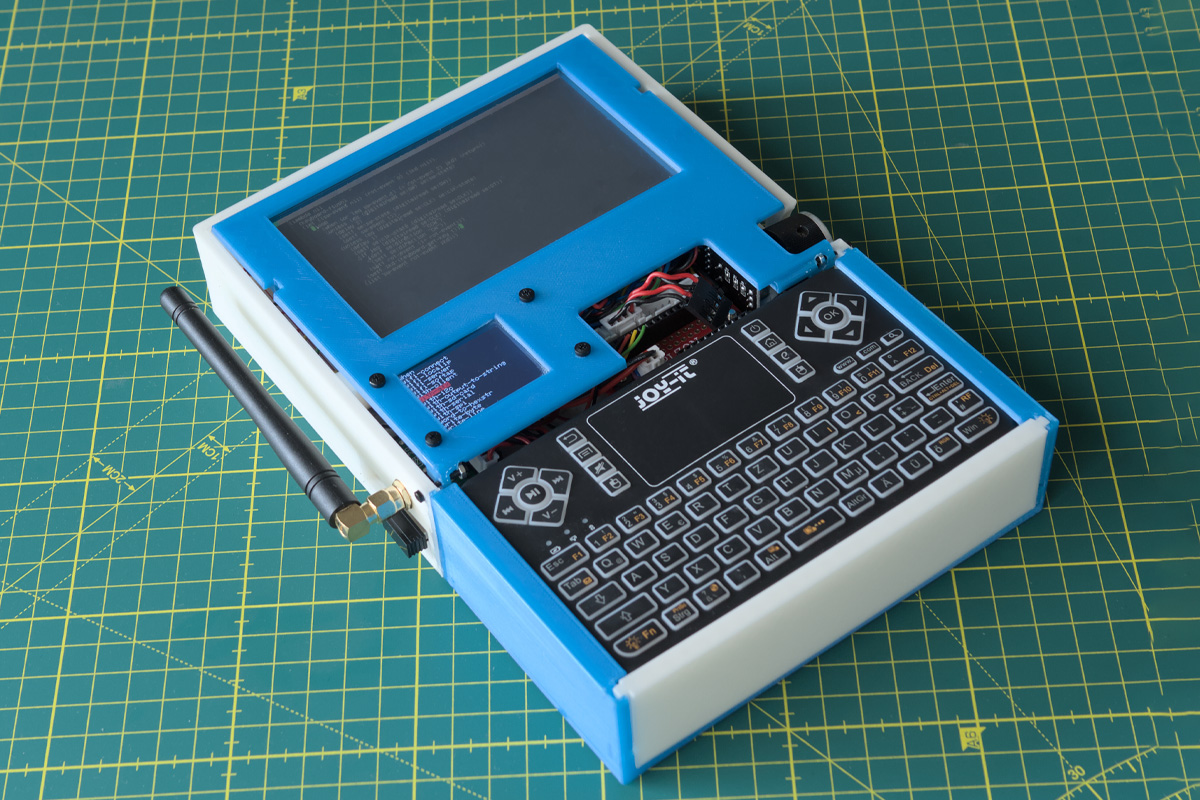
Based on Raspberry Pi Zero 2 W, the Bee Write Back writerdeck is another DIY project that should be relatively easy to reproduce, since it relies on off-the-shelf parts, including an OLED and mechanical key switches and caps, as well as a 3D printed enclosure. Simon (shmimel) had trouble falling asleep and found out that journaling helped him a lot, but he was not so fond of writing in a physical journal. So instead, he created the Bee Write Back journal/writerdeck as a distraction-free writing machine, and the result looks pretty neat. Bee Write Back key components: Raspberry Pi Zero 2 W SBC with Broadcom BCM2711 quad-core Cortex-A53 SoC, 512 MB RAM, WiFi 4 and Bluetooth 4.2 Display – 5.5-inch AMOLED screen with 1280 x 720 resolution($52 on AliExpress) Keyboard accessories 47x switches 47x keycaps YMDK Air40 keyboard PCB (about $30 on AliExpress) Power – Seengreat Pi Zero UPS USB HUB […]
Flash Bee – An ESP32-C3-based DIY handheld lightning detector
Flash Bee is an easy-to-make DIY handheld lightning detector based on off-the-shelf parts such as the XIAO ESP32C3 board and the Round Display for XIAO, as well as a 3D-printed enclosure. The design relies on the AMS AS3935 Franklin lightning sensor that’s been around for years, and found in kits like Sparkfun’s Arduino IoT weather station, which is capable of detecting lightning up to 40 km away with 1km accuracy. While it’s not quite new technology, I found the Flash Bee design to be rather cute and convenient, and it looks really easy to reproduce. Flash Bee key components: Seeed Studio XIAO ESP32-C3 with Wi-Fi 4 & Bluetooth LE 5.0 connectivity ($4.90) Round Display for XIAO – 1.28-inch touchscreen display with 240×240 resolution, 65K colors, 100 Hz refresh rate ($18) Grove Lightning Sensor AS3935 ($26.90, alternative link if out of stock) 3.7V 400mAh LiPo battery Slide switch 2x M2 5mm […]
DIY ESP32-S3 Internet radio features Winamp-styled user interface
Volos Projects recently showcased an easy-to-reproduce, inexpensive DIY ESP32-S3 Internet radio based on a Waveshare ESP32-S3-LCD-1.54 development board and an Arduino sketch with a Winamp-styled user interface. As its name implies, the hardware is based on the ESP32-S3 WiFi and Bluetooth SoC, connected to a 1.54-inch 240×240 color display and a speaker that delivers better-than-expected audio quality, according to Volos Projects. Waveshare ESP32-S3-LCD-1.54 specifications: SoC – Espressif ESP32-S3R8 CPU – Dual-core Tensilica LX7 microcontroller up to 240 MHz with vector instructions for AI acceleration Memory – 512KB SRAM, 8MB PSRAM Wireless – WiFi 4 and Bluetooth 5.0 LE + Mesh connectivity Storage 16MB NOR flash MicroSD card slot Display 1.54-inch IPS display with 240×240 resolution, 262K colors 4-wire SPI ST7789 driver Optional CST816 capacitive touch controller (not used by the DIY Radio project) Audio Speaker 2x microphones NS4150B audio amplifier ES8311 low-power audio codec ES7210 AEC (acoustic echo cancellation) chip USB […]
AERIS-10 open-source hardware radar can track multiple objects up to 20km away
AERIS-10 is an open-source hardware, “low-cost” (more on that later) 10.5 GHz phased array radar system featuring Pulse Linear Frequency Modulated (LFM) modulation and based on an AMD Artix-7 FPGA. Two versions are available: the AERIS-10N (Nexus), providing up to 3km range with an 8×16 patch antenna array, and the AERIS-10X (Extended), offering up to 20km range thanks to a 32×16 dielectric-filled slotted waveguide array. ARIES-10 key components and features: Main board FPGA – AMD Artix-7 XC7A100T for: PLFM Chirps generation via the DAC Raw ADC data read Automatic Gain Control (AGC) I/Q Baseband Down-Conversion Decimation Filtering Forward FFT Pulse Compression Doppler, MTI, and CFAR processing USB Interface MCU – ST STM32F746xx microcontroller for Power management FPGA communication Setup and interface with the components on the main, frequency synthesizer, and power amplifier boards, plus: GPS module for GUI map centering GY-85 IMU for pitch/roll correction of target coordinates BMP180 Barometer […]