
Rockchip RK3588 and RK3576 H.264 and H.265 video decoders gain mainline Linux support

Rockchip RK3588 RK3576 main linux H.265 H.264 video decoders

VDPU381 and VDPU383 video decoders are found in Rockchip RK3588 and RK3576 SoCs and variants like the RK3588S and RK3576J. So far, we had to rely on the Rockchip BSP to support hardware video decoding, but Collabora has just announced upstream/mainline Linux support for H.264 (AVC) and H.265 (HEVC) video decoding for RK3588 and RK3576 SoCs. Highlights of H.265/H.264 video decoder implementation on mainline Linux: A 17-patch series adding decoder support, in addition to dt-bindings and device tree nodes New V4L2 HEVC UAPI controls for explicit short-term and long-term RPS (Reference Picture Set) handling Fixing a non-obvious IOMMU restore issue caused by decoder-embedded IOMMU resets Struct-based register programming model to enforce completeness, ordering, and future multi-core readiness The new V4L2 UAPI controls for HEVC long and short-term Reference Picture Set (RPS) are required for the VDPU381 (RK3588) and VDP383 (RK3576) video decoders, contrary to some other decoders (e.g., VeriSilicon) that […]

M5Stack AI-8850 LLM Accelerator M.2 Kit offers an alternative to Raspberry Pi AI HAT+ 2

M5Stack AI-8850 LLM accelerator M.2 kit

M5Stack has launched the “AI-88502 LLM Accelerator M.2 Kit 8GB Version” based on its LLM-8850 M.2 card with a 24 TOPS Axera AX8850 SoC, and offering an alternative to the Raspberry Pi AI HAT+ 2, supporting both LLM and AI vision workloads. The kit is comprised of the M.2 card and a Raspberry Pi-HAT 8850 board with USB PD power input for the card and Raspberry Pi 5, a 16-pin PCIe connector and 40-pin GPIO header for connection to the SBC, as well as accessories. M5Stack AI-8850 LLM accelerator M.2 kit specifications: M5Stack LLM‑8850 M.2 card SoC – Axera AX8850 CPU – Octa-core Cortex‑A55 processor at 1.7 GHz NPU – 24 TOPS @ INT8 VPU Video Encoder – 8K @ 30 fps H.264/H.265 encoding, supports scaling / cropping Video Decoder – 8K @ 60 fps H.264/H.265 decoding, supports 16 channels 1080p parallel decoding, supports scaling / cropping Memory (two options) 8GB 64‑bit LPDDR4x @ 4266 Mbps 4GB 64-bit LPDDR4x, 4266 Mbps (not […]

MUSE Book laptop review – Testing an octa-core RISC-V Linux laptop in 2026

MUSE Book RISC-V Laptop Review 2026

SpacemiT sent me a sample of the MUSE Book RISC-V Linux laptop for review. It’s based on the SpacemiT K1/M1 octa-core 64-bit RISC-V SoC, ships with up to 16 GB of RAM, eMMC flash and/or NVMe SSD, and features a 14.1-inch IPS display with 1920×1080 resolution, WiFi 6 connectivity, a few USB ports, and more. I won’t go through all the hardware specifications since Leo already did that when he wrote about the MUSE Book Laptop in April 2024, along with a teardown, and additional details about the SpacemiT K1/M1 SoC. I’ll still do an unboxing and quickly check the hardware, but I’ll focus on the software part to show the progress with Bianbu OS 2.3 (Ubuntu 24.04-based) on RISC-V hardware, as I just did for the low-end StarFive JH7110S-based VisionFive 2 Lite SBC. It’s quite a long review, so if you are short on time, you can jump directly […]

VisionFive 2 Lite SBC Review – Ubuntu 24.04 on a low-cost RISC-V SBC in 2026

VisionFive 2 Lite RISC-V SBC Ubuntu Review 2026

StarFive has sent me a sample of the VisionFive 2 Lite RISC-V SBC for review. It’s a low-cost credit card-sized board based on the StarFive JH7110S quad-core RISC-V SBC and designed to get started with Linux RISC-V on the cheap. When I first tested the earlier VisionFive 2 SBC with a StarFive JH7110 RISC-V SoC in February 2023, I didn’t call it a review, but rather a hands-on experience, since, at the time, many features still didn’t work properly. Almost three years have passed since then, so reviewing the VisionFive 2 Lite SBC with Ubuntu 24.04 will allow us to see how much progress has been made on the software side. If you are in a rush, you can jump to the what works, what doesn’t section. VisionFive 2 Lite unboxing I received the board in a plastic box with a cover reading “VisionFive 2 Lite Your Gateway to RISC-V”. […]

Ugoos AM9 Android 14 TV box features Amlogic S905X5 Armv9 SoC, supports H.266 and AV1 codecs

Ugoos AM9

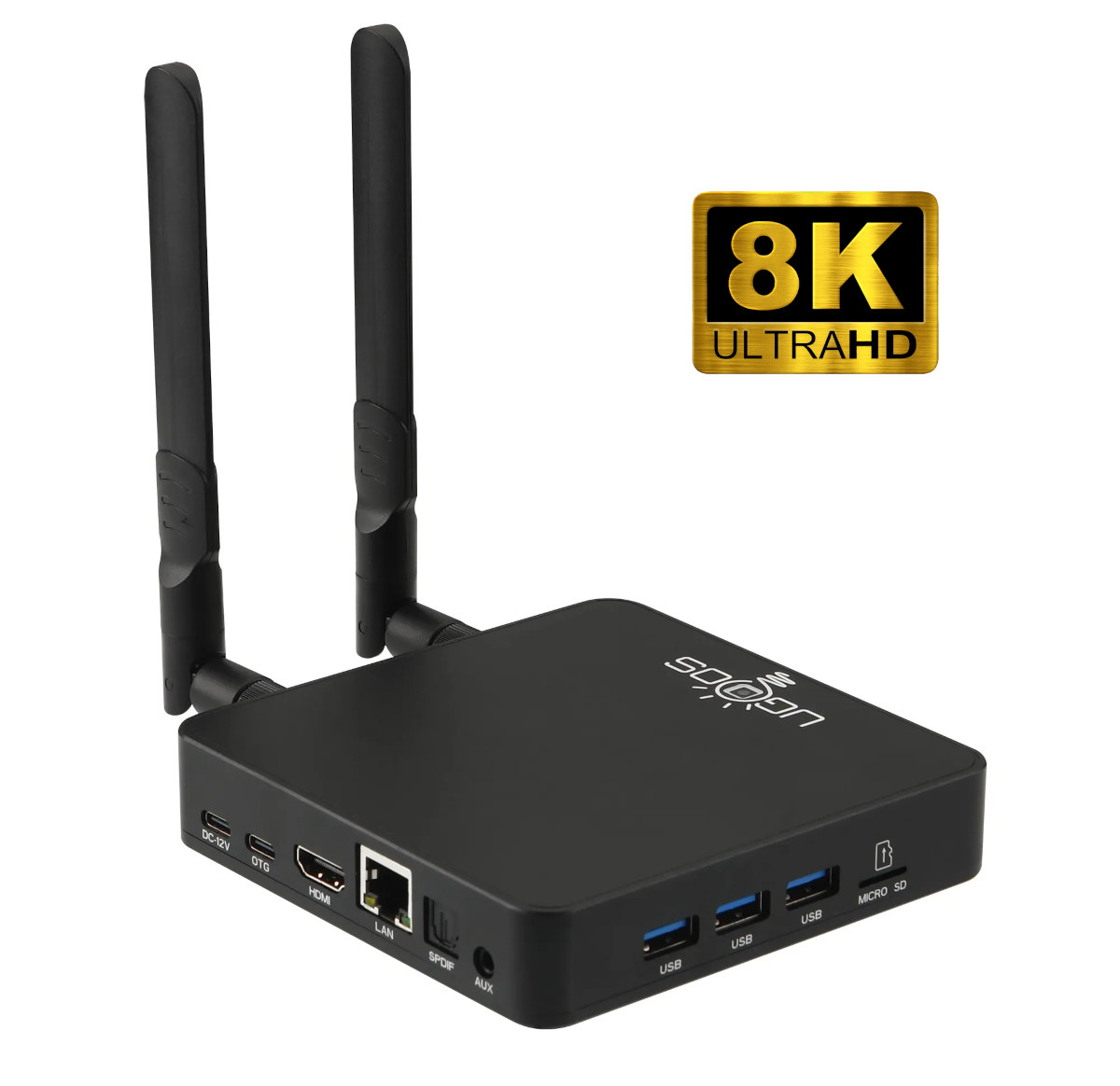
Ugoos AM9 is an Android 14 TV box powered by an Amlogic S905X5 quad-core (Armv9) Cortex-A510 SoC, which supports features such as H.266 and AV1 hardware video decoding and AI Super Resolution (AI-SR) through the built-in 4 TOPS NPU. We first noted the Amlogic S905X5 SoC in an upcoming SEI Robotics TV box about two years ago. Details were sparse at the time, and in the meantime, Amlogic introduced the similarly named S905X5M, which is still a “regular” Armv8 SoC with four Cortex-A55 cores, and found in products such as ODROID-C5 SBC and Ugoos X5M Pro. However, I had not heard anything about the more powerful S905X5 SoC until I came across the Ugoos AM9 TV box this morning. Ugoos AM9 specifications: SoC – Amlogic S905X5 CPU – Quad-core Cortex-A510 Armv9 processor delivering 40K+ DMIPS GPU – Arm Mali-G310 V5 GPU clocked at 1 GHz for 4K HDR user interfaces […]

OMBAR DC42 Dash Cam Review – A 4K+1080p dash cam with dual-band WiFi and GPS

OMBAR DC42 dash cam review

We’ve been sent the OMBAR DC42 Dash Cam for review. It’s a car dash cam kit with a 4K UHD front camera and a 1080p FHD rear camera, each with a wide F1.8 aperture that allows more light for clear images day and night. The kit ships with a 64GB microSD card and supports cards with up to 256GB capacity. The distraction-free, screenless camera supports dual-band (2.4 + 5GHz) WiFi connectivity, GPS location recording to show driving routes, voice guidance, and in-car audio recording. The dash cam also includes accident detection with a G-sensor and a 24-hour parking mode, but the latter requires the optional OMBAR 3-lead hard-wire kit, which sadly was not included in our kit. In this review, we will start with the specifications of the OMBAR 42 dash car, go through an unboxing, report our experience installing the cameras in our car (spoiler: it’s much easier than […]

LinkPi ENC1Pro 4Kp60 HDMI video encoder supports NDI HX, Tally light, and 4G/5G/Wi-Fi USB Expansion
LinkPi ENC1Pro NDI Video Encoder

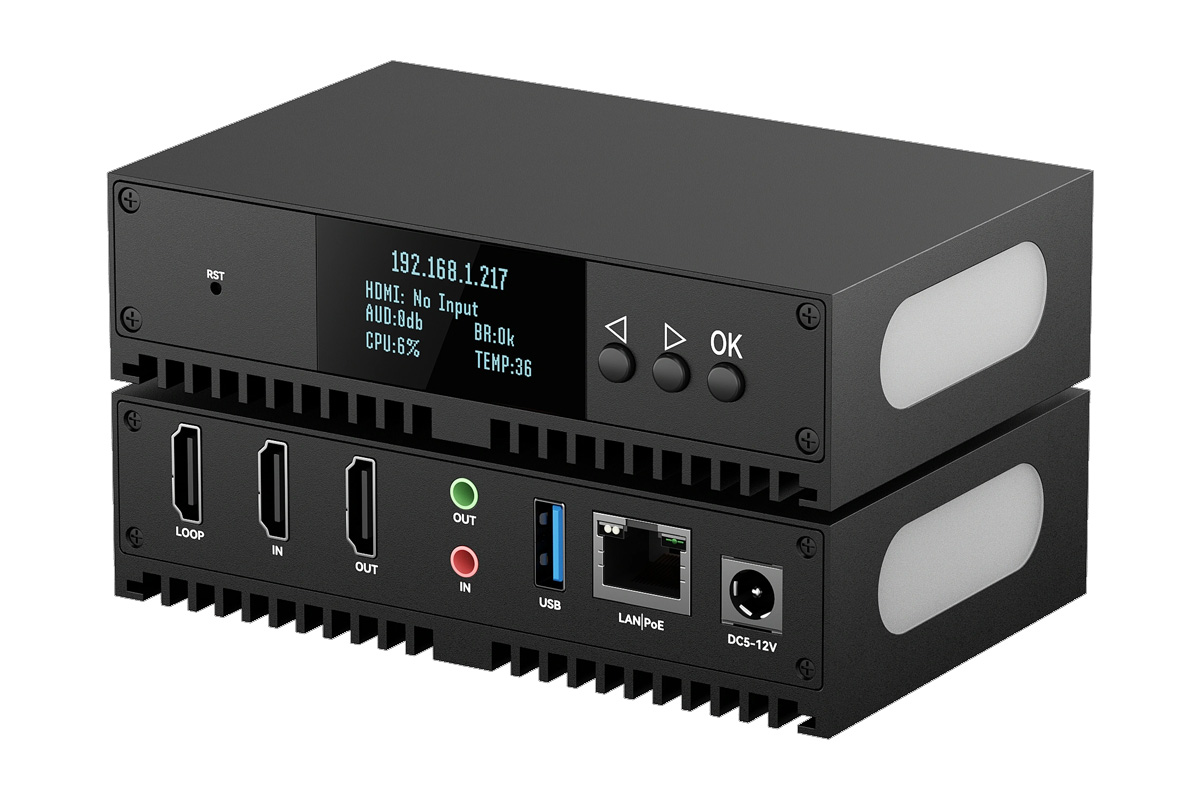
The LinkPi ENC1Pro is a compact, high-performance 4Kp60 HDMI video encoder designed for professional live streaming and broadcasting applications. It supports two HDMI 2.0 inputs and outputs with resolutions up to 4K @ 60fps, and is equipped with a built-in Tally light for studio use. Powered by an unnamed quad-core Arm Cortex-A55 processor coupled with 4GB DDR4 RAM and 8GB eMMC flash, the device supports H.265 (HEVC), H.264, and MJPEG compression formats. It is compatible with various streaming protocols, including NDI HX (license required), RTSP, RTMP, SRT, HTTP, HLS, and ONVIF. Other features include real-time picture-in-picture, multi-view, watermarking, subtitles, audio mixing, and video recording in formats such as MP4, MOV, and MKV. The ENC1Pro also supports AAC, MP3, OPUS, and other audio codecs, and includes 3.5mm stereo audio I/O alongside HDMI audio. It also offers flexible network connectivity with Gigabit Ethernet, USB expansion for 4G/5G/Wi-Fi modules, and supports remote management […]

Pine64 StarPro64 is a RISC-V SBC with ESWin EIC7700X AI SoC, 32 GB LPDDR5

StarPro64 SBC

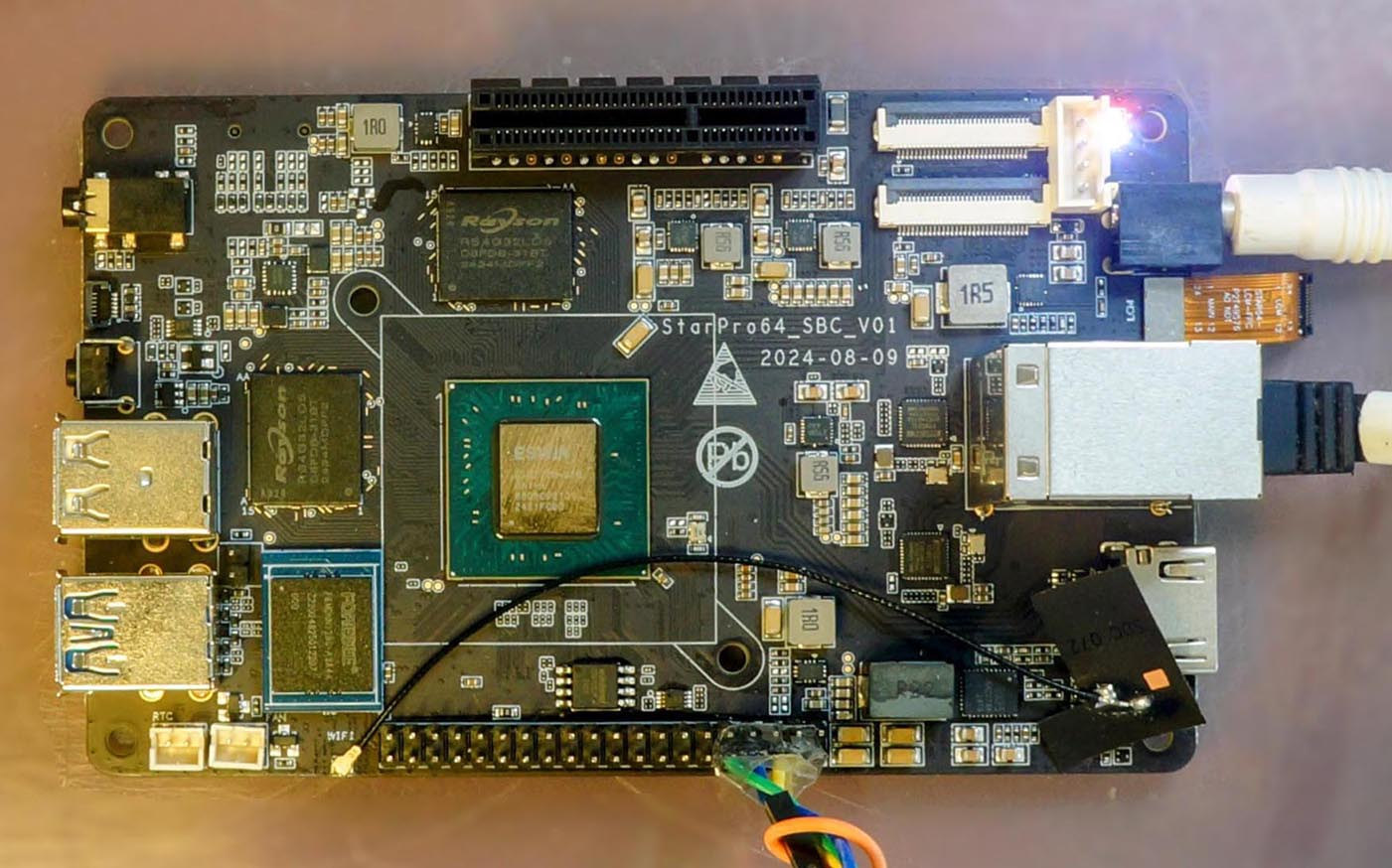
Pine64 StarPro64 is a single board computer (SBC) powered by an ESWin EIC7700X quad-core 64-bit RISC-V SoC with a 19.95 TOPS AI accelerator and equipped with up to 32GB LPDDR5 RAM. It has a similar design to the Star64 SBC powered by a StarFive JH7110 RISC-V SoC, and features HDMI video output, MIPI DSI and CSI display/camera interfaces, two gigabit Ethernet ports, four USB ports, a 40-pin GPIO header, and a PCIe Gen3 x4 slot. The OS can boot from a microSD card or an eMMC flash module. StarPro64 specifications: SoC – ESWIN EIC7700X CPU 4x SiFive Performance P550 RV64GC RISC-V cores @ up to 1.4GHz or 1.8GHz with Cortex-A75-class performance 32KB(I) + 32KB(D) L1 Cache 256KB L2 Cache 4MB shared L3 Cache Cache supports ECC (supports SECDED) NPU – Up to 19.95 TOPS in INT8, 9.975 TOPS in INT16, and 9.975 FTOPS in FP16 Vision Engine HAE (2D Blit, […]

Exit mobile version