SN1 Solar Node – An ESP32-C3-based board with IP67 enclosure, solar charging, ESPHome firmware

WiFi IoT Solar Node Dev Board ESPHome

Designed by Granz Scientific LLC, the SN1 Solar Node is an ESP32-C3-based IoT node/development board designed specifically for off-grid IoT projects. Development boards like Seeed Studio Wio Tracker, or industrial controllers like DFRobot LoRaWAN Control Terminal, allow you to handle your own battery management and weatherproofing, or on the other end, you have products like SenseCAP Solar Node P1 that come with everything integrated but do not allow adding custom hardware. This is where the SN1 Solar Node is different; it features an IP67-rated enclosure with an integrated solar panel on the lid, 18650 battery support, and prototyping strip-board areas for custom circuitry. It also includes a smart power switch that allows the battery to continue charging from the solar panel even when the board is powered off. Additionally, it provides battery voltage monitoring, breaks out most GPIOs for easy access, and includes optional jumpers for an onboard LED and […]

Digi IX25 – A rugged 5G RedCap/eMBB industrial cellular router

Digi IX25 5G Industrial Cellular Router

Digi International Digi IX25 is a rugged, industrial 5G cellular router designed for critical and enterprise applications. Built around a 1.2 GHz quad-core Cortex-A53 processor, this router combines cellular networking, edge computing, remote management, and secure connectivity into a single device, simplifying deployment across utilities, oil & gas, transportation, kiosks, ATMs, and digital signage. The platform comes in multiple variants, including 5G eMBB (Enhanced Mobile Broadband), 5G RedCap (Reduced Capability), and LTE-only, with some models supporting Wi-Fi 6E and others not. Other features, including dual SIM + eSIM for remote provisioning, four Gigabit Ethernet ports, GNSS, serial, and GPIOs, stay the same across all varieties. It is designed for harsh environments with −40°C to 75°C operation and certifications like C1D2, ATEX, and MIL-STD-810H. Digi IX25 specifications: Processor – 1.2 GHz quad-core ARM Cortex-A53 processor (could be NXP i.MX 8 family or MediaTek/Rockchip based chips) System Memory – 1 GB DDR […]

Toradex OSM and Lino SoMs – 30×30mm NXP i.MX 93/i.MX 91 modules with solder-down or B2B connector designs

Toradex Lino IMX93 B2B System on Module

Toradex has launched two new ultra-compact (30x30mm) System-on-Module (SoM) families: OSM and Lino, powered by NXP i.MX 91 or i.MX 93 Arm Cortex-A55 SoC for Edge industrial and IoT applications. The OSM iMX91 and OSM iMX93 variants comply with the OSM Size-S standard, featuring a 332-ball contact grid designed to be soldered to the carrier board. The Lino is a proprietary format that keeps the OSM Size-S dimensions but features two board-to-board (B2B) connectors offering more flexibility for potential replacement or future upgrades. Toradex Lino iMX91/iMX93 system-on-module Toradex Lino specifications: SoC (one or the other) NXP i.MX 93 CPU 2x Arm Cortex-A55 up to 1.7 GHz 2x Arm Cortex-M33 up to 250 MHz GPU – PXP 2D GPU with blending/composition, resize, and color space conversion NPU – Arm Ethos-U65 NPU @ 1 GHz up to 0.5 TOPS Security – EdgeLock Secure Enclave NXP i.MX 91 CPU – Single-core Arm Cortex-A55 […]

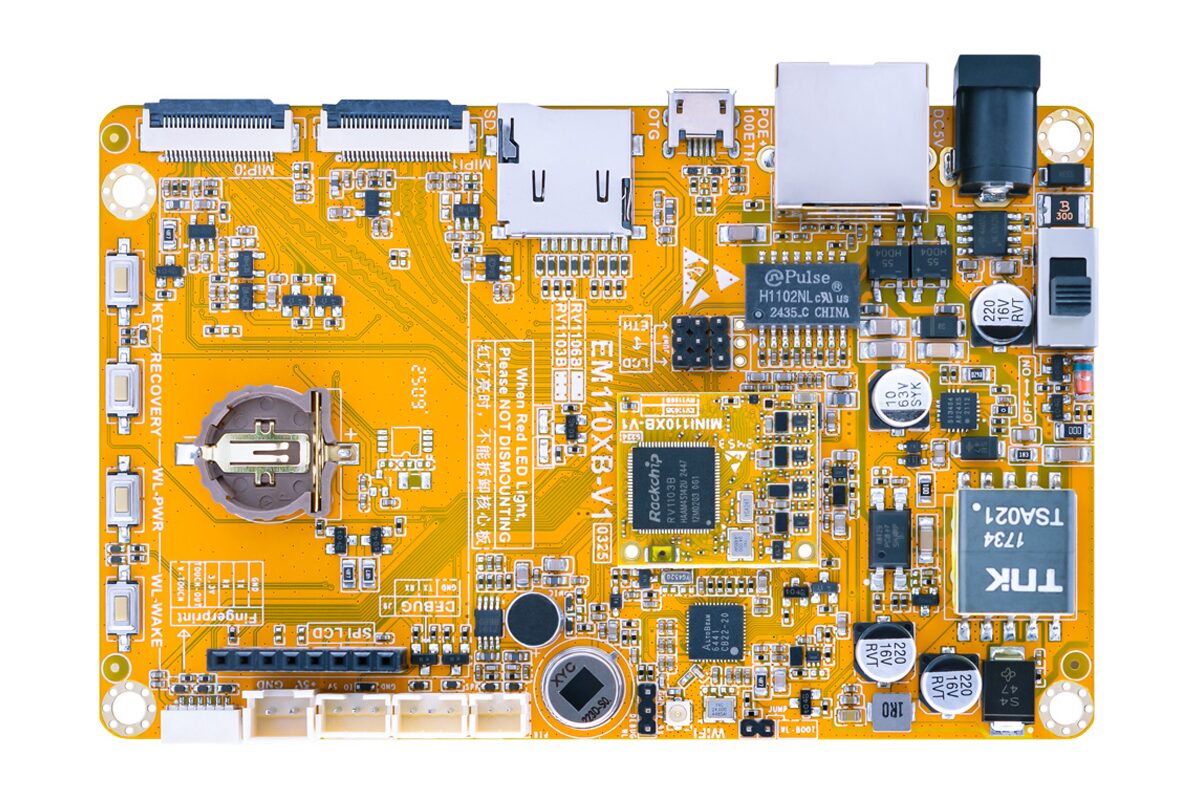
Rockchip RK3506J-based Forlinx FCU1501 fanless industrial IoT gateway offers dual Ethernet, plenty of I/Os and serial interfaces

Forlinx FCU1501 Embedded Computer

Forlinx Technology has recently introduced the FCU1501, a rugged, fanless industrial embedded computer and IoT gateway built around the Rockchip RK3506J processor with a tri-core Cortex-A7 and a single Cortex-M0 core. The system is designed for high-reliability data acquisition and protocol conversion in harsh environments. The gateway comes in two variants (basic and extended), which have similar dimensions but differ mainly in interface density. Both models feature up to 512MB DDR3 RAM, 8GB eMMC flash, dual Fast Ethernet, dual-band Wi-Fi & Bluetooth 5.0, and 4G LTE Cat 1 support. Applications include automation, rail transit, and smart manufacturing. The system supports a wide industrial temperature range (-40°C to +85°C) and meets Level 3 EMC standards. Forlinx FCU1501 Specifications: SoC – Rockchip RK3506J CPU 3x Arm Cortex-A7 cores up to 1.5 GHz Arm Cortex-M0 real-time core GPU – 2D GPU only No VPU, no NPU System Memory – 256MB or 512MB DDR3 Storage 256MB NAND […]

SparkFun Thing Plus – ESP32-C5 board offers dual-band WiFi 6, Adafruit Feather pinout, LiPo battery support

SparkFun Thing Plus ESP32 C5

Espressif has recently released the ESP-IDF v6.0 framework with support for ESP32-C5 and ESP32-C61, so we can expect more ESP32-C5 boards. Following the launch of boards like DFRobot FireBeetle 2 and the Espressif DevKitC-1, SparkFun has now launched its Thing Plus – ESP32-C5, an Adafruit Feather-compatible board based on the ESP32-C5. The timing is no coincidence. Although the ESP32-C5 dual-band WiFi 6 SoC was announced back in 2022, hardware makers have been waiting for stable software support. With the release of ESP-IDF v6.0, the ESP32-C5 moves from “preview” to “stable” and adds key features, such as Safe Bootloader OTA updates. This enables the ROM bootloader to fall back to a recovery partition if an update fails, making it reliable enough for companies like SparkFun to launch hardware for remote deployments and Matter-compatible smart home applications. SparkFun Thing Plus – ESP32-C5 specifications: Wireless module –  ESP32-C5-WROOM-1 SoC – Espressif Systems ESP32-C5 CPU Single-core […]

u-blox JODY-W6 – NXP IW623/AW693 tri-band Wi-Fi 6E and Bluetooth 5.4 LE audio modules

u blox JODY W6 tri band Wi Fi 6E module for industrial IoT

u-blox has expanded its JODY family of modules with the NXP IW623/AW693-based JODY-W6 series that adds tri-band Wi-Fi 6E and Bluetooth 5.4 (including LE Audio) in a single package. There are seven product variants across five main series models, mainly based on NXP’s IW623 chipset for professional use and the AW692/AW693 for automotive use. The modules are optimized for the parallel operation of Wi-Fi and Bluetooth and target high-throughput, low-latency, and secure connectivity use cases such as industrial automation, healthcare systems, smart buildings, network infrastructure, and in-vehicle infotainment and telematics systems. It has a 15.6 × 19.8 mm LGA form factor, and it’s designed for easy migration within the JODY family. u-blox JODY-W6 specifications Wireless SoC NXP IW623 (Professional grade – JODY-W672, JODY-W673 ) NXP AW692 / AW693 (Automotive grade 2 – JODY-W682, JODY-W683, JODY-W663 ) Connectivity Wi-Fi Standards – Wi-Fi 6E IEEE 802.11a/b/g/n/ac/ax Frequencies – 2.4 GHz (1-13), 5 […]

Rabbit-Labs Flipper Zero ESP32-C5 multi-board features CC1101, GPS, and dual-band Wi-Fi 6

Flipper Zero ESP32 C5 multi board

Designed by Rabbit-Labs EU, the Flipper Zero ESP32-C5 multi-board is an expansion board for the Flipper Zero built around the ESP32-C5 dual-band Wi-Fi 6 (2.4 GHz and 5 GHz) microcontroller. The board also features a TI CC1101 sub-GHz transceiver, a GPS module, an SD card slot, and a USB-C port for power and programming. Last month, we wrote about the ESP32 Marauder 5G Apex 5 module, another ESP32-C5-based add-on for the Flipper Zero that comes with dual-band Wi-Fi 6, two sub-GHz radios, an NRF24 radio, and a built-in GPS module, which makes it quite bulky, to say the least. Compared to that, Rabbit Labs’ multi-board can be considered a stripped-down, simpler alternative, with a more compact design and straightforward setup. ESP32-C5 multi-board specifications: Main module – ESP32-C5-WROOM-1U SoC – Espressif Systems ESP32-C5 CPU Single-core 32-bit RISC-V processor @ up to 240 MHz Low-power RISC-V core @ 40 MHz acting as the […]

SparkFun OpenScale IoT – An ESP32 board with HX711 ADC for smart scales with WiFi and Bluetooth connectivity

SparkFun OpenScale IoT

The SparkFun OpenScale – IoT project is a ready-to-use ESP32-based IoT smart scale with open-source hardware and firmware support that makes it easy to read precise weight data from load cells without writing custom code from scratch for basic operation. It handles amplification via the HX711 24-bit ADC, calibration, temperature compensation (using the onboard TMP102 and an optional external DS18B20 probe), and serial output/configuration through a simple text-based menu. It also features Wi-Fi for live data and OTA firmware updates, requiring no dedicated apps—just standard terminal tools and a browser for viewing data. Additionally, there is a Qwiic I²C connector for adding extra sensors or displays. The board operates from 5 V with a typical current consumption of 80 to 100 mA, supports selectable output data rates of 10 or 80 SPS, and includes an adjustable gain for accurate measurements in long-term monitoring setups. SparkFun OpenScale – IoT Specifications: Wireless […]

Exit mobile version