Creality has sent us a sample of the Pika portable 3D scanner for review. In some ways, it shares some of the features of the high-end Sermoon S1 3D scanner, like blue laser and NIR structured light scanning modes, but it’s more affordable and compact, works out of the box through USB or WiFi, and is offered in a design and form factor similar to an action or point-and-shoot camera. In this review, I’ll start by listing the specifications, then go through an unboxing, and test the Pika with an (underpowered) Android phone, before spending more time testing the portable 3D scanner on a powerful mini PC connected to an NVIDIA GeForce RTX 5060 Ti 16GB GPU dock. Pika 3D scanner specifications and host requirements Pika (CRS15CPK) specifications: SoC – Unnamed octa-core processor clocked at 2.0 GHz Display – 3-inch touchscreen display Scanning Modes 7 Parallel Blue Laser Lines Working […]
Linux 7.1 Release – Main changes, Arm, RISC-V, and MIPS architectures
Linus Torvalds has just released Linux 7.1 on LKML: So it’s only Sunday morning back home, but it’s Sunday afternoon where I am right now, so I’m doing the 7.1 release at the regular time – just not in the regular timezone. This obviously means that the merge window opens tomorrow, but I’ll be in yet another timezone by then, so timing will all be a bit irregular. Normally I try to front-load the merge window and do as much as possible the first few days – this time I’m not sure that will work out with my laptop and a couple of long flights without internet, but I’ve made sure that I have fetched the early pull requests (thank you – you know who you are), so I will be able to do some of it off-line. Anyway, possible slight hiccups in the merge window aside, the news today […]
Creality Sermoon S1 review – Part 3: 3D scanning with Khadas Mind 2 and NVIDIA GeForce RTX 5060 Ti 16GB dock
At the end of last year, I received a Creality Sermoon S1 high-end 3D scanner for review. After checking the specifications and going through an unboxing in the first part of the review, I used the 3D scanner with an Intel Core i5-13500H laptop with 16GB of RAM running Creality Scan 4 software on Windows 11. The laptop specs were below the minimum hardware requirements (NVIDIA GPU, 32GB RAM), and while I managed to scan a face and bust using infrared mode, it was a struggle with 4 to 5 FPS scanning, and I wasn’t able to use Blue light scanning at all. Luckily, shortly after the review, Khadas informed me they planned to send a Khadas Mind Graphics 2 dock featuring an NVIDIA GeForce RTX 560 Ti 16GB graphics card and a Mind 2 mini PC with 32GB of RAM and an Intel Core Ultra 7 155H 16-core Meteor […]
AweSun Cloud KVM Q1 Review – An ultra-compact, low-cost KVM over IP solution tested with Windows 11 and Android clients
AweSun has sent me a sample of their “Cloud KVM Q1” 4K KVM over IP solution for review. It’s a compact device with the minimum number of ports for a connected KVM: USB-C for keyboard and mouse emulation, HDMI input for video, and Ethernet for connectivity to the host. Like other such KVMs, it enables hardware-level remote access even in the BIOS, and the company advertised remote access to server, computer, and mobile phone targets, with the latter requiring an additional USB-C dock for HDMI input. I’ll start the review by going through the specifications, performing an unboxing and a teardown, and testing both mobile and desktop clients with targets like a Raspberry Pi 5 and an Android mobile phone. AweSun Cloud KVM Q1 specifications Here are the specifications from the company: Video Input HDMI port Resolution – Up to 2560 x 1600 with 15 FPS framerate Networking 100Mbps RJ45 […]
Khadas Mind Graphics 2 review – A powerful NVIDIA GeForce RTX 5060 Ti eGPU dock for the Mind 2 mini PC
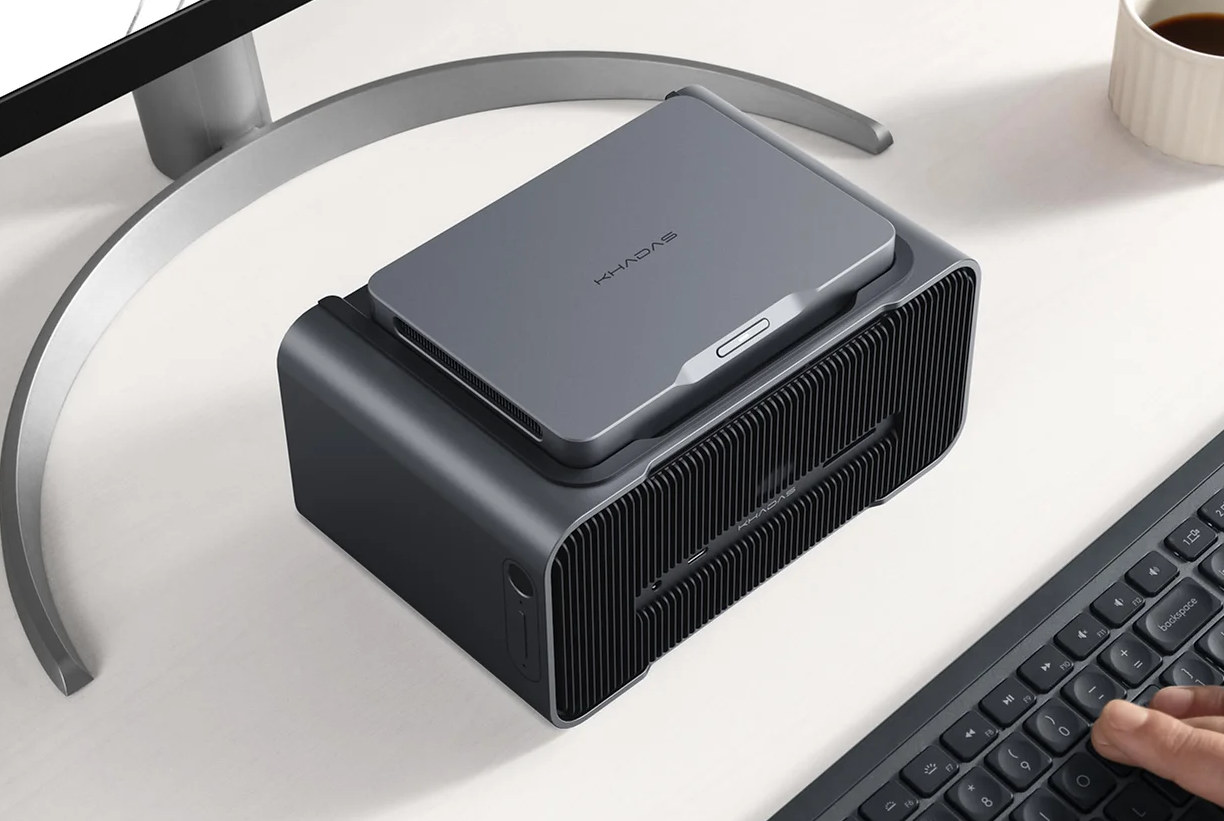
Earlier this month, I received the Khadas Mind 2 (Intel Core Ultra 7 155H) mini PC with two accessories connecting through the Mind Link (PCIe x8) connector: The Mind xPlay Display and Keyboard combo, and the Mind Graphics 2 dock, adding a range of interfaces and an NVIDIA GeForce RTX 5060 Ti GPU with 16GB of VRAM. After going through the specifications, an unboxing, and a partial teardown in the first part of the review, I tested the Mind xPlay using the Mind and Mind 2 mini PCs running Windows 11 and Ubuntu 24.04. I’ve now had time to test the Khadas Mind Graphics 2 dock with the Mind 2 mini PC running Windows 11, so I’ll report my experience with the NVIDIA GPU (3D graphics and AI), and test all features, including 2.5GbE networking, the built-in speakers, microphone array, and so on. A few gremlins and system info When […]
Mind xPlay display and keyboard review using Khadas Mind and Mind 2 mini PCs
In this review, I’ll report my experience with the Khadas Mind xPlay display and keyboard using the Mind and Mind 2 mini PCs, as well as a CHUWI CoreBook Air Plus 16 laptop to test it as a standard external display. Using Mind xPlay with the Mind 2 mini PC I received the Mind xPlay with the Mind 2 Meteor Lake mini PC, and I already showed how to connect it and get started in the first part of the review. So I’ll continue the review with it initially. I used the EIZO monitor test website to evaluate the display panel itself. I went through all 13 tests, including dead pixel and gradients tests. The pattern above looks fine too, so I compare the Mind xPlay monitor to the 16-inch display of the ASUS Vivobook 16 to find differences. Both were set to maximum brightness. The xPlay delivers noticeably more […]
My experience upgrading the BIOS of a Windows 11 mini PC (with BitLocker) in 2026
I don’t always update the BIOS of my system, but when I do, I always make sure to waste several hours doing so. Last time I did that was in 2020, but this happened again when I updated the BIOS for the Khadas Mind 2 to test it with the Mind xPlay display and Mind Graphics 2 dock. Khadas provides the BIOS with instructions to update the Mind 2 mini PC, and it’s supposed to take five minutes, but I ended up wasting two about hours… The first step is to download and extract a zip file (mind-2-bios-v1.07-260122.zip), then start the Flash_BIOS upgrade program, and finally wait for the upgrade to complete. That part went great. No problem, but when the system rebooted, I was greeted by a BitLocker window asking me to enter a recovery key to carry on with the boot process. There’s no way to avoid this, […]
Khadas Mind Graphics 2 and Mind xPlay display + keyboard review – Part 1: Unboxing, teardown, and first try
Khadas has sent us the Mind Graphics 2 dock, Mind xPlay portable display and keyboard, as well as the Mind 2 mini PC for review. In the first part of the review, I’ll start by listing specifications, an unboxing of all three packages, a teardown of the graphics dock, and a first try of the xPlay and Mind Graphics 2 with the mini PC. While the Mind 2 will be used for testing, I won’t go into details here since it’s quite similar to the Mind 2 AI Maker Kit we reviewed last year. Instead, in the next parts, I’ll do a review of the xPlay with it, the first-generation Mind, and maybe another platform with USB-C video output. I’ll follow that by detailed testing of the Khadas Mind 2, including graphics and AI performance with the built-in NVIDIA GeForce RTX 5060 Ti 16GB card, and check all its features. […]