GL.iNet Comet Q (GL-RMQ1) is a USB-C KVM device designed to remotely control smartphones, tablets, and laptops via a single USB Type-C cable and web browser. The hardware is based on a dual-core Arm processor paired with 512MB of RAM and a 512MB NAND flash, integrates a 1.8-inch touchscreen LCD for control and information display (e.g., IP address), a short USB-C cable to connect to the target, and a USB-C port for optionally charging the target while it is being controlled. Comet Q specifications: SoC – Unnamed dual-core Arm Cortex-A53 processor System Memory – 512MB LPDDR4 Storage – 512 MB NAND flash Display – 1.8-inch touchscreen color LCD Video Resolution and frame rate – 2K QHD @ 60 FPS Latency – About 80 ms Wireless Wi-Fi 6 IEEE 802.11 a/b/g/n/ac/ax 5 GHz: 286 Mbps 2.4 GHz: 286 Mbps Internal Wi-Fi antenna Interface USB Type-C port with power passthrough USB Type-C […]
Sixfab AI HAT+ for Raspberry Pi 5 integrates DEEPX DX-M1 AI accelerator
Sixfab has launched the AI HAT+ for Raspberry Pi 5, a PCIe HAT+ based on the DEEPX DX-M1 AI accelerator, which we also found in the DEEPX DX-AIPlayer, Mini DX-M1 SoM, and ALPON X5. Unlike the M.2 module used in the ALPON X5, the AI HAT+ has the accelerator soldered directly to the board. It connects to the Pi 5 via the PCIe FFC cable and draws power from the 40-pin header. The board is also available in 13 TOPS and 25 TOPS versions and is designed to run vision AI tasks such as object detection and segmentation locally on the Pi 5. Sixfab AI HAT+ specifications: Supported SBC – Raspberry Pi 5 AI Accelerator (one or the other): DEEPX DX-M1M with up to 25 TOPS (INT8), 1 GB LPDDR4X NPU memory DEEPX DX-M1ML with up to 13 TOPS (INT8), 512 MB LPDDR4X NPU memory Host Interface – PCIe Gen […]
Radxa’s 2026 Qualcomm hardware: Dragon Q8B and Q5E SBCs, DragonStation and DragonBay NAS systems
Radxa started its partnership with Qualcomm last with the Dragon Q6A SBC, but it turns out it was just the start, and the company showcased more Qualcomm SBCs and NAS systems at a Radxa + Qualcomm developer day on May 30, 2026. The Radxa Q8B SBC will be based on a Qualcomm Snapdragon 8cx Gen3 octa-core SoC and the Q5E SBC on a Dragonwing QCS6690 octa-core Kryo SoC. The company also teased DragonStation and DragonBay NAS systems, and a 2026 roadmap features a total of 22 Qualcomm systems made by Radxa. Radxa Dragon Q8B Dragon Q8B specifications: SoC – Qualcomm Snapdragon 8cx Gen 3 compute platform Octa-core CPU – 4x 3.0 GHz Kryo Prime cores, 4x 2.4 GHz Kryo Efficiency Cores GPU – Adreno 690 GPU with DirectX 12 (DX12) API support DSP – Qualcomm Hexagon Processor, Qualcomm Sensing Hub AI – Qualcomm Neural Processing Engine SDK support for AI […]
ODROID-H5 Review – Part 2: A dual 10GbE mini PC tested with Ubuntu 26.04
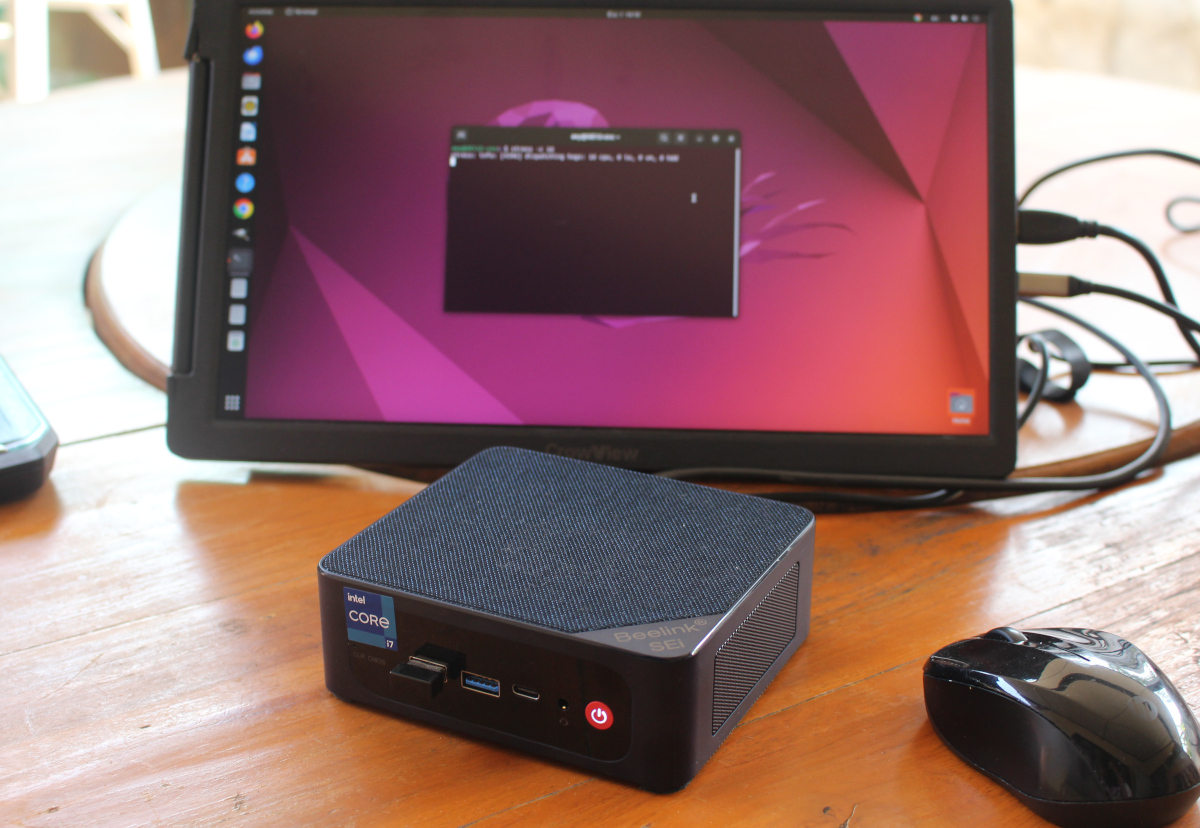
I received a kit for review last week with an ODROID-H5 SBC, a Type1 case, an M.2 10GbE module, and other accessories. In the first part of the review, I went through an unboxing, assembled the kit, and tested whether it could boot an M.2 NVMe SSD with Ubuntu 24.04 and Windows 11. I’ve now updated the system to Ubuntu 26.04, run a few benchmarks, tested the two 10GbE RJ45 ports, as well as other features. I’ll report my experience about all that today. Upgrading from Ubuntu 24.04 to Ubuntu 26.04 The 512GB M.2 NVMe SSD I use in the ODROID-H5 comes from a laptop, which I upgraded with a 2TB SSD. That means the operating systems were not upgraded for a few months. While Ubuntu 24.04 could boot, it would not show the two 10GbE interfaces. That’s because the required drivers were not available in the version of Ubuntu […]
AMD launches Versal Prime Gen 2 2VM3454, 2VM3254, and 2VM3104 adaptive SoCs in compact 23x23mm packages
AMD has added three new chips to its Versal Prime Series Gen 2 lineup: the Versal 2VM3454, 2VM3254, and 2VM3104. Designed for space-constrained applications like Pro AV, broadcast, and industrial IoT, these new devices deliver up to 100K DMIPS of scalar compute in packages as small as 23 x 23 mm. AMD started shipping the first production units of the Versal Prime Gen2 Series with the 2VM3858 device late last year. The 2VM3558 has since entered full production, while the 2VM3358 is currently sampling. These new devices are designed to provide an optimized footprint and processing subsystem compared to the earlier models. Despite the reduction in core count, AMD claims these devices can deliver up to 5x the scalar compute performance compared to existing AMD adaptive SoCs. AMD Versal Prime Series Gen 2 (2VM3104, 2VM3254, and 2VM3454) specifications: Processor Subsystem (PS) APU – Quad-core Arm Cortex-A78AE with 64 KB L1 […]
Privacy-focused, open-source Raspberry Pi Zero 2W DIY security camera offers end-to-end encryption, on-device AI
Secluso is a private, open-source, DIY home security camera system built around the Raspberry Pi Zero 2 W, featuring true end-to-end encryption (E2EE) and on-device AI for human, pet, and vehicle detection. It was designed as an alternative to commercial smart home cameras that require sending raw video feeds to a proprietary cloud, a practice that often raises significant privacy concerns. Developed by Secluso, Inc., co-founded by UC Irvine professor Ardalan Amiri Sani and John Kaczman, the project utilizes Messaging Layer Security (MLS, RFC 9420) to ensure end-to-end encryption between the camera and the user’s smartphone. Because the system uses an untrusted relay (either self-hosted on a VPS or via Secluso’s free beta relay), the server routing the footage only sees encrypted files and cannot decrypt the video or thumbnails. Secluso hardware requirements: SBC – Raspberry Pi Zero 2W Camera – Raspberry Pi Camera Module V1 (OV5647) or V2 (IMX219) […]
ODROID-H5 SBC Review – Part 1: Unboxing, Type1 case assembly, and first boot
Hardkernel has sent me a kit with the ODROID-H5 10GbE SBC for review. In addition to the Intel Core i3-300 board itself, the kit also comes with an ODROID-H5 Type-1 case, an M.2 card for a second 10 Gbps Ethernet port, and other accessories. I’ll start the review with an unboxing, my experience assembling the kit, and first boot using an M.2 NVMe SSD with Ubuntu 24.04 and Windows 11 in a dual-boot configuration. In a few weeks, I’ll continue the review after upgrading to Ubuntu 26.04 and perform thorough testing of all features and performance. ODROID-H5 kit unboxing An advantage of the ODROID family is that it’s highly flexible, and you can build your own customized system. For this review, Hardkernel sent me a package with the following items: External LED power button H5 Case Type 1 enclosure ODROID-H5 16GB DDR5 SO-DIMM (Crucial) 15V/4A PSU with US plug adapter […]
WCH BLE Analyzer Pro USB Bluetooth LE sniffer gains Linux software with Wireshark (pcap) support
Last November, we wrote about the WCH BLE Analyzer Pro, an inexpensive (~$20) USB Bluetooth LE sniffer and analyzer, which looked useful and good value for reverse engineering and debugging. One downside is that the WCH BLE Analyzer software was only made for Windows 7 to 11, but Xecaz decided to look into it and reverse-engineered the USB protocol to write Linux software using libusb that outputs a standard pcap compatible with popular tools such as Wireshark, or as he puts it: “WinChipHead forgot to ship a Linux driver. We forgot to ask permission.” As a reminder, the BLE Analyzer Pro features three CH582F Bluetooth LE RISC-V microcontrollers and a CH334 USB hub, supports Bluetooth Low Energy (BLE) 4.0/4.2/5.0, and connects to the host through its USB-C port. The Linux “driver” for the BLE Analyzer Pro tool can be found on GitHub. Building and installing the software is quick and […]