LightBlue Bean+ Bluetooth LE Board is Programmed Wirelessly, Lasts One Year on a Charge (Crowdfunding)

Punch Through launched a crowdfunding campaign back in 2013 for LightBlue Cortado an innovative Arduino compatible BLE board that can only be programmed wirelessly over Bluetooth Smart. The board has since then been renamed to LightBlue Bean, and the company allegedly delivered rewards to backers on time, a rarity in the crowdfunding world. LightBlue Bean+, the second version of the board, is larger with solderless headers, supports more Bluetooth LE capabilities such as MIDI, and includes a battery. The project launched on Kickstarter yesterday, and already raised over $40,000, surpassing the $30,000 funding target set by the team. LightBlue Bean+ board specifications: MCU – Info N/A (Bean has an Atmel ATmega328P @ 8MHz with 32KB Flash, 1KB EEPROM, 2KB SRAM) Bluetooth Bluetooth LE with support for 5 new capabilities: beacon, MIDI, HID, ANCS and observer role. Hardware module undisclosed (Bean has an LBM313 Module with Texas Instruments CC2540) Up to 400 […]

Freaks3D is a Low Cost Portable 3D Printer (Crowdfunding)
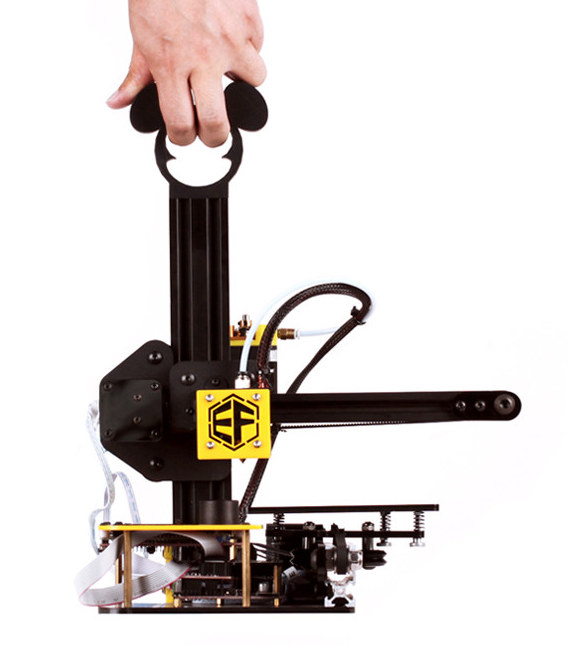
ElecFreaks is a design house based in Shenzhen that caters to makers and startups, and started selling Arduino shields and accessories, as well as  Raspberry Pi add-on boards, before moving to robotics kits, 3D printers, and other tools in demand by electronics hobbyists. The company has now designed Freaks3D portable 3D printer, and launched an Indiegogo campaign to fund production. Freaks3D printer specifications: Technology – Fused Deposition Modeling Build Volume – 130 x 150 x 100 mm (LxWxH) Nozzle Size – Standard 400 microns Resolution – Layer: 100 microns; XY: 50 microns Filament diameter – 1.75mm Filament Material – PLA or TPU 3D Files Transfer – USB via PC, or SD card Misc – LCD Display, one button operation, printing bed does not require heating Power Supply – 12V / 8A power adapter, or 12V / 5A power bank (Not included) Dimensions –  290 x 320 x 325 mm Weight […]

ESP8266 Wi-Fi Module is Now Supported in Arduino IDE

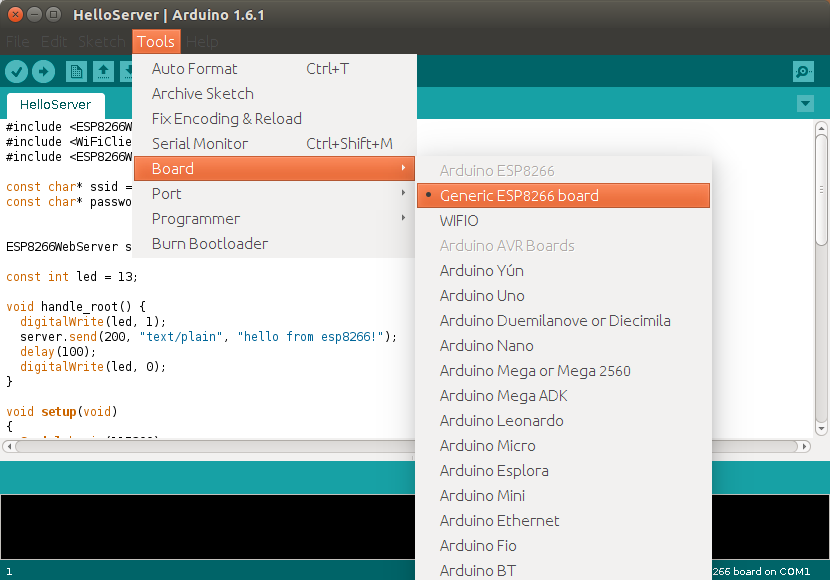
ESP8266 revolutionized the IoT world by offering an ultra low cost Wi-Fi solution either standalone or connected to a micro-controller board via SPI or UART. There are plenty of tutorials on the web to play with the Wi-Fi module, but it’s only recently an Arduino IDE has added support for ESP8266. If you want to try it, you can download the binary for Linux, Windows, or Mac OS X. Since my computer is running Ubuntu 14.04, I download and extracted arduino-1.6.1-linux64.tar.xz to install it in my PC. Now simply run the arduino script to start the IDE, and select to Tools->Board->Generic ESP8266 board. I don’t own an ESP8266 module myself, but Olimex tried it on their ESP8266-EVB: They connected a serial debug board and selected Tools->Port->/dev/ttyUSB0 in the IDE Selected Tools-> Programmer->esptool Loaded Blink example, and modified it to turn on and off the relay on their evaluation board. If […]

XBMC 13 “Gotham” Released

After month of development, alpha releases, beta releases, RC releases, XBMC 13 “Gotham” is finally out. This is the first official release that supports hardware video decoding for ARM and x86 based Android 4.0+ devices. Support is not available for 100% of devices, as for instance, AllWinner A1X/A20 and Amlogic SoCs do not support the standard Android StrageFright or MediaCodec APIs, but most others should. There’s one XBMC Android version for ARM, one for x86. Android hardware video decoding is obviously not the only feature or improvement brought about by XBMC 13. Here are the key ones: Raspberry Pi and Android speed improvements – Overall system performance improvements, but optimizations are said to be particularly noticeable when opening and browsing libraries, loading images and starting videos. Stereoscopic 3D Rendering – SBS, TAB, anaglyph, and interlaced are supported. XBMC cannot yet support 3D blurays and cannot provide hardware acceleration for FullSBS/TAB […]

AIRTAME is a Wi-Fi Display HDMI Dongle for Windows, Linux, and Mac (Crowdfunding)

Earlier today, I wrote about Tronsmart T1000 Mirror2Tv, a $30 Wi-Fi Display adapter that can mirror the display from Android, iOS, and Windows devices and computers to your HDMI TV via Wi-Fi, and I’ve been informed a somewhat similar device called AIRTIME had a very successful Indiegogo campaign albeit selling for over $100 including shipping, and with shipping expected for May 2014, so I decided to have a closer look. AIRTIME specifications have not been fully release, but we still get some information: Processor – ARM @ 1GHz System Memory – 512MB RAM Wi-Fi – 802.11 b/g/n Video Output – HDMI 1.4 with CEC and MHL – Up to 1080p resolution Audio – 2 channel stereo with variable bit rate, work in progress for surround sound 5.1 support USB – 1x micro USB for power, 1x USB host port for accessories Power Consumption – About 500ma @ 5V via MHL […]

Tronsmart T1000 Mirror2TV EZCast, Miracast, Airplay, DLNA HDMI Dongle Sells for $29.99

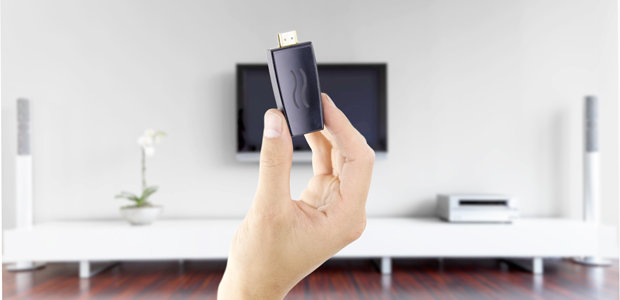
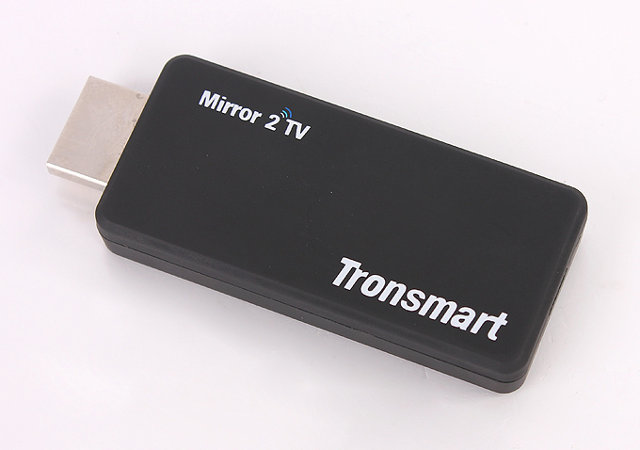
There has already been several dongles released to the mark that support Miracast, Airplay, and DLNA, either a subset, or a combination of the standards. One of the cheapest is iPush that now sells in the low $20, but there are different models, and one of them is only supporting DLNA. A couple of months later, EZCast was released with support for DLNA, as well as Miracast and Airplay (with some limitations), and their own EZCast support. EZCast is supported on several hardware dongles that often sell for about $35 to $45, and although it’s not outrageously expensive, you can get full single or dual core Android HDMI TV for this price. I’ve just come across a new product called Tronsmart T1000 Mirror2TV sold for $29.99 including shipping by GeekBuying, and a couple of sellers on Aliexpress, that appears to be another EZCast dongle with support for Miracast, Airplay, and DLNA. […]

Cydia Impactor Provides an Alternative Method to Root Android Devices via Windows or Mac OS X

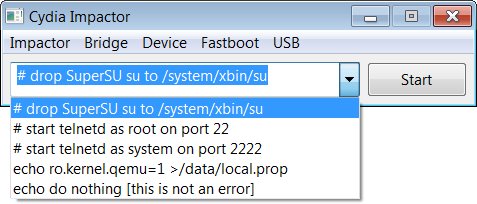
Cydia Impactor is a GUI tool for working with Android devices from computers running Windows or Mac OS X.  It can be used to reboot the device, enter fastboot mode, access the shell, scan for USB drivers for your device, and a bit more. But its key feature is to provide root access to many Android devices by exploiting of the Android “Master Key” vulnerability, and if it does not work falling back to a different signature verification bug. There are other tools (e.g. unlockroot, Moborobo,…) or methods to provide root access, but if those do not work or you have troubles installing drivers, Cydia Impactor may be worth a try. I did try on MK908 and T428 mini PCs in a Windows XP netbook, but for some reasons the software could not detect the USB connection (with USB debug enabled in Android), although Moborobo did. But Benjamin, who tipped me […]

Bluetooth Versions Walkthrough, and Bluetooth 4.0 Low Energy Development Resources

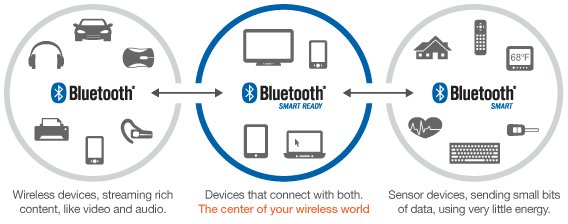
I’ve seen more and more Bluetooth 4.0 LE devices in the last few months including RFDuino, Wimoto Motes, TI SensorTag, and Scadanu Scout, so I thought it would be good to write a bit about Bluetooth. First, I’ll write about the different version of Bluetooth, since I was still confused with the practical implications between the versions, and then I’ll show some development kits and software resources to play around and/or develop Bluetooth 4.0 LE applications both on devices and hosts. Bluetooth Versions Bluetooth v1.0 and v1.0B The Bluetooth 1.0 Specification was released in 1999, and according to an entry in Wikipedia, 1.0 and 1.0B devices had many issues, mainly interoperability issues. You won’t find any Bluetooth 1.0 device today. Bluetooth v1.1 Bluetooth v1.1 was ratified as IEEE Standard 802.15.1-2002 in 2002. It fixed many issues found in the previous specifications, added the option to use non-encrypted channels, as well […]

Exit mobile version