
The nanoCH32V317 from MuseLab is a low-cost RISC-V development board designed for prototyping embedded systems and education. Built around the 144MHz WCH CH32V317WCU6 MCU. This development board is suitable for various embedded, IoT, prototyping, and automation projects. Other features of the development board include a USB 2.0 high-speed and full-speed controller, a 10/100Mbps Ethernet MAC with PHY, SDIO, and a DVP interface for digital video input, as well as advanced motor PWM timers for control applications. The board also includes an 8MHz main crystal and a 32.768KHz RTC crystal. For programming, it includes a dual USB Type-C interface, a USB ISP, as well as an SWD port. nanoCH32V317 board specifications: MCU – WCH CH32V317WCU6 32-bit RISC-V core up to 144 MHz clock frequency USB 2.0 High-Speed (HS) and Full-Speed (FS) controllers Integrated Ethernet MAC + 10/100M PHY DVP interface, SDIO, and advanced motor PWM timer support Memory – Up to […]
FPGA-based Game Bub handheld console supports original Nintendo cartridge, wireless controllers (Crowdfunding)
Game Bub is an open-source AMD Artix-7 FPGA and ESP32-S3-based handheld gaming console that supports Nintendo Game Boy, Game Boy Color, and Game Boy Advance cartridges. On top of that, it supports TV output via the Game Bub Dock and features Bluetooth for connecting wireless controllers. The device also features cartridge backup and restore functions through FlashGBX, letting users save files, dump ROMs, reflash writable carts, and even extract photos from the Game Boy Camera. The device supports direct ROM loading and the built-in rumble motor, accelerometer, gyroscope, and real-time clock ensure compatibility with games that rely on these peripherals. The device is housed in a transparent 90s-style enclosure, runs on a 3000 mAh battery for over 14 hours of gameplay, and weighs just 250 g, making it portable yet durable. Additionally, it can be used as an FPGA development board with its PMOD expansion slot and plenty of unused […]
Genesis IoT Discovery Lab is a modular ESP32-S3-based wire-free prototyping platform (Crowdfunding)
Developed by Axiometa in Lithuania, the Genesis IoT Discovery Lab is a modular Wi-Fi-enabled prototyping platform built around the ESP32-S3 and a standardized module with AX22 connectors, designed to replace messy breadboards with a structured, plug-and-play system. Designed to simplify hardware development and education, this prototyping module features eight universal AX22 ports, a USB OTG Type-C port, a battery module with charging, and support for over 50 sensors and peripherals. Modules include sensors, buttons, motors, LEDs, relays, and displays, all secured with robust connectors. With open-source hardware and various expansion add-ons, it’s suitable for education, IoT prototyping, and fast hardware iterations. Genesis IoT Discovery Lab specifications: Wireless Module – ESP32-S3-WROOM-1 SoC – Espressif Systems ESP32-S3 CPU – Dual-core Tensilica LX7 up to 240 MHz with vector extension for AI/ML workloads RAM – 512KB SRAM Storage – 8MB flash Wireless – WiFi 4 and Bluetooth LE 5 Antenna – PCB antenna USB […]
PicoEMP – A Raspberry Pi Pico-based open-source electromagnetic fault injector designed for EMFI testing and research
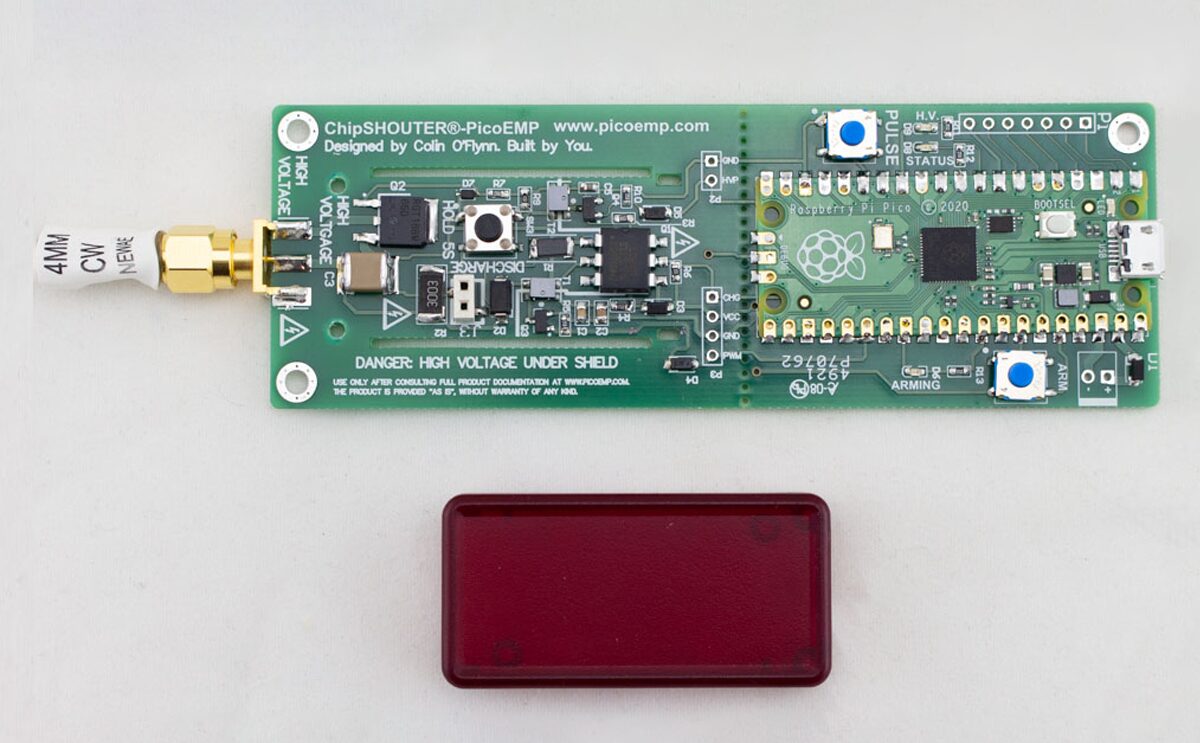
The PicoEMP is a compact, low-cost, open-source electromagnetic fault injector (EMFI) tool developed by Colin O’Flynn for researchers, hobbyists, and educators interested in hardware security. Unlike NewAE’s professional-grade ChipSHOUTER, PicoEMP is a bare-bones device designed to be safe, usable, and most importantly, affordable. Built around the Raspberry Pi Pico, this device generates high-voltage pulses using a transformer circuit (originally for photographic flash charging) to discharge energy from a low-ESR ceramic capacitor into a custom-made coil tip, which creates an electromagnetic field capable of injecting a little bit of power to the internals of the processors such as registers and SRAM. This can be exploited to flip bits and test the robustness of embedded systems against such attacks. ChipSHOUTER-PicoEMP specifications Main controller – Raspberry Pi Pico (RP2040 dual-core Arm Cortex-M0+ MCU @ up to 133 MHz) Purpose – Electromagnetic Fault Injection (EMFI) for testing embedded systems security Components High-voltage pulse generator circuit […]
Olimex launches STMicro STM32MP157 SoM and open-source hardware EVB
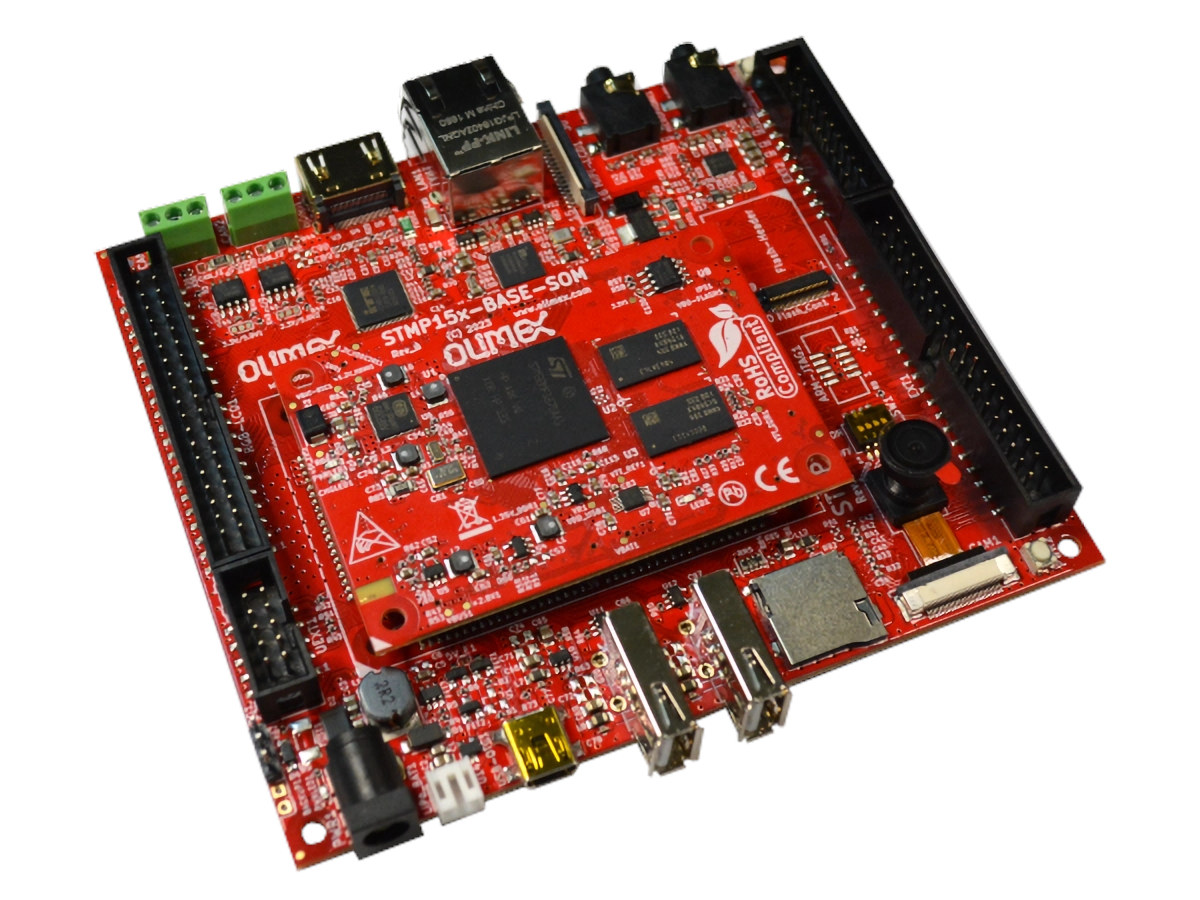
Olimex has just launched the STMP157-BASE-SOM-EXT system-on-module (SoM) powered by an STMicro STM32MP157 dual-core Cortex-A7 microprocessor along with the open-source hardware STMP157-BASE-SOM-EVB evaluation board designed in KiCAD. The CPU module comes with 1GB RAM, an EEPROM for configuration, and power management circuitry, and the carrier board exposes all features of the microprocessor with HDMI video output, LCD display interfaces, a 2MP camera, gigabit Ethernet, USB ports, CAN bus terminal block, audio jacks, several GPIO headers, and more. STMP157-BASE-SOM-EXT System-on-Module specifications: Microprocessor – STMicro STM32MP157DAA1 dual-core Cortex-A7 processor @ 800 MHz with Arm Cortex-M4 real-time core @ 209 MHz, Vivante 3D GPU with OpenGL ES 2.0 support System Memory – 1GB DDR3 Storage – Linux configuration EEPROM Host interface – 6x 40-pin board-to-board connect with 1.27mm pitch for I/Os Misc – User LED, 24 MHz oscillator Power Management – AXP209 PMIC, LDO, DCDC power management Dimensions – 72 x 48 mm […]
Antmicro releases open-source hardware Snapdragon 845 baseboard designed with KiCad
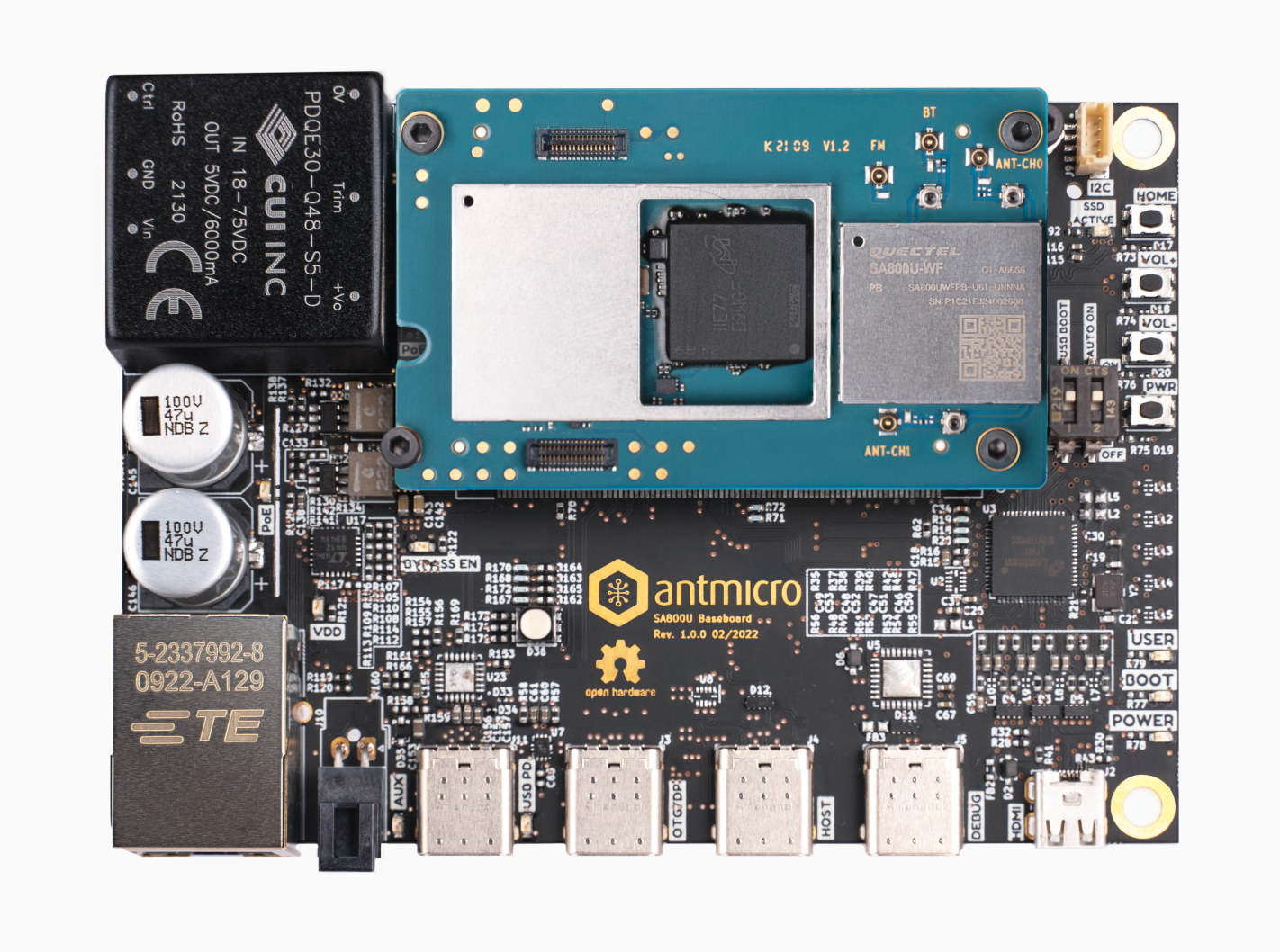
Antmicro team has released an open-source hardware baseboard for Quectel SA800U-WF System-on-Module powered by Qualcomm Snapdragon 845 octa-core processor, which they designed with KiCad open-source EDA tool. The baseboard supports NVMe storage and offers Micro HDMI and MIPI DSI video interfaces, Gigabit Ethernet with PoE support, USB 3.1 Type-C interfaces, and other I/Os, plus three separate power inputs. The company expects the design to serve as a starting point for building portable smart assistants, kiosks, VR/AR or smart screens, and more. Antmicro Snapdragon 845 baseboard specifications: Supported system-on-module – Quectel SA800U-WF with: SoC – Qualcomm Snapdragon 845 octa-core Kryo 385 processor (4x Cortex A75 cores + 4x Cortex-A55 cores), Adreno 630 GPU, Hexagon 685 DSP, 4K H.265/H.264 video decoding and encoding System Memory – 4 GB LPDDR4X Storage – 64 GB UFS storage 802.11b/g/n/ac Wi-Fi 5 2×2 MIMO and Bluetooth 5.0 module Board-to-board connector for connection to baseboard Dimensions – […]
The BeagleBone Black Turns Blue with BlueSteel-Basic, Loses HDMI and Flash
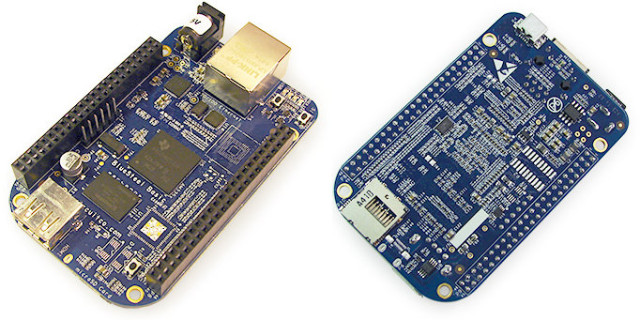
CircuitCo has just introduced BlueSteel-Basic, a development board based on the Beaglebone Black but with a Blue PCB, no HDMI output, and no eMMC flash that’s destined to be used by OEMs in their products. LinuxGizmos also reports that BlueSteel-Basic is to be followed by BlueSteel-IT, an industrial temperature grade (-40 to 100°C) board based on the Beaglebone Black, and Bluesteel-Core, a computer-on-module (CoM) based on Ti Sitara AM335x that are scheduled for July 2014. Let’s checkout BlueSteel-Basic specifications: SoC – Texas Instruments Sitara AM3358BZCZ100 @ 1GHz (2000 MIPS) with PowerVR SGX530 3D GPU (20M Polygons/S) System Memory – 512MB DDR3L @ 800MHz Storage – micro SD slot Connectivity – 10/100M Ethernet (RJ45) USB – 1x USB 2.0 host port, 1x mini USB 2.0 port Debugging – Serial header and optional on-board 20-pin CTI JTAG Expansion Connectors Signals: Power 5V, 3.3V, VDD_ADC (1.8V) 3.3V I/O On All Signals McASP0, SPI1, […]
$275 HackRF Open Source Software Defined Radio (SDR) Platform
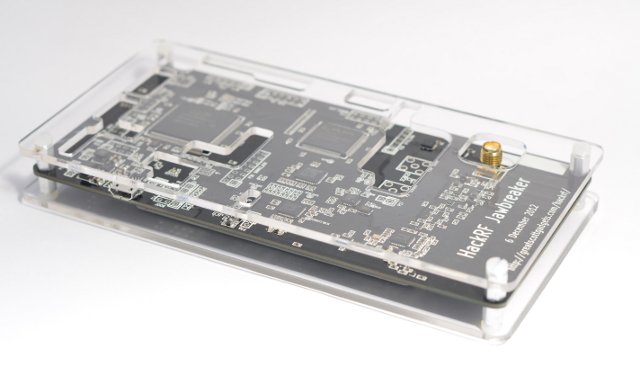
HackRF is an open source hardware project to build a Software Defined Radio (SDR) supporting a frequency range between 30 MHz and 6GHz in both directions (Tx and Rx, half-duplex) with a maximum bandwidth of 20MHz. Jawbreaker (shown below) is a beta hardware that has been tested by several developers and beta testers, and applications such as Digital Audio Broadcasting (DAB), Bluetooth monitoring, spectrum sensing, wireless microphones, AIS, FM radio, etc.. have already been ported to the platform. In order to lower the cost of the hardware, Michael Ossmann has launched a Kickstarter campaign to fund mass production. There seems to be many SDR enthusiasts as the campaign has already reached its funding target ($80,000) and received for over $300,000 in ledges. What is Software Defined Radio (SDR) and What Can it Be Used for? Before providing details about the hardware and software, it may be useful to provide some […]