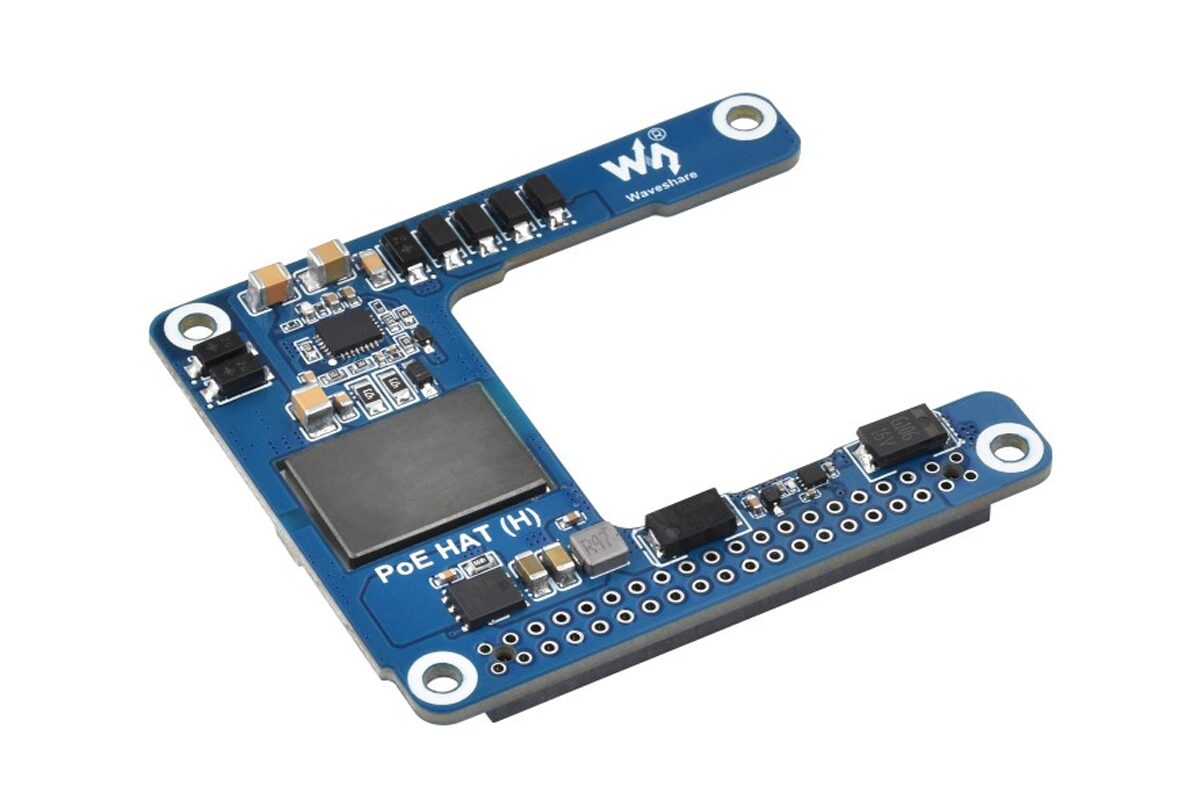

The 52Pi UPS Gen 6 is another UPS solution for the Raspberry Pi 5 that supports external battery packs for long-duration projects, and uses I²C plus PikaPython scripting to manage power settings and safe shutdowns. Designed for the Raspberry Pi 5 and 4B, the module mounts on the bottom of the board and delivers power via pogo pins. It also includes an aluminum heatsink with an automatic fan for cooling. It runs on two 18650 batteries, which can be mounted to the Pi with spacers, and there is an option to add three more battery packs in parallel if you need longer runtime. The board also features a physical power button for manual control, a 12V power interface for SATA hard drives, and switching hardware (bumpless power transfer) that instantly falls back to battery power so the system stays on during a power outage. 52Pi UPS Gen 6 specifications: Main […]
AQEX qUPS-P-BC-2.0 UPS HAT works with large capacity, multi-chemistry batteries (Li-Ion, LiFePO4, Sodium-Ion)
Developed by Hungary-based AQEX, qUPS-P-BC-2.0 is a Raspberry Pi-compatible UPS HAT that supports multi-chemistry batteries, including Li-Ion, LiFePO₄, Sodium-Ion, and even supports large, high-capacity packs up to 300Ah. It is designed for applications that require long backup times and reliable 5V power. It features an offline UPS-like architecture with a highly efficient boost converter, adjustable input voltage and energy thresholds, as well as AUTO/ON/OFF operating modes to prevent reboot loops or unsafe restarts. Communication with the Raspberry Pi is handled through three GPIO pins to provide alerts for power loss and low battery. The board supports up to 7.5A discharge, 2A charging, USB-C and auxiliary 6–28V input, reverse-polarity and thermal protection, and external power-control capability. It’s also stackable with other HATs thanks to a robust soldered 40-pin header. AQEX qUPS-P-BC-2.0 specifications: Compatibility – Raspberry Pi 5 / 4B / 3B+ and other boards with compatible form factor and 40-pin PIO header […]
Mini review of JOYROOM PODIX 140W 5-port USB GaN charger with power meter function
I’ve just received a review sample of the JOYROOM PODIX 140W 5-port USB GaN charger, which I found interesting because it integrates a power meter function for the whole charger and for each individual port, which could be useful for reviews of USB-powered boards and devices. In this short review, I’ll go through an unboxing, before testing the features with a smartphone, and trying to stress it a little with five devices, including a laptop, a USB-C powered HDMI display, a wireless display, an Android smartphone, and a Raspberry Pi 5 SBC. JOYROOM PODIX 140W charger unboxing I received the device in its retail package, reading “JOYROOM PODIX” “140W 5-port desktop GaN charger” and listing key features like fast charging, 80cm retractable cables, and a 1.54-inch “ultra large” display, as well as compatibility with standards such as USB PD 3.1, PPS, AFC, SCP, FCP, and QC 3.0. The side of […]
$19.90 XIAO Debug Mate ESP32-S3-based 3-in-1 multi-tool acts as a DAPLink debugger, serial monitor, and/or power profiler
Seeed Studio XIAO Debug Mate is an inexpensive ESP32-S3-based multi-tool designed for the company’s XIAO boards, offering DAPLink debugger, serial monitor, and power profiler modes. The debugger comes with 8MB flash, 8MB PSRAM, a 2.01-inch display to display debugging/power information, two 14-pin headers to provide easy access to the XIAO’s module I/Os, a 36 LED matrix for status indication, and a couple of buttons, plus a srcoll wheel to navigate the menu. The serial monitor function can also be used be Arduino, Raspberry Pi, or other boards. XIAO Debug Mate specifications: Wireless MCU – Espressif Systems ESP32-S3R8 CPU – Dual-core Tensilica LX7 microcontroller @ 240 MHz Memory – 512KB SRAM, 8MB PSRAM Wireless – Wi-Fi 4 & Bluetooth 5.0 dual-mode (Classic + BLE) connectivity Storage – 8MB SPI flash Display – 2.01-inch TFT LCD with 296 x 240 resolution Expansion 2x 14-pin female GPIO headers routing the XIAO module pins […]
BenchVolt PD – An USB-C PD lab power supply with five channels and arbitrary waveform generator (Crowdfunding)
BenchVolt PD is a five-channel, open-source USB-C PD lab power supply that turns any USB Type-C charger/power bank into a compact, portable bench PSU. Designed for makers, engineers, and field technicians, it delivers up to 100 W with fixed, adjustable, and waveform-capable outputs, making it an alternative to bulky lab units. It integrates three low-noise fixed rails (1.8 V, 2.5 V, 3.3 V), two adjustable outputs (0.5–5 V and 2.5–32 V), and supports up to 3A per channel with current limiting. An STM32 MCU handles sequencing, real-time safety checks, and monitoring. The device also features a 1.9-inch display and a rotary encoder for monitoring and control. It also includes protections for overcurrent, temperature, and power budgeting. BenchVolt PD specifications: MCU – STMicroelectronics STM32F030F4 32-bit Cortex-M0 @ 48 MHz with up to 256KB of flash Display – 1.9-Inch TFT display (320 x 170) showing voltage, current, thermal, and PD status Power […]
pdsink – An open-source USB PD 3.2 sink stack for embedded devices
pdsink is an open-source USB Power Delivery (PD) 3.2 sink implementation for embedded devices released under an MIT license. Vitaly Puzrin noticed that most available USB PD stacks come with at least one hard constraint: vendor lock-in, NDA, no public sources, coupling to a specific OS or framework, incomplete sink feature set (e.g., no EPR), or difficulty extending to new Type-C Port Controller (TCPC)/MCU combinations. So he created pdsink is an attempt to provide a small, platform-agnostic, readable sink-only stack that’s easy to adapt to different controllers. pdsink highlights: USB PD 3.2, SPR (Extended Power Range), and EPR (Extended Power Range for 28V and up) support on the sink side. Platform-agnostic C++ core that does not depend on a specific HAL or RTOS. Reference implementation using OnSemi FUSB302B + FreeRTOS (ESP32-C3). MIT license enabling the project to be used in commercial products without conditions. pdsink can be found on any […]
Giveaway Week 2025 – USB Vsense USB PD voltage indicator
The fifth prize of CNX Software Giveaway Week 2025 will be the USB Vsense USB PD voltage indicator. I received three samples for review last August, so I’m keeping one for myself, giving one here on CNX Software (International), and another one on CNX Software Thailand. It’s a simple device with two USB-C ports and color-coded LEDs showing the voltage supported from 5V up to 48V as defined in the Extended Power Range (EPR) specs. In my review, I found the little device to work as expected, testing it with various USB PD adapters connected to a laptop and a Raspberry Pi 5 SBC. There are already such USD PD voltage testers on the market, and what differentiates the Vsense from the rest is its multi-layered design, since it’s made of seven PCBs stacked on top of each other and secured with four screws. To enter the draw, simply leave […]
Palm-sized PocketPD USB-C programmable power supply delivers up to 21V/5A output (Crowdfunding)
PocketPD is a compact USB PD programmable power supply developed by CentyLab in Salem, Oregon. Designed to fit in your pocket, it provides precise, programmable voltage and current control using the USB Power Delivery 3.0 PPS mode. The device outputs 3.3V to 21V at up to 5A, features constant voltage/current modes, and includes a 0.96-inch OLED display for real-time monitoring. Powered by a Raspberry Pi RP2040 MCU and AP33772 PD controller, it supports fine adjustment in 20mV/50mA steps, with built-in protections against short circuits and reverse current. Weighing just 63g, PocketPD also offers magnetic mounting, open-source firmware, and KiCad hardware files for customization. The company offers two versions, featuring either a detachable screw terminal or Anderson Powerpole/XT60 connector options. PocketPD specifications: MCU – Raspberry Pi RP2040 dual-core Cortex-M0+ microcontroller @ 125 MHz with 264 KB SRAM Storage – Non-volatile storage for user profiles (voltage/current settings) Display – 0.96-inch OLED display […]