Velxio is an open-source, self-hosted Arduino, Raspberry Pi, and ESP32 simulator

Velxio multi board simulator

Velxio is an open-source, self-hosted simulator for Arduino, ESP32, and Raspberry Pi boards that works directly in your web browser. You can drag-and-drop boards, connect components and modules, write and run code in Arduino or Python, and access the serial console, all without hardware. If it looks similar to what the Wokwi simulator has to offer, it’s because Velxio was inspired by it and even integrates the AVR8 CPU emulator, RP2040 emulator, and QEMU fork for ESP32 Xtensa emulation from the Wokwi project. But the key difference is that Velxio can be self-hosted, although there’s also an online demo. Velxio currently supports 19 targets across five architectures AVR8 (ATmega / ATtiny) Arm Cortex-M0+ (Raspberry Pi RP2040) RISC-V RV32IMC/EC (ESP32-C3 / CH32V003) Xtensa LX6/LX7 (ESP32 / ESP32-S3 via QEMU) Arm Cortex-A53 (Raspberry Pi 3 Linux via QEMU) The project also offers 48 components. The developer mentions that additional features compared to […]

Akeana unveils 10 RISC-V cores suitable for microcontrollers up to data center chips
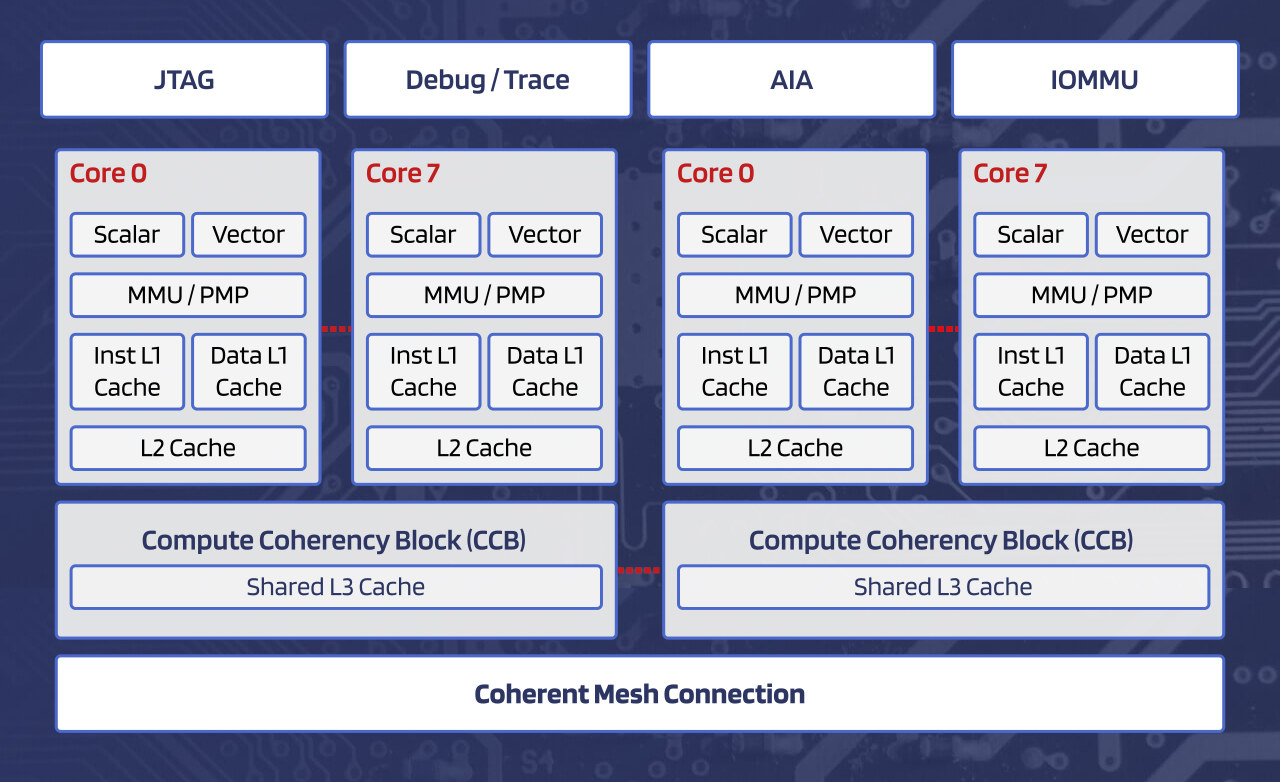
Chip Diagram Akeana 5000

Founded about three years ago, Akeana has just officially launched and announced three 32-bit and 64-bit RISC-V processor lines and SoC IP with the Akeana 100 series for 32-bit microcontrollers, the Akeana 1000 series for 64-bit processors with MMU, and the Akeana 5000 series with much higher single-thread performance and designed for laptops, data centers, and cloud infrastructure. The company also introduced Scalable Coherent Interconnect, Interrupt Controller, and IOMMU IP for building out compute subsystems based on the aforementioned RISC-V cores,  as well as AI-targeted Vector RISC-V Cores and Matrix Computation IP. The design team is said to have previously worked on Marvell’s ThunderX2 server chips. Akeana 100 Series The Akeana 100 Series is a line of highly configurable processors with 32-bit RISC-V cores that support applications from embedded microcontrollers to edge gateways, to personal computing devices. Four Akeana 100 RISC-V cores are available Akeana 110 for area- and power-constrained […]

RAUC open-source OTA update solution for embedded Linux ported to Rock Pi 4 SBC

RAUC OTA firmware update Rock Pi 4

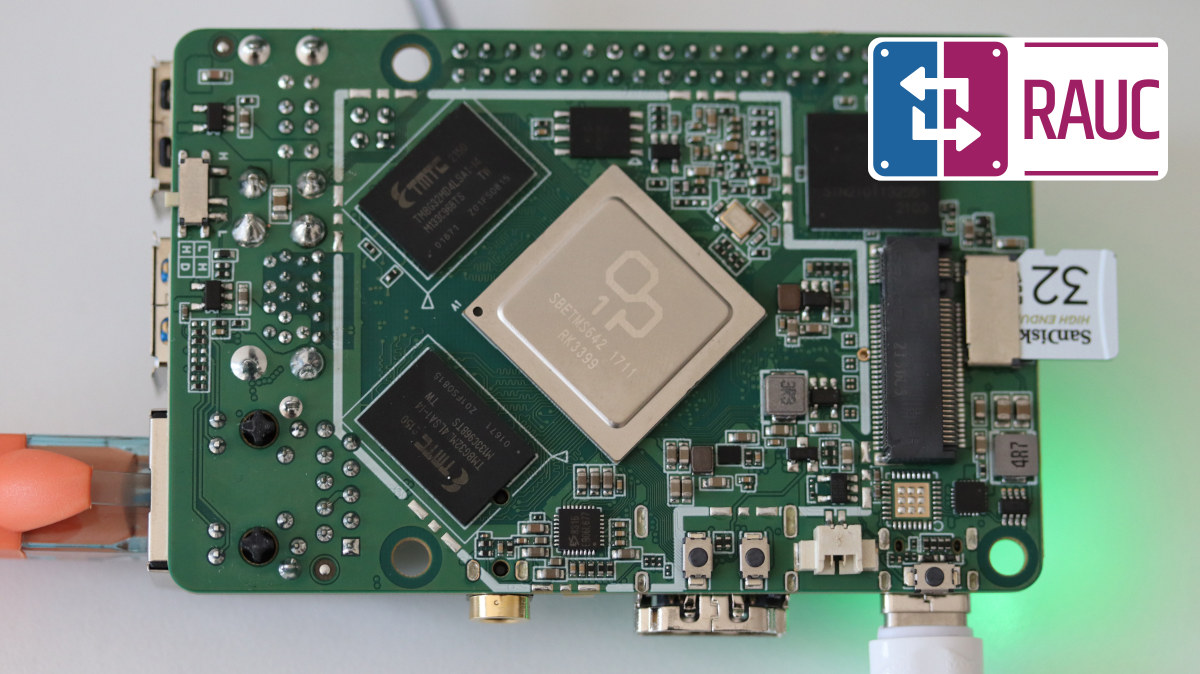
RAUC open-source OTA update solution enabling A/B updates for embedded Linux images has recently been ported to the Radxa Rock Pi 4 Model B SBC powered by a Rockchip OP1 SoC by the project’s maintainer, Leon Anavi working for Konsulto Group. If you run a Linux distribution like Ubuntu, Debian, or Fedora, packages and OS images are taken care of automatically or by running a few commands. However, software engineers who build custom embedded Linux images with the Yocto Project or Buildroot must handle this themselves. Luckily, there are already open-source OTA firmware update solutions such as Mender, Balena, Torizon, OSTree, Snap, or RAUC, and we’ll look at the latter today. RAUC (Robust Auto-Update Controller) was started by Pengutronix in 2015 and eventually adopted by the community. It’s a lightweight update client that runs on an Embedded Linux device and controls the A/B update procedure when a new firmware revision […]

QEMU 9.0 released with Raspberry Pi 4 support and LoongArch KVM acceleration

QEMU 9.0

QEMU 9.0 open-source emulator just came out the other day, and it brings on board major updates and improvements to Arm, RISC-V, HPPA, LoongArch, and s390x emulation. But the most notable updates are in Arm and LoongArch emulation. The QEMU 9.0 emulator now supports the Raspberry Pi 4 Model B, meaning you can run the 64-bit Raspberry Pi OS for testing applications without owning the hardware. However, QEMU 9.0 has some limitations since Ethernet and PCIe are not supported for the Raspberry Pi board. According to the developers, these features will come on board in a future release. For now, the emulator supports SPI and I2C (BSC) controllers. Still on ARM, QEMU 9.0 provides board support for the mp3-an536 (MPS3 dev board + AN536 firmware) and B-L475E-IOT01A IoT node, plus architectural feature support for Nested Virtualization, Enhanced Counter Virtualization, and Enhanced Nested Virtualization. If you develop applications for the LoongArch […]

Yocto Project 5.0 “Scarthgap” released with Linux 6.6 and plenty of changes

Yocto Project 5.0

The Yocto Project 5.0 codenamed “Scarthgap” has just been released with Linux 6.6, glibc 2.39, LLVM 18.1, and over 300 other recipe upgrades. As a result of the release, the developers have made it available for download (bz2 tarball). The Yocto Project, or Yocto for shorts, is a popular framework used to create custom embedded Linux distributions, and we’ve played with it over the year showing how to create a minimal image for the Raspberry Pi, and last year, we used it again when reviewing two industrial development boards, namely the VOIPAC IMX8M and ADLINK i-Pi SMARC 1200. Yocto is quite a powerful framework/build system with plenty of options that make it highly customizable, but the learning curve is fairly steep. Some other changes in Yocto Project 5.0 include: New variables: CVE_DB_INCR_UPDATE_AGE_THRES: Configure the maximum age of the internal CVE database for incremental update (instead of a full redownload). RPMBUILD_EXTRA_PARAMS: […]

QEMU 7.0 released with support for RISC-V KVM, Intel AMX, and more

QEMU 7.0

QEMU (Quick EMUlator) is an open-source emulator used to run OS or programs on various architectures such as Arm, RISC-V, and many others when you don’t own specific hardware, or for quick testing. The developers have released QEMU 7.0 a few days ago with over 2500 commits from 225 developers. New features include support for RISC-V KVM and vector extensions, Intel AMX (Advanced Matrix Extension), improved flexibility for fleecing backups, various new features for Arm, and many more. QEMU 7.0 highlights listed by the developers: ACPI: support for logging guest events via ACPI ERST interface virtiofs: improved security label support block: improved flexibility for fleecing backups, including support for non-qcow2 images ARM: ‘virt’ board support for virtio-mem-pci, specifying guest CPU topology, and enabling PAuth when using KVM/hvf ARM: ‘xlnx-versal-virt’ board support for PMC SLCR and emulating the OSPI flash memory controller ARM: ‘xlnx-zynqmp’ now models the CRF and APU control […]

Ubuntu 20.04/21.04 64-bit RISC-V released for QEMU, HiFive boards

Ubuntu RISC-V HiFive QEMU

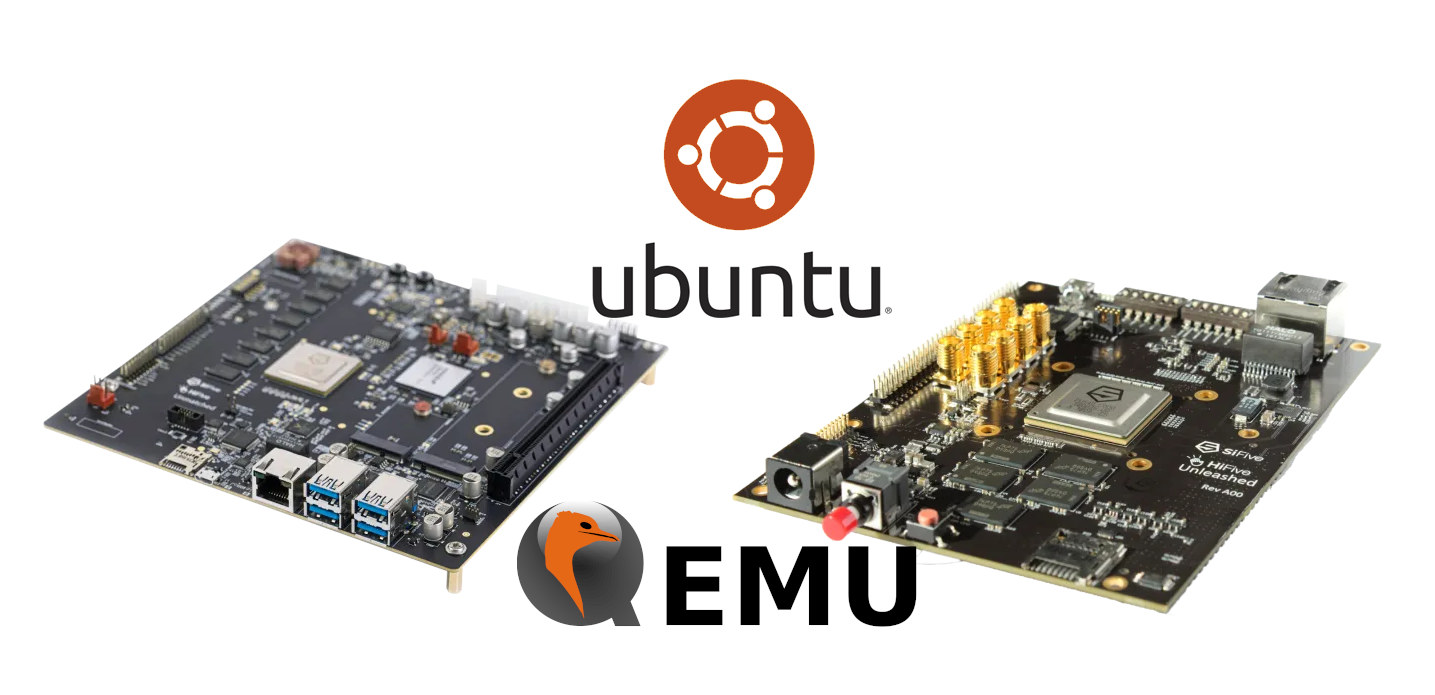
Let’s a lot of excitement around RISC-V open architecture, but a lot of work still needs to be done to bring the ecosystem to level with Arm or x86 architecture from the silicon to the software. Progress is made step-by-step and one of these steps is Canonical released Ubuntu 64-bit RISC-V (RISCV64) images for some of SiFive HiFive boards, as well as QEMU open-source emulator. Specifically, Canonical released an Ubuntu 20.04.2 LTS image for HiFive Unleashed & QEMU, and an Ubuntu 21.04 image for HiFive Unleashed, HiFive Unmatched, and QEMU. Note those are only server images, and there’s no desktop image yet like for Ubuntu 21.04 on Raspberry Pi 2/3/4. It’s been possible to run RISC-V Linux in QEMU for at least three years, but when I tried it was a minimal system based on Busybox, so let’s try again with Ubuntu 21.04 following the instructions provided on Discourse. I […]

QEMU 5.0 Supports Recent Armv8.x Features, Cortex-M7 CPU, Host Directory Access, and More

Qemu 5.0

QEMU (Quick EMUlator) is an open-source emulator that’s great to run programs on various architectures such as Arm, RISC-V, and many others when you don’t own proper hardware. The developers have now released QEMU 5.0.0 will plenty of new features and such as support for Armv8.1 to Armv8.4 architectures, Arm Cortex-M7 processor, various changes to MIPS, PowerPC, RISC-V, s390… architectures, support for accessing a directory on the host filesystem from the guest using virtiofsd and more. There have been over 2800+ commits from 232 developers, so the list of changes to too long to write here, but some of the highlights include: Support for passing host filesystem directory to guest via virtiofsd Support for ARMv8.1 VHE/VMID16/PAN/PMU, ARMv8.2 UAO/DCPoP/ATS1E1/TTCNP, ARMv8.3 RCPC/CCIDX,  ARMv8.4 PMU/RCPC Added ARM Cortex-M7 CPU support New Arm boards: tacoma-bmc, Netduino Plus 2, and Orange Pi PC Allwinner SoC model now wires up the USB ports TPM support for […]

Exit mobile version