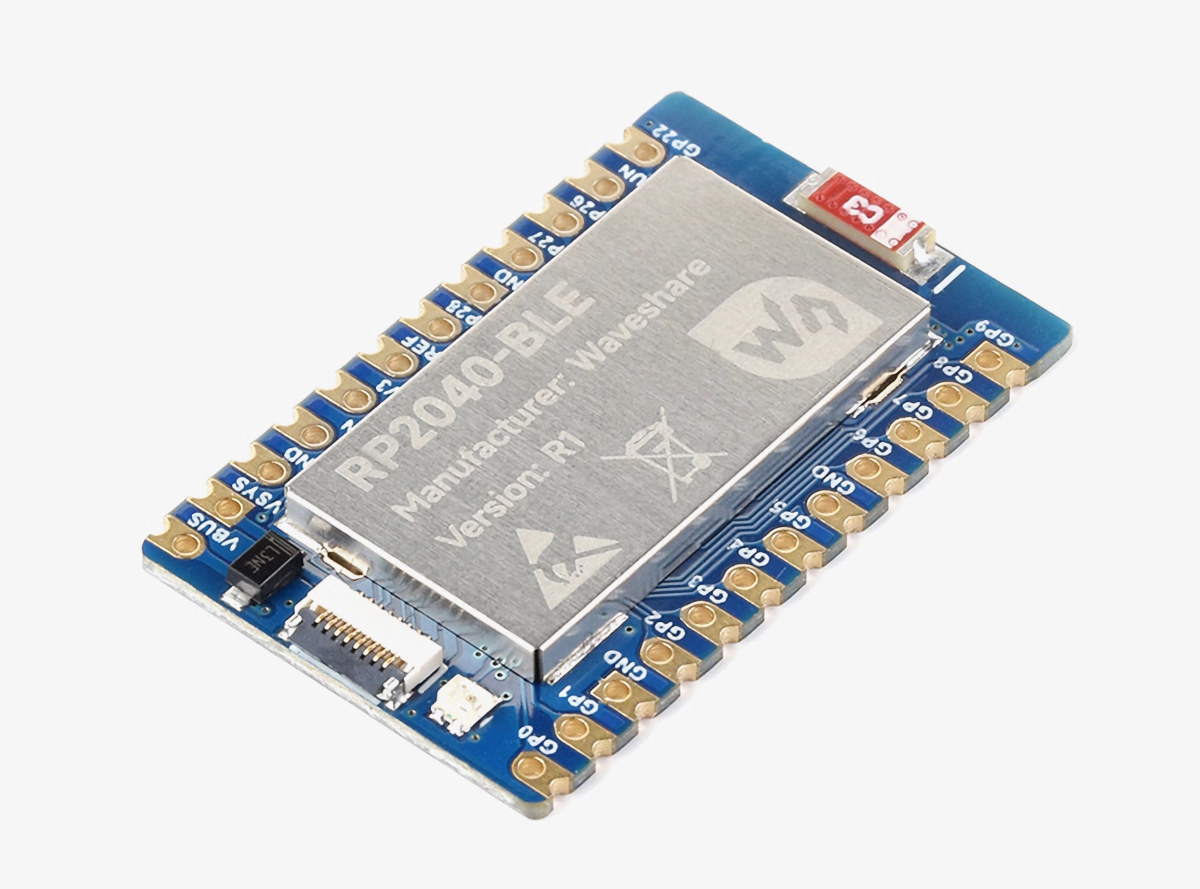
While searching Aliexpress, I stumbled upon the RP2350 Tiny and Tiny XL, both of which are RP2350-based low-cost stamp-size development boards that look exactly like the Solder Party’s “RP2350 Stamp” modules, but are available at nearly half the price. Both modules feature the Raspberry Pi RP2350 dual-core Arm Cortex-M33 microcontroller and an integrated LiPo charging circuitry. The RP2350 Tiny offers 30x GPIOs, while the larger RP2350 Tiny XL breaks out 48x GPIOs, adds PSRAM, and includes SWD/UART JST connectors. Key interfaces include USB host/device, UART, SPI, I²C, PWM, ADC, and PIO state machines, along with Secure Boot and Arm TrustZone. These features make this board suitable for rapid prototyping and testing with CircuitPython support. RP2350 Tiny and Tiny XL specifications: Microcontroller RP2350 Tiny – Raspberry Pi RP2350A MCU, QFN-60; 7×7 mm RP2350 Tiny XL – Raspberry Pi RP2350B MCU,QFN-80; 10×10 mm Memory – 520KB internal RAM, 8KB OTP storage Storage – 16MB […]
Raspberry Pi-like Allwinner A527/T527 industrial SBC features dual camera support and AI acceleration
EBYTE has recently released an Allwinner A527/T527-based Raspberry Pi-like industrial SBC with dual camera and AI features, with a design very similar to the Walnut Pi 2B, and to a lesser extent, the Orange Pi 4A. It is designed for embedded, IoT, and smart commercial applications. The board supports up to 4GB LPDDR4 RAM, 32GB eMMC storage, and MicroSD card expansion. Display options include HDMI 2.0 and a 4-lane MIPI DSI interface enabling dual 4K output, while two 4-lane MIPI CSI connectors allow simultaneous camera inputs. Connectivity options include Gigabit Ethernet, Wi-Fi 4, Bluetooth 4.2, and a PCIe 2.1 x1 slot for high-speed expansion. It also features four USB 2.0 ports, a Type-C power interface, and a 40-pin Raspberry Pi-compatible GPIO header. EBYTE Allwinner A527/T527 SBC specifications: SoC – Allwinner T527 (industrial) / Allwinner A527 (commercial) CPU Octa-core Arm Cortex-A55 processor with four cores @ 1.80 GHz (T527) or 2.0 […]
$4 Shrike-lite FPGA board combines 1120 LUTs Renesas ForgeFPGA with Raspberry Pi RP2040 MCU
Shrike-lite is an ultra-cheap FPGA board based on a 1120 LUTs Renesas ForgeFPGA device (SLG47910V) and also equipped with a Raspberry Pi RP2040 microcontroller. The board also features a USB-C port for power and programming, two 18-pin headers and a 12-pin PMOD-compatible header for I/Os, as well as Boot and Reset buttons, but not much else since it’s designed as a minimal development board. Shrike-lite and Shrike boards specifications: FPGA – Renesas ForgeFPGA (SLG47910V,1120 LUTs) 1120 5-bit LUTs 1120 DFFs 5 kb distributed memory 32 kb BRAM Configurable through NVM and/or SPI interface Package – STQFN-24 MCU – Raspberry Pi RP2040 dual-core Cortex-M0+ microcontroller @ 125 MHz with 264KB SRAM FPGA/ MCU interface – 6-bit high-speed bridge Storage – QSPI flash for configuration and storage USB – USB Type-C for programming & power Expansion 2x 18-pin headers for RP2040 and ForgeFPGA’s I/Os 12-pin PMOD compatible header Misc Boot and Reset buttons […]
Ubo Pod – A Raspberry Pi 4/5-based personal AI assistant (Crowdfunding)
The Ubo Pod Developer Edition (DE) is an open-source AI vision and conversational voice assistant platform built around the Raspberry Pi 4 or 5, and designed for developers who want more control over their AI experiences. The device aims to replace black boxes like Amazon Echo or Google Next AI assistants, with an open hardware smart speaker running open-source software, and offering features such as speech-to-text, LLMs/VLMs, text-to-speech, tool calling, and various multiple trigger mechanisms, among others. The Ubo Pod supports both cloud-based and fully local private AI, and features an embedded GUI on the integrated display and a WebUI for no-code setup. Ubo Pod specifications: SBC Ubo Pro 4 – Raspberry Pi 4 Ubo Pro 5 – Raspberry Pi 5 Storage 32GB MicroSD card included and preloaded with OS. Ubo Pro 5 – M.2 PCIe socket for NVMe SSD (or AI accelerator) Display – 1.54-inch color TFT IPS display […]
4-inch square HDMI displays with USB touchscreen sell for $33 and up
We’ve already seen some small HDMI displays, mostly useful for SBCs like Raspberry Pi boards, including a 7-inch monitor with a stand, a 7-inch HDMI touchscreen display, and a 7.9-inch ultrawide HDMI display. Today, I’ve come across another form factor with two 4-inch square HDMI touchscreen displays with 720×720 resolution: the VIEWE model appears to be new and is the cheaper of the two at about $33, while the Waveshare “4inch HDMI LCD (C)” has been around for a couple of years and offers extra features such as a 3.5 mm audio jack and speakers support, and mounting for Raspberry Pi 3/4/5 single board computers with adapters. VIEWE 4-inch square HDMI touchscreen display VIEWE 4-inch HDMI display (UEDX72720040-HMD-RB-A) specifications: Display 4-inch square HDMI TFT display with 720×720 resolution ST7703 display driver Brightness – 300 cd/㎡ Active area – 71.93 x 71.93 mm Touchscreen – 5-point capacitive touch screen via USB-C […]
upyOS modular MicroPython-based OS for microcontrollers works with ESP32, RP2040, etc…
upyOS is a modular, lightweight MicroPython-based operating system (OS) that provides a Unix-like experience on low-resource microcontrollers such as Espressif Systems ESP32/ESP32-C3/ESP32-S3, Raspberry Pi RP2040, and others. Inspired by smolOS, upyOS offers remote development tools, OTA updates, and a built-in web server. Its modular architecture separates system functions into reusable components, instead of large, monolithic programs. Key Features: Modular architecture: Commands and system functionality are broken down into small, independent modules to reduce memory usage. Built-in shell environment: Execute commands and scripts directly, providing a Unix-like CLI experience. Startup and shutdown scripting: Configure boot and shutdown behaviors using /etc/init.sh and /etc/end.sh. Recovery mode: A built-in failsafe mechanism lets users recover the system when booting fails. Background execution: Supports threads and asyncio for background tasks, along with & sufix, hold, resume, kill and killall commands for process control. Remote development support: Telnet and FTP servers allow file transfer and terminal access over […]
The latest Raspberry Pi OS images are now based on Debian 13 “Trixie”
Since Debian 13 “Trixie” was released last August, it was just a matter of time until Raspberry Pi OS followed. Raspberry Pi announced the update from Bookworm to Trixie a few days ago. The new Raspberry Pi OS images get the new and updated packages from Debian 13, and features like 64-bit time support to solve the Y2K38 bug. However, as Simon Long, UX engineer at Raspberry Pi, points out, there have been fewer changes in newer versions of Debian, and most changes in the new version of Pi OS are cosmetic, although there are some interesting under-the-hood changes as well. The most obvious change from the user’s perspective is the new theme featuring a completely new set of icons, a new font (Nunito Sans Light), new desktop backgrounds (the new default is a photo of the sun rising over the Drakensberg mountains in Lesotho), and some other small tweaks. […]
M5Stack LLM-8850 card – An M.2 M-Key AI accelerator module based on Axera AX8850 24 TOPS SoC
M5Stack LLM‑8850 card is an M.2 M-Key 2242 AI acceleration module powered by an Axera AX8850 SoC delivering 24 TOPS ( INT8) of performance, and suitable for host devices such as Raspberry Pi 5, Rockchip RK3588 SBCs, and even x86 PCs like mini PCs with a spare M.2 Key-M socket. The card ships with 8GB RAM, a 32Mbit SPI NOR flash, and also supports H.265/H.264 8Kp30 video encoding and 8Kp60 video decoding, with up to 16 channels for 1080p videos. It is also equipped with an active cooling system to maintain stable temperatures and prevent thermal degradation inside enclosures. M5Stack LLM‑8850 card specifications: SoC – Axera AX8850 CPU – Octa-core Cortex‑A55 processor at 1.7 GHz NPU – 24 TOPS @ INT8 VPU Video Encoder – 8K @ 30 fps H.264/H.265 encoding, supports scaling / cropping Video Decoder – 8K @ 60 fps H.264/H.265 decoding, supports 16 channels 1080p parallel decoding, supports scaling / cropping Memory – 8GB 64‑bit LPDDR4x @ 4266 Mbps Storage – 32Mbit QSPI NOR […]