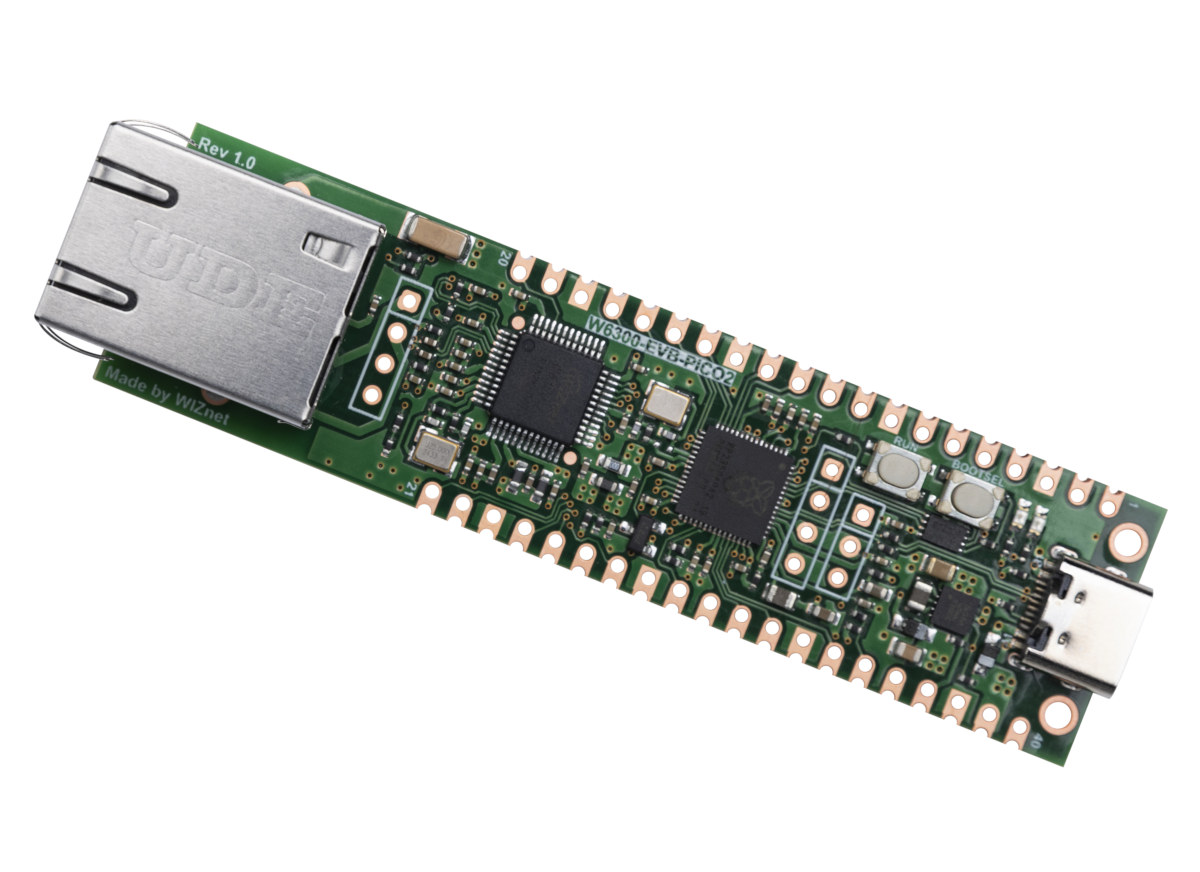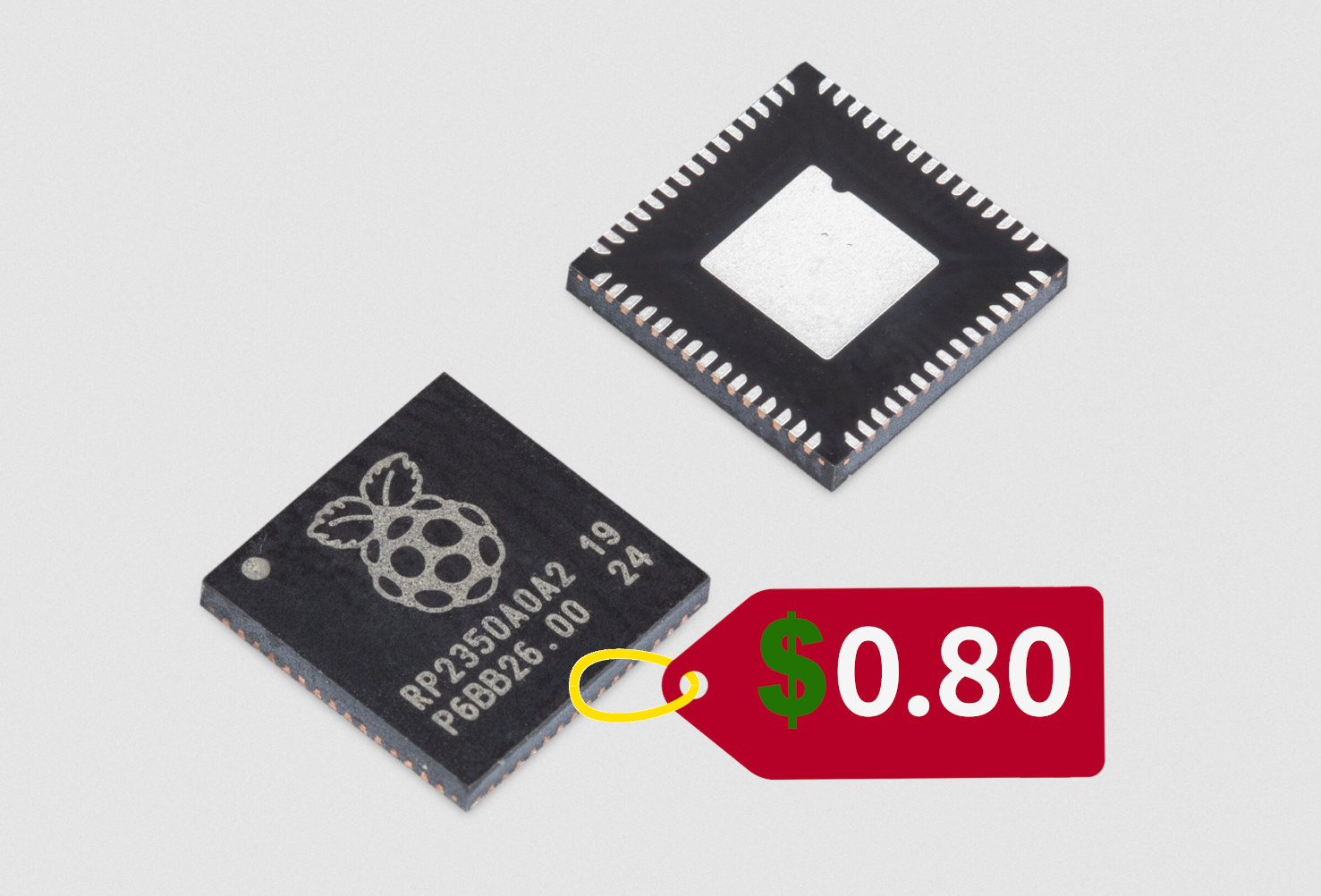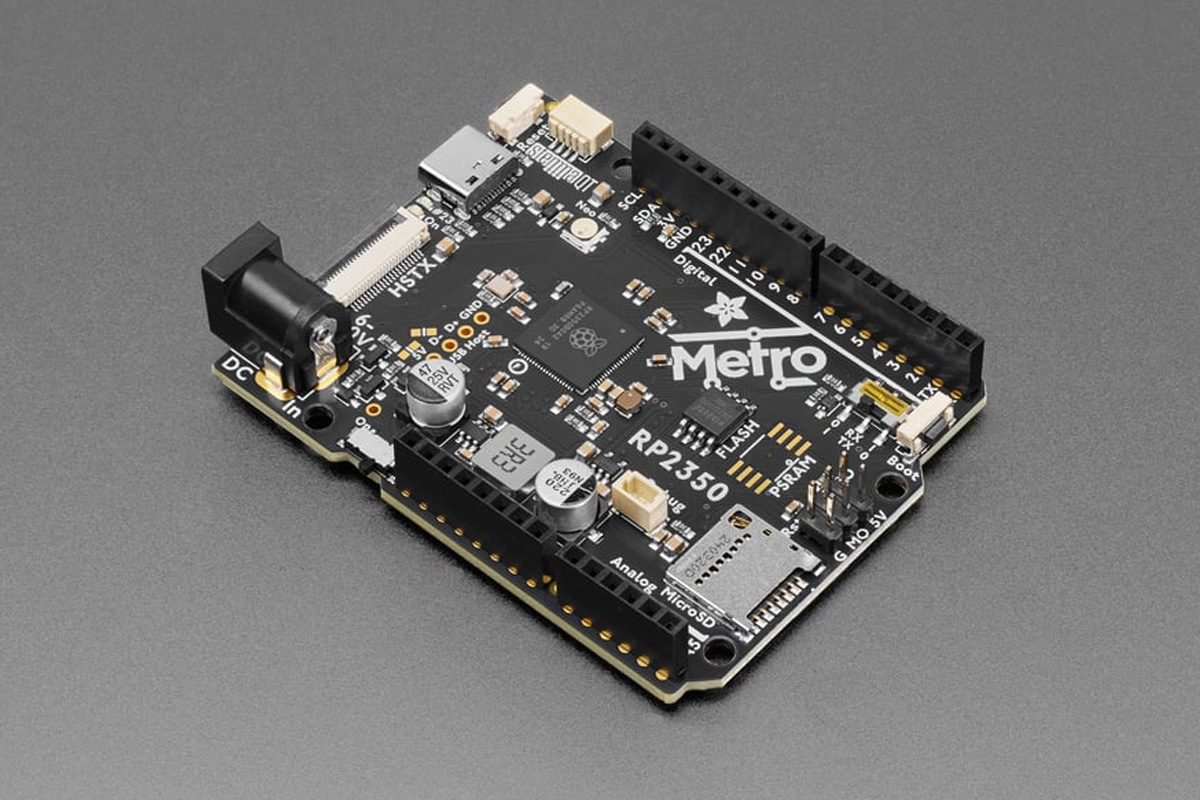

The picoZ80 board is a drop-in replacement for the Z80 microprocessor based on the Raspberry Pi RP2350B dual-core Cortex-M33 microcontroller and an ESP32 wireless SoC for WiFi and Bluetooth connectivity. My first computer was a ZX81 powered by a Zilog Z80 microprocessor, which was eventually phased out in 2024 after almost 50 years of production. But retro computing enthusiasts keep the platform alive, usually with softcore FPGA implementations such as MiSTer. The picoZ80 is different as it relies on the programmable I/O (PIO) state machines from the RP2350B MCU to reproduce cycle-accurate address, data, and control buses of the Z80 MPU. picoZ80 specifications: MCU – Raspberry Pi RP2350B CPU – Dual-core Arm Cortex-M33 CPU @ up to 150/300 MHz (the two RISC-V cores do not appear to be used by the project) Memory – 520KB SRAM Storage – 8KB OTP flash Package – QFN-80 Memory – 8MB PSRAM Storage 16MB flash […]
Clintech Pico – The first Raspberry Pi RP2354B board offers 48 GPIOs in Raspberry Pi Pico form factor
Designed by Clintech Ltd. in Bulgaria, the Clintech Pico Board appears to be the first development board based on the Raspberry Pi RP2354B chip with 2MB on-chip flash. It retains the same form factor as a Raspberry Pi Pico 2 but adds extra GPIOs to make use of the 48 general-purpose GPIOs provided by the RP2354B chip. Like the Raspberry Pi Pico 2, this board features 40 castellated and through holes on the sides, exposing GPIOs 0–22 and 26–28, along with 3 debug pins. Additionally, the board includes 27 extra on-board through holes that break out the remaining GPIOs (23–25 and 29–47) as well as the QSPI interface (SD0–SD3 and SCLK) for external memory. Clintech Pico specifications: SoC – Raspberry Pi RP2354B CPU Dual-core Arm Cortex-M33 @ 150 MHz with Arm Trustzone, Secure boot Dual-core 32-bit RISC-V Hazard3 @ 150 MHz (3-stage in-order pipeline; RV32IMAC with Zba, Zbb, Zbs, Zbkb, Zcb, Zcmp, and […]
PycoClaw – A MicroPython-based OpenClaw implementation for ESP32 and other microcontrollers
PycoClaw is a MicroPython-based platform for running AI agents on ESP32 and other microcontrollers that brings OpenClaw workspace-compatible intelligence to resource-constrained embedded devices. We had already covered the C-based Miniclaw for ESP32-S3 SoCs, the PycoClaw’s developer (Jonathan Peace) told CNX Software that it is a “full OpenClaw-compliant agent” that supports more LLM providers (OpenAI, Gemini, Ollama, etc.), interfaces with not only Telegram, but also ScriptO Studio and WebRTC, and offers features like OTA updates, extensions, and battery-optimized operation. The table below compares PycoClaw to OpenClaw, Nanobot, PicoClaw, NullClaw, and MimiClaw. MimiClaw still offers the lowest footprint and highest efficiency, but PycoClaw appears to offer many more features, including improved GPIO support. It works on ESP32-S3 with at least 8MB flash and PSRAM, ESP32-P4, and should soon support Raspberry Pi RP2350 boards with PSRAM as well. PycoClaw can be installed on supported hardware through a “one-click install” using a compatible web […]
PicoIDE – An open-source hardware IDE/ATAPI drive emulator for vintage computers (Crowdfunding)
PicoIDE is an open-source hardware IDE/ATAPI drive emulator based on a Raspberry Pi RP2350 board and designed to replace hard drives and CD-ROM drives in vintage computers with microSD card storage. Users don’t need to burn optical discs or deal with old IDE hard drives with bad blocks, and instead, they can simply put their disk images on a microSD card and swap between them as needed. Two versions are offered, namely the PicoIDE Base featuring full IDE/ATAPI emulation in a standard 3.5-inch enclosure with a microSD card slot, and CD audio output, and the PicoIDE Deluxe, adding an ESP32-C3-based front panel with WiFi connectivity, an OLED, and navigation buttons. PicoIDE specifications: MCU – Raspberry Pi RP2350 microcontroller CPU 2x Arm Cortex-M33 cores @ 150 MHz 2x Hazard3 RISC-V cores @ 150 MHz Up to two cores can be used at any time (configured at boot) Memory – 520KB SRAM […]
Witty Pi 5 HAT+ – A Raspberry Pi RP2350-based power scheduler with time, temperature, and voltage-based triggers
Designed by UUGear, the Witty Pi 5 HAT+ is a power scheduler board for Raspberry Pi that features an RP2350 MCU for running scheduling logic. It includes a high-precision RTC with voltage and temperature monitoring for automated power on/off, making it suitable for solar-powered projects, environmental monitors, and industrial controllers that require scheduled power on/off control to extend battery life. The board follows the Raspberry Pi HAT+ specification and accepts power from either a 6V–30V DC input through a terminal block or a 5V USB-C supply, while delivering up to 5A to the Raspberry Pi and connected peripherals. It can also work as a simple UPS, thanks to its dual “ideal diode” configuration with an automatic switchover feature in case of power failure. Other hardware features include an onboard DC/DC converter, an ID EEPROM for HAT+ identification, a CR2032 RTC battery, and a wide –30°C to +80°C operating temperature range. […]
Raspberry Pi RP2350 devkit features 1.85-inch round touch display, microphone, optional speaker and battery box
Waveshare RP2350-Touch-LCD-1.85C is a Raspberry Pi RP2350 devkit with a 1.85-inch round touchscreen display with 360×360 resolution, a built-in microphone, a 28-pin GPIO header, and a USB-C port. The RP2350-Touch-LCD-1.85C-BOX model builds on the platform to add a box with a speaker and a 3.7V battery. Both models also come with 16MB SPI flash, a microSD card slot, a 6-axis IMU, a few buttons and LEDs, and UART and I2C expansion connectors. They can be used for HMI solutions using touch, button, and voice recognition inputs, as well as display and audio outputs. RP2350-Touch-LCD-1.85C specifications: Microcontroller – Raspberry Pi RP2350A MCU CPU 2x Arm Cortex-M33 cores @ 150 MHz 2x Hazard3 RISC-V cores @ 150 MHz Up to two cores can be used at any time (configured at boot) Memory – 520KB SRAM Storage – 8KB OTP Package – QFN-60; 7×7 mm Storage – 16MB SPI NOR flash, microSD card slot Display […]
MicroPython v1.27 adds support for ESP32-C5, ESP32-P4, and STM32U5 microcontrollers
MicroPython is one of the most popular firmware for microcontrollers due to its ease of use. The MicroPython v1.27 release adds support for some interesting microcontrollers, namely Espressif Systems ESP32-C5 and ESP32-P4, thanks to an update to the ESP-IDF v5.5.1 framework, as well as STMicroelectronics STM32U5, and features a range of other changes. These include improvements to the test suite to cater to the increasing number of supported hardware platforms, the introduction of tier levels for different hardware platforms, various optimizations and bug fixes, updated libraries, new ESP32 and STM32 boards, and more. The last time we reported on a MicroPython release was for v1.24, which added support for Raspberry Pi RP2350 and ESP32-C6 microcontrollers. Other MicroPython v1.27 highlights: Test suite improvements Auto-detecting if the target has Unicode support Automatically including float tests when possible Always including stress tests Improving the skipping of tests that use slice and the […]
HackBEE is a Raspberry Pi RP2350 USB-C dongle for developers (Crowdfunding)
Hack the Board’s HackBEE is a tiny programmable USB-C dongle and development platform powered by the Raspberry Pi RP2350 Arm Cortex-M33/Hazard3 RISC-V microcontroller. It supports USB host and device modes, has side buttons, and includes a multi-color RGB LED for feedback. The device can be used as a programmable HID device (keyboard/mouse/media controller), a USB host or device for testing and prototyping, an automation tool for repetitive tasks, a compact input emulator, or a teaching tool for C/C+, MicroPython, and embedded systems education. HackBEE specifications: MCU – Raspberry Pi RP2350A CPU Dual-core Arm Cortex-M33 @ 150 MHz with Arm Trustzone, Secure boot OR Dual-core RISC-V Hazard3 @ 150 MHz Either two cores can be used. Memory – 520 KB on-chip SRAM Package – QFN-60 Storage – Not disclosed USB – 1x USB Type-C host/device port Security – Arm TrustZone for Cortex-M33 cores, optional boot signing (OTP), protected OTP storage, SHA-256 […]