Xibo digital signage solution is now compatible with the Raspberry Pi 5 thanks to Axeribo, an unofficial alternative to the digital signage player for Xibo, that is implemented in Rust, and designed for Linux platforms. Long-time readers of CNX Software may remember that I played around with the Xibo open-source digital signage player many years ago (2011-2012). I notably managed to run Xibo for Arm in QEMU, test Xibo digital signage in the Raspberry Pi emulator, and even try it on real hardware: a MeLE A1000 Android TV box to which I installed Linux. It kind of works, but without hardware video decoding and no 3D graphics acceleration, performance was rather on the low side. I eventually stopped playing around with Xibo Arm Linux once Xibo for Android was released in late 2012, and the developers decided to drop support for the Linux client (although they relaunched it in 2019 […]
Tyr – A Rust GPU driver for Arm Mali GPUs
One interesting addition to the just-released Linux 6.18 kernel is the Tyr Rust GPU driver for CSF-based Arm Mali GPUs, which is a port of the mature Panthor C GPU driver merged into Linux 6.10. It was developed by Collabora in collaboration with Arm and Google. Tyr aims to implement the same userspace API offered by Panthor, so that it can eventually be used as a drop-in replacement in the company’s PanVK Vulkan driver. After several years, the Tyr Rust driver might replace the Panthor C driver, but in the meantime, Panthor will keep being used since it is more mature and conformant with OpenGL ES 3.1 since July 2024. The work on Tyr is fairly advanced, and Collabora provided an update at the end of November. The key takeaway is that the Tyr (prototype) driver works with GNOME, Weston, and even full-screen 3D games like SuperTuxKart while matching the […]
Linux 6.18 LTS release – Main changes, Arm, RISC-V, and MIPS architectures
Linus Torvalds has just announced the release of Linux 6.18 on the Linux Kernel Mailing List (LKML), which will likely become the next LTS kernel [update: it’s now official]: So I’ll have to admit that I’d have been happier with slightly less bugfixing noise in this last week of the release, but while there’s a few more fixes than I would hope for, there was nothing that made me feel like this needs more time to cook. So 6.18 is tagged and pushed out. Most of the last-minute fixes are minor fixes to drivers, with some random noise elsewhere (bluetooth, ceph, afs..). Nothing strikes me as standing out, but hey, there’s a shortlog appended if you want to see the details. And this obviously means that the merge window will open tomorrow, and I already have three dozen pull requests pending. Thanks. And as I already mentioned a couple of […]
CrowPanel Advance 7-inch ESP32-P4 HMI display supports Zigbee, LoRa, and 2.4GHz radio modules
The CrowPanel Advance 7.0-inch ESP32-P4 HMI AI display is an ESP32-P4 HMI terminal that is similar to the GUITION 7-inch touchscreen display. It also adds an ESP32-C6 module for WiFi 6, Bluetooth LE, and 802.15.4 connectivity, and is suitable for Smart Home, industrial automation, and AIoT applications. It features a 7-inch 1024×600 IPS capacitive touchscreen and optional AI vision and audio through a 2MP MIPI-CSI camera for face and object recognition, and a speaker header and a dual microphone array for interactive voice applications. The smart display also supports interchangeable wireless expansion for Zigbee/Thread, LoRa, and 2.4 GHz proprietary (nRF2401) connectivity. CrowPanel Advance 7.0-inch display specifications: Microcontroller – Espressif Systems ESP32-P4 CPU Dual-core RISC-V HP (High-performance) CPU @ up to 400 MHz with AI instructions extension and single-precision FPU, 768KB of on-chip SRAM Single-RISC-V LP (Low-power) MCU core @ up to 40 MHz with 8KB of zero-wait TCM RAM Memory – […]
FPGA-based Modos Paper Dev Kit supports a wide range of E-Ink displays, up to 75 Hz refresh rate (Crowdfunding)
Modos Paper Dev Kit helps users create an open-hardware E-Ink monitor with a fast 75 Hz refresh rate and low latency thanks to a Xilinx Spartan-6 FPGA driver board, and compatibility with a wide and of E-Ink displays between 4-inch and 42-inch in size. The resulting grayscale or color E-ink monitor can be connected through HDMI or USB and works on Linux, macOS, and Windows. Modos Paper driver board specifications: FPGA – AMD/Xilinx Spartan-6 LX16 FPGA running Caster gateware Memory – DDR3-800 framebuffer memory MCU – STMicro STM32H750 Arm Cortex-M7 microcontroller for USB communication, firmware upgrades, and standalone applications. Processing rate up to 133 MP/s when error-diffusion dithering is enabled, and 200 MP/s when disabled Supported Displays – 4-inch to 42-inch E-Ink displays without integrated TCON; See long list on GitHub Video Input USB Type-C DisplayPort Alt-Mode with on-board PTN3460 decoder microHDMI connector for DVI video input with on-board ADV7611 […]
FOSDEM 2025 schedule – Embedded, Open Hardware, RISC-V, Edge AI, and more
FOSDEM 2025 will take place on February 1-2 with over 8000 developers meeting in Brussels to discuss open-source software & hardware projects. The free-to-attend (and participate) “Free and Open Source Software Developers’ European Meeting” grows every year, and in 2025 there will be 968 speakers, 930 events, and 74 tracks. Like every year since FOSDEM 2015 which had (only) 551 events, I’ll create a virtual schedule with sessions most relevant to the topics covered on CNX Software from the “Embedded, Mobile and Automotive” and “Open Hardware and CAD/CAM” devrooms, but also other devrooms including “RISC-V”, “FOSS Mobile Devices”, “Low-level AI Engineering and Hacking”, among others. FOSDEM 2025 Day 1 – Saturday 1 10:30 – 11:10 – RISC-V Hardware – Where are we? by Emil Renner Berthing I’ll talk about the current landscape of available RISC-V hardware powerful enough to run Linux and hopefully give a better overview of what to […]
RootMaster is a Raspberry Pi Zero 2W-based hydroponic automation system with STM32G4 MCU, CAN Bus, sensors
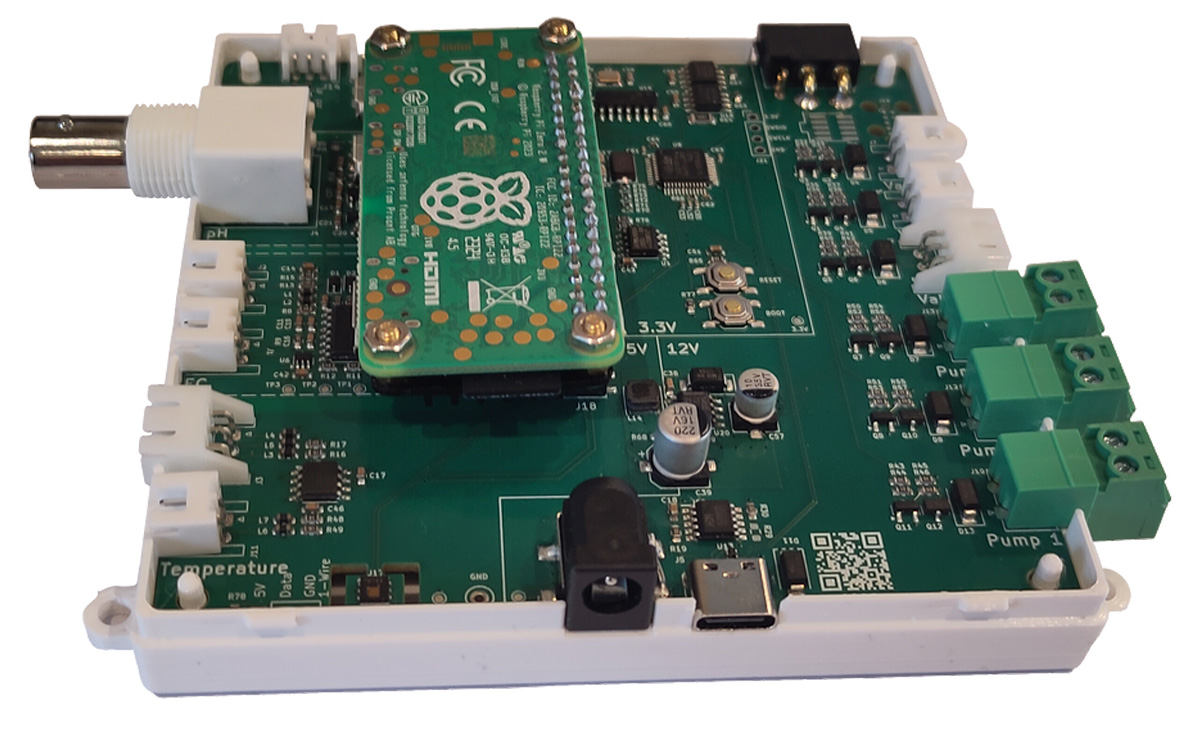
The RootMaster is a Raspberry Pi Zero 2W-based hydroponic automation system designed to precisely manage water and environmental conditions. The solution also integrates an STM32G4 microcontroller to handle real-time operations such as controlling pumps and peripherals, managing sensors, and processing data from external sensors like water level indicators. It also generates PWM signals to control the power of connected devices and handles communication with external modules through a CAN FD interface. While STM32 handles hardware-level tasks, the Raspberry Pi Zero 2W manages high-level control and user interaction. The RootMaster can be programmed with Python, C, C++, or other programming languages and is useful for applications like Hydroponics automation, water circulation, and environmental control. RootMaster specifications MCU – STMicro STM32G473 32-bit Arm Cortex-M4 microcontroller @ 170 MHz for real-time operations Main controller – Compatible with Raspberry Pi Zero 2 WH for GUI and other interfaces Sensors pH sensor for nutrient solution […]
Linux 6.8 release – Notable changes, Arm, RISC-V, and MIPS architectures
Linus Torvalds has just announced the release of Linux 6.8 on the Linux kernel mailing list: So it took a bit longer for the commit counts to come down this release than I tend to prefer, but a lot of that seemed to be about various selftest updates (networking in particular) rather than any actual real sign of problems. And the last two weeks have been pretty quiet, so I feel there’s no real reason to delay 6.8. We always have some straggling work, and we’ll end up having some of it pushed to stable rather than hold up the new code. Nothing worrisome enough to keep the regular release schedule from happening. As usual, the shortlog below is just for the last week since rc7, the overall changes in 6.8 are obviously much much bigger. This is not the historically big release that 6.7 was – we seem to […]