
NXP i.MX 93W wireless MPU SiP pairs dual-core Arm Cortex-A55 processor with NXP iW610 WiFi 6, Bluetooth LE, and 805.15.4 radio

NXP i.MX 93W

NXP i.MX 93W is the company’s first integrated wireless MPU System-in-Package (SiP) and combines a dual-core Cortex-A55 processor (NXP i.MX 93) with an iW610 WiFi 6, Bluetooth LE, and 802.15.4 tri-radio into a single chip. The 14.2 x 12 mm package also includes all the external radio components needed for wireless connectivity, replacing up to 60 discrete components on the PCB. NXP says it reduces the PCB area, simplifies PCB design and regulatory approval, and speeds up time-to-market. NXP i.MX 93W specifications: CPU Dual-Core Arm Cortex-A55 at up to 1.7 GHz Arm Cortex-M33 core at 250 MHz for real-time control GPU – 2D graphics accelerator AI accelerator – Arm Ethos-U65 microNPU Memory I/F – Up to 3.7GT/s 16-bit LPDDR4/LPDDR4X with inline ECC Storage I/F – 2x SD 3.0/SDIO 3.0/eMMC 5.1 Display Interfaces MIPI DSI up to 1080p60 LVDS up to 720p60 24-bit parallel RGB Camera Interface – 2-lane MIPI CSI up […]

Iridium 9604 3-in-1 IoT module integrates Iridium SBD satellite service, LTE-M cellular connectivity, and GNSS positioning

Iridium 9604

Iridium Communications has just unveiled the Iridium 9604 3-in-1 IoT module with support for Iridium Short Burst Data (SBD) satellite service, LTE-M cellular connectivity, and GNSS positioning. Solutions relying on satellite, cellular, and/or GNSS positioning are typically implemented using three different chips or modules. For example, the earlier Iridium Certus 9704 Satellite IoT Developer Kit relies on an Iridium 9704 module and a u-blox GNSS module, but the Iridium 9604 module implements everything into a single 26 x 16 mm package, saving up to 60 percent or more in board space and lowering the costs of the final product. Iridum 9604 specifications: Iridium Short Burst Data 340 bytes mobile-originated 270 bytes mobile-terminated Global LEO coverage Cellular LTE-M (CAT-M1) Global band support Carrier certifications FirstNet certification in the US GNSS – GPS, GLONASS, Galileo, BeiDou Antennas Iridium/GNSS antenna LTE-M antenna Host interface – Single interface (not specified, likely UART or SPI) Dimensions – 26 […]

Semtech launches AirLink RX400 and EX400 5G RedCap routers for IoT applications

AirLink RX400 EX400 5G RedCap routers

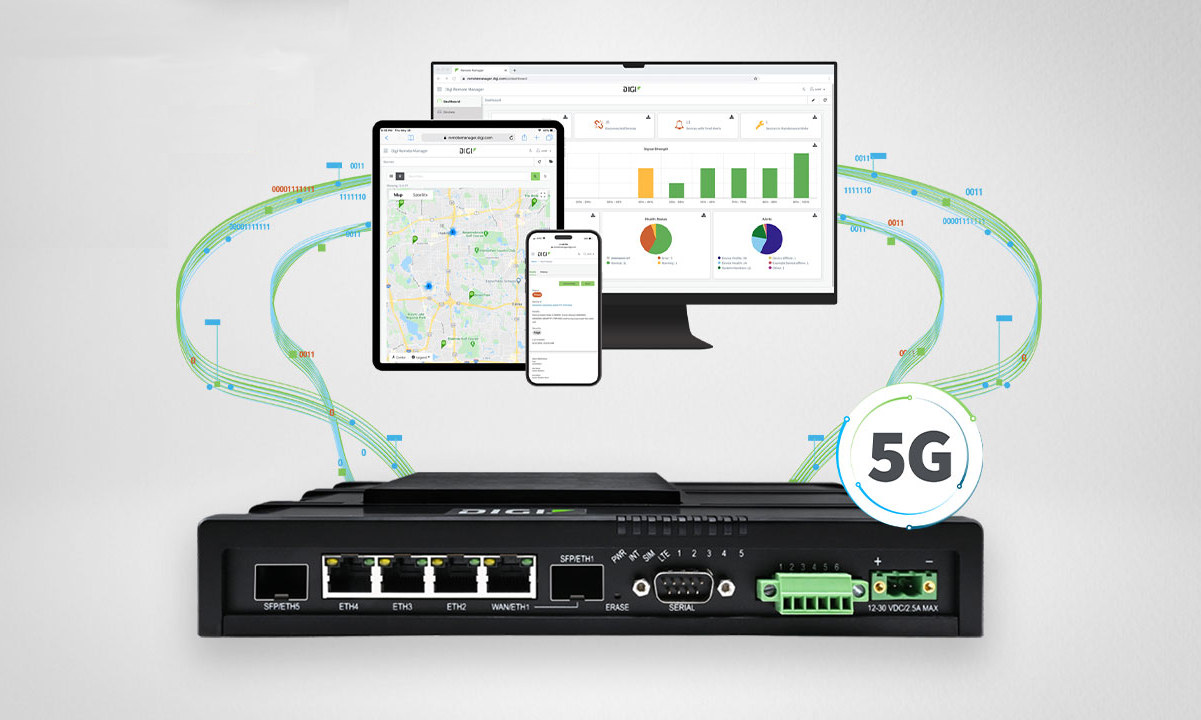
Semtech has just launched the AirLink RX400 and EX400 5G RedCap routers for industrial and commercial IoT applications. They offer a lower power consumption and lower costs compared to traditional 5G deployment. The routers are powered by an unnamed Arm Cortex-A55 processor, feature up to two Gigabit Ethernet ports, 5G RedCap cellular connectivity (3GPP Release 17 and 5G Standalone) with LTE Cat 4 fallback, dual-band GNSS, optional WiFi 6 connectivity, and optional RS-232 interfaces, among other features. AirLink RX400/RX400 specifications: SoC – Unnamed dual-core Arm Cortex-A55 processor System Memory – 600 MB RAM available to containers Storage – 500 MB flash available to containers Networking AirLink EX400 – 2x Gigabit Ethernet ports AirLink RX400 – Gigabit Ethernet port 5G RedCap (Reduced Capability) cellular connectivity up to 226 Mbps downlink, 120 Mbps uplink, dual SIM (Nano-4FF); 4G LTE fallback Optional dual-band Wi-Fi 6 1×1 MIMO up to 600 Mbps Serial (AirLink RX400 […]

AMD Spartan UltraScale+ SU35P FPGA evaluation kit supports Raspberry Pi, Arduino, Mikrobus, and Pmod expansion

AMD SCU35 evaluation kit

AMD’s SCU35 Evaluation Kit is an affordable ($229) development board powered by the AMD Spartan UltraScale+ SU35P FPGA device, which targets low-power industrial, medical, and data center applications requiring I/O expansion and board management capabilities. Designed for headless applications, the board features a 10/100 Mbps Ethernet port and a USB-C port for power, as well as plenty of headers and connectors compatible with off-the-shelf expansion boards or modules, including Arduino UNO headers, two 40-pin Raspberry Pi GPIO headers, two Mikrobus headers, four Pmod connectors, and an HSIO board-to-board connector.   AMD SCU35 evaluation kit specifications: FPGA – AMD Spartan Ultrascale+ SU35P (XCSU35P-2SBVB625E) 36K Logic Cells 304 Max Total I/O• Board Management Controller Memory – 1.93 Mb on-chip memory Memory – 64 Mbit HyperRAM Storage 128 Mbit QSPI flash 64 Kbit EEPROM Networking – 10/100Mbps Ethernet RJ45 port Sensor – 3-axis linear accelerometer Expansion Arduino UNO headers 2x 40-pin Raspberry Pi […]

Zigbee 4.0 introduces ”Suzi” Sub-GHz connectivity and security enhancements

ZIgbee 4.0 Suzi sub-GHz Zigbee

The Connectivity Standards Alliance (CSA) has just announced the release of Zigbee 4.0, integrating security and interoperability improvements, as well as the Suzi Zigbee’s Sub-GHz feature operating in the 800 MHz (Europe) or 900 MHz (North America) band for longer range and lower interference compared to the traditional 2.4 GHz band. Highlights of Zigbee 4.0 release: Simplified certification processes Enhanced information exchange for smart home solutions. Formalized Parent Selection, Unique Link Key Monitoring, and Trust Center Connectivity improve network resilience Standardized network-level retries, more reliable data polling for sleepy end devices, and expanded use of APS acknowledgements increase overall network performance and reduce message loss. Sleepy-to-sleepy communication using Coordinated Sample Listening (CSL) allows direct, low-power exchanges between devices, optimizing energy and further extending battery life Security updates aligned with evolving international security standards Dynamic Link Key, Device Interview, and Smart Energy Authentication Level Control for stronger device authentication, selective communication […]

Quectel KCMCA6S industrial wM-bus modules target smart metering

cnx KCMCA6S series sub GHz Wireless M Bus (WM Bus) modules

Quectel’s KCMCA6S is a series of industrial wireless M-Bus (wM-Bus) modules built around Silicon Labs’ EFR32FG23 chipset. The modules operate in the 868 MHz, 169 MHz, and 433 MHz bands and support the EN13757-4 wM-Bus standard for smart metering and AMI (Advanced Metering Infrastructure) applications. The device features an Arm Cortex-M33 processor, 32 KB of SRAM, 256 KB of flash, and a Sub-GHz transceiver. It supports multiple wM-Bus modes (T, C, S, R, N, F), with dynamic multi-mode switching, flexible frequency configuration, and low-power operation alongside multi-layer security mechanisms. Interfaces include USART, SWD, and GPIOs, with optional EUSART, I²C, and ADC through pin multiplexing. Available in two variants (with or without SAW filter), the module comes in a compact 25.4 × 14.0 × 2.9 mm LCC package for water, electricity, gas, and heat metering systems. Quectel KCMCA6S specifications: MCU- Silicon Labs EFR32FG23 Core – Arm Cortex-M33 core, up to 78 […]

Renesas RA4C1 Arm Cortex-M33 MCU targets Smart Meters and energy-efficient IoT applications

Renesas RA4C1

Renasas RA4C1 microcontroller (MCU) group is based on an 80-MHz Arm Cortex M33 core and designed for utility meters and battery-powered IoT applications. It’s especially suited to devices that require advanced security and segment LCD support, such as smart locks, thermostats, building controls, and industrial user interfaces. The RA4C1 is very similar to the Renesas RA4L1 MCU designed for HMI applications, but it comes with more RAM (96KB vs 64KB), and being optimized for Smart Meters lacks features like capacitive touch and audio output. The new MCU group still comes with up to 512KB code flash, 8KB data flash, plenty of I/Os, and a low-power consumption down to 168 µA/MHz in active mode, and a standby current of less than 1.79 µA with all SRAM retained. Renesas RA4C1 specifications: MCU core – Arm Cortex-M33 Armv8-M core up to 80 MHz Memory – 96 KB SRAM Storage 256 KB or 512 KB […]

AI-On-The-Edge-Cam ESP32-S3 board aims to digitize legacy utility meters

AI-On-The-Edge-Cam ESP32-S3 board

AI-On-The-Edge-Cam is an ESP32-S3 board with a 2MP camera, microSD card, WiFi, BLE, and PoE Ethernet connectivity designed to digitize legacy utility meters such as water meters, gas meters, or electricity meters that require manual onsite reading. AI-On-The-Edge-Cam is also the name of the firmware running on the board and was initially designed for the ESP32-CAM board. But the new board adds a few features that make it more versatile, like PoE support and a microSD card slot for storage, as well as RGB LEDs acting as a flash to allow meter reading at any time of the day or night. AI-On-The-Edge-Cam specifications: Wireless module – ESP32-S3-WROOM-1U-N16R8 SoC – Espressif Systems ESP32-S3 CPU – Dual-core Tensilica LX7 up to 240 MHz Memory – 512KB SRAM, up to 8MB PSRAM Storage – 16 MB flash Wireless – WiFi 4 and Bluetooth LE 5 IPEX antenna connector Storage – microSD card slot […]

Exit mobile version