Linus Torvalds has just announced the release of Linux 6.18 on the Linux Kernel Mailing List (LKML), which will likely become the next LTS kernel [update: it’s now official]: So I’ll have to admit that I’d have been happier with slightly less bugfixing noise in this last week of the release, but while there’s a few more fixes than I would hope for, there was nothing that made me feel like this needs more time to cook. So 6.18 is tagged and pushed out. Most of the last-minute fixes are minor fixes to drivers, with some random noise elsewhere (bluetooth, ceph, afs..). Nothing strikes me as standing out, but hey, there’s a shortlog appended if you want to see the details. And this obviously means that the merge window will open tomorrow, and I already have three dozen pull requests pending. Thanks. And as I already mentioned a couple of […]
The Librephone project aims to remove proprietary blobs from smartphones running an open-source OS
Some of you may already be running an open-source operating system on your smartphone, which could be Android-based, such as LineageOS, GrapheneOS, and e/OS, or Linux-based like postmarketOS and Ubuntu Touch. However, due to closed-source firmware files/proprietary blobs, you’re only running a partially open-source OS. The Free Software Foundation aims to change that with the Librephone project, whose goal is to reverse-engineer nonfree blobs and provide open-source alternatives. Some proprietary blobs are used to run WiFi, Bluetooth, 4G LTE/5G modems, touchscreen, fingerprint sensor, and other hardware. So it won’t be a trivial task, as serious reverse-engineering work is needed and done in a clean-room way to prevent copyright lawsuits, plus there may be regulatory issues with the code handling the radios\ frequency and power from the FTC and other governmental agencies around the world. To be clear, the Librephone project won’t be another operating system, and the only goal is […]
$200 SpecFive Spectre Pro Android 12 smartphone integrates LoRa Mesh connectivity
LoRa Mesh solutions like Meshtastic or MeshCore enable off-grid messaging, GPS coordinates, and in some cases, audio communication for emergencies, working or hiking in remote areas, or simply to be able to communicate outside of cellular networks. However, adoption is limited, as users need to buy a terminal that costs about the same as an entry-level smartphone, or they may not see any use for it, except for emergencies. Integrating LoRa Mesh into Android smartphones can lower the cost of the feature, since the battery, enclosure, etc… are already there, and you just need to add a LoRa module and an antenna. That’s what SpecFive has done with the SpecFive Spectre Pro 4G LTE smartphone with a LoRa module. The rugged phone runs Android 12 and ships with Meshtastic, Mesh Tic Tac Toe, CheckTastic, and Mesh Chess. Spec5 Spectre Pro specifications: SoC – Unnamed quad-core processor System Memory – 4GB […]
Broadcom unveils WiFi 8 chips for access points and clients
Broadcom has recently revealed its first WiFi 8 (802.11bn) chips with the BCM43109 for wireless clients such as smartphones, laptops, tablets, and automotive devices, the BCM6718 designed for residential and operator access applications, and the BCM43840 and BCM43820 made for enterprise access applications. Broadcom BCM43109 WiFi 8, Bluetooth 6.0, and 802.15.4 client chip Specifications: IEEE 802.11bn compliant Dual-stream spatial multiplexing data rate of up to 5 Gbps during single-band operation and 5.25 Gbps in RSDB mode Up to 320 MHz channels for the 2×2 5 GHz and 6 GHz radio, and 20 MHz channels for the 2×2 2.4 GHz radio STR MLO and EMLSR support Scan radio enhances 2.4 GHz, 5 GHz, and 6 GHz channel performance Dual-core Bluetooth 6.0 with 2G, higher band SDB with HDT, and support for future Bluetooth versions IEEE 802.15.4 supporting OpenThread, ZBOSS, etc. Host interface PCIe Gen3 x1 for WiFi UART for Bluetooth PCM and I2S […]
kv4p HT – Turn an Android smartphone into a ham radio transceiver
kv4p HT is an open-source hardware VHF or UHF radio designed to plug into the USB-C port of an Android smartphone and turn it into a handheld ham radio transceiver. It’s based on an ESP32 wireless module and an SA818 radio module. This accessory makes your phone capable of off-grid voice and text communication with a Technician-class amateur radio license. It’s small enough to fit into a pocket, partially because it does not need a battery, relying on the built-in battery of your phone. kv4p HT V2.0 specifications: Wireless module – ESP32-WROOM-32E-N4 SoC – ESP32 dual-core Tensilica LX6 microcontroller @ up to 240 MHz with 520KB SRAM Storage – 4MB flash Wireless – 2.4 GHz WiFi 4 and Bluetooth 4.2 BR/LE connectivity, built-in PCB antenna VHF Radio SA818-V radio module or DRA818V (134 – 174MHz) VHF low-pass filter SMA antenna connector Tx Power – Up to 1 Watt for several […]
Linux 6.17 release – Main changes, Arm, RISC-V, and MIPS architectures
Linux 6.17 has just been released on LKML: No huge surprises this past week, so here we are, with kernel 6.17 pushed out and ready to go. Below is the shortlog for just the last week – not the full 6.17 release – as usual. It’s not exciting, which is all good. I think the biggest patch in there is some locking fixes for some bluetooth races that could cause use-after-free situations. Whee – that’s about as exciting as it gets. Other than that, there’ the usual driver fixlets (GPU and networking dominate as usual, but “dominate” is still pretty small), there’s some minor random other driver updates, some filesystem noise, and core kernel and mm. And some selftest updates. This obviously means that the merge window for 6.18 will open tomorrow, and I already have four dozen pull requests pending. Thanks to the proactive people – you know who […]
Android 14 smartphone offers 6.13-inch E-Ink color display, 5G cellular connectivity
Bigme HiBreak Pro Color is an Android 14 smartphone with 4G LTE and 5G cellular connectivity, and a more unique feature: a 6.13-inch E-Ink color display. We had seen a few smartphones with E-ink grayscale displays in the past, with products such as the Hisense A5 or YotaPhone 3, but phones with an E-Ink color display are more of a rarity, and the Bigme HiBreak Pro Color adds to the Hisense A7CC. Other key features include a MediaTek Dimensity 1080 octa-core Cortex-A78/A55 processor, 8GB of RAM, and a 256GB UFS flash. Bigme HiBreak Pro Color specifications: SoC – MediaTek Dimensity 1080 Octa-core CPU – 4x Arm Cortex-A78 cores @ 2.6 GHz, 4x Arm Cortex-A55 cores @ 2.0 GHz GPU – Arm Mali-G68 MC4 VPU Video decoding – H.265, H.264, MPEG-4, VP9 up to 4K @ 30 FPS Video encoding – H.265, H.264 up to 4K @ 30 FPS System Memory […]
Arm introduces Lumex platform with SME2-enabled C1 CPU for Edge AI, Mali-G1 GPU
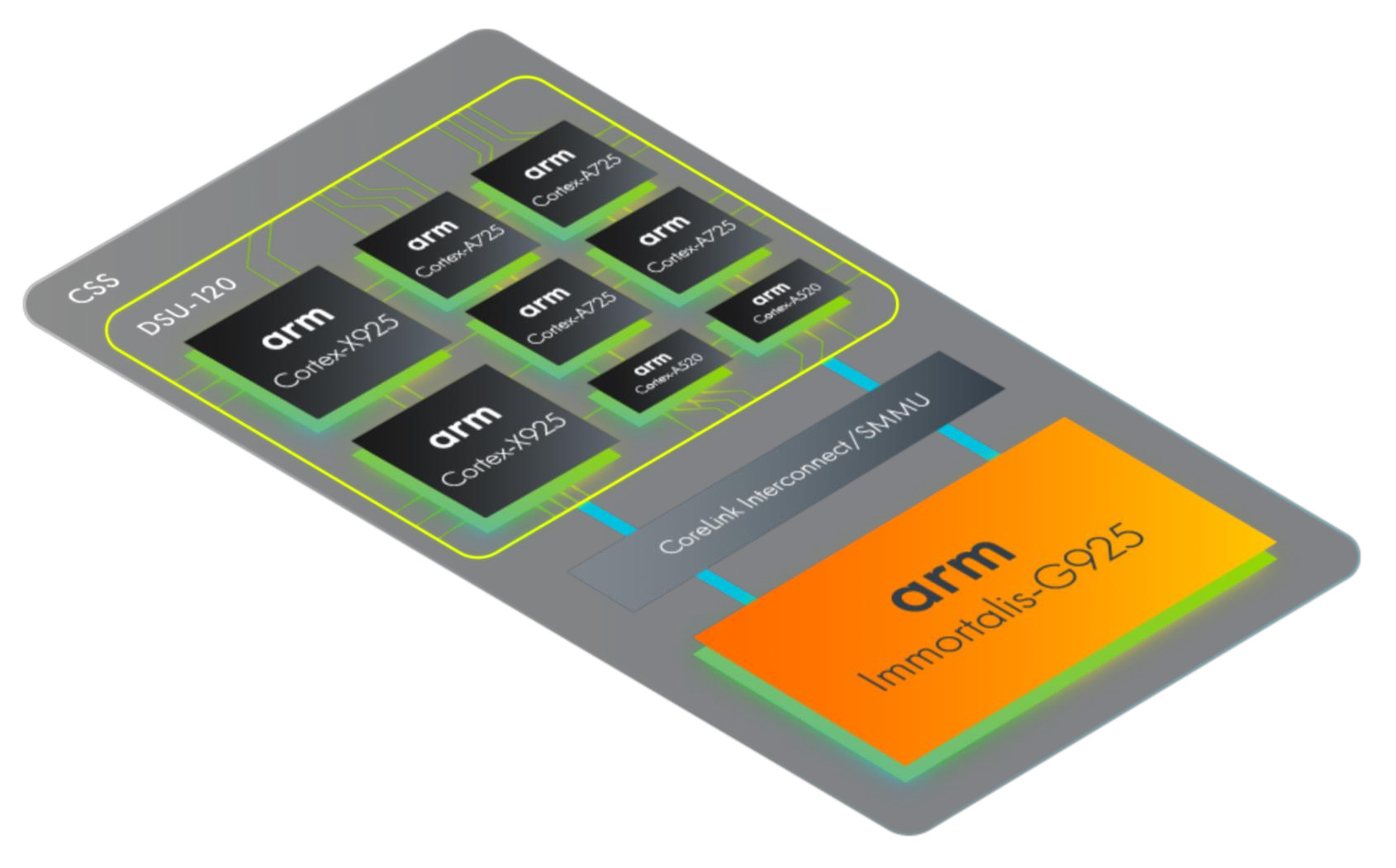
Arm Lumex CSS (Compute SubSystem) platform for mobile devices combines high-performance Arm C1 CPUs with Scalable Matrix Extension version 2 (SME2) and Mali-G1 GPUs to enable real-time on-device AI use cases like assistants, voice translation, and personalization. Lumex is part of Arm’s new product naming architecture announced last May, and targets specifically mobile devices. Arm says SME2-enabled Arm CPUs can deliver up to 5x faster AI performance, 4.7x lower latency for speech-based workloads, and 2.8x faster audio generation. Lumex components: Next-generation SME2-enabled Armv9.3 CPU cluster: C1-Ultra for flagship peak performance with +25% single-thread performance vs Cortex-X925; suitable for large-model inference, computational photography, content creation, generative AI C1-Premium with C1-Ultra performance, but greater area efficiency (35% smaller area than C1-Ultra); suitable for sub-flagship mobile segments, voice assistants, multitasking C1-Pro for sustained efficiency; +16% sustained performance vs Cortex-A725; ideal for video playback, streaming inference C1-Nano for maximum efficiency, smaller area for wearables, […]