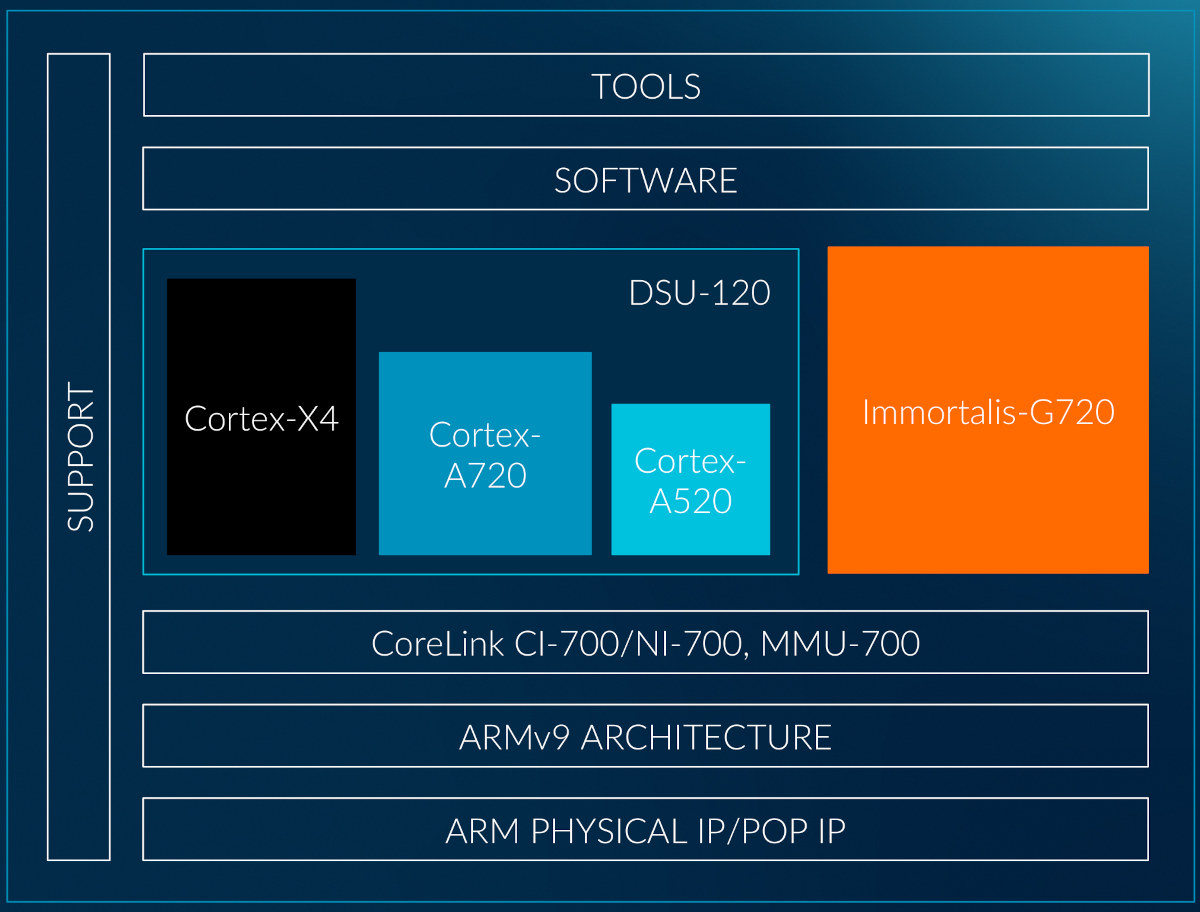
Arm Lumex CSS (Compute SubSystem) platform for mobile devices combines high-performance Arm C1 CPUs with Scalable Matrix Extension version 2 (SME2) and Mali-G1 GPUs to enable real-time on-device AI use cases like assistants, voice translation, and personalization. Lumex is part of Arm’s new product naming architecture announced last May, and targets specifically mobile devices. Arm says SME2-enabled Arm CPUs can deliver up to 5x faster AI performance, 4.7x lower latency for speech-based workloads, and 2.8x faster audio generation. Lumex components: Next-generation SME2-enabled Armv9.3 CPU cluster: C1-Ultra for flagship peak performance with +25% single-thread performance vs Cortex-X925; suitable for large-model inference, computational photography, content creation, generative AI C1-Premium with C1-Ultra performance, but greater area efficiency (35% smaller area than C1-Ultra); suitable for sub-flagship mobile segments, voice assistants, multitasking C1-Pro for sustained efficiency; +16% sustained performance vs Cortex-A725; ideal for video playback, streaming inference C1-Nano for maximum efficiency, smaller area for wearables, […]
Arm neural technology to add AI acceleration to Arm GPUs, enable “Neural Super Sampling” for lower bandwidth/higher FPS
Arm neural technology will add dedicated neural/AI accelerators to Arm GPUs launched in 2026 and beyond to deliver up to 50% GPU workload reduction for mobile games and other graphics-intensive apps. The first application is called Arm Neural Super Sampling (NSS). It’s a kind of AI Super Resolution implementation for games, where rather than upscaling videos, the AI accelerator upscales graphics to lower the required bandwidth and increase the frame rate (or lower the power consumption) with no impact on the rendering quality. Watch the video below to see a demo rendered at 540p resolution by the GPU and upscaled to 1080p resolution by Arm neural technology with no obvious defects. The upscaler will introduce some lag, but only about 4ms per frame in sustained performance conditions, as explained in a technical blog about the Arm Neural and NSS announcement: We assume a target of 10 TOP/s per-watt of neural acceleration […]
Linux 6.16 Release – Main changes, Arm, RISC-V, and MIPS architectures
Linus Torvalds has just announced the release of Linux 6.16 on LKML: It’s Sunday afternoon, and the release cycle has come to an end. Last week was nice and calm, and there were no big show-stopper surprises to keep us from the regular schedule, so I’ve tagged and pushed out 6.16 as planned. It’s worth noting that the upcoming merge window for 6.17 is going to be slightly chaotic for me: I have multiple family events this August (a wedding and a big birthday), and with said family being spread not only across the US, but in Finland too, I’m spending about half the month traveling. That means that I will try very hard to get most of the merge window done the first week before my travels start, and I already ended upgiving a heads-up on that to the people who tend to send me the most pull requests. […]
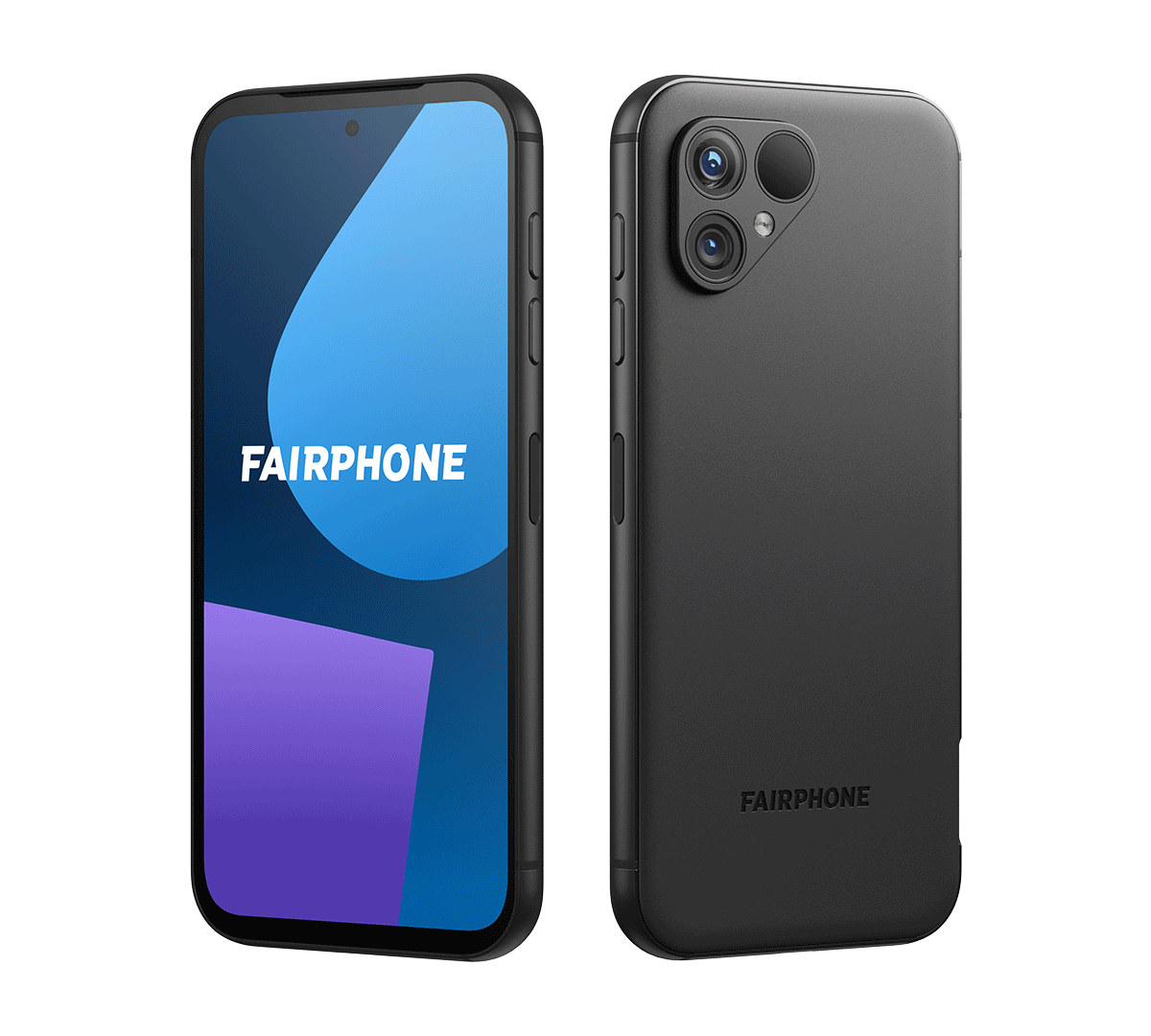
Fairphone (Gen. 6) is a sustainable, repairable 6.31-inch Android 15 smartphone with Snapdragon 7s Gen 3 SoC
The Fairphone (Gen. 6) is a 6.31-inch Android 15 smartphone powered by a Qualcomm Snapdragon 7s Gen 3 SoC designed to be sustainable and repairable with eight years of software updates, a 5-year warranty, a modular design, and the use of recycled materials. The Fairphone (Gen. 6) – not sure why it was not just called Fairphone 6 – offers mid-range features with an octa-core processor, 8GB RAM, 256GB UFS and microSD card storage, a 6.31-inch touch screen display, two rear cameras, a front-facing camera, 5G, WiFi 6, and Bluetooth 5.4 LE connectivity, as well as support for NFC for payment, and a USB-C port for charging and expansion. Fairphone (Gen.6) specifications: SoC – Qualcomm Snapdragon 7s Gen 3 Mobile Platform CPU – Octa-core Kryo CPU with 1x Prime core @ 2.5 GHz, 3x Performance cores @ 2.4 GHz, 4x Efficient cores @ up to 1.8 GHz GPU – Adreno […]
Liberux NEXX is a Linux smartphone with Rockchip RK3588S, 32GB RAM, 6.34-inch OLED (Crowdfunding)
Liberux NEXX is a Linux smartphone powered by a Rockchip RK3588S octa-core Cortex-A76/A55 processor coupled with 32 GB LPDDR4x and a 512GB eMMC flash, as well as a 6.34-inch 2400×1080 OLED display. We’ve seen other Linux smartphones in the past with the most popular likely being the Purism Librem 5 and Pine64’s PinePhone Pro. However, those are showing their age with older NXP i.MX 8M and Rockchip RK3399 SOCs, and the Liberux NEXX brings much-needed performance with a Rockchip RK3588S and 32GB of RAM, enabling mobile/desktop convergence to an extent. Liberux NEXX specifications: SoC – Rockchip RK3588S CPU – Octa-core processor with 4x Cortex-A76 cores @ up to 2.4 GHz, 4x Cortex-A55 cores @ up to 1.8 GHz GPU – Arm Mali-G610 GPU with OpenGL ES 3.2, OpenCL 2.2, and Vulkan 1.2 support VPU – 8Kp60 video decoder for H.265/AVS2/VP9/H.264/AV1 codecs, 8Kp30 H.265/H.264 video encoder AI accelerator – 6 TOPS NPU […]
Linux 6.14 release – Main changes, Arm, RISC-V, and MIPS architecture
Linus Torvalds has just announced the release of Linux 6.14 on LKML: So it’s early Monday morning (well – early for me, I’m not really a morning person), and I’d love to have some good excuse for why I didn’t do the 6.14 release yesterday on my regular Sunday afternoon release schedule. I’d like to say that some important last-minute thing came up and delayed things. But no. It’s just pure incompetence. Because absolutely nothing last-minute happened yesterday, and I was just clearing up some unrelated things in order to be ready for the merge window. And in the process just entirely forgot to actually ever cut the release. D’oh. So yes, a little delayed for no good reason at all, and obviously that means that the merge window has opened. No rest for the wicked (or the incompetent). Below is the shortlog for the last week. It’s nice and […]
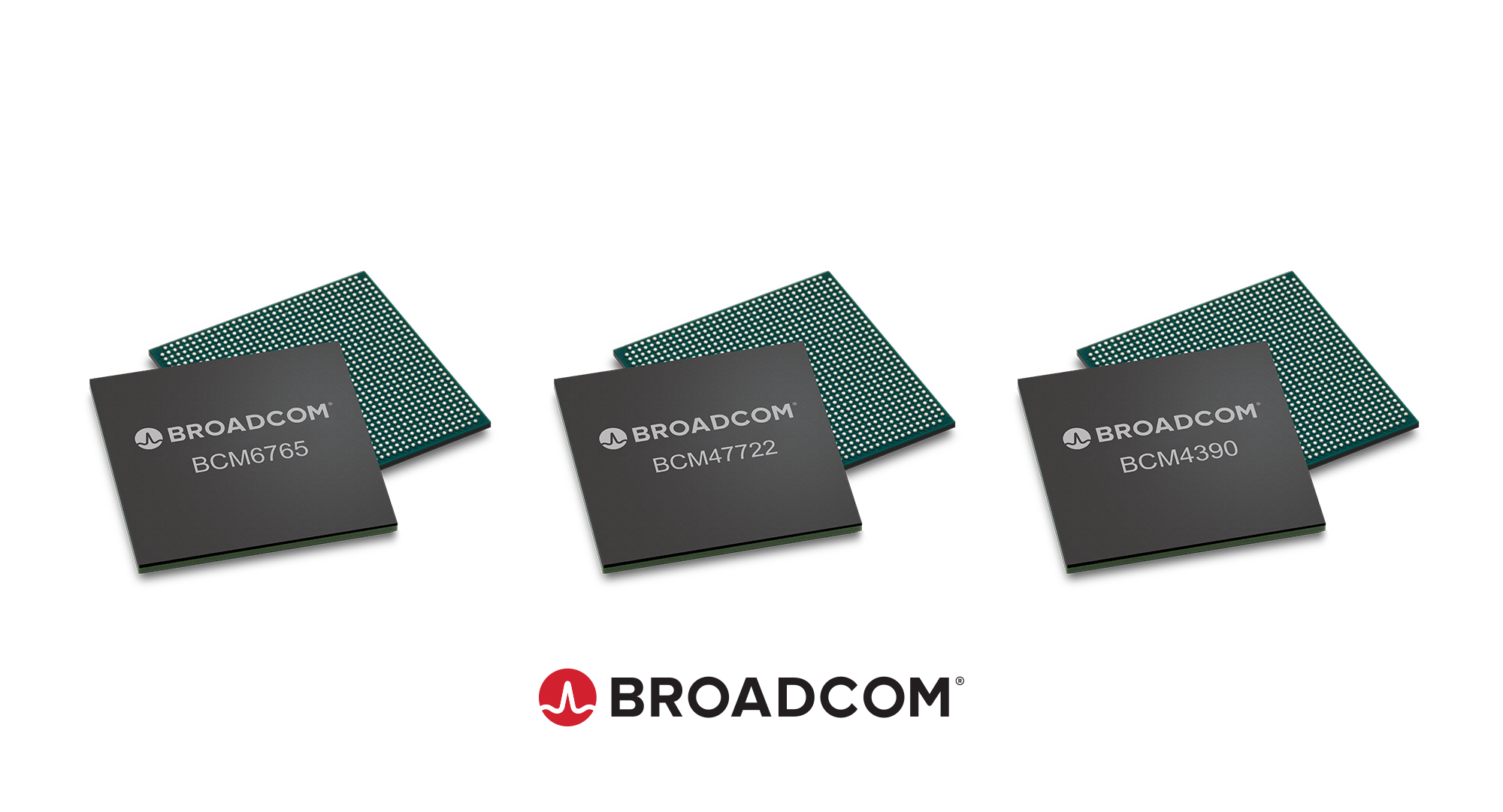
Qualcomm X85 5G modem powers 12.5Gbps Dragonwing Fixed Wireless Access (FWA) Gen4 Elite platform
As Mobile World Congress 2025 has just started, Qualcomm has announced the X85 5G modem with up to 12.5 Gbps peak download speed, 3.7 Gbps uploads and targeting a wide range of applications from Android smartphones to PCs, FWA routers, industrial applications with Ethernet TSN, or even railways with support for FRMCS (Future Railway Mobile Communication System) in Europe. The company also introduced the Dragonwing Fixed Wireless Access (FWA) Gen 4 Elite platform based on the Qualcomm X85 5G modem, a quad-core processor, GNSS, tri-band Wi-Fi 7, and network Edge AI coprocessor with up to 40 TOPS of NPU processing power. Qualcomm X85 5G modem Qualcomm X85 5G Modem-RF System specifications: Peak Download Speed – 12.5 Gbps (FR1 + FR2), 10.3 Gbps Peak Upload Speed – 3.7 Gbps Cellular Modem-RF – 10CC aggregation in mmWave, 6CC aggregation in 5G sub 6GHz, 400 MHz carrier aggregation (DL) Cellular Technology 5G NR […]
Citronics built a router based on the Fairphone 2 mainboard
Belgium-company Citronics has designed a router based on the mainboard of the Fairphone 2 smartphone, connecting the Qualcomm Snapdragon 801 “system-on-module” to a carrier board with Ethernet, USB ports, and other connectors, while leveraging 4G LTE, WiFi, and Bluetooth connectivity from the phone’s core board. Citronics calls this type of hardware “Circular Microcomputers,” which refers to small computers focusing on sustainability and circular economy principles using parts from discarded devices like old smartphones. There’s actually more than one router, as Citronics designed its own development kit, and also partnered with other companies to design custom gateways based on the Fairphone 2 mainboard. Let’s have a look at the devkit first. Citronics devkit: Fairphone 2 mainboard SoC – Qualcomm Snapdragon 801 (MSM8974AB) quad core Krait 400 processor @ up to 2.26 GHz with Adreno 330 GPU System Memory – 2 GB LPDDR3 Storage – 32GB eMMC flash Connectivity – 2G/3G/4G LTE, […]