
PyBLE open-source MicroPython IDE works over Bluetooth LE for tablet and iPad users

PyBLE MicroPython IDE for Tablets

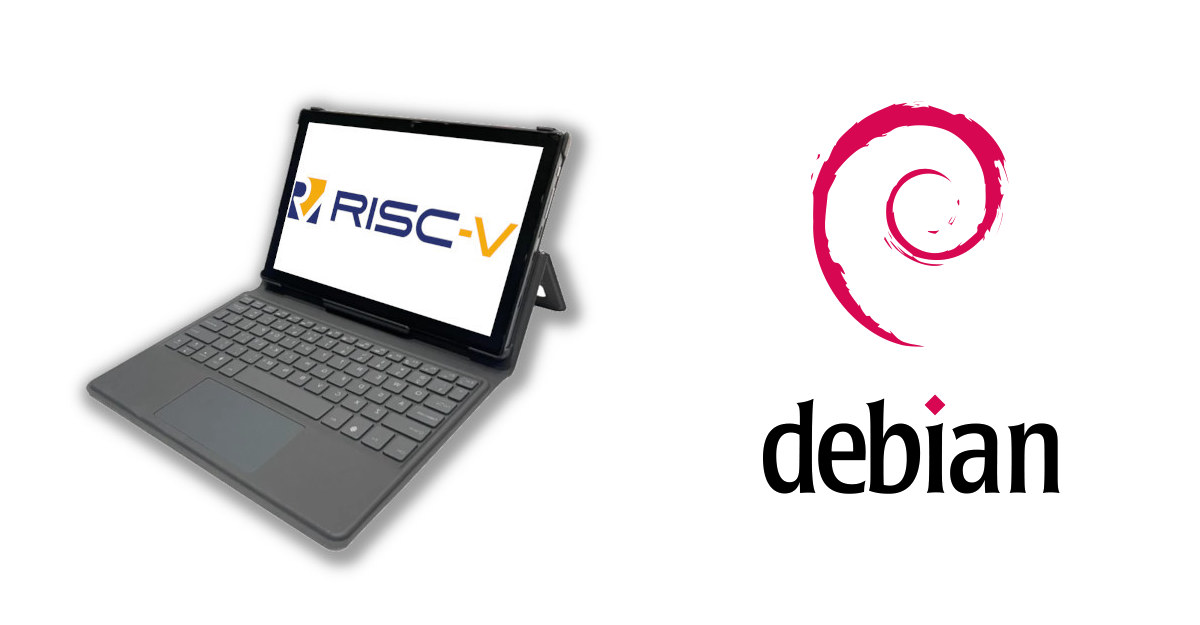
PyBLE is an open-source, MIT-licensed MicroPython IDE for programming microcontroller boards over Bluetooth Low Energy (BLE), which targets Android tablet and iPad users. PyBLE combines a Flutter-based IDE for iPad and Android with support for MicroPython and visual programming (Blockly), an open MicroPython agent firmware, and the PBLE/1 protocol fully documented by the developer. The IDE currently supports features such as editing and running Python, a live console, wireless file management, and initial firmware targets include ESP32, ESP32-S3, and ESP32-C3 wireless microcontrollers. PyBLE highlights: Flutter app Filtered BLE discovery and PBLE/1 open protocol support MicroPython editor with save, run, stop, soft reboot, and live console Wireless file browsing and transfer with integrity checks Offline Blockly workspace with GPIO and standard MicroPython NeoPixel blocks Editable beginner examples Exact Blockly sidecar reopening and a bounded Python-to-blocks importer Adaptive tablet interface for portrait and landscape use Local operation without an account, analytics, or […]

Sipeed NanoKVM-Go – A 4K USB-C KVM with Recall-like function, AI integration (Crowdfunding)

NanoKVM-Go

Sipeed NanoKVM-Go is a 4K USB-C KVM designed to control any USB-C device from anywhere with one cable. It also supports “full screen memory”, a function similar to the controversial Microsoft Recall feature, which enables an AI agent to search through your screenshots. Remote control software works fine until your system freezes or BIOS access is required, and traditional KVMs do the job with HDMI, USB, Ethernet, power cables, and adapters, but that’s a bit too much when working on the go. The NanoKVM-Go aims to solve all these little issues with a small and light device that requires only one cable to the target, while the host connects to the USB KVM over WiFi 6. NanoKVM-Go and Go+ specifications: SoC – Unamed, but almost certainly the Axera Tech AX630C used in the Sipeed NanoKVM Pro 4K IP KVM. CPU – Dual-core Cortex-A53 AI accelerator – 3.2TOPS NPU System Memory […]

Comet Q USB-C KVM device is made for smartphones, tablets, and laptops (Crowdfunding)

GL.iNet Comet Q

GL.iNet Comet Q (GL-RMQ1) is a USB-C KVM device designed to remotely control smartphones, tablets, and laptops via a single USB Type-C cable and web browser. The hardware is based on a dual-core Arm processor paired with 512MB of RAM and a 512MB NAND flash, integrates a 1.8-inch touchscreen LCD for control and information display (e.g., IP address), a short USB-C cable to connect to the target, and a USB-C port for optionally charging the target while it is being controlled. Comet Q specifications: SoC – Unnamed dual-core Arm Cortex-A53 processor System Memory – 512MB LPDDR4 Storage – 512 MB NAND flash Display – 1.8-inch touchscreen color LCD Video Resolution and frame rate – 2K QHD @ 60 FPS Latency – About 80 ms Wireless Wi-Fi 6 IEEE 802.11 a/b/g/n/ac/ax 5 GHz: 286 Mbps 2.4 GHz: 286 Mbps Internal Wi-Fi antenna Interface USB Type-C port with power passthrough USB Type-C […]

Huion Note E – A 8.4-inch Android 15 electronic notebook with battery-free, pressure sensitive stylus

Huion Note E Android 15 note taking device

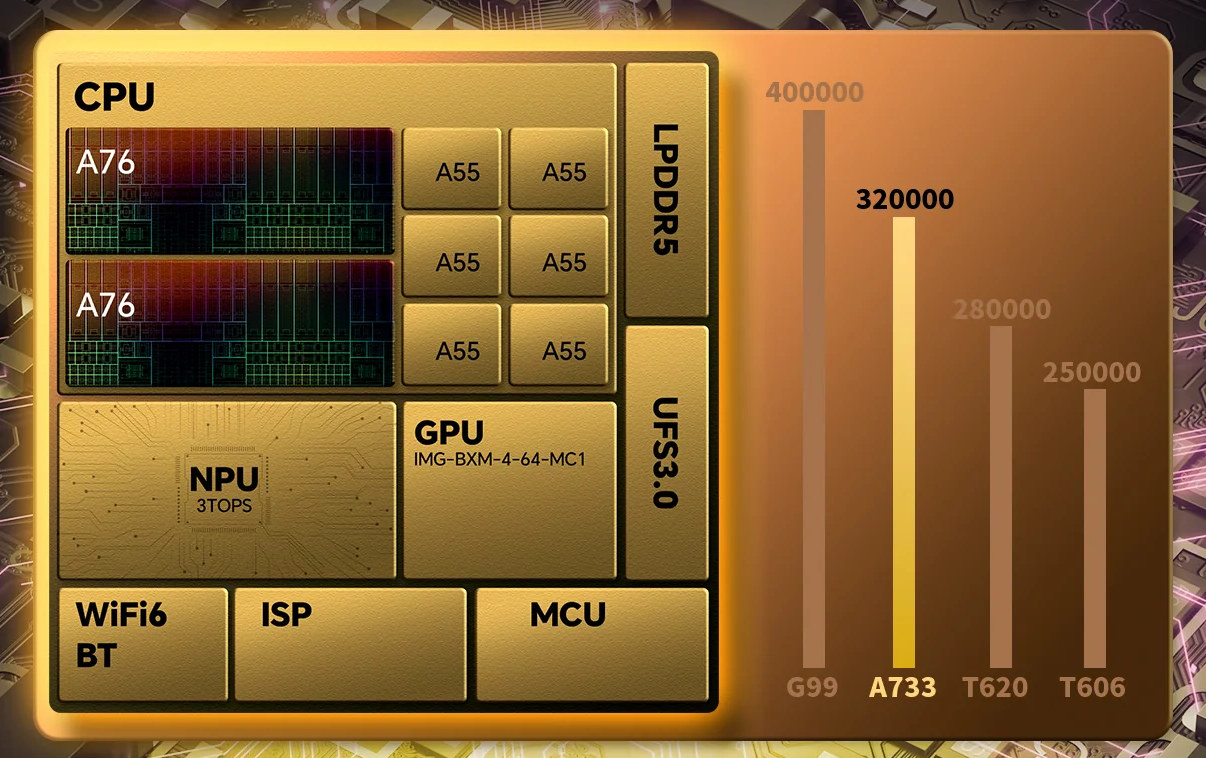
Huion Note E is an Android 15 note-taking device/electronic notebook powered by a MediaTek Helio G99 SoC and equipped with an 8.4-inch color LCD designed to work with a battery-free PenTech 3.0 pressure-sensitive stylus. The device ships with 6GB LPDDR4 memory, 128GB storage, and a single USB-C port for charging and data. The company says the 1920×1080 display leverages “AG nano-etching technology to create a refined, matte surface that mimics the traditional pen-on-paper experience” and provides an e-Paper-like experience, while maintaining a 60 Hz refresh rate. Huion Note E (X50) specifications: SoC – MediaTek Helio G99 CPU – Octa-core processor with 2x Arm Cortex-A76 cores @ 2.2 GHz, 6x Arm Cortex-A55 cores @ 2.0 GHz GPU – ARM Mali-G57 MC2 VPU Video Encoding – H.264, H.265/HEVC up to 2Kp30, 1080p60, 720p120 Video Playback – H.264, H.265/HEVC, VP-9 up to 2Kp30, 1080p60, 720p120 System Memory –  6GB LPDDR4 Storage – 128GB […]

Qualcomm X105 6G-ready 5G modem to deliver 14.8 Gbps download and 4.2 Gbps upload peak data speeds

Qualcomm X105 5G Model RF

Qualcomm X105 is the world’s first 3GPP Release 19-ready modem-RF system supporting 5G connectivity up to 14.8 Gbps download and 4.2 Gbps upload peak data speeds, and enabling 6G development and testing. Other Qualcomm X105 highlights include a 6nm RF transceiver with 30% lower power consumption and 15% smaller board footprint compared to the Qualcomm X85 5G modem, support for quad-band GNSS, an integrated NR-NTN for video, data and voice over satellite, and a fifth-generation AI processor leveraging agentic AI to detect, classify, and optimize data traffic for mobile gaming, video calling, and social media. Qualcomm X105 Modem-RF system specifications: Peak speeds Download – 14.8 Gbps (FR1 + FR2), 13.1 Gbps (FR1) Upload – 4.2 Gbps Downlink Carrier Aggregation: 6F+T CA (500MHz) with 1024 QAM TDD/FDD with 1024 QAM Turbo DSDA enhancements, including Multi-SIM CA support (up to 60% higher throughput) 3rd-gen 6Rx for smartphones and FWA CPEs (with 10% […]

Lepton XDS dual-camera module combines 160 x 120 thermal imager with 5MP RGB camera

Teledyne FLIR XDS module

The Teledyne FLIR Lepton XDS dual-camera module combines a factory‑aligned radiometric 160 × 120 Lepton 3.5 thermal camera with a 5 MP visible camera. Its size, weight, and power (SWaP)‑optimized design makes it suitable for mobile devices, compact electronics, smart buildings, fire detection, occupancy analytics, and equipment‑condition‑monitoring applications. The company highlights that the Lepton XDS module is International Traffic in Arms Regulations (ITAR)-free, which reduces development risk and accelerates time‑to‑market, since it’s easier to export or integrate into products sold globally. Lepton XDS specifications: EO Camera Optics – EFL 1.57 mm, 98.2° HFOV, F/1/2.2 Sensor – 2592 x 1944 pixels (5 MP), 1.4 µm pitch Video – 640×480 @ 30Hz IR Camera Optics – 57° HFOV, f/1.1 Video – 8.7 Hz (commercial application exportable, since it’s below 9 FPS) Thermal Imaging Detector Lepton 3.5 160 x 120 pixels, 12 µm pitch Thermal Sensitivity – <50 mK (0.050 °C) Temperature Accuracy […]

Murena Volla 12.6-inch privacy-focused tablet runs /e/OS Google-free Android OS on MediaTek Helio G99 SoC

Murena Volla tablet

Murena Volla is a 12.6-inch privacy-focused tablet running /e/OS and designed for users seeking a Google-free experience. While the hardware is developed in collaboration with German-based Volla, the Murena edition comes preloaded with the Android-based /e/OS and integrated Murena cloud services for users who want full control over their personal data. The tablet is built around a MediaTek Helio G99 octa-core processor paired with 12GB of RAM and 512GB of internal storage. The device also features a USB Type-C port, Wi-Fi 6, 4G LTE support (Europe only), and 13MP rear and 5MP front-facing cameras. Applications include secure business use, education, and family environments for privacy-first media, communication, and document management workflows. Murena Volla Tablet Specifications: SoC – MediaTek Helio G99 (Most probably a MT8781) CPU – Octa-core processor with 2x ARM Cortex-A76 cores @ 2.2 GHz, 6x ARM Cortex-A55 cores @ 2.0 GHz GPU – ARM Mali-G57 MC2 VPU Video […]

Linux 6.19 Release – Main changes, Arm, RISC-V, and MIPS architectures

Linux 6.19

Linus Torvalds has just released Linux 6.19 on the Linux Kernel Mailing List (LKML): No big surprises anywhere last week, so 6.19 is out as expected – just as the US prepares to come to a complete standstill later today watching the latest batch of televised commercials. The betting man would expect them all to be AI-generated, but maybe some enterprising company decides to buck the trend? Doubtful, but there’s always a slight chance. But for anybody outside the US, maybe taking the newest kernel out for a spin instead is an option? I have more than three dozen pull requests for when the merge window opens tomorrow – thank you to all the early maintainers. And as people have mostly figured out, I’m getting to the point where I’m being confused by large numbers (almost running out of fingers and toes again), so the next kernel is going to […]

Exit mobile version