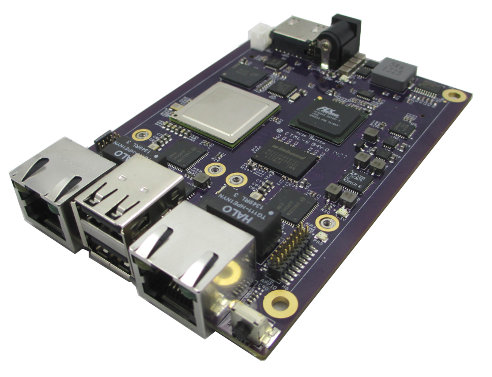
Xilinx Zynq and Altera Cyclone V are both SoC families combining an ARM processor (Hard Processor System – HPS) with FPGA fabric into a single chip. But Armadeus Systems, a French company designing industrial ARM Linux processor modules, has unveiled a new module where the CPU and FPGA are two separate chips, namely Freescale i.MX6 (single to quad) and Altera Cyclone V GX FPGA, in order to provide more flexibility, and extra features like a GPU with OpenCL support, an hardware video processing unit, a dedicated SATA port, and so on. Armadeus APF6_SP SoM specifications: SoC – Freescale i.MX6 single, dual or quad core Cortex A9 processor with Vivante GPUs FPGA – Altera Cyclone V GX (C4/C5/C7/C9) System Memory 512MB to 1GB DDR3 32-bit @ 800 MHz for i.MX6 Solo or Duallite 512MB to 2GB DDR3 64-bit @ 1066MHz for i.MX6 Dual or Quad Optional up to 768MB RAM dedicated […]
RaidSonic Releases Firmware and Source Code for Atheros AR9331 Wi-Fi Audio Streamers
RaidSonic is a German company releasing products such as media players and multimedia accessories under their ICY BOX brand. One of those products is ICY Box IB-MP401Air music streaming received based on Atheros AR9331, and that looks very similar to SoundMate M2 I reviewed last year. But if you look on their product page, you’ll find out a few download links: ICY BOX IB-MP401Air (multilang) – The Quick Start Guide and User’s manual in English and German IB-MP401Air (Source code) – a 648 MB rar file with source code for U-boot and OpenWRT IB-MP401Air (Firmware) – The firmware IB-MP401Air (Open Source Software) – Just the open source licenses So I’ve downloaded the source code file (IB-MP401Air_Sources_and%20License_Terms.rar) to have a look. It has two compressed files, one with the license, and IB-MP401Air_Sources.tar.gz with the source code.
|
1 2 3 4 5 6 7 |
tar xzvf IB-MP401Air_Sources.tar.gz cd dns320B_GPL20150212/ ls -l total 12 -rwxr--r-- 1 jaufranc jaufranc 1400 Apr 16 16:49 building-the-firmware.txt drwxr-xr-x 14 jaufranc jaufranc 4096 Feb 12 10:54 dns320B_GPL20150212 -rwxr--r-- 1 jaufranc jaufranc 925 Feb 12 08:25 making-u-boot.txt |
The file showing how to build the firmware (OpenWRT) explains you should not use […]
DENX Computer Systems Introduces Atmel SAMA5D44 and Freescale i.MX6 System-on-Modules
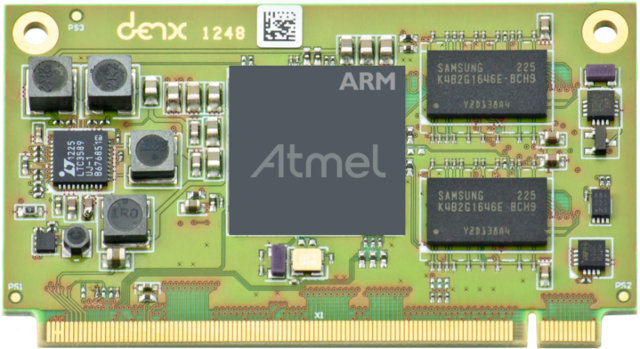
Embedded World 2015 exhibition and conference will take place in Nuremberg, Germany on February 24-26, 2015, and we should expect interesting news related to MCU, industrial processors, and related development kits and boards next week. DENX Computer Systems has already unveiled two new SoM families with MA5D4 based on Atmel SAMA5D44 Cortex A5 processor, and M6R based on Freescale i.MX 6 Cortex A9 processors. DENX MA5D4 System-on-Module MA5D4 SoM specifications: Processor – Atmel SAMA5D44 Cortex A5 @ 528MHz with 720p hardware video decoder supporting H264/263, VP8, JPEG. System Memory – 128 – 512MB DDR2 RAM Storage – 4 – 32GB eMMC Flash (or optionally 256MB NAND Flash); 4 MB MByte SPI NOR-Flash; I/Os via 230-pin MXM2 edge connector Video Out / Display Support – HDMI. TFT controller, overlay support for image composition, resitive Touchscreen controller Camera – CMOS image sensor interface external bus A/D 25/16 bit 2x 10/100MBit Ethernet, IEEE1588 […]
Gateworks GW5520 Single Board Computer Features Dual Gigabit Ethernet Ports, Two mini PCIe Slots
If you need industrial grade ARM Linux boards with lots of Ethernet ports and several mini PCIe slots, you may want to check out Gateworks Ventana boards. The company has now released a smaller member of Ventana family with GW5520 SBC powered by Freescale i.MX6 dual, with two Gigabit Ethernet port, two mini PCIe slots, and support for PoE. Gateworks Ventana GW5520 SBC specifications: SoC- Freescale i.MX6 Dual Cortex A9 processor @ 800MHz with Vivante Vivante GC2000 / GC355 / GC320 GPUs. Option: i.MX6 Quad System Memory – 512 MB DDR3-800 SDRAM (Up to 2GB RAM as option) Storage – 256 MB Flash (Up to 2GB as option), serial configuration EEPROM Video and Audio Output – HDMI 1.4 Connectivity – 2x Gigabit Ethernet ports. USB – 2x USB 2.0 host ports Expansion 2x Mini-PCIe sockets Optional mini-PCIe socket to supports a mSATA disk drive (i.MX6 Quad only) I/Os Serial – […]
Black Swift is a Tiny OpenWRT Wi-Fi Board Powered by Atheros AR9331 (Crowdfunding)
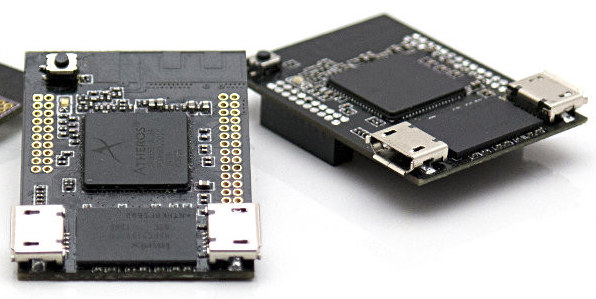
In case you thought there were not enough Wi-Fi board in the market already, here’s another one with Black Swift. The board runs OpenWRT, is a little larger than Vocore, and quite smaller than WRTnode, is powered by Atheros AR9331, provides access to I/Os via headers, and comes with two micro USB ports which should make it easy to use, and allow some interesting applications with USB devices. Black Swift specifications: SoC – Qualcomm Atheros AR9331 32-bit MIPS 24K CPU core @ 400 MHz, or 200 MHz in energy-saving mode selectable by software System Memory – 64 MB DDR2 SDRAM Storage – 16 MB NOR flash Connectivity – 802.11 b/g/n Wi-Fi (1×1, up to 150 Mbps) with PCB antenna USB – 1 x microUSB for power, 1x microUSB 2.0 port Expansion – Headers for 26x GPIO, 2x Fast Ethernet, SPI, I²C, 1x 16550 UART, 1x USB 2.0 Misc – Factory reset […]
Zsun SD111 Wi-Fi Flash Drive Hacking Tentative
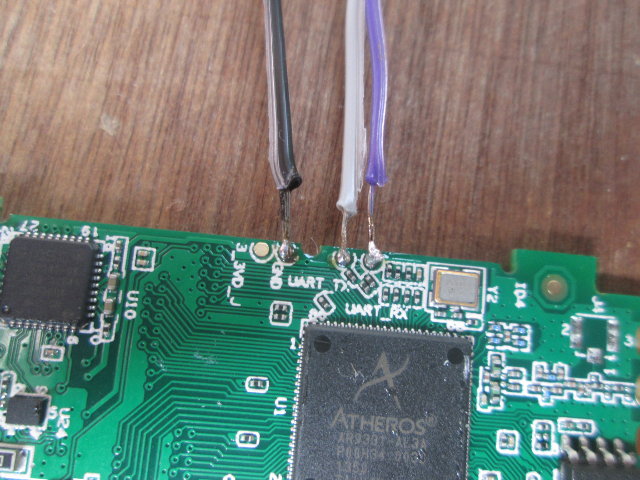
Two days ago, I reviewed Zsun SD111 a 8GB Wi-Fi flash drive based on Atheros AR9331, and I discovered the telnet port was open, but I could not access it because none of the standard username and password combinations (root/root, admin/admin, root/admin, etc…) would work, which is actually a good thing. However, as I opened the stick, the serial pins were clearly marked, so today I’ve soldered some Dupont wires to access the serial console. In order to open the stick, you need a rigid sharp object to push the top cover via the neck strap hole, as shown below, and another tool (mine looks similar to a scalpel) to help popping the cover up. Then I connected the three wires to a USB to TLL debug board, connected it to my PC, started minicom (115200 8N1), and pressed the power button. I could see U-Boot 1.1.4 message, so it […]
Rayeager PX2 Development Board Features Rockchip PX2 Dual Core Cortex A9 Processor
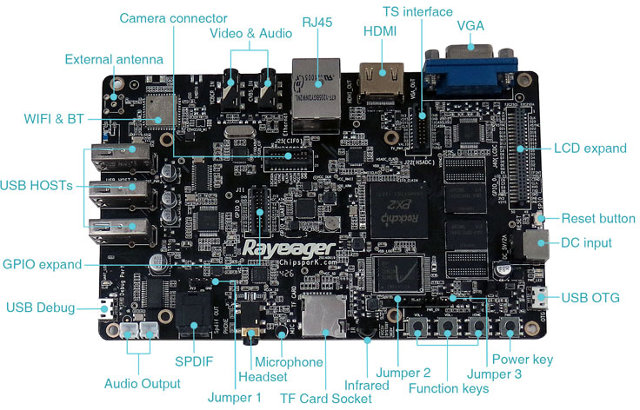
Rockchip has apparently discreetly released a PX2 SoC with a dual core Cortex A9 processor @ 1.4 GHz coupled with a Mali-400MP4 GPU, that on the surface looks extremely similar to their RK3066 SoC. Unfortunately, at first, I could not find much details about the processor itself, but Chipspark have introduced Rayeager PX2 development board based on the new Rockchip processor, with 1 to 2 GB RAM, an 8GB eMMC flash, and various ports including a SATA 2.0 interface. Rayeager PX2 specifications: SoC – Rockchip PX2 dual core Cortex A9 @ 1.4 GHz with Mali-400 MP4 GPU System Memory – 1 to 2 GB DDR3@400MHz Storage – 8 GB eMMC flash, micro SD slot, and SATA 2.0 interface for 2.5″ and 3.5″ hard drives (the latter may require external power supply) Video Output – HDMI, and VGA up to 1080p, , and LCD interface Video Input – 1x CVBS input […]
AllWinner A80 Linux SDK Released
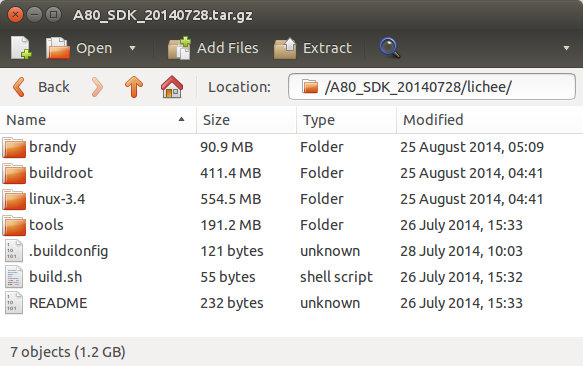
After Android 4.4 SDK for AllWinner A31 last week, another AllWinner software development kit has been seen in the wild, this time for the new AllWinner A80 octa-core processor. A80 SDK includes source code for the Linux Kernel and U-boot, as well as buildroot, and various AllWinner tools. I’ve also noticed AllWinner A80 datasheet is available, but with the strict minimum information (45 pages). Let’s get the code, and extract it:
|
1 2 3 |
wget http://dl.linux-sunxi.org/SDK/A80/A80_SDK_20140728.tar.gz tar xvf A80_SDK_20140728.tar.gz cd A80_SDK_20140728 |
Now we need to configure the build:
|
1 2 3 4 5 6 7 8 9 10 11 12 13 14 15 16 17 18 19 20 21 |
./build.sh config Welcome to mkscript setup progress All available chips: 0. sun9iw1p1 Choice: 0 All available platforms: 0. android 1. dragonboard 2. linux Choice: 2 All available kernel: 0. linux-3.4 Choice: 0 All available boards: 0. optimus 1. p1 2. perf 3. perf5 4. perf-lpddr3 Choice: 0 |
sun9i is the codename for AllWinner A80, not sure what w1p1 means. Dragonboard must be the internal Allwinner development board, but I just selected Linux, since the SDK does not come with Android, and finally I opted for optimus, which could stand for OptimusBoard. You may need to install extra dependencies in your build machine, for example (in Ubuntu 14.04):
|
1 |
sudo apt-get install flex texinfo build-essential |
Now let’s start buildroot which should retrieve the toolchain, […]