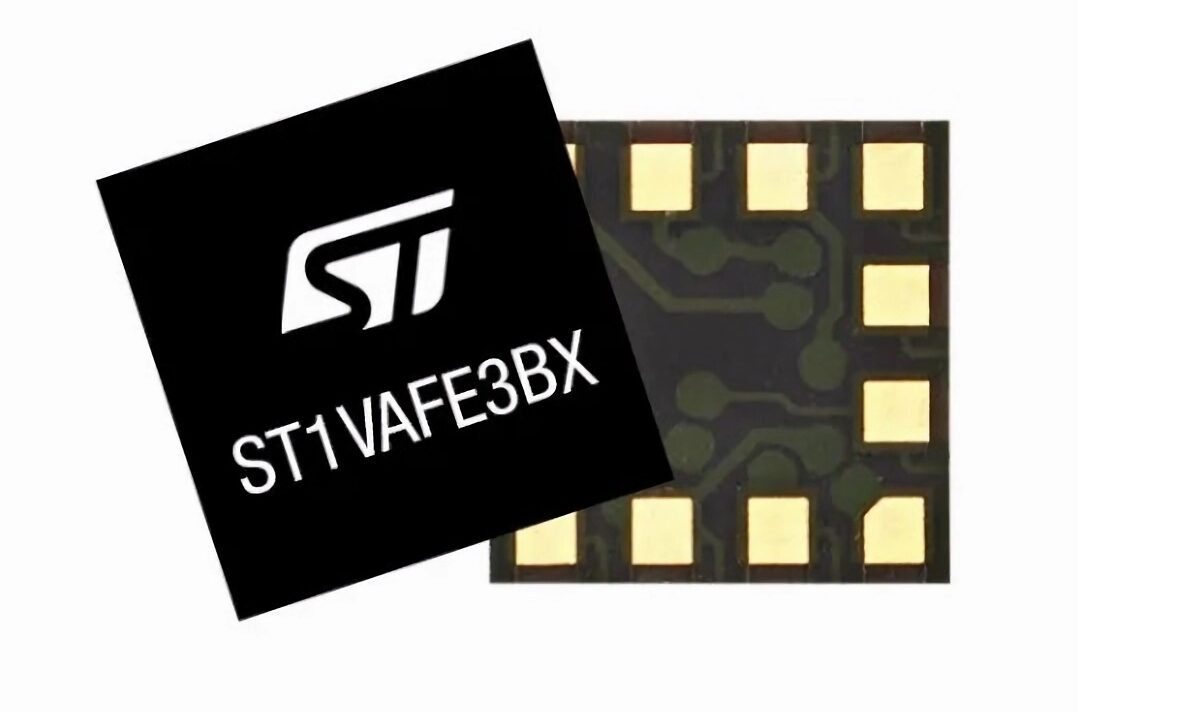
Following the launch of the UBX-M10150-CC low-power GNSS module, u-blox has expanded its lineup with the MAX-M10N, another ultra-low-power module based on the UBX-M10150-KB GNSS chip. The new module supports firmware upgradeability and offers up to 50% lower power consumption thanks to features such as Low Energy Accurate Positioning (LEAP) and PSMCT cyclic tracking modes. The latest SPG 5.30 firmware also adds support for RTCM correction input for sub-meter positioning accuracy, along with improved spoofing and jamming detection. It also includes data logging and geo-fencing for autonomous tracking and uses AssistNow Predictive and Live Orbits for faster satellite acquisition. The MAX-M10N integrates an LNA and dual SAW filters for better RF sensitivity and interference protection, while maintaining pin compatibility with earlier MAX modules. These features make it suitable for low-power, high-accuracy applications such as wearables, asset tracking, and battery-powered IoT devices. u-blox MAX-M10N GNSS module specifications: Receiver type – u-blox M10 […]
Upbeat introduces UP201 and UP301 ultra-low power RISC-V MCUs with always-on AI processing
Upbeat Technology, in collaboration with SiFive, has introduced UP201 and UP301 always-on AI MCUs for ultra-low-power AI and IoT applications such as wearables, drones, and sensor-based systems. The UP201 is designed for compact, battery-driven devices such as smartwatches, hearing aids, and IoT sensor nodes, whereas the UP301 targets AI and vision-based applications for more complex edge systems such as smart glasses, robotics, and industrial AI equipment. Both chips feature a dual-core RISC-V architecture. The SiFive E21 lightweight core is Always-On (AON), managing continuous low-power sensing, whereas the SiFive E34 performance core activates for higher workloads. The MCUs also integrate a 2.5D GPU and various I/O options. UP201 and UP301 MCU specifications: CPU cores (SiFive Essential RISC-V IP cores) E21 core in Always-On (AON) domain for continuous low-power sensing E34 performance core in the Non-AON domain for higher workloads Up to 400 MHz operating frequency Up to 717 DMIPS performance Near-threshold […]
Google’s open-source, RISC-V-based Coral NPU is integrated into Synaptics SL2610 Edge AI SoCs
Google has very recently introduced Coral NPU full-stack, open-source RISC-V-based platform for always-on AI on low-power edge devices and wearables. The first chip to integrate the Coral NPU is the upcoming Synaptics Astra SL2610 family. Google Coral NPU The Coral NPU aims to address the software fragmentation on entry-level AI accelerators that makes them difficult to program. By releasing an open-source NPU and associated source code, Google hopes its design will be adopted by silicon vendors, reduce software fragmentation over time, and help machine learning (ML) developers bring products to market faster. Building on the works on the Coral platform, the new, open-source Coral NPU is comprised of three main components: A scalar core – A lightweight, C-programmable RISC-V core that manages data flow to the back-end cores. It uses a simple “run-to-completion” model for ultra-low power consumption and traditional CPU functions. A vector execution unit – A single instruction […]
Ambiq Apollo510B ultra-low-power Cortex-M55 Edge AI MCU adds Bluetooth LE 5.4
After the release of Apollo510, Ambiq has released Apollo510B, an ultra-low power Edge AI MCU that adds a 48 MHz network coprocessor for Bluetooth 5.4 LE (BLE) support. The new SoC combines Cortex-M55 with Helium MVE for AI/ML acceleration, secureSPOT 3.0 security, and graphiqSPOT 2.0 graphics for connected wearables, healthcare devices, and industrial IoT applications. The Apollo510B features 3.75MB of system RAM, 4MB of non-volatile memory, and a 12-bit ADC. It supports MIPI DSI and Quad SPI interfaces for displays, and offers audio capabilities such as always-on low-power ADC, a PDM stereo microphone interface, and dual multichannel I²S ports with asynchronous sample rate conversion. Peripheral options extend to USB 2.0 HS/FS, dual SDIO/eMMC controllers, multiple SPI and I²C masters, UART interfaces with flow control, and various GPIOs. Ambiq Apollo510B specifications: MCU Core Arm Cortex-M55 core at up to 250 MHz with Helium (MVE) vector instructions, FPU, TrustZone, MPU Caches/TCM – […]
LILYGO T-Circle-S3 – An ESP32-S3 devkit with 0.75-inch circular touch display, microphone and speaker
The LILYGO T-Circle-S3 is a circular touch display development board built around the ESP32-S3 MCU and designed for smart gadgets, IoT devices, and wearable applications. The board integrates Wi-Fi 4, Bluetooth 5.0, a MEMS microphone, a 3W Class-D audio amplifier with speaker support, an RGB LED, six rear GPIO pins, a Qwiic interface, and USB-C for charging. The board is very similar to the Waveshare RP2350-LCD-1.28, with its round display design, but it does not support wireless connectivity and audio. It also resembles SB Components’ Dual Roundy (ESP32-S3), but compared to that, the T-Circle-S3 is smaller and features a touch display, a microphone, a speaker amplifier, and an RGB LED. LILYGO T-Circle-S3 specifications: Wireless SoC – ESP32-S3R8 CPU – Dual-core Tensilica LX7 @ up to 240 MHz with vector instruction Memory – 512KB SRAM, 8MB PSRAM Storage – 384KB ROM Wireless – 2.4 GHz WiFi 4 and Bluetooth LE Storage […]
Snapdragon W5+ and W5 Gen 2 wearable platforms gain NB-NTN satellite support
Qualcomm Snapdragon W5+ and W5 Gen 2 are new wearable platforms adding NB-NTN satellite support for emergencies to the Snapdragon W5+/W5 wearable platforms introduced in 2022, and found in various WearOS smartwatches and the Beacon W5 SoM. The W5+/W5 Gen 2 platforms still feature a 1.7 GHz quad-core Cortex-A53 processor, an Adreno A702 GPU, an AON QCC5100 ML co-processor (W5+ Gen 2 only), MIPI DSI and MIPI CSI interfaces, cellular connectivity, dual-band WiFi, Bluetooth 5.3, GNSS, and optional NFC support. The main changes are NB-NTN support, an upgrade to 3GPP Rel 17 with Cat 1Bis, a 20% (or 30% depending on where you read) smaller RF frontend, and 50% more accurate GPS in urban or deep canyon areas. Snapdragon W5+/W5 Gen 2 specifications: SWS5100 SoC CPU – Quad-core Cortex-A53 processor @ up to 1.7 GHz GPU – Qualcomm Adreno A702 @ up to 1 GHz with OpenGL ES 3.1 API […]
Seeed Studio XIAO nRF54L15 USB-C boards support Matter, Thread, Zigbee, and Amazon Sidewalk
Seeed Studio recently introduced the XIAO nRF54L15 series, which includes the XIAO nRF54L15 and XIAO nRF54L15 Sense USB-C development boards. Built around Nordic’s 128MHz nRF54L15 Cortex-M33 wireless SoC with 1.5MB NVM, 256KB RAM, these modules are suitable for wearables, smart home, IIoT sensors, and low-power wireless devices. Both boards support BLE 6.0, Matter, Thread, Zigbee, Amazon Sidewalk, and proprietary 2.4 GHz protocols. The Sense variant adds a digital microphone and a 6-axis IMU. Common features include 16 GPIOs and a USB Type-C port for power, programming, and charging. Security features include TrustZone, secure boot, firmware update support, side-channel protection, and tamper detection. XIAO nRF54L15 Series Specifications Wireless MCU – Nordic Semi nRF54L15 wireless SoC CPU Arm Cortex-M33 @ up to 128 MHz RISC-V coprocessor for “software-defined peripheral” Memory – 256 KB SRAM Storage – 1.5MB Non-volatile Memory (NVM) Wireless Bluetooth LE 6.0 (includes Channel Sounding) Thread, Zigbee (IEEE 802.15.4-2020) Matter […]
Waveshare ESP32-S3 watch devkit features AMOLED touch screen, supports on-device AI voice interaction
Waveshare has recently released the ESP32-S3 2.06-inch AMOLED Touch, an ESP32-S3-based watch devkit with Wi-Fi 4, Bluetooth 5, and offline voice recognition in a watch-style enclosure. We have written about various ESP32-S3-powered smartwatches in the past. Some examples include the TinyWatch S3 open-source device with various sensors, but no battery or a strap, and the more complete LILYGO’s T-Watch S3 with LoRa, audio, and a built-in battery. Compared to both of those, the Waveshare ESP32-S3 watch stands out with a 2.06-inch AMOLED capacitive touchscreen, a 6-axis IMU, two digital microphones, an ES8311 audio codec, an RTC (PCF85063), and AXP2101 PMIC with lithium battery support. The watch also features a microSD card slot, a USB Type-C port, programmable buttons, and reserved I2C/UART/USB headers for communications. ESP32-S3-Touch-AMOLED-2.06 specifications: SoC – Espressif ESP32-S3R8 CPU – Dual-core Tensilica LX7 microcontroller up to 240 MHz with vector instructions for AI acceleration Memory – 8MB PSRAM Wireless – […]