HealthyPi 6 – A portable Wi-Fi 6 biosignal acquisition device with ECG, PPG, respiration, and temperature sensors (Crowdfunding)

HealthyPi 6 open source multi modal biosignal research platform

Designed by ProtoCentral Electronics in India, the HealthyPi 6 is an open-source, portable, research-grade biosignal acquisition device designed for academic research, education, and prototyping. It targets labs, classrooms, and field studies that need professional-quality physiological measurements without bulky desktop systems or proprietary lock-in. Building on the HealthyPi 5 (2023) and HealthyPi 4 (2019), the HealthyPi 6 is a standalone device with 3-channel/5-lead ECG, dual-wavelength PPG for heart rate and SpO₂, respiration via impedance pneumography, skin temperature sensing, and a 9-axis IMU for motion and artifact detection. Built around the STM32H757 real-time microcontroller and an ESP32-C6 handling Wi-Fi 6 and BLE connectivity, the device features a USB-C port, onboard flash and microSD storage, and 48+ hours of operation on a charge. Modular HealthyLink ports allow for EEG, EMG, GSR, additional analog inputs, triggers, and co-processors expansion. These features make it suitable for cardiovascular and sleep research, rehabilitation studies, wearable prototyping, biosignal […]

Luckfox Aura – A Raspberry Pi-like Linux SBC powered by Rockchip RV1126B SoC with 3 TOPS NPU

Luckfox Aura Development Board

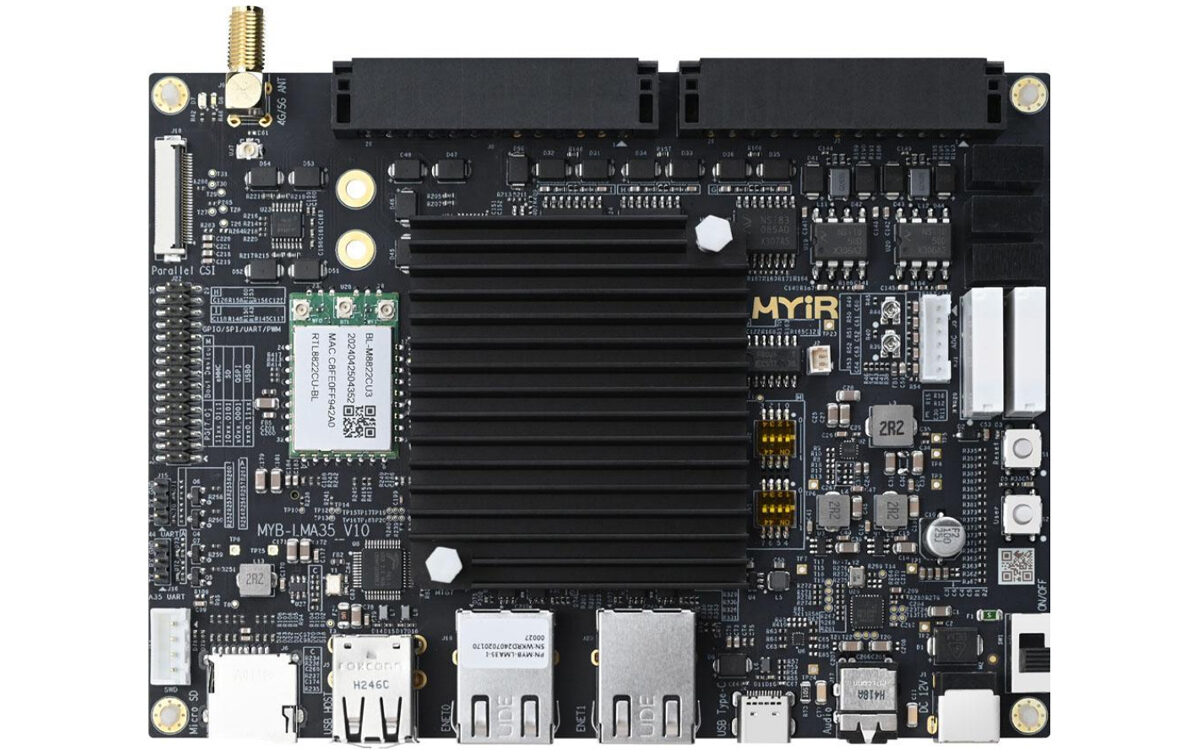
The Luckfox Aura is a compact, high-performance Linux SBC built around Rockchip’s RV1126B quad-core Arm Cortex-A53 processor with a 3 TOPS NPU and designed for AI vision, multimedia processing, and edge computing Applications. Aura board supports up to 4 GB LPDDR4X memory and up to 64 GB of optional eMMC storage. Camera and display options include two 4-lane MIPI CSI camera inputs, a 4-lane MIPI DSI display interface up to 1080p60, and an AI-enhanced ISP with HDR, noise reduction, dehazing, and image correction features. The board also features Gigabit Ethernet with PoE support, onboard dual-band Wi-Fi 6 and Bluetooth 5.4/BLE, USB 3.0 OTG, four USB 2.0 host ports, a 40-pin GPIO header compatible with some Raspberry Pi HATs, audio I/O, an RTC, and a microSD card slot. Luckfox Aura specifications: SoC – Rockchip RV1126B quad-core Cortex-A53 SoC CPU – Quad-core Arm Cortex-A53 up to 1.6 GHz with 32KB L1 I-Cache and […]

tinySA is a low-cost handheld spectrum analyzer with built-in signal generator

tinySA Spectrum Analyzers and Signal Generators

The tinySA is a compact, low-cost handheld spectrum analyzer and RF signal generator designed for hobbyists, radio amateurs, educators, and engineers. It comes in three different variants and can be used for RF debugging, signal inspection, interference hunting, filter testing, antenna-related measurements, and basic RF education, both in the field and on the bench. The product line includes the tinySA Basic, tinySA Ultra, and tinySA Ultra+, which mainly differ in their supported frequency ranges and performance. The tinySA Basic supports 100 kHz to 350 MHz on its low input and up to about 960 MHz on the high input, while the Ultra and Ultra+ models can observe signals up to 12GHz. The devices run from an internal rechargeable battery with USB-C charging, support firmware updates, internal self-test and calibration routines, marker and peak detection, configurable frequency span and amplitude settings, and PC control over USB. Input protection limits are specified at +10 […]

Calixto Systems SL1680 OPTIMA industrial SoM and EVK features Synaptics SL1680 Edge AI processor

SL1680 OPTIMA SOM

Calixto Systems has recently introduced the SL1680 OPTIMA, an industrial SoM built around the Synaptics SL1680 quad-core Arm Cortex-A73 SoC with a 7.9+ TOPS secure NPU for Edge AI and advanced multimedia applications. They also announced an evaluation kit (EVK) for rapid product development. The SoM offers up to 4GB LPDDR4 RAM, up to 16GB eMMC flash, an onboard Gigabit Ethernet PHY, and a wide range of interfaces through compact Hirose connectors, including dual MIPI CSI camera inputs, MIPI DSI, HDMI 2.1 Tx/Rx, PCIe 2.0, USB 3.0/2.0, SDIO, RS485, CAN-FD, and various GPIOs. The EVK further expands connectivity with MikroBUS, display and camera interfaces, and industrial I/O, making the platform suitable for AI-enabled vision systems, smart HMIs, automation equipment, and other edge computing applications. SL1680 OPTIMA SoM specifications SoC – Synaptics SL1680 (Astra Series) CPU – Quad-core Arm Cortex-A73 processor @ 2.1 GHz GPU – Imagination PowerVR Series9XE GE9920 GPU with […]

Renesas RA6W1/RA6W2 Cortex-M33 wireless MCUs offer dual-band Wi-Fi 6, BLE, Matter, 15-year availability

Renesas RA6W1 and RA6W2 dual band Wi Fi 6, BLE, Matter Cortex M33 Wireless MCU

Renesas has added the RA6W1 (Wi-Fi 6) and the RA6W2 (Wi-Fi 6 + BLE) MCUs to its high-performance RA6 family, adding dual-band Wi-Fi 6 and Bluetooth LE, as well as Matter connectivity to the series. Both models feature a 160 MHz Arm Cortex-M33 core, dual-band Wi-Fi 6 with WPA3 security, on-chip PA/LNA/RF switch, and a full TCP/IP stack for fast connectivity. They integrate up to 704 KB SRAM, 256 KB ROM, and support eMMC/SD, O-QSPI, and QSPI for external flash and/or PSRAM. The series also includes generic peripherals like SPI, I²C, I²S/PDM, SDIO, 12-bit ADCs, PWM timers, and up to 28 GPIOs. Offered in compact QFN/WLCSP packages, the RA6W1/2 MCUs target smart home, wearables, industrial, and consumer IoT markets where long battery life and wireless connectivity are essential. Renesas RA6W1 specifications: MCU core – Arm Cortex-M33 @ up to 160 MHz, Armv8-M architecture with MPU and SysTick Memory & Storage […]

Up to 16-core AMD EPYC Embedded 2005 Series Zen 5 processors support up 28 PCIe Gen5 lanes, offer 10-year availability

AMD EPYC Embedded 2005 Series Processors

After the release of the high-performance EPYC Embedded 9005, AMD has now introduced the EPYC Embedded 2005 Series, a mid-range processor family also based on the “Zen 5” architecture and designed for space-constrained networking, storage, and industrial edge applications. The new SoCs feature up to 16 cores (32 threads) with 64 MB L3 cache, support dual-channel DDR5-5600 memory with ECC, and offer 28 lanes of PCIe Gen5 connectivity. It also supports advanced RAS capabilities, BMC, PCIe Hot Plug, multi-SPI ROM, and AMD Infinity Guard security. The processors come in a compact 40 x 40mm BGA package, which, according to AMD, is up to 2.4x smaller than competing enterprise solutions (Intel Xeon 6500P-B). Yet, they are designed for 24/7 operation, with up to 10 years of availability with full open-source software support. These features make it suitable for networking switches/routers, cold storage systems, aerospace, robotics, and other high-reliability embedded infrastructure. EPYC […]

IoT HDMI switch – An ESP32-C3-powered 2-source HDMI switch automated with Home Assistant

IoT HDMI Switch

Designed by Guimpt in Spain, the IoT HDMI Switch is an ESP32-C3-based open-source HDMI switch that integrates with Home Assistant and ESPHome to automate up to two HDMI inputs for TVs, monitors, or projectors. It targets smart home setups that need seamless source switching without manually handling cables. It includes a 3D-printed enclosure for a compact install behind media equipment. The device also offers open hardware and firmware for easy upgrade, and it lets users switch inputs via phone, voice assistant, or a button. It also supports automations such as automatically selecting a game console or media player. It works with common HDMI devices like Chromecast, Raspberry Pi, PCs, and consoles, making it ideal for smart home enthusiasts, DIY tinkerers, and anyone who wants a hands-free media setup. IoT HDMI Switch specifications: SoC – Espressif Systems ESP32-C3FH4 Single-core 32-bit RISC-V microcontroller @ up to 160 MHz Memory – 400 KB […]

52Pi UPS Gen 6 UPS for Raspberry Pi 4/5 supports up to 4x external battery packs, PikaPython scripting 

Rapsberry Pi 5 UPS with four external battery packs

The 52Pi UPS Gen 6 is another UPS solution for the Raspberry Pi 5 that supports external battery packs for long-duration projects, and uses I²C plus PikaPython scripting to manage power settings and safe shutdowns. Designed for the Raspberry Pi 5 and 4B, the module mounts on the bottom of the board and delivers power via pogo pins. It also includes an aluminum heatsink with an automatic fan for cooling. It runs on two 18650 batteries, which can be mounted to the Pi with spacers, and there is an option to add three more battery packs in parallel if you need longer runtime. The board also features a physical power button for manual control, a 12V power interface for SATA hard drives, and switching hardware (bumpless power transfer) that instantly falls back to battery power so the system stays on during a power outage. 52Pi UPS Gen 6 specifications: Main […]

Exit mobile version