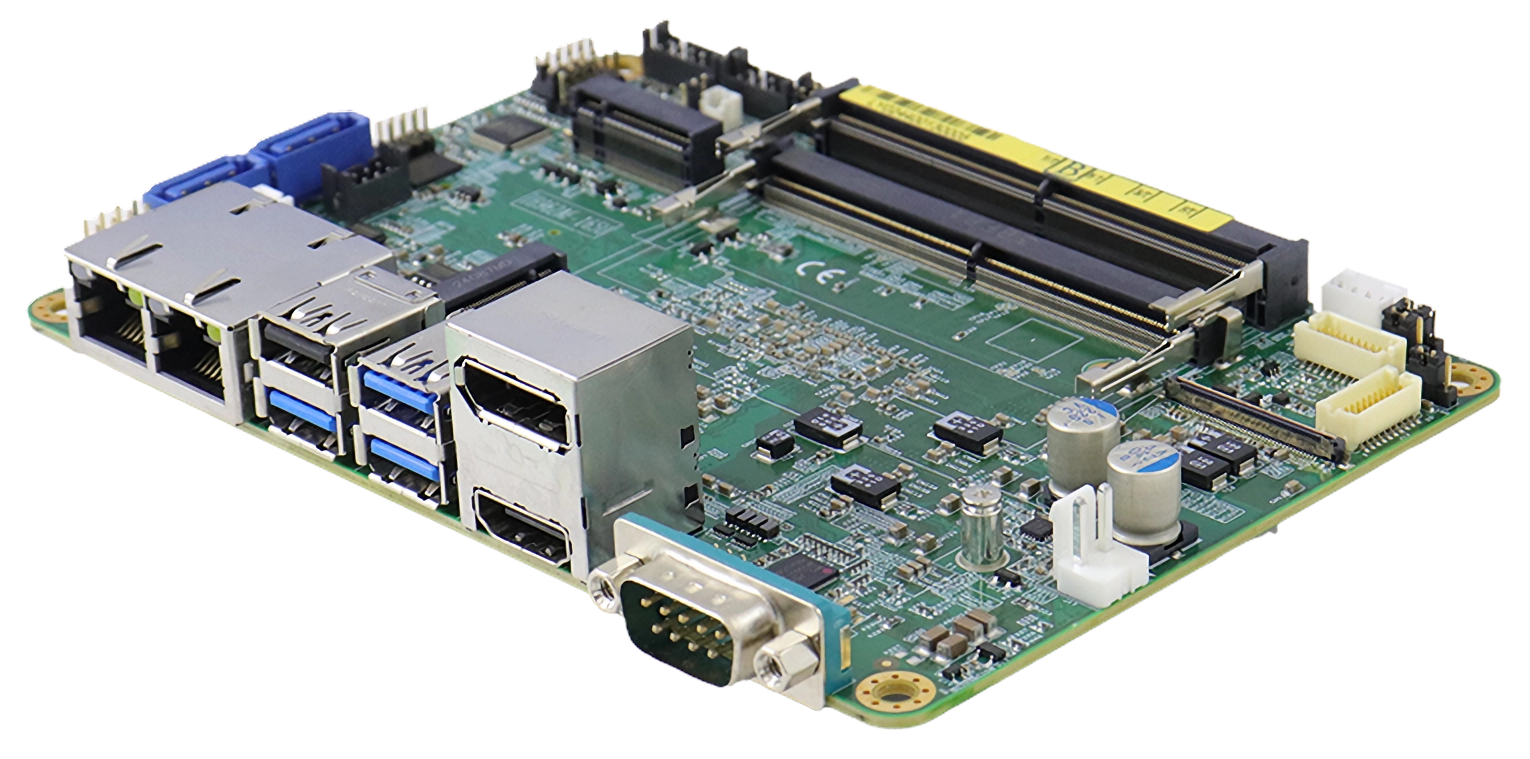
We first noted the UltraRISC UR-DP1000-powered Milk-V Titan mini-ITX motherboard when we wrote an article about three high-performance RISC-V processors to watch in H2 2025. There have been some delays, as there often are, but the Titan board finally appears to be in stock, so it’s probably a good time to have a closer look. Powered by a 2 GHz UR-DP1000 octa-core RISC-V CPU, the Titan mini-ITX motherboard supports up to 64GB DIMM memory and M.2 NVMe storage (PCIe Gen4 x4), and features a PCIe Gen4 x16 slot for a graphics card or other expansion, Gigabit Ethernet, four USB 3.0 ports, a BMC, and more. Milk-V Titan specifications: CPU – UltraRISC UR-DP1000 8x 64-bit RISC-V UR-CP100 “RV64GCBHX” cores up to 2.0 GHz Two 4x core cluster design with 4MB L3 cache each, and a total of 16MB cache. Fully RVA22 compliant, and “Compliant with RVA23 excluding V extension.” Supports Hardware […]
Xibo open-source digital signage solution now works with Raspberry Pi 5 thanks to the Arexibo project
Xibo digital signage solution is now compatible with the Raspberry Pi 5 thanks to Axeribo, an unofficial alternative to the digital signage player for Xibo, that is implemented in Rust, and designed for Linux platforms. Long-time readers of CNX Software may remember that I played around with the Xibo open-source digital signage player many years ago (2011-2012). I notably managed to run Xibo for Arm in QEMU, test Xibo digital signage in the Raspberry Pi emulator, and even try it on real hardware: a MeLE A1000 Android TV box to which I installed Linux. It kind of works, but without hardware video decoding and no 3D graphics acceleration, performance was rather on the low side. I eventually stopped playing around with Xibo Arm Linux once Xibo for Android was released in late 2012, and the developers decided to drop support for the Linux client (although they relaunched it in 2019 […]
EtherealOS: easily install Linux ISO and OS images from the Internet on Amlogic SBCs
Libre Computer has just announced the general availability of EtherealOS for the company’s Amlogic SBCs, namely AML-S905X-CC (Le Potato), AML-S805X-AC (La Frite), AML-S905X-CC-V2 ( Sweet Potato), AML-S905D3-CC (Solitude), and AML-A311D-CC (Alta). EtherealOS is described as a lightweight internet-booted operating system designed for performing tasks such as file and disk manipulation, operating system deployment, light browser tasks, and more. It includes a limited set of tools compared to a full operating system, and it’s basically an OS to install other operating systems directly from the Internet, in a way similar to Khadas OOWOW or Radxa ROOBI OS. The difference is that EtherealOS apparently supports upstreamed operating systems, namely Debian (debian-12.11.0-arm64-DVD-1.iso / debian-testing-arm64-DVD-1.iso), Fedora (Fedora-Workstation-Live-42-1.1.aarch64.iso), and OpenSUSE, besides images optimized by Libre Computer based on Debian, Ubuntu, and Raspbian. The video below shows how the terminal GUI in EtherealOS can install Debian to the eMMC flash of one of the company’s single […]
Jupiter NX SoM – An NVIDIA Jetson Nano/NX alternative powered by SpacemiT K1 octa-core RISC-V SoC
The Jupiter NX is a system-on-module (SoM) powered by a SpacemIT octa-core 64-bit RISC-V SoC that follows NVIDIA’s Jetson Nano / Xavier NX form factor for compatibility with existing carrier boards. Designed by Shenzhen Milk-V Technology, the module supports up to 16GB LPDDR4x memory and 32GB eMMC flash, and integrates two gigabit Ethernet PHYs and a WiFi 6 & Bluetooth 5.2 wireless module. Jupiter NX specifications: SoC – SpacemIT K1/M1 CPU – 8-core X60 RISC-V (RV64GCVB) processor @ 1.6 GHz GPU – Imagination IMG BXE-2-32 @ 819 MHz with support for OpenGL ES3.2, Vulkan 1.3, OpenCL 3.0; 20 GFLOPS VPU H.265, H.264, VP8, VP9, MPEG4, MPEG2 decoder up to 4K @ 60fps H.265, H.264, VP8, VP9 encoder up to 4K @ 30fps Support simultaneous processing 1080p60 encoding + 1080p60 decoding 1080p30 H.264/H.265 encoding + 4Kp30 H.264/H.265 decoding AI performance – 2.0 TOPS (INT8) through “CPU core fusion” RVA 22 Profile […]
Radxa Orion O6 mini-ITX motherboard gets Arm SystemReady SR v2.5 certification
Radxa Orion O6 mini-ITX motherboard powered by a CIX P1 12-core Cortex-A720/A520 SoC has just obtained Arm SystemReady SR (ServerReady) v2.5 certification, meaning it’s been shown to run unmodified several OS images such as Windows and Ubuntu. I’ve already tested a Debian 12 image modified by Radxa on the Orion O6, but one of the goals of the platform was to provide a universal UEFI + ACPI firmware to boot any Arm ISO released by OS vendors, for instance, the Ubuntu Desktop ISO for Arm 64-bit architecture downloaded directly from the Ubuntu website. The Arm SystemReady SR certification is a step in the right direction, as it means the Orion O6 has passed a number of tests showing it can boot several off-the-shelf OS images. We’ll find Radxa’s Orion O6 listed on the Arm SystemReady Compliance page among boards from other manufacturers, as well as the Radxa ROCK Pi 4B+, […]
Radxa Orion O6 Review – Part 1: Unboxing, Debian 12 installation, and first benchmarks
Radxa sent me a sample of the Orion O6 mini-ITX motherboard for review. The system is powered by an CIX P1 (CD8180) 12-core Armv9 processor, equipped with 16GB RAM, and offers features like 5GbE, HDMI and DisplayPort, a PCIe Gen4 x16 slot, and more. It’s one of the most anticipated boards of the first part of 2025 since it’s powerful, offers a good performance/value ratio, and eventually promises to boot any ISO Arm64 image through an open-source BIOS / EDKII bootloader. I’ll start this review with an unboxing, NVMe SSD and WiFi module installation, and a short tutorial showing how to install Debian 12 operating systems before getting some system information and running a few benchmarks. In a few weeks, I’ll publish a more detailed review with features testing and more benchmarks to see what works and what doesn’t at this very early stage. Radxa Orion O6 unboxing I received […]
Radxa Orion O6 mini-ITX motherboard is powered by Cix P1 12-core Armv9 SoC with a 30 TOPS AI accelerator
Radxa Orion O6 is an Arm mini-ITX motherboard with performance similar to Apple M1 and Qualcomm 8cx Gen3 platform thanks to the Cix P1 12-core Armv9 processor with four Cortex-A720 cores clocked at 2.8 GHz, four Cortex-A720 cores at 2.4GHz, and four low-power Cortex-A520 cores clocked at 1.8 GHz. The Cix P1 SoC also features an Arm Immortalis-G720 GPU for graphics and AI computing, a 30 TOPS AI accelerator for a combined 45 TOPS of AI inference performance, an 8Kp60 video decoder, and an 8Kp30 video encoder. The Orion O6 SBC ships with up to 64GB LPDDR5, features a 4Kp60 HDMI 2.0 port, a 4Kp120 DP 1.4 connector, two 5Gbps Ethernet ports, M.2 socket for storage and wireless, a PCIe x16 slot, and more. Radxa Orion O6 specifications: SoC – Cix P1 (Codename: CD8180, not the CP8180 variant for AI PCs) 12-core DynamIQ processor 4x Cortex‑A720 big cores @ up […]
DC-ROMA RISC-V Mainboard is designed for the Framework Laptop 13 modular laptop
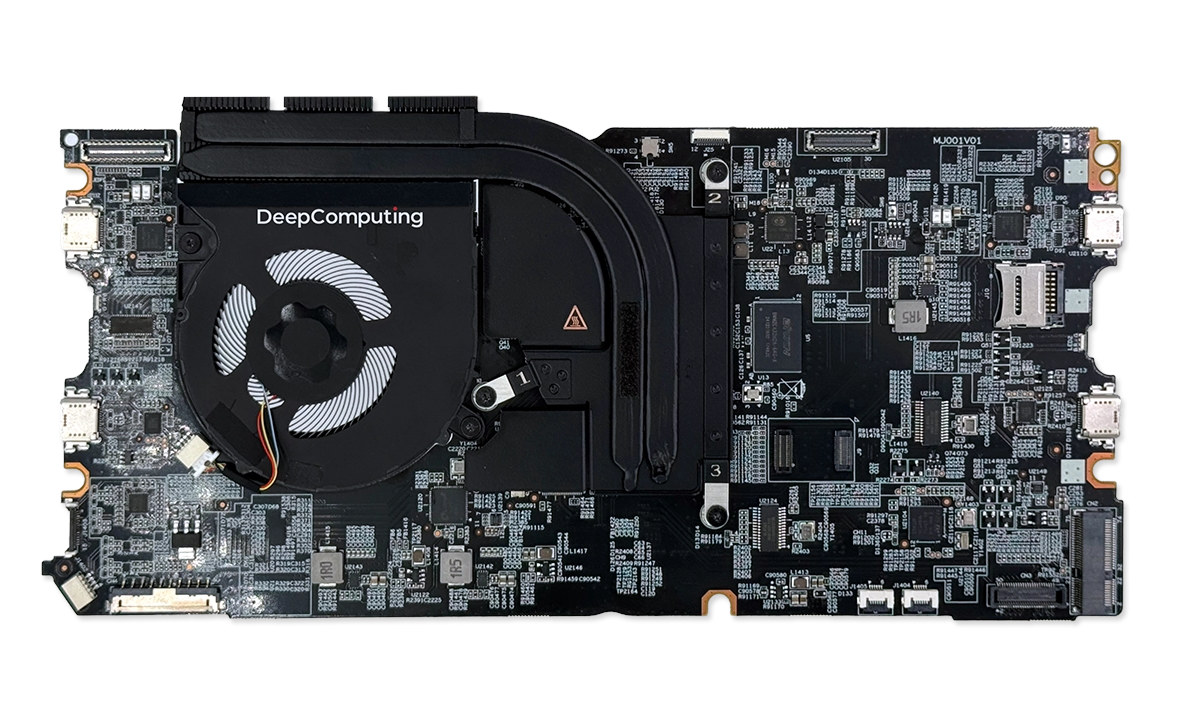
DeepComputing’s DC-ROMA RISC-V Mainboard is designed for the modular Framework Laptop 13 and powered by a StarFive JH7110 quad-core RISC-V processor running either Ubuntu 24.04 Desktop or Fedora 41 Linux distribution. The Framework Laptop 13 was initially offered with Intel Core i5-1135G7, Core i7-1165G7, or Core i7-1185G7 processor, but the advantage of a modular laptop is that you can replace components, and that’s exactly what the “DC-ROMA RISC-V Mainboard” does by allowing users/developers to do by switching to a less powerful RISC-V processor for software development. Framework Laptop 13 specifications with DC-ROMA RISC-V Mainboard: SoC – StarFive JH7110 CPU Quad-core 64-bit RISC-V SiFive U74 (RV64GC) processor @ up to 1.5 GHz with 32KB D-Cache, 32KB I-cache Single-core 64-bit RISC-V SiFive S7 (RV64IMAC) monitor core with 16KB I-cache, 8KB DTIM Single-core 32-bit RISC-V SiFive E24 (RV32IMFC) real-time control core with 16KB I-cache Up to 2MB L2 cache GPU – Imagination BXE-4-32 […]