KernelUNO is an Arduino sketch with 546 lines of code that provides a lightweight OS for the Arduino UNO with a Linux-like shell offering commands such as ls, df, uname, and so on. All you need is an Arduino UNO R3 or a compatible board with a Microchip ATmega328P microcontroller, a USB cable for programming, and optionally a few LEDs and resistors for testing the gpio command in the terminal. KernelUNO offers the following features: Virtual Filesystem – Create files and directories in RAM (/dev, /home) Hardware Control – GPIO management with pin mode configuration System Monitoring – Memory usage, uptime, kernel messages (dmesg) Interactive Shell – Real-time command execution with input buffering 23 built-in commands File system commands – ls, cd, pwd, mkdir, touch, cat, echo [text] > [file], rm, info [name] Hardware commands pinmode [pin] [in/out] – Set pin mode write [pin] [high/low] – Write to pin read […]
Velxio is an open-source, self-hosted Arduino, Raspberry Pi, and ESP32 simulator
Velxio is an open-source, self-hosted simulator for Arduino, ESP32, and Raspberry Pi boards that works directly in your web browser. You can drag-and-drop boards, connect components and modules, write and run code in Arduino or Python, and access the serial console, all without hardware. If it looks similar to what the Wokwi simulator has to offer, it’s because Velxio was inspired by it and even integrates the AVR8 CPU emulator, RP2040 emulator, and QEMU fork for ESP32 Xtensa emulation from the Wokwi project. But the key difference is that Velxio can be self-hosted, although there’s also an online demo. Velxio currently supports 19 targets across five architectures AVR8 (ATmega / ATtiny) Arm Cortex-M0+ (Raspberry Pi RP2040) RISC-V RV32IMC/EC (ESP32-C3 / CH32V003) Xtensa LX6/LX7 (ESP32 / ESP32-S3 via QEMU) Arm Cortex-A53 (Raspberry Pi 3 Linux via QEMU) The project also offers 48 components. The developer mentions that additional features compared to […]
AngstromIO – A tiny 9.0 x 8.9 mm ATtiny1616 board that fits on top of a USB-C connector
Dieu-de-l-elec’s AngstromIO is an incredibly tiny open-source development board based on Microchip’s ATtiny1616 MCU. Measuring just 9.0 x 8.9 mm, the board is barely larger than the edge-mounted USB Type-C connector that powers it, making it ideal for highly space-constrained embedded projects. Despite its tiny footprint, AngstromIO packs a QFN20-packaged ATtiny1616 MCU, two addressable SK6805-EC15 RGB LEDs, and includes access to various usable GPIOs, including I2C, UART, and UPDI for programming. AngstromIO specifications: MCU – Microchip ATtiny1616 8-bit AVR microcontroller @ up to 20 MHz with 16KB flash, 2KB SRAM, 256 bytes EEPROM USB – 1x USB Type-C port (power only, no data lines connected to the MCU) Expansion via solder pads UPDI pin for programming I2C (SDA, SCL) 2x GPIOs (PB2/TX, PA3) 5V and GND Misc – 2x SK6805-EC15 addressable RGB LEDs Power Supply 5V via USB-C port Ultra-low power consumption (down to 200nA in power-down mode) Dimensions – 9.0 […]
Open-source hardware USB to GPIB adapter connects legacy GPIB/IEEE-488 instruments to modern hosts
XyphroLabs’s UsbGpib is an open-source hardware, inexpensive, and portable USB to GPIB adapter aiming to provide “access to legacy GPIB/IEEE-488 instruments using contemporary hardware and software, with a focus on accessibility, openness, and ease of integration into current workflows”. Initially developed by Hewlett-Packard in the late 1960s/early 1970s, GPIB (General Purpose Interface Bus), also known as IEEE-488 or initially HP-IB (Hewlett-Packard Interface Bus), is a short-range digital communications bus standard designed for connecting and controlling programmable electronic test and measurement instruments such as oscilloscopes, multimeters, and power supplies to computers or controllers. The UsbGpib project helps connect GBIP-compliant equipment to modern host computers with a USB port. UsbGpib key hardware features and specifications: Microcontroller – Microchip ATMega32U4 8-bit AVR microcontroller for 5V I/O compatibility USB – USB Type-C port with full USBTMC (USB Test and Measurement Class) support 24-pin GPIB interface – Fully IEEE-488.1 and IEEE-488.2 enabled, including service request […]
MicroSui lightweight, open-source C framework brings the Sui Network to microcontrollers
MicroSui (Sui Embedded Framework) is a lightweight, modular, open-source C framework that brings the Sui Network to microcontrollers from low-end 8-bit MCUs like AVR to more powerful 32-bit SoCs like the ESP32. Wait… What’s the Sui Network / Protocol exactly? It’s a blockchain platform designed for high-speed, scalable, and low-cost decentralized applications, which was introduced in May 2023 by Mysten Labs, a company founded by former Meta engineers. It competes with networks like Solana and Ethereum but with better performance. So far, the Sui Network works with web and mobile applications, but MicroSui aims to expand its usage to resource-constrained embedded devices. We’re told MicroSui provides support for all core operations such as key management, transaction construction, signing, and broadcast. It is a pure-C library with no OS dependency or dynamic memory usage, so it can be deployed on a wide range of microcontrollers. Higher-end microcontrollers with Internet access, such […]
Microchip AVR SD 8-bit dual-core microcontrollers offer functional safety for less than one dollar
Microchip AVR SD family of low-cost 8-bit microcontrollers (MCUs) feature built-in functional safety (FuSa) mechanisms designed to meet Automotive Safety Integrity Level C (ASIL C) and Safety Integrity Level 2 (SIL 2) requirements, both of which mandate redundant safety checks. Hardware safety features include a dual-core lockstep CPU, two ADCs for redundancy, an Error Correction Code (ECC) on all memories, a dedicated error controller module, error injection mechanisms, and voltage and clock monitors. The company further explains the AVR SD MCU meets Fault Detection Time Interval (FDTI) targets as low as 1 millisecond, and its functional safety management system has been certified by TÜV Rheinland. Microchip AVR SD specifications: MCU core – AVR CPU in Dual-Core Lockstep (DCLS) clocked at up to 20 MHz Memory – 4 KB or 8KB SRAM with ECC Storage 32 KB or 64KB in-system-programmable Flash memory with ECC 256B EEPROM with ECC 512B of user […]
Microchip 8-bit AVR DU family supports secure USB connectivity and 15W power delivery
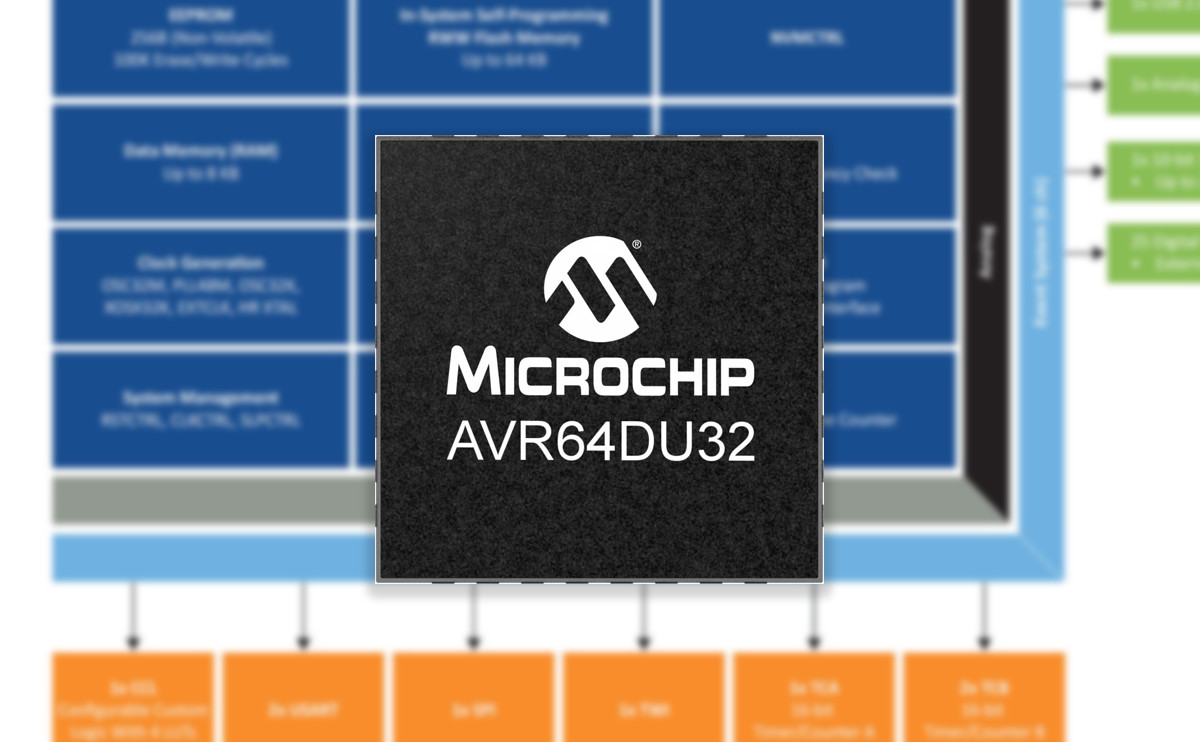
At Embedded World 2024, Microchip announced their new AVR DU family of 8-bit MCUs featuring a full-speed USB 2.0 data interface along with USB-C 15W Power Delivery enabling up to 12Mbps data transfer and charging. They also have features like secure bootloaders and Program and Debug Interface Disable (PDID), which protect your embedded designs. Based on the Harvard architecture, these MCUs can have up to 64 KB of Flash memory, 8 KB of SRAM, and 256 bytes of EEPROM. Their wide operating voltage range of 1.8V to 5.5V makes them suitable for small, space-sensitive devices, power bricks, and rechargeable devices. But one thing to note is that the USB function is only available for VDD above 3.0V and I2C Fm+ (Fast-mode Plus) is only supported for 2.7V and above. I²C Fm+ extends the standard I²C protocol, boosting communication speeds up to 1 MHz while maintaining compatibility with older I²C devices. It’s […]
Ovrdrive USB is an open-source, privacy-oriented USB flash drive that can self-destruct (Crowdfunding)
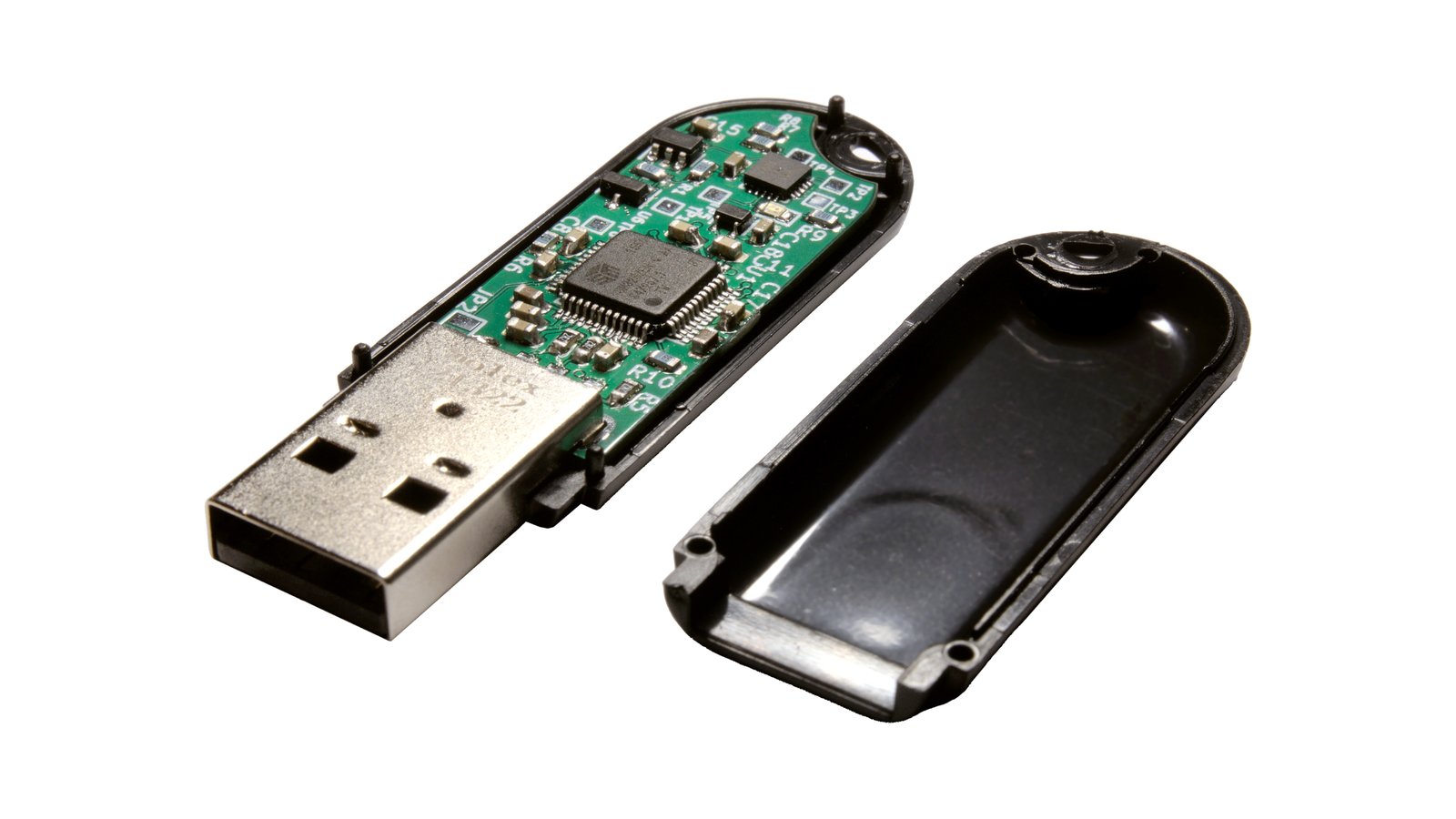
We have previously covered the Tillitis Tkey, an open-source security key in a USB-C case but the Ovrdrive USB stick is not a security key. It is a simple, plain USB flash drive with a special security feature. It will appear completely blank unless you plug this drive in three times in quick succession. The Ovrdrive flash drive is aimed at journalists in repressive areas and security researchers but may be useful to other security and open-source hardware enthusiasts. As for how it works, the Ovrdrive has two identical circuits connected to the ATtiny24A microcontroller that controls the rapid plug-in functionality. When the flash is plugged in, the microcontroller powers on, and the CHG1 node goes high, charging C3 through D2. The pin will remain high for a while and then slowly discharge via R1 and body resistance. C3 and the identical C14 will remain high through power cycling/a quick […]