Linus Torvalds has just announced the release of Linux 6.18 on the Linux Kernel Mailing List (LKML), which will likely become the next LTS kernel [update: it’s now official]: So I’ll have to admit that I’d have been happier with slightly less bugfixing noise in this last week of the release, but while there’s a few more fixes than I would hope for, there was nothing that made me feel like this needs more time to cook. So 6.18 is tagged and pushed out. Most of the last-minute fixes are minor fixes to drivers, with some random noise elsewhere (bluetooth, ceph, afs..). Nothing strikes me as standing out, but hey, there’s a shortlog appended if you want to see the details. And this obviously means that the merge window will open tomorrow, and I already have three dozen pull requests pending. Thanks. And as I already mentioned a couple of […]
Turris Omnia NG Wi-Fi 7 router features dual 10GbE SFP+, mini PCIe slot for 4G LTE/5G, runs OpenWrt-based Turris OS
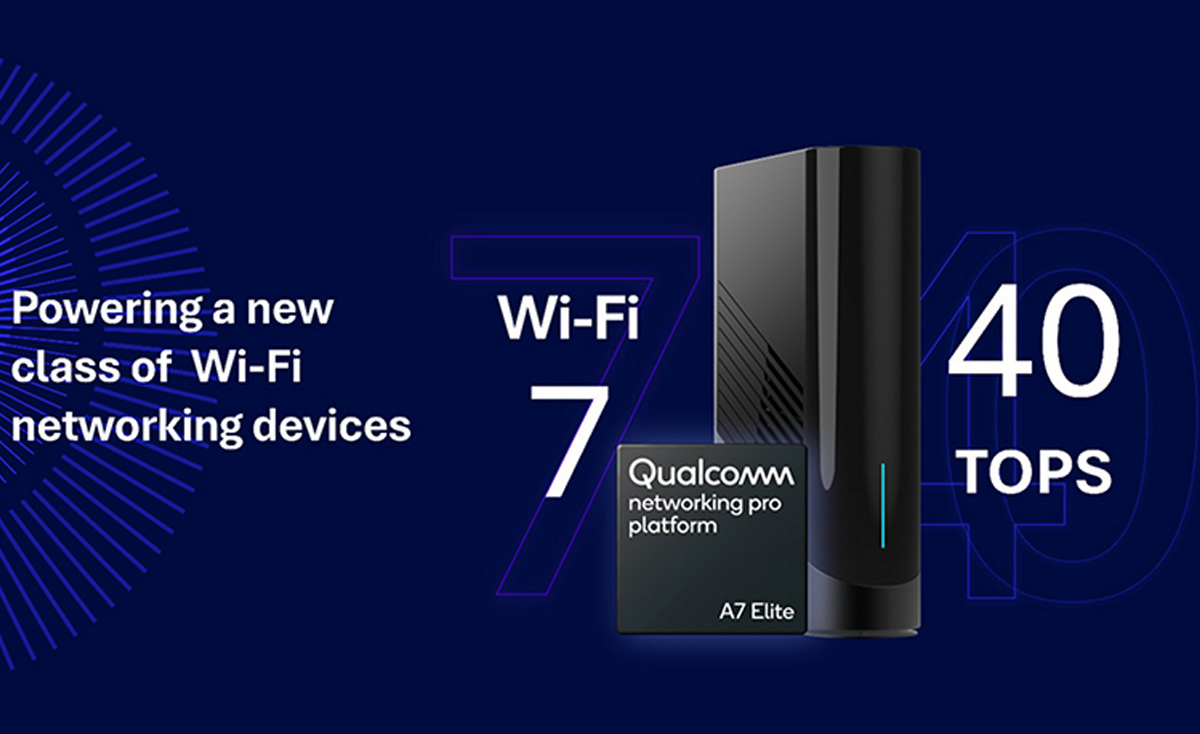
The Turris Omnia NG is a high-performance Wi-Fi 7 router with a mini PCIe slot for 4G/5G modems, two 10GbE SFP+ cages, a 240×240 px color display, and a D-Pad button, running OpenWrt-based Turris OS, and designed for advanced home users, small businesses, and lab environments. Built around a 2.2 GHz Qualcomm IPQ9574 quad-core 64-bit Arm Cortex-A73 CPU, the Omnia NG supports Wi-Fi 7/6 tri-band connectivity. Additionally, it features four 2.5Gbps Ethernet ports, two USB 3.0 ports, NVMe storage support, and includes a 90 W power supply for attached peripherals. Other hardware highlights include rack-mount supports, a metal chassis, and antenna arrays for 4×4 MIMO operation. It comes 10 years after the original Turris Omnia open-source router was launched on Indiegogo. Turris Omnia NG Router specifications: CPU – Qualcomm IPQ9574 quad-core Arm Cortex-A73 processor @ 2.2GHz processor Memory – 2 GB RAM Storage 8 GB eMMC storage M.2 socket for […]
Nexalta Guardian NXG0042AI – Qualcomm IPQ9574-based networking solution with 10GbE, WiFi 7, 5G, local AI (Crowdfunding)
Nexalta Guardian NXG0042AI is a large networking and IoT gateway “monster” powered by a Qualcomm IPQ9574 chipset offering 10GbE and 2.5GbE networking, WiFi 7 support with up to five concurrent WiFi radios, up to four/seven 5G modems, up to 52 (e)SIMs, and two on-board Compute Module slots for Rockchip RK3588 or NVIDIA Jetson SO-DIMM system-on-modules. The main board (XWR A1) also offers 25Gbps WAN fabric, three MCUs for BMC, power management, and cryptography, M.2 slots for NVMe storage or AI accelerators, two mSATA sockets, HDMI video output, USB ports, Starlink satellite support, and a range of IoT protocol options such as LoRaWAN, 5G RedCap, UWB, Bluetooth LE, and so on. Nexalta Guardian specifications: Main SoC subsystem SoC – Qualcomm IPQ9574 quad-core Arm Cortex-A73 processor @ 2.2GHz processor System Memory – 2GB DDR4 RAM Storage – 8GB eMMC flash, 64MB NOR flash SoM sub-system 2x 260-pin SO-DIMM sockets for: Turing RK1 […]
Compex “JustWiFi⁷™” driverless, Ethernet-connected Wi-Fi 7 module delivers up to 10 Gbps throughput (Sponsored)
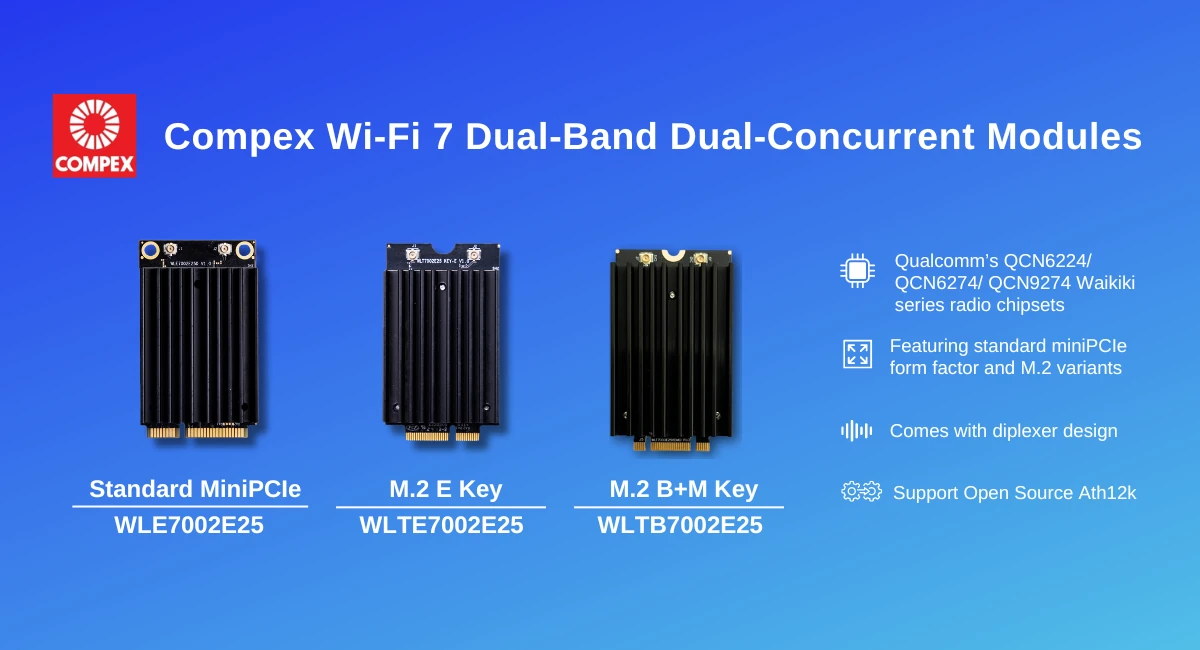
Compex Systems (Compex) is redefining how wireless is integrated into modern embedded and industrial systems with the launch of JustWiFi⁷™, a one-of-a-kind, driverless, tri-band concurrent Wi-Fi 7 module that connects through Ethernet protocols. Designed to eliminate the complexity of traditional wireless integration, JustWiFi⁷™ makes high-performance Wi-Fi deployment faster, simpler, and smarter. Rethinking Wi-Fi Integration: No Drivers. No Hassle. JustWiFi⁷™ Most of the Wi-Fi modules today rely on PCIe, SDIO, or USB interfaces and are controlled through drivers. Developers will need to deal with the drivers’ compatibility with the host platform, particularly its OS and kernel version. The drivers for Wi-Fi 7 are particularly complex due to the standard’s advanced features. Many open-sourced drivers and sometimes the host CPU are not able to deliver the full capabilities of the Wi-Fi 7 chipset. These complications often unnecessarily slow down and add to the development time and effort. Engineered for speed, simplicity, and […]
Linux 6.16 Release – Main changes, Arm, RISC-V, and MIPS architectures
Linus Torvalds has just announced the release of Linux 6.16 on LKML: It’s Sunday afternoon, and the release cycle has come to an end. Last week was nice and calm, and there were no big show-stopper surprises to keep us from the regular schedule, so I’ve tagged and pushed out 6.16 as planned. It’s worth noting that the upcoming merge window for 6.17 is going to be slightly chaotic for me: I have multiple family events this August (a wedding and a big birthday), and with said family being spread not only across the US, but in Finland too, I’m spending about half the month traveling. That means that I will try very hard to get most of the merge window done the first week before my travels start, and I already ended upgiving a heads-up on that to the people who tend to send me the most pull requests. […]
GL.iNet Flint 3 (GL-BE9300) is an affordable tri-band WiFi 7 router with 5 2.5GbE ports
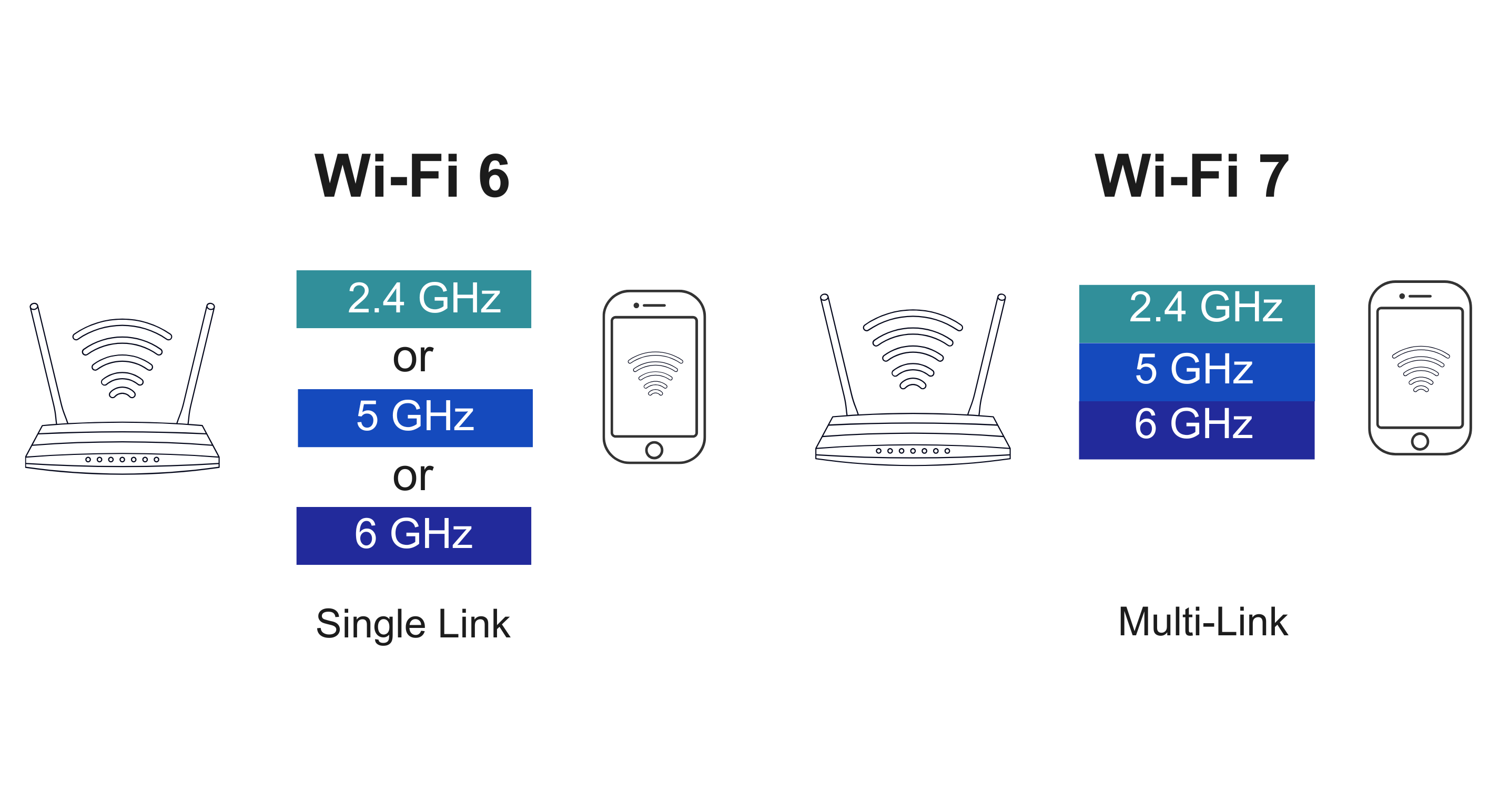
The GL.iNet Flint 3 (codenamed GL-BE9300) is an affordable tri-band WiFi 7 BE9300 router with five 2.5GbE RJ45 ports supporting 10Gbps aggregation, and now available for pre-order for $119 to $159. It follows the lower-end GL.iNet Slate 7 (GL-BE3600) WiFi 7 dual-band travel router introduced a few months ago. The tri-band WiFi 7 router is powered by a 1.5 GHz quad-core Qualcomm processor coupled with 1GB RAM and 8GB eMMC flash for the OS, features a USB 3.0 port for smartphone tethering or cellular dongle, and supports up to 680 Mbps VPN throughput using WireGuard or OpenVPN. Other features include AdGuard Home, failover, load balancing, and more. GL.iNet Flint 3 specifications: CPU – Qualcomm quad-core @1.5 GHz; unamed, but likely Qualcomm IPQ5332 Memory – 1 GB DDR4 Storage – 8 GB eMMC flash Networking WiFi 7 Protocol – IEEE 802.11a/b/g/n/ac/ax/be Wi-Fi Speed – 688Mbps (2.4GHz), 2882Mbps (5GHz), 5765Mbps (6GHz) 4x […]
Linux 6.15 Release – Main changes, Arm, RISC-V and MIPS architectures
Linus Torvalds has just announced the release of Linux 6.15: So this was delayed by a couple of hours because of a last-minute bug report resulting in one new feature being disabled at the eleventh hour, but 6.15 is out there now. Apart from that final scramble, things looked pretty normal last week. Various random small fixes all over, with drivers as usual accounting for most of it. But we’ve got some bcachefs fixes, some core networking, and some mm fixes in there too. Nothing looks particularly scary. And this obviously means that the merge window opens tomorrow as usual, and I see the usual people being proactive and having sent me their pull requests. It’s memorial day tomorrow here in the US, but like the USPS, “neither snow nor rain nor heat nor gloom of night” – nor memorial day – stops the merge window. [ Actually, thinking back […]
GL.iNet Spitz Plus GL-X2000 – An affordable WiFi 6 cellular router with GbE, dual SIM, and load balancing capabilities
GL.iNet Spitz Plus GL-X2000 is a Wi-Fi 6 cellular router with GbE networking, two nano SIM slots, interchangeable high-gain antennas, and more. It is built around a Qualcomm IPQ5018 dual-core 1 GHz SoC and supports AX3000 Wi-Fi speeds with data rates of up to 574 Mbps on 2.4GHz and 2402 Mbps on 5GHz. Other features include support for multi-WAN connectivity, failover, and load balancing for stable connections, it also comes with preinstalled VPN support for over 30 providers. It also has remote management features that allow users to monitor data usage, update firmware, and troubleshoot through a centralized interface. The device is available in different LTE variants for North American and international markets, supporting region-specific bands. These features make this router useful for applications such as remote work, mobile offices, industrial IoT, and backup connectivity in areas with unreliable broadband. GL-X2000 (Spitz Plus) specifications: SoC – Qualcomm IPQ5018 dual-core Cortex-A53 […]