Forlinx Embedded UP4 is a new family of pin-to-pin compatible system-on-modules currently offered with Rockchip RK3568J/RK3562J, NXP i.MX 9352, or Allwinner T527N/T536 processors. The UP4 modules measure just 40×40 mm and expose 487 pins through a hybrid LCC (Leadless Chip Carrier) and LGA (Land Grid Array) design with 1.0mm contact pitch and 1.27mm ball pitch, respectively. This should allow companies to design a single carrier board for multiple CPU variants. Forlinx UP4 specifications: SoC FET-MX9352-UP4 – NXP i.MX 9352 with 2x Arm Cortex-A55 cores @ up to 1.7 GHz, Cortex-M33 real-time core @ 250 MHz, 2D GPU only, 0.5 TOPS Arm Ethos U65 microNPU FET3568-UP4 – Rockchip RK3568B2/J with 4x Arm Cortex-A55 cores @ up to 2.0/1.8 GHz, Arm Mali-G52 MP2 3D GPU, 1 TOPS AI NPU FET3562J-UP4 – Rockchip RK3562J with 4x Arm Cortex-A53 cores @ 1.8 GHz, Arm Mali-G52-2EE 3D GPU, 1 TOPS NPU FET527N-UP4 – Allwinner T527N […]
Linux 7.0 Release – Main changes, Arm, RISC-V, and MIPS architectures
Linus Torvalds has just released Linux 7.0 on LKML: The last week of the release continued the same “lots of small fixes” trend, but it all really does seem pretty benign, so I’ve tagged the final 7.0 and pushed it out. I suspect it’s a lot of AI tool use that will keep finding corner cases for us for a while, so this may be the “new normal” at least for a while. Only time will tell. Anyway, this last week was a little bit of everything: networking (core and drivers), arch fixes, tooling and selftests, and various random fixes all over the place. Let’s keep testing, and obviously tomorrow the merge window for 7.1 opens. I already have four dozen pull requests pending – thank you to all the early people. Linus This follows the Linux 6.19 release about two months ago, which brought us PCIe link encryption and […]
Linux 6.19 Release – Main changes, Arm, RISC-V, and MIPS architectures
Linus Torvalds has just released Linux 6.19 on the Linux Kernel Mailing List (LKML): No big surprises anywhere last week, so 6.19 is out as expected – just as the US prepares to come to a complete standstill later today watching the latest batch of televised commercials. The betting man would expect them all to be AI-generated, but maybe some enterprising company decides to buck the trend? Doubtful, but there’s always a slight chance. But for anybody outside the US, maybe taking the newest kernel out for a spin instead is an option? I have more than three dozen pull requests for when the merge window opens tomorrow – thank you to all the early maintainers. And as people have mostly figured out, I’m getting to the point where I’m being confused by large numbers (almost running out of fingers and toes again), so the next kernel is going to […]
Allwinner V861 dual-core 64-bit RISC-V AI Camera SiP features 128MB DDR3L, 4K H.265/H.264 video encoder
Allwinner V861 is a new dual-core 32-bit/64-bit RISC-V C907 system-in-package (SiP) with 128MB on-chip DDR3L and designed for 4K AI camera applications with a 1 TOPS AI NPU. The chip also features a 32-bit RISC-V E907 low-power core, a 4Kp25 H.264/H.265 video encoder, a 1080p60 JPEG video decoder and encoder, MIPI CSI and parallel camera interfaces, audio codec with input and output interfaces, Fast Ethernet, USB 2.0, and a range of digital and analog I/Os. Allwinner V861M3-XXX specifications: CPU Dual-Core RISC-V XuanTie C907 (RV64GCBV/RV32GGCBV) clocked up to 1.4GHz with RVV 1.0 extensions Single-core RISC-V XuanTie E907 (RV32IMAFC) clocked up to 800MHz VPU Video Encoder H.264/H.265 up to 4K @ 25fps (M)JPEG up to 8192×8192 Video Decoder – (M)JPEG up to 1080p60 AI accelerator – 1 TOPS (INT8) NPU dubbed “AI-ISP 2.0” Memory 128MB DDR3/DDR3L (SiP) “SQPI” PSRAM interface Storage QSPI flash eMMC 4.41 SDIO 2.0/3.0 Display – SPI interface Camera […]
Year 2025 in Review, CNX Software stats, and looking ahead to 2026
Time for the last post of 2025, as the year is almost over. I’ll look back at key developments and notable products launched in 2025, share some CNX Software website traffic statistics, and look ahead to 2026. Year 2025 in Review After 22 product releases in 2024, Raspberry Pi calmed down a little bit in 2025, and the highlights of the year included the Raspberry Pi 500+ mechanical keyboard, the 5-inch variant of the Raspberry Pi Touch Display 2, and a Raspberry Pi 5 1GB RAM. What didn’t quite stop were the accessories from third parties for Raspberry Pi SBC and Raspberry Pi Pico boards. The most exciting Arm SoC release of 2025 was probably the 12-core CIX P1 Armv9 SoC found in Radxa Orion O6 SBC, MINISFORUM MS-R1 Arm mini PC, and Orange Pi 6 Plus board, but while performance was fine, it was overhyped in 2024, and software […]
Linux 6.18 LTS release – Main changes, Arm, RISC-V, and MIPS architectures
Linus Torvalds has just announced the release of Linux 6.18 on the Linux Kernel Mailing List (LKML), which will likely become the next LTS kernel [update: it’s now official]: So I’ll have to admit that I’d have been happier with slightly less bugfixing noise in this last week of the release, but while there’s a few more fixes than I would hope for, there was nothing that made me feel like this needs more time to cook. So 6.18 is tagged and pushed out. Most of the last-minute fixes are minor fixes to drivers, with some random noise elsewhere (bluetooth, ceph, afs..). Nothing strikes me as standing out, but hey, there’s a shortlog appended if you want to see the details. And this obviously means that the merge window will open tomorrow, and I already have three dozen pull requests pending. Thanks. And as I already mentioned a couple of […]
$149 Allwinner A733 development board offers HDMI Input, eDP, Android 15 support
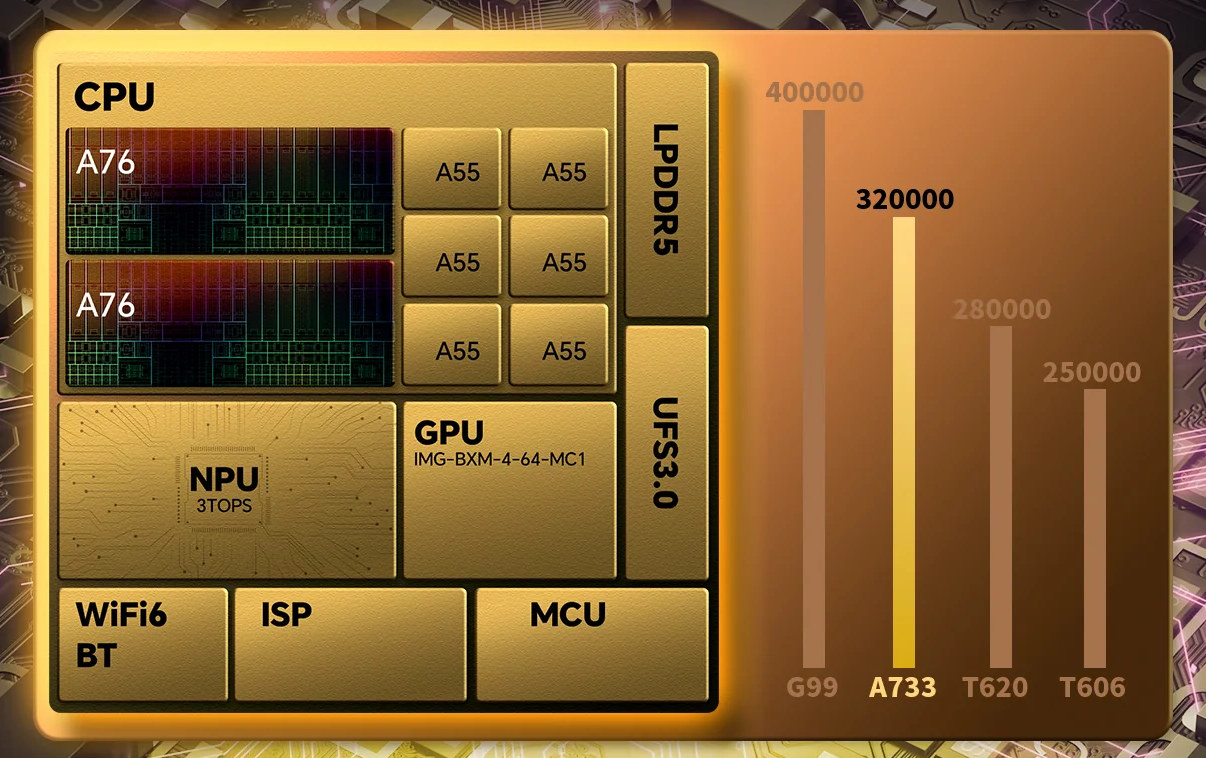
While browsing AliExpress, I came across an Allwinner A733 development board (A733MAIBORADBV1) priced at $149, which piqued my interest as the price tag was much higher than other A733 boards, such as the $35+ Orange Pi 4 Pro or Radxa Cubie A7Z/A7A. It turns out that this board not only supports up to 16GB of RAM, and Android 15. It also includes features like HDMI input and output, MIPI-CSI/DSI, eDP, capacitive touch, and M.2 expansion, making it a development platform for tablets, laptops, and AI prototypes rather than low-cost maker projects. A733MAIBORADBV1 board specifications: SoC – Allwinner A733 CPU Dual-core Arm Cortex-A76 @ up to 2.00 GHz Hexa-core Arm Cortex-A55 @ up to 1.79 GHz Single-core RISC-V E902 real-time core GPU – Imagination Technologies BXM-4-64 MC1 GPU VPU 8Kp24 H.265/VP9/AVS2 decoding 4Kp30 H.265/H.264 encoding AI accelerator – Optional, up to 3 TOPS NPU System Memory – 2GB, 4GB, 8GB, or 16GB […]
Waveshare MK20 macro keyboard features twenty mechanical keys with 0.85-inch color LCD keycaps
Waveshare MK20 is a multifunctional macro keyboard with twenty mechanical keys featuring 0.85-inch LCD keycaps. As an upgrade to the earlier MK10 model, it adds a 2.8-inch secondary display along with two control knobs. The device supports AI voice interaction, real-time data display, and smart home integration with Home Assistant. Like its predecessor, the MK20 relies on a dual-system architecture: an Allwinner T113-S3 dual-core Cortex-A7 processor runs Linux to drive the displays, and a GD32 microcontroller runs QMK for low-latency keyboard and knob input. Each LCD key offers 128×128 resolution and supports dynamic images, videos, and multi-layer overlays, while the 2.8-inch secondary display (428 × 142 resolution) provides status or customization information. The keyboard also includes two rotary encoders with aluminum caps for volume, playback, or timeline control. The device is built with an aluminum alloy top case and a 2.5D acrylic lens for durability. Waveshare MK20 specifications: Main Controller – Allwinner […]