
Qualcomm Dragonwing Q‑7790 and Q‑8750 AIoT SoCs target AI-enhanced drones, cameras, TVs and media hubs

Dragonwing Q-7790

Qualcomm has made a range of announcements at CES 2026, and notably introduced the Dragonwing Q‑7790 and Q‑8750 processors supporting on‑device AI for drones, smart cameras & industrial vision, AI TVs/media hubs, and video collaboration systems. The mid-range Dragonwing Q-7790 targets both consumer and industrial IoT devices, and offers up to 24 TOPS of on-device AI, 4K video outputs and camera inputs, and AV1 hardware video decode. The higher-end Dragonwing Q-8750 is designed for more advanced IoT applications, delivers up to 77 TOPS (dense) for real-time inference and up to 11B LLMs, handles 8K displays and 8K cameras, and supports up to 12 physical cameras for drones, media hubs, and multi-angle vision systems. Dragonwing Q-7790 Dragonwing Q-7790 (CQ7790M/CQ7790S) specifications: CPU – Octa-core Kryo processor up to 2.8 GHz 1x Gold+ core @ 2.8 GHz 4x Gold cores @ 2.4 GHz 3x Silver cores @ 1.8 GHz GPU – Qualcomm Adreno […]

ESP32-DIV V1 handheld pentesting tool supports Wi-Fi Attacks, BLE spoofing, 2.4GHz scanning, and Sub-GHz jamming

ESP32 DIV Wi Fi, BLE, 2.4GHz and Sub GHZ pentesting tool

Designed by Cirket open-source hardware in China, the ESP32-DIV V1 is a handheld wireless pentesting and experimentation tool with Wi-Fi, BLE, generic 2.4 GHz (NRF24), and Sub-GHz RF (CC1101) communication. The device targets hardware hackers and cybersecurity researchers for learning and testing wireless vulnerabilities across multiple frequency bands. The device features a modular “sandwich” design consisting of a Main Board and a Shield Board connected via a 20-pin header. The Main Board integrates an ESP32 microcontroller, a 2.8-inch ILI9341 TFT display with XPT2046 touch controller, SD card slot, battery charging and power management, and navigation controls. The Shield Board hosts the RF hardware, including three NRF24L01 modules, a CC1101 Sub-GHz transceiver, and multiple SMA antenna connectors. ESP32-DIV (V1) specifications: Wireless Module  – ESP32-WROOM-32U SoC –  ESP32 dual-core wireless microcontroller CPU – Dual-core Xtensa 32-bit microprocessor @ 240MHz Memory –  520KB internal SRAM Wireless – Wi-Fi 802.11b/g/n, and Bluetooth (4.2 and […]

LoRa, BLE, and GNSS tracker supports open-source software, solar charging, outdoor and indoor tracking

Ruictec's TD04 Asset Tracker

Designed by Ruictec in China, the TD04 is a LoRa-based low-power tracker that also features BLE and dual-band GNSS. It supports both indoor and outdoor positioning, and is suitable for fleet management, asset tracking, and geofencing over public or private LoRaWAN networks with minimal maintenance. The device combines GNSS (L1/L5) for outdoor positioning with BLE-based indoor tracking. It automatically switches between the two to optimize accuracy and power usage, delivering around 1–2 m accuracy outdoors and 2–4 m indoors. It is LoRaWAN 1.0.3-compliant, supports OTAA and ABP, and operates across multiple regional bands (EU868, US915, IN865, AS923, and others). Other features include a built-in motion sensor (G-sensor), configurable reporting and heartbeat intervals, iBeacon support, optional Bluetooth gateway mode, BLE-based configuration, OTA updates, and batch firmware upgrades. The device is powered by a 6000 mAh rechargeable battery and support 1.3 W solar panel input, enabling up to six months of standby […]

ESP32-C6 development board features 1.8-inch AMOLED touch display, built-in mic and speaker, IMU, RTC, and more

ESP32 C6 Display Development Board

Waveshare ESP32-C6-Touch-AMOLED-1.8 is an ESP32-C6-based touch display development board featuring a 1.8-inch capacitive AMOLED display, a 6-axis IMU, RTC, audio codec, microSD card slot, USB-C for power and programming, power/boot buttons, and various I/Os including I²C, UART, USB, and GPIO pads. Compared to boards like Waveshare ESP32-S3-LCD-1.28, ESP32-S3-Touch-LCD-1.69 (based on ESP32-S3), and ESP32-P4-WIFI6-Touch-LCD-3.4C/4C (based on ESP32-P4), this board is based on the ESP32-C6 wireless SoC with 2.4 GHz Wi-Fi 6, Bluetooth 5 LE, Zigbee, and Thread connectivity. It also includes a 16 MB external flash and a 368 × 448 AMOLED display with 16.7 million colors and capacitive touch support. Power is managed by an AXP2101 PMIC for Li-ion battery support and charging. Typical applications include smart home control panels, wearable and handheld IoT devices, voice-enabled assistants, data loggers, portable dashboards, and HMI-focused embedded prototypes. Waveshare ESP32-C6-Touch-AMOLED-1.8 specifications: SoC – Espressif Systems ESP32-C6 CPU Single-core 32-bit RISC-V clocked up to 160 MHz […]

Jetway B903DMTX Intel N97 fanless industrial box PC features 10 USB ports, four DB9 serial interfaces

Jetway B903DMTX Intel N97 Box PC

Jetway B903DMTX is a fanless industrial box PC built around the Intel N97 quad-core Alder Lake-N CPU and designed for industrial applications with up to ten USB Type-A ports, four DB9 serial ports, dual GbE, and support for M.2 wireless modules. It supports up to 32GB of DDR5-4800 SO-DIMM memory, SATA III and M.2 SSD storage, along with WiFi and Bluetooth through an M.2 E-Key slot. The system also features 4Kp60-capable HDMI and DisplayPort video outputs. The embedded box PC runs on a 12–19V DC input, supports AT/ATX power modes, and includes features such as a watchdog timer, Intel PTT (fTPM), and a wide -10°C to 60°C operating temperature. These features make it suitable for factory automation, kiosks, digital signage, industrial gateways, and edge computing systems. Jetway B903DMTX specifications: SoC – Intel Processor N97 quad-core Alder Lake N-series processor up to 3.6 GHz with 6MB cache, 24EU Intel UHD Graphics Gen 12 @ 1.2 […]

GigaDevice GD32VW553-UNIFI – A $2+ WiFi 6 and Bluetooth 5.2 LE wireless IoT module

GD32VW553-UNIFI module

GD32VW553-UNIFI is an inexpensive wireless IoT module based on GigaDevice GD32VW553 RISC-V microcontroller featuring 2.4 GHz WiFi 6 and Bluetooth 5.2 LE connectivity, and offered with a PCB antenna or IPEX antenna connector. The GD32VW553 MCU integrates 320KB SRAM and 4096KB on-chip flash, and supports link rates of up to 114.7 Mbps over WiFi and 2 Mbps over Bluetooth LE. The UNIFI module exposes 18 GPIOs from the microcontroller and is available in two different temperature ranges: -40 to +85°C or -40 to +105°C. GD32VW553-UNIFI specifications: SoC – GigaDevice GD32VW553 CPU – 32-bit RISC-V processor up to 160 MHz with RV32I/M/A/F/D/C/P/B instruction extensions Memory – 320KB (288 KB + 32KB shared) SRAM Storage – 4096 KB flash Wireless WiFi 802.11b/g/n/ax compatible 802.11i (WPA, WPA2, WPA3). Open, shared key, and pair-wise key authentication services Single antenna 1×1 stream in 20MHz channels upport of 802.11ax MCS up to MCS9 with a Max […]

LILYGO T-Echo Plus off-grid LoRa communicator features a climbing hook for hiking, cycling, and remote communication

LILYGO T Echo Plus

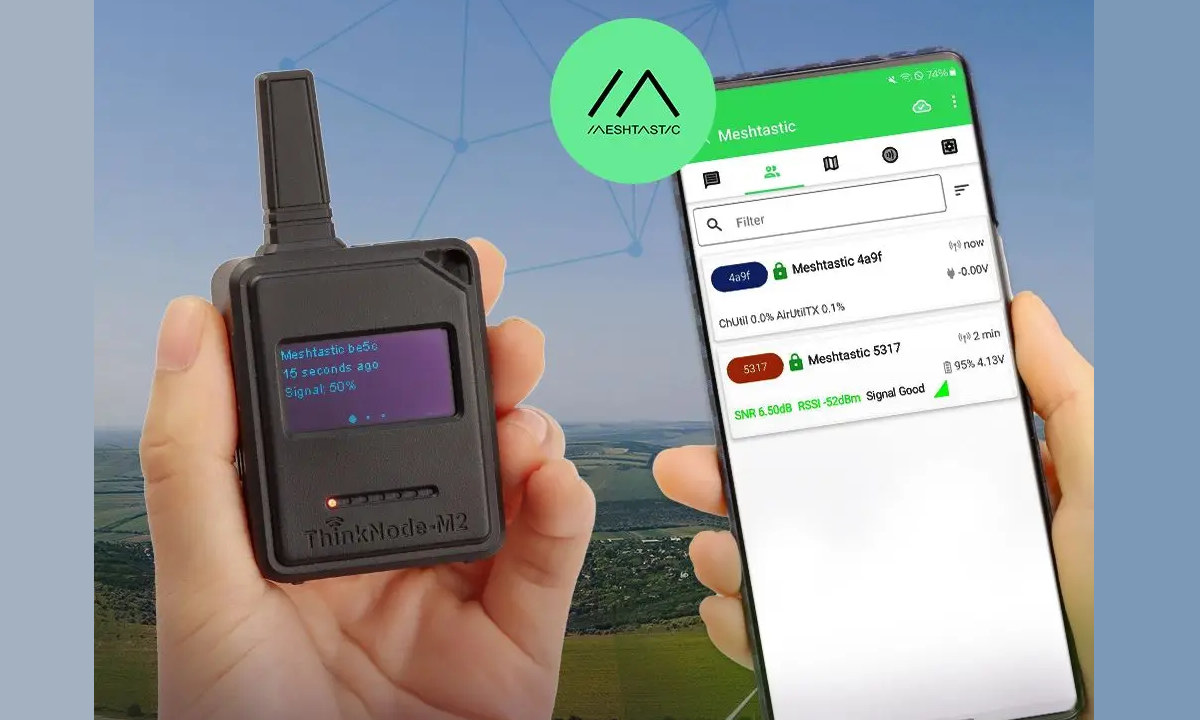
The LILYGO T-Echo Plus is another off-grid LoRa communicator, similar to Blackout Comms, ThinkNode M2, and Wio Tracker L1 Pro, but it features a metal attachment loop (designed like a climbing hook) for use in hiking, cycling, and off-grid environments. Built around a Nordic Semi nRF52840 MCU, it supports Bluetooth 5, Thread, Zigbee, and 802.15.4. It also adds an SX1262 LoRa transceiver, a 1.54-inch 200×200 SPI E-Paper display, and an L76K GNSS module. Other features include a 6-axis IMU (BHI260AP), a vibration motor, a buzzer, and a larger 2400mAh battery, along with a 1/4-inch mount and a “climbing finger loop” for gear attachment. Additional features include an optional BME280 sensor, Grove expansion, all in a rugged and compact enclosure with a long external antenna for extended LoRa range. LILYGO T-Echo Plus Specifications: SoC – Nordic Semiconductor nRF52840 CPU – 32-bit Arm Cortex-M4F microcontroller @ 64 MHz Memory/Storage – 2 MB Flash, […]

Compact development board features a single ESP32-P4 + ESP32-C5 dual-band Wi-Fi 6 module, MIPI display and camera interfaces

WTDKP4C5 S1, ESP32 P4 and ESP32 C5 WI FI6 Development Board

Just a few months back, Wireless-Tag released the WT99P4C5-S1, which combines the ESP32-P4 with an ESP32-C5 dual-band WiFi 6 module, instead of the more commonly used ESP32-C6 wireless module found on most ESP32-P4 development boards we’ve covered. The company has now released the WTDKP4C5-S1, a more compact development board built around the WT01P4C5-S1 ESP32-P4 and ESP32-C5 core module. The board supports MIPI-CSI and MIPI-DSI through the ESP32-P4, while the SDIO-connected ESP32-C5 provides dual-band Wi-Fi 6 (2.4/5 GHz) connectivity along with BLE 5, Zigbee, Thread, and Matter. Other features include a USB 2.0 Type-C OTG port, two UART debug interfaces, two 40-pin GPIO breakouts from both chips, and various power options via USB-C, a 12V DC input, or headers. The board is suitable for LVGL-based HMIs, data acquisition, industrial control, and Edge AI applications such as IPCs and smart displays. Wireless Tag WTDKP4C5-S1 specifications: Core module – Wireless Tag WT01P4C5-S1 Main […]

Exit mobile version