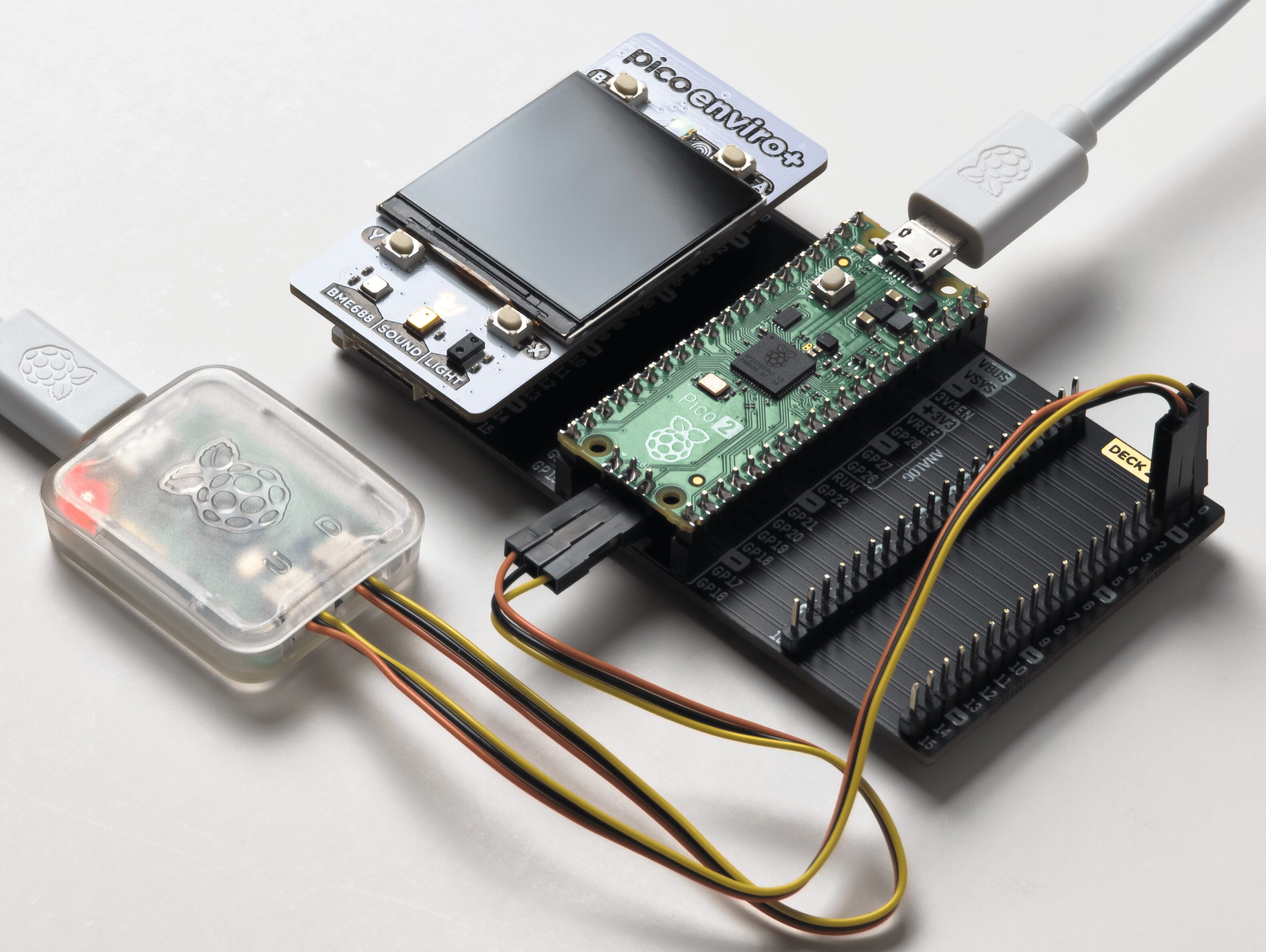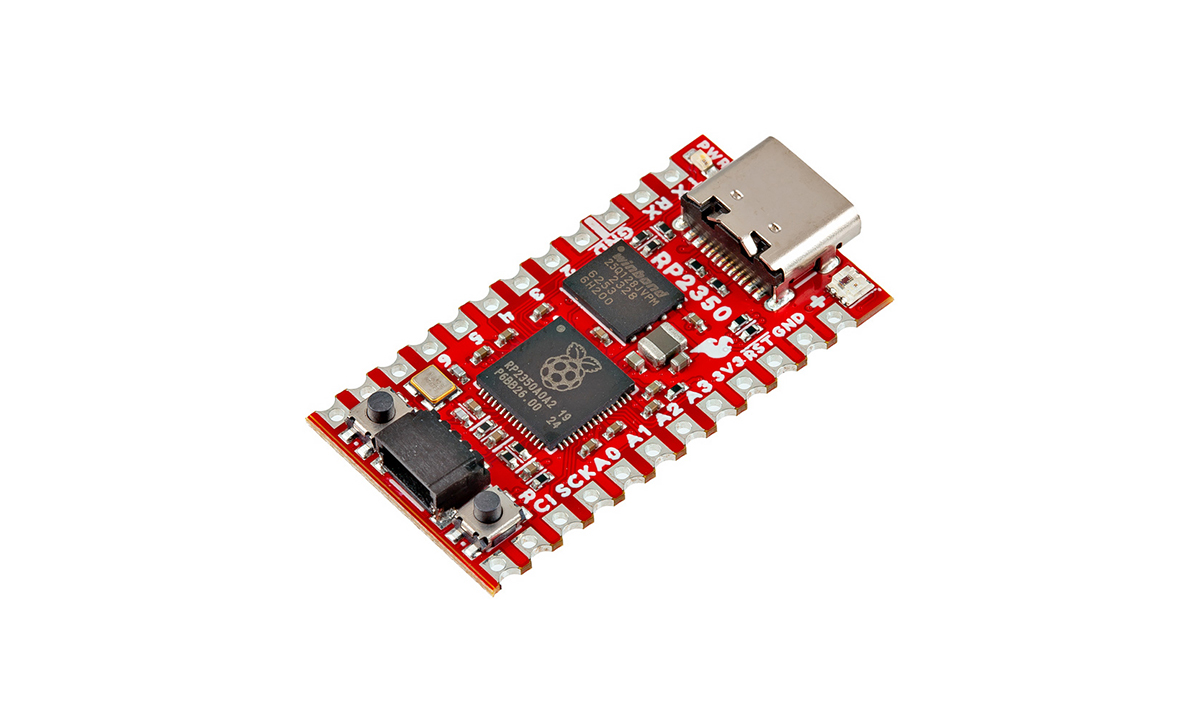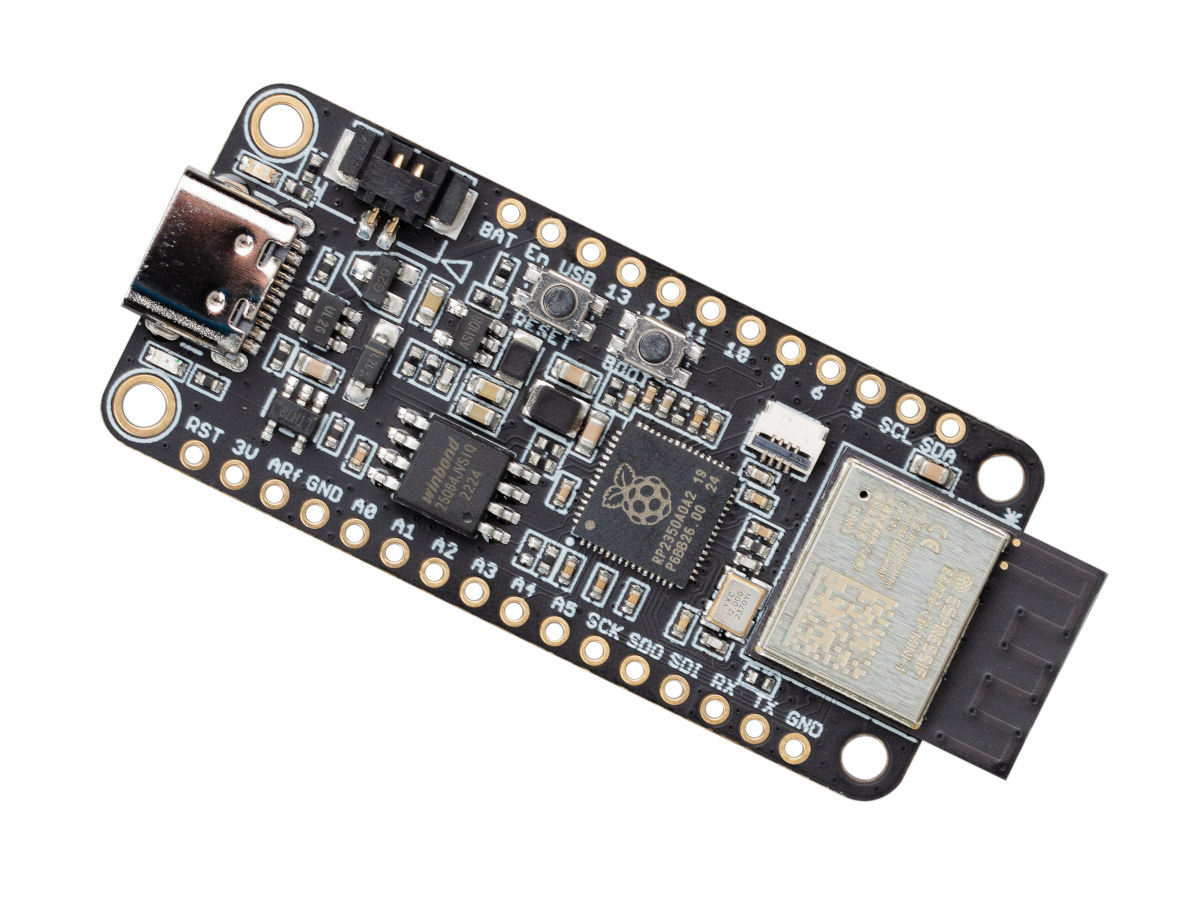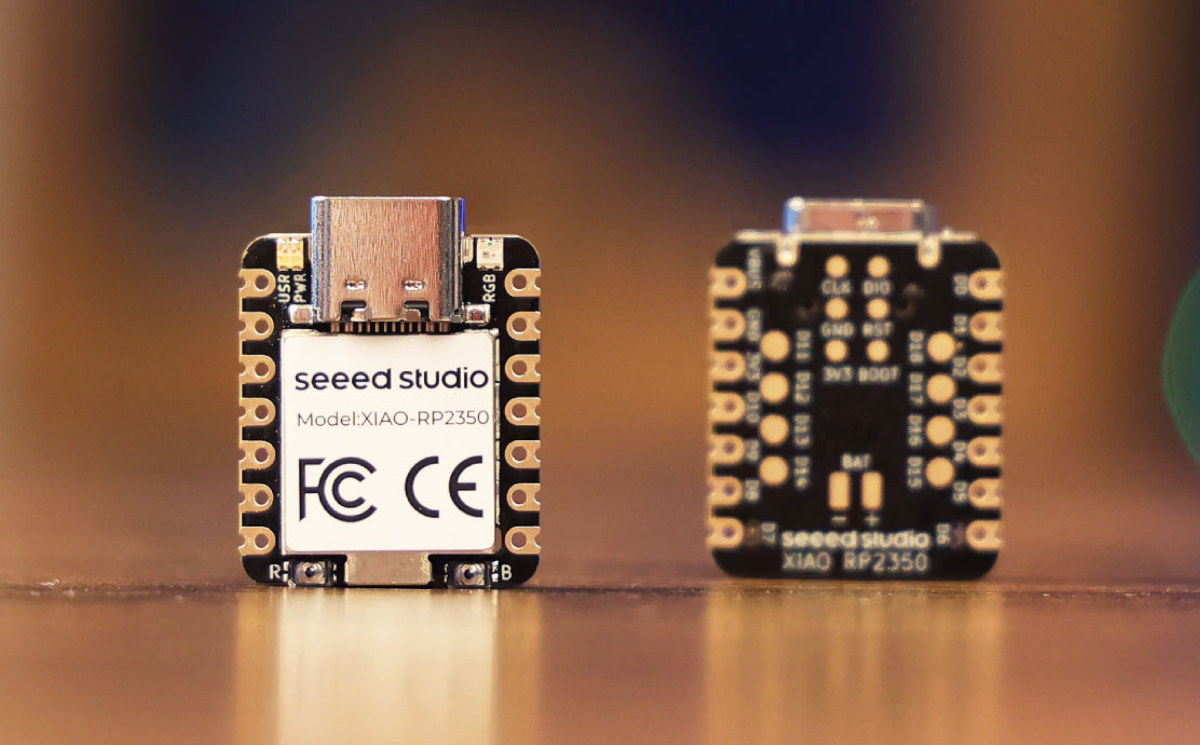
$15 STM32U575 development board features FPC display connector, microSD card slot, two 48-pin GPIO headers

STM32U575VGT6 development board

A few days ago, we looked at the WeAct Studio STM32U585CIU6 development board, which features an ultra-low-power STM32U5 Cortex-M33 MCU and was added to MicroPython v1.28. If you’re looking for another STM32U5-based option, especially for compact UI projects, Maker Go now offers an STM32U575 board with a display connector, a microSD card slot, and many more GPIOs While the STM32U585 on the WeAct board features cryptographic accelerators, the STM32U575VGT6 MCU on the Maker Go board is closely related and still offers the same high-performance Cortex-M33 core running at 160 MHz, along with ultra-low-power capabilities. This new board also adds 8MB of external flash and is designed to accept 1.47-inch or 2.0-inch LCDs directly via a ribbon cable. STM32U575VGT6 board specifications: Microcontroller – ST STM32U575VGT6 Core – Arm Cortex-M33 Armv8-M core clocked at up to 160 MHz with FPU, Arm TrustZone Memory – 786 KB SRAM Flash – 1024 KB (1 […]

WeAct STM32U585CIU6 Core Mini – An $8 STM32U5 board supported by MicroPython v1.28

WeAct Studio STM32U585CIU6 Core Mini board

While checking out MicroPython v1.28 changelog, I noticed a board from WeAct Studio based on ST’s STM32U5 Cortex-M33 microcontroller: the WeAct STM32U585CIU6 Mini Core board (WEACTSTUDIO_MINI_STM32U585 in MicroPython code). I found it interesting/newsworthy, as while I had written about the initial STM32U5 MCU release in 2021, and followed up with beefier STM32U5 SKUs with NeoChrom 2.5D GPU and up to 4MB flash in 2023, we had yet to cover a third-party board based on an STM32U5 MCU, excluding the Arduino UNO Q SBC running Linux on a Qualcomm QRB2210 MPU and using an STM32U585 for real-time and I/O control. The WeAct STM32U585CIU6 Core Mini changes that as a low-cost, standalone STM32U5 MCU board. WeAct STM32U585CIU6 Core Mini specifications: Microcontroller – ST STM32U585CIU6 Core – Arm Cortex-M33 Armv8-M core clocked at up to 160 MHz with FPU, Arm TrustZone Memory – 768 KB RAM Flash – 2048 KB flash GPU – […]

wolfIP – An open-source, lightweight TCP/IP stack with no dynamic memory allocations for embedded systems

wolfip TCP/IP library no memory allocations

Better known for its open-source wolfSSL SSL/TLS library, wolfSSL (the company) has now released the wolfIP open-source, lightweight TCP/IP stack with no dynamic memory allocations (e.g., no malloc calls) designed for resource-constrained embedded systems.

The company highlights that wolfIP “supports both endpoint-only mode and full multi-interface support with optional IP forwarding. By default, it operates as a network endpoint, but can be configured to forward traffic between multiple network interfaces”.

$2 WeAct CH32V006F8U6 Mini Core board features CH32V006 RISC-V MCU, supports 3.3V or 5V I/O voltage

WeAct CH32V006 Mini Core Board

WeAct CH32V006F8U6 Mini Core is an inexpensive, tiny development board based on the 48 MHz CH32V006 RISC-V microcontroller and equipped with a USB-C port, a Reset button, and two rows of 12-pin headers for I/Os using either 3.3V or 5V voltage. WCH introduced the CH32V006 in 2024 as an update to the popular CH32V003 with more memory (8KB vs 2KB SRAM), storage (62KB vs 8KB flash), additional GPIOs, a wider supply voltage range, and an upgraded 32-bit RISC-V2C core. I just hadn’t seen any third-party CH32V006 boards so far. The WeAct Studio board changes that. WeAct CH32V006F8U6 Mini Core board specifications: SoC – WCH CH32V006F8U6 CPU – 32-bit “RISC-V2C” core up to 48 MHz Memory – 8KB SRAM Storage – 62KB flash + 3KB “boot” flash USB – 1x USB Type-C port for power and debugging Expansion 2x 12-pin headers with GPIO, ADC, USART, I2C, SPI I/O Voltage – 3.3V […]

ESP32-P4-Pi-VIEWE – A Raspberry Pi-inspired ESP32-P4 + ESP32-C6 board with Ethernet, USB, 40-pin GPIO header, and more

ESP32-P4 ESP32-C6 Raspberry-Pi sized SBC

The ESP32-P4-Pi-VIEWE is a Raspberry Pi-inspired development board equipped with a VIEWE ESP32-P4C6-Core module, combining a 400 MHz ESP32-P4 dual-core RISC-V MCU with an ESP32-C6 chip for Wi-Fi 6 and Bluetooth 5.0 wireless connectivity, as well as 32MB PSRAM and 16MB NOR flash. The board also offers 10/100Mbps Ethernet connectivity, MIPI DSI, and CSI connectors for display and/or camera, two onboard microphones, a speaker output, a USB 2.0 port, a micro SD card slot, and the usual 40-pin GPIO header, all in a familiar 85 x 56 mm credit card form factor. ESP32-P4-Pi-VIEWE specifications: Main module – VIEWE ESP32-P4C6-Core Microcontroller – ESP32-P4NRW32 MCU Dual-core RISC-V microcontroller @ 360/400 MHz with AI instructions extension and single-precision FPU Single-RISC-V LP (Low-power) MCU core @ up to 40 MHz GPU – 2D Pixel Processing Accelerator (PPA) VPU – H.264 and JPEG codecs support Memory – 768 KB HP L2MEM, 32 KB LP SRAM, […]

ESP-IDF v6.0 framework adds support for ESP32-C5 and ESP32-C61, preview for ESP32-H21 and ESP32-H4

ESP-IDF Release v6.0

Espressif Systems released the ESP-IDF v6.0 framework a few days ago with stable support for ESP32-C5 and ESP32-C61 SoCs, as well as preview support for ESP32-H21 and ESP32-H4 low-power wireless microcontrollers. The framework also implements a new ESP-IDF Installation Manager (EIM) to make the ESP-IDF installation easier, relies on the low-footprint Picolibc C library, adds security and tooling updates, as well as a few Wi-Fi enhancements, and the ability to update the bootloader over the air. Here are some of the ESP-IDF v6.0 highlights: ESP-IDF Installation Manager – Unified cross-platform tool to simplify the setup process for ESP-IDF and compatible IDEs. It’s available as a graphical interface or a CLI for automation and CI/CD pipelines. You can check the installation instructions for your OS. Picolibc replaces Newlib for a smaller memory footprint and better performance on resource-constrained devices. Check the Newlib vs Picolibc comparison for details. Contrary to some of […]

8-inch ESP32-P4 touch display offers WiFi 6, BLE, 802.15.4 connectivity, optional 4G LTE and LoRaWAN

reTerminal D1001

Seeed Studio’s reTerminal D1001 is an 8-inch capacitive touch display powered by an ESP32-P4 RISC-V microcontroller and equipped with an ESP32-C6 wireless module, a camera, a dual-microphone array, and a speaker. The reTerminal D1001 is a fully enclosed solution designed for HMI applications such as control panels, vision-enabled IoT terminals, video intercoms, and smart dashboards. One highlight compared to other ESP32-P4 displays is optional support for 4G LTE cellular connectivity using an mPCIe module and SIM card slot, as well as LoRaWAN using a Stamp module. reTerminal D1001 specifications: SoC – Espressif Systems ESP32-P4NRW32 CPU Dual-core 32-bit RISC-V HP (High-performance) CPU @ up to 400 MHz with AI instructions extension and single-precision FPU Single-RISC-V LP (Low-power) MCU core @ up to 40 MHz Memory 768 KB HP L2MEM (for dual-core CPU), 32 KB LP SRAM, 8 KB TCM (for LP MCU core) 32MB PSRAM Storage – 128 KB HP ROM, 16 […]

Clintech Pico – The first Raspberry Pi RP2354B board offers 48 GPIOs in Raspberry Pi Pico form factor

Clintech Pico Board

Designed by Clintech Ltd. in Bulgaria, the Clintech Pico Board appears to be the first development board based on the Raspberry Pi RP2354B chip with 2MB on-chip flash. It retains the same form factor as a Raspberry Pi Pico 2 but adds extra GPIOs to make use of the 48 general-purpose GPIOs provided by the RP2354B chip. Like the Raspberry Pi Pico 2, this board features 40 castellated and through holes on the sides, exposing GPIOs 0–22 and 26–28, along with 3 debug pins. Additionally, the board includes 27 extra on-board through holes that break out the remaining GPIOs (23–25 and 29–47) as well as the QSPI interface (SD0–SD3 and SCLK) for external memory. Clintech Pico specifications: SoC – Raspberry Pi RP2354B  CPU Dual-core Arm Cortex-M33 @ 150 MHz with Arm Trustzone, Secure boot Dual-core 32-bit RISC-V Hazard3 @ 150 MHz (3-stage in-order pipeline; RV32IMAC with Zba, Zbb, Zbs, Zbkb, Zcb, Zcmp, and […]

Exit mobile version