
Renesas RZ/G3E Arm Cortex-A55/M33 MPU targets mid-range HMI systems requiring AI acceleration

Renesas RZ/G3E HMI SoC

Renesas RZ/G3E is a new member of the company’s RZ/G SoCs with a quad-core Cortex-A53 application processor, a Cortex-M33 real-time core, and an Ethos-U55 NPU for mid-range, AI-enhanced HMI (Human Machine Interface) systems with up to two 1920 x 1080 resolution displays. The industrial-grade processor features MIPI-DSI, dual-link LVDS, and Parallel RGB display interfaces, 2D and 3D graphics accelerators, H.264/H.265 video decoding,  a 4-lane MIPI CSI interface, two gigabit Ethernet interfaces, 2-lane PCIe Gen3, USB 3.0/2.0, and a range of analog and digital I/Os. Renesas RZ/G3E specifications: CPU Dual- or quad-core Arm Cortex-A55 processor clocked at up to 1.8 GHz Arm Cortex-M33 system management processor clocked at up to 200 MHz GPU – Arm Mali-G52 3D GPU, Image Scaling Unit (ISC), Frame Data Processor (FDP) VPU – H.264/H.265 Video codec unit (VCD) NPU – Optional Arm Ethos-U55 NPU clocked at up to 1 GHz (512 GOPS) Memory 512KB on-chip SRAM […]

Renesas R8P1 – A 1 GHz Arm Cortex-M85 microcontroller with Ethos-U55 NPU for Audio and Vision AI applications

Renesas RA8P1

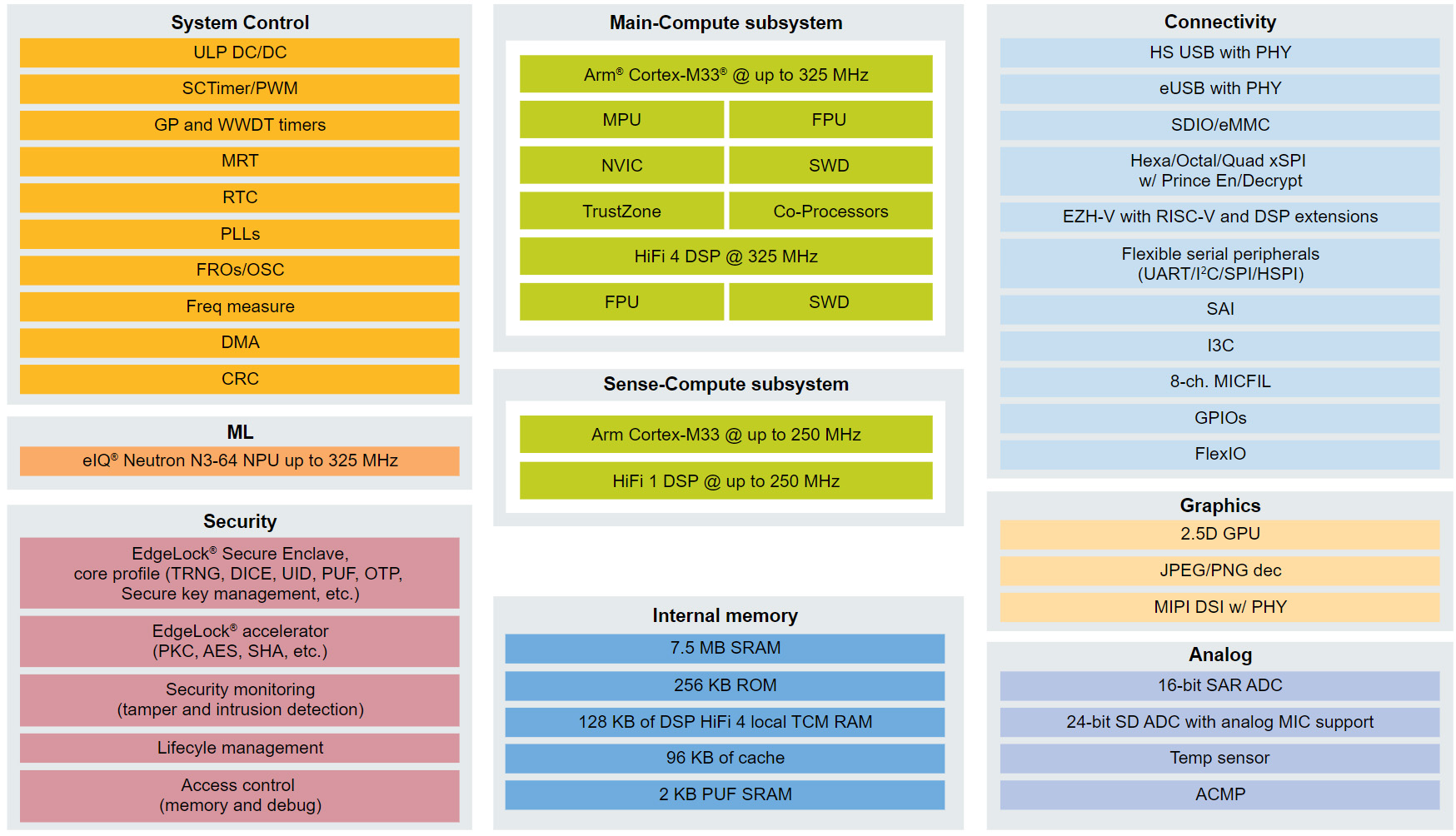
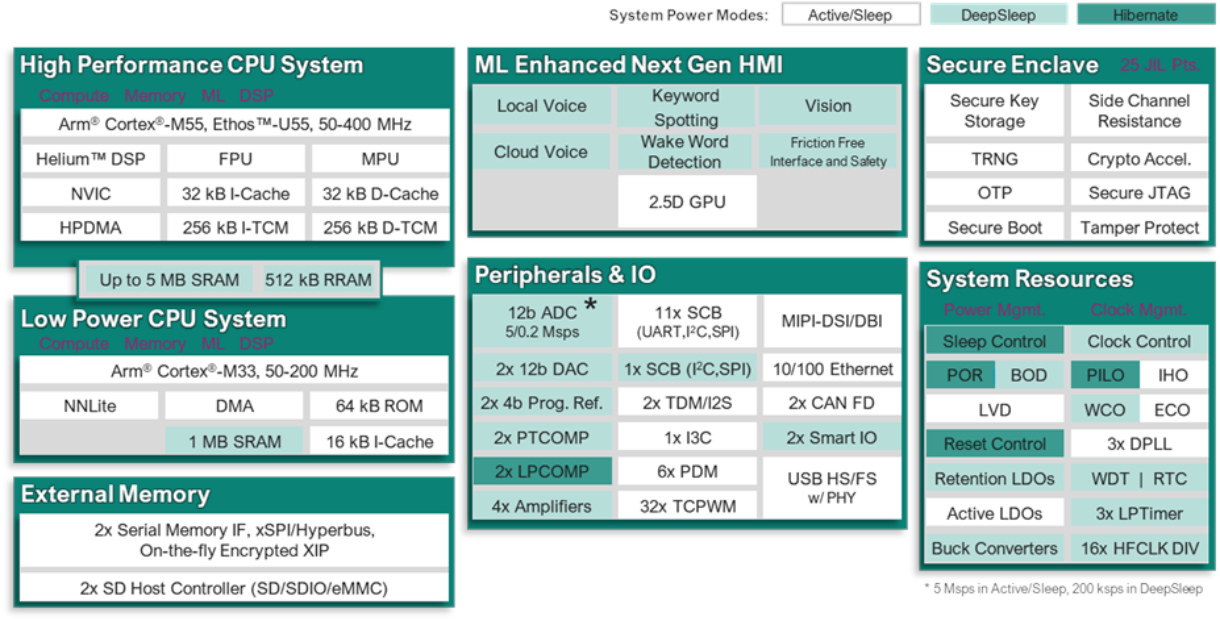
Renesas has introduced its most powerful Cortex-A85 microcontroller to date: the R8P1, clocked at 1 GHz and equipped with a 500 MHz Arm Ethos-U55 NPU for edge AI applications, as well as an Arm Cortex-M33 real-time core clocked at 250 MHz. With a 2D GPU, MIPI DSI and parallel RGB display interfaces, MIPI CSI and parallel camera interfaces, and I2S and PDM audio interface, the Renesas RA8P1 is mainly designed to address Voice AI and Vision AI applications requiring real-time analytics. The 1 GHz microcontroller also has plenty of other peripherals and security features, as we can see from the specifications and block diagram below. Renesas RA8P1 specifications: MCU core Arm Cortex-M85 clocked at 1 GHz with Helium MVE (M-Profile Vector Extension) with 32KB I/D caches; 7300+ CoreMarks Arm Cortex-M33 clocked at 250 MHz with 32KB I/D caches GPU – 2D drawing engine NPU – Arm Ethos-U55 NPU delivering 256 […]

NXP MCX W72x Cortex-M33 wireless SoC supports Bluetooth 6.0 with Channel Sounding, Zigbee, Thread and Matter

NXP MXC W72x block diagram

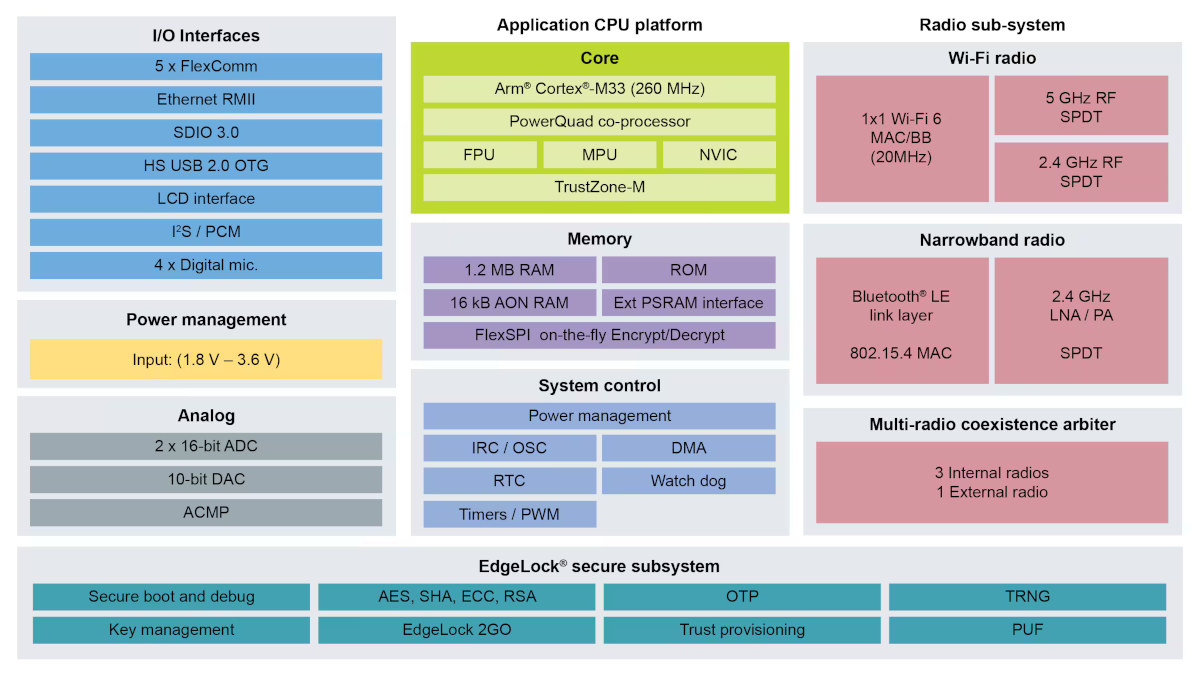
NXP MCX W72x series Cortex-M33 wireless SoCs support for Bluetooth 6.0 and an 802.15.4 radio for Zigbee, Thread, and Matter. The MCX W72x family also implements Bluetooth Channel Sounding for accurate distance measurements with the help of a Localization Compute Engine (LCE) to reduce latency. It’s the second MCU part of the MCX W wireless family following the MCX W71x MCU, and the new MCX W72x wireless microcontroller is offered with up to 264 KB SRAM, 2MB flash, features a dedicated Cortex-M33 core to handle Bluetooth and 802.15.4 radios, implements an EdgeLock Secure Enclave for security, and integrates plenty a range of I/Os in a 48-pin package. NXP MCX W72x key features and specifications: MCU cores and memory/storage Application core – Arm Cortex-M33 core up to 96 MHz  with  2 MB program Flash with ECC, 264 kB SRAM with ECC and parity Networking core – Arm Cortex-M33 core with dedicated […]

Silicon Labs SiXG301 and SiXG302 “Series 3” wireless SoCs are built for line-powered and battery-powered IoT applications

Silicon Labs SiMG301 Series 3 wireless SoC

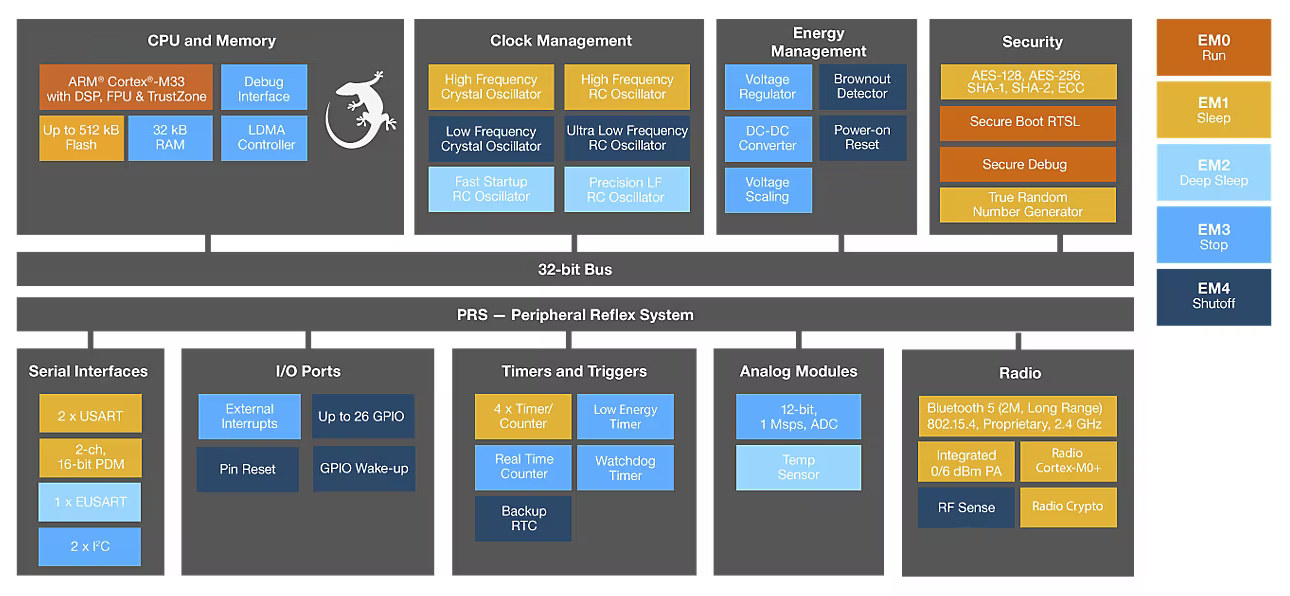
Silicon Labs has just introduced the first 22nm Series 3 SoCs with the SiXG301 and SiXG302 Arm Cortex-M33 multiprotocol wireless SoCs designed for line-powered and battery-powered IoT devices, respectively. The SiXG301 is offered with 4MB flash and 512 KB SRAM, embeds an LED pre-driver for advanced LED smart lighting and smart home products, and supports 2.4 GHz wireless protocols such as Bluetooth, Zigbee, and Thread with support for Matter.  The upcoming SiXG302 Bluetooth and Matter SoC offers an ultra-low-power consumption using only 15 µA/MHz active current, or 30% lower than competitive devices in its class, and as such is ideal for battery-powered wireless sensors and actuators.  We’ll be focusing on the SiMG301 multi-protocol SoC and SiBG301 Bluetooth LE SoC in this article since the details are sparse for the SiXG302 parts (SiMG302 and SiBG302). Silicon Labs SiMG301 / SiBG301 specifications: MCU Core – 32-bit Arm Cortex-M33 with DSP instructions and […]

SiFli SF32LB52J big.LITTLE Arm Cortex-M33 Bluetooth MCU powers the Core Time 2 smartwatch

SiFli SF32LB52J block diagram

SiFli SF23LB52J is a Bluetooth 5.3 microcontroller part of the SF32LB52x family with two Cortex-M33 in big.LITTLE configuration with a 240 MHz high-performance core for user application/GUI and a 24 MHz low-power core to manage the Bluetooth part. A few months ago, Eric Migicovsky, the founder of the smartwatch company Pebble, and now Core Devices, introduced the Core 2 Duo and Core Time 2 smartwatches running PebbleOS open-source firmware that were mostly relaunches of the never-released Pebble 2 and Pebble Time 2 with some tweaks. We already knew the Core 2 Duo would be based on a Nordic nRF52840 Arm Cortex-M4F microcontroller, however, the one for the Core Time 2 was kept secret. That’s until today, as Eric has just announced that the Core Time 2 would be based on the SiFli SF23LB52J MCU, since the smartwatch required an MCU with more RAM and processing power, and SiFli also offers […]

Renesas RA4L1 ultra-low-power MCU family offers 168 µA/MHz operation, dual-bank flash, capacitive touch

Renesas RA4L1 ultra low power MCU family

Renesas has recently introduced the RA4L1 ultra-low-power Arm Cortex-M33 MCU family along with two evaluation/development boards. This new lineup consists of 14 ultra-low-power devices based on an 80 MHz Arm Cortex-M33 processor with TrustZone support and designed for metering, IoT sensing, smart locks, digital cameras, and human-machine interface (HMI) applications. The RA4L1 MCU family offers high power efficiency at 168 µA/MHz while active and a standby current of 1.70 µA while retaining SRAM. Additionally, they support segment LCD, capacitive touch, USB-FS, CAN FD, low-power UART, multiple serial interfaces (SPI, QSPI, I2C, I3C, SSI), ADC, DAC, real-time clock, and security features like the RSIP security engine with TRNG, AES, ECC, and Hash. Renesas RA4L1 microcontroller Renesas RA4L1 specifications MCU core Arm Cortex-M33 core (Armv8-M) Up to 80 MHz operating frequency Arm Memory Protection Unit (MPU) 8 secure regions (MPU_S) 8 non-secure regions (MPU_NS) CoreSight ETM-M33 Dual SysTick timers (secure & non-secure) […]

Silicon Labs unveils low-cost BG22L BLE 5.4 and BG24L BLE 6.0 SoCs

Silicon Labs BG24L BG22L

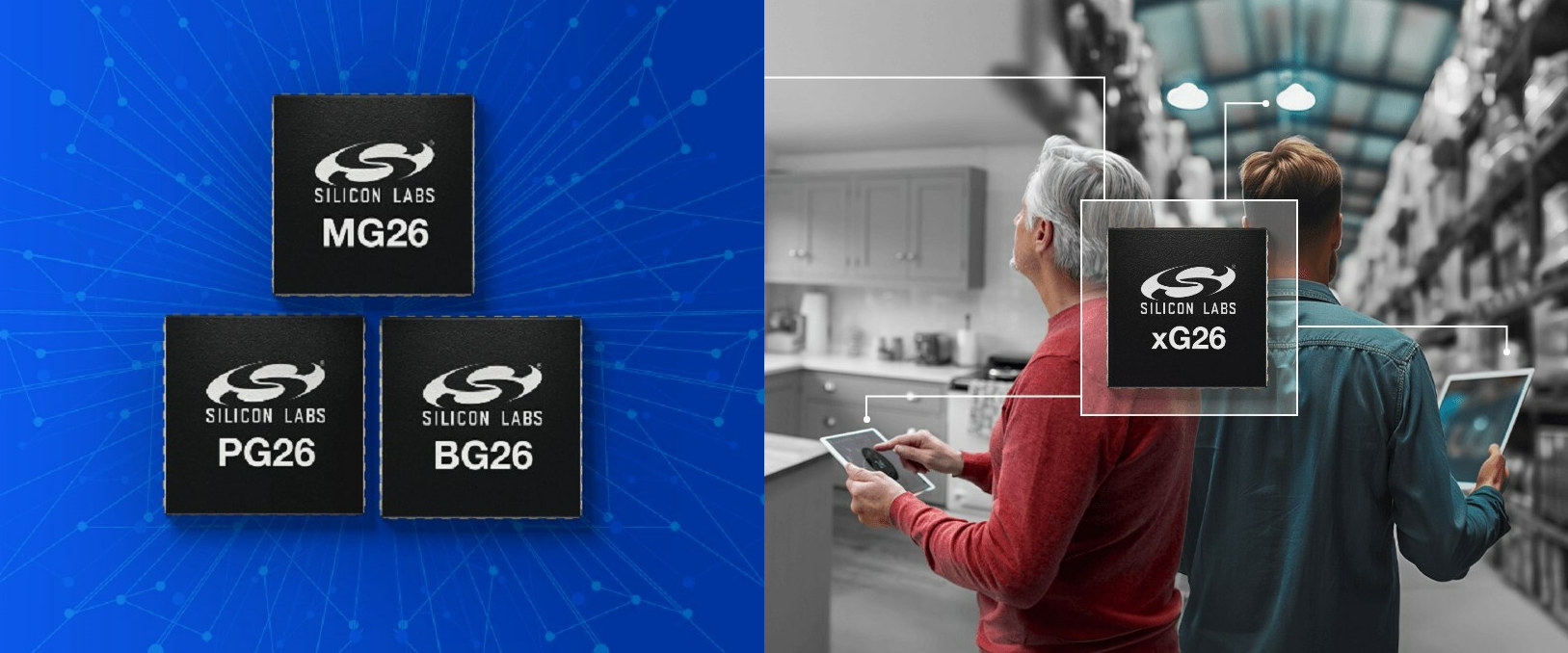
Silicon Labs has unveiled the BG22L and BG24L SoCs for low-cost, ultra-low-power Bluetooth LE connectivity. These are Lite versions of the company’s BG22 and BG24 SoC families introduced in 2020 and 2022 respectively. The 38.4 MHz Silabs BG22L Arm Cortex-M33 SoC targets high-volume, cost-sensitive Bluetooth 5.4 applications like asset tracking tags and small appliances. In comparison, the 78 MHz BG24L Cortex-M33 SoC offers an affordable entry-level solution with AI/ML acceleration and Bluetooth 6.0 Channel Sounding to locate items or implement access control in crowded areas such as warehouses and multi-family housing. Since the specs for the BG22L and BG24L are similar to the ones for the BG22 and BG24 chips I won’t reproduce those here, and instead highlights the main features and cost-saving measures. Silicon Labs BG22L Bluetooth LE 5.4 SoC Silicon Labs BG22L highlights: MCU – Arm Cortex-M33 @ 38.4 MHz with DSP and FPU (BG22 is clocked at […]

NXP MCX L14x and MCX L25x ultra-low-power Cortex-M33 MCUs target energy harvesting and battery-powered devices

MCX L series chip

NXP Semiconductors has launched the MCX L series of ultra-low-power Arm Cortex-M33 MCUs with the MCX L14x and MCX L25x SKUs. The new series offers similar peripherals as the rest of the MCX portfolio but uses a new “power management architecture that supports always-on, battery-powered applications” The MCX L series uses a dual domain architecture, with “real-time processing and ultra-low-power sensing functions in a single device.” The Arm Cortex-M33 core supports real-time processing functions while the Arm Cortex-M0+ core offers always-on operation in the ultra-low-power sense domain. The new microcontrollers reportedly use three times less power than their predecessors. The ultra-low-power series is targeted at energy-constrained applications, powered by a battery, ultracapacitor, or power harvesting circuit. These include building control, industrial sensing, smoke and fire alarms, flow meters, smart appliances, and motion detectors. NXP MCX L14x and L25x specifications: CPU Main core: Arm Cortex-M33 microcontroller @ up to 96 MHz […]

Exit mobile version